


8,49 €
Mehr erfahren.
- Herausgeber: Publisher s23429
- Kategorie: Religion und Spiritualität
- Sprache: Englisch
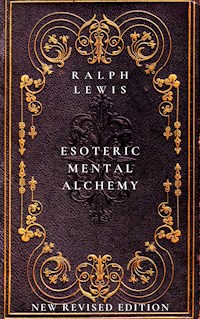
Finally The New Revised Edition is Available!
The Esoteric secrets of Mental Alchemy finally revealed to the Public! We can transmute our problems to workable solutions through mental alchemy. While this process is neither easy nor instantaneously effective, eventually the serious person will be rewarded. Certain aspects of our lives can be altered to make them more compatible with our goals. Use this book to alter the direction of your life through proper thought and an understanding of practical mystical philosophy.
Das E-Book können Sie in Legimi-Apps oder einer beliebigen App lesen, die das folgende Format unterstützen:
Veröffentlichungsjahr: 2021
Ähnliche

















CONTENTS
0.Introduction
1.Was There a Beginning?
2.Is God an Energy?
3.Body, Mind, Soul
4.Are Good and Evil Absolute?
5.Is Consciousness Universal?
6.What is Psychic Development?
7.Intuition, Idealism, and Illumination
8.Creativity—It’s Mystery and Mechanism
9.Applying Creativity to your Environment
10.The Nature of Value
11.What is Positive Thinking?
12.What is Self-Mastery?
13.Mysticism—A Way of Life
14.Suggestion to the Inner Self
15.What is Transcendental Meditation?
16.Willing Oneself to Relax
17.Interpreting Cosmic Guidance
18.Our Mission in Life
19.Cosmic Ethics
20.Mysteries of Psychic Phenomena
21.Reincarnation—Fact or Fancy?
22.Metaphysics and Science
23.What Constitutes Progress?
24.How Should We Regard Death?
INTRODUCTION
What is life all about? What is the real, which of our thoughts are reality? Our minds ever go through a process of mental alchemy. Our experiences are constantly transmuting former ideas into new concepts. But which are the true guides in life, the former beliefs, traditional ideas, or the new conclusions we personally arrive at? In the final analysis our view of life, what we expect of it, is a personal construct. We have a better chance of shaping our existence into a happy state if we do not try to avoid the puzzling questions which life brings forth. How should we confront these mysteries of the self and its relation to all else which the self confronts?
What we believe is as important a motivating factor in the course of our lives as what we know. In fact, many of the thoughts by which we shape our lives are abstract. They are what we believe but which have not yet been experienced and perhaps cannot be. What is presented in the following chapters are those ideas that in some form or manner eventually come to the attention of most everyone. The presentation may not have the reader’s acceptance but we hope it will cause him to think seriously about the so-called “mysteries of life.” Accepting just the traditional explanations often restricts thought and causes misconceptions leading to pitfalls of error and their adverse consequences. However, is the reliance which we place upon our beliefs always justified? Do we resort to beliefs as the substitution for knowledge? It behooves us to give thought, especially in this day and age, to the nature of belief. We should learn of any distinction that may exist between beliefs and points of knowledge. Why do we say, for example, “I believe in life after death,” instead of declaring, “I know.” In fact, why do we say that we believe anything rather than affirming our knowledge of it?
Belief is an assumption of knowledge. Knowledge, in contrast to belief, is experience. Knowledge is empirically realized, that is, it is objectively perceived. If, for example, we hear a pattering noise on the windowpane, we may say, “I believe it is raining.” We say believe because we have not directly perceived the rain. Previous experience tells us that the noise we hear could be from other sources, so we say “believe.” We are thus assuming a knowledge.
Are we then to presume that knowledge is only that which is experienced through our receptor senses? Suppose we have a problem. It consists of several elements. The elements of the problem are facts. They are that which has been experienced. We, therefore, call them points of knowledge. However, it is necessary for us to relate them into a satisfactory and useful order. We turn these ideas over and over in our minds, seeking a solution. We exercise our reason to do so. Finally we arrive at a solution. The problem seems to be solved, so it appears self-evident to us. We have no further doubt about it.
But can we call the solution we arrived at knowledge? Or are the conclusions of our reasoning not equal to what we objectively experience? A vast majority of our thoughts, the result of our reasoning, we have come to refer to as our beliefs. It is because we come to realize that our private judgments are subjective in nature, in contrast to experience. In other words, we have come to distinguish between the ideas we form on the one hand and our perceptual knowledge— the result of our senses—on the other. The ideas of reason, of course, are something that is known to us. Such ideas exist in consciousness, but they do not have any counterpart, anything that exactly represents them, outside of our minds. Perceptual knowledge, however, is that which can be perceived by the senses of anyone. Anyone may see, hear, feel, taste, or smell that which is perceptual knowledge. It is something that may be realized immediately without reasoning about it.
Let us use an analogy for better understanding. For a long time people thought that a heavy object would fall faster than a lighter one. They most assuredly thought that a stone always falls faster than a feather. This idea was accepted as knowledge. It took Galileo to demonstrate that objects fall alike when they are not impeded by air; actually, a feather and a lead pellet will fall the same in a vacuum. Galileo’s demonstration constituted perceptual knowledge. It was something that was a matter of common observation that could be proved to all.
I think it is agreed that the value of knowledge is being able to transmit it. By that we mean being able to transmit it either by speech, writing, or gestures to the minds of others. Certainly something that is known to everyone separately and differently would not have any universality. Such a knowledge would have no common good. However, an idea may be cogent. It may be quite comprehensible to one person, and yet he may not make another understand it by communicating it. The imagination and reasoning of individuals vary. An idea that one arrives at may have absolutely no meaning to the mind of another—it may not be knowledge at all to other persons. Therefore, our ideas, to become knowledge that will be universally accepted, must be objectified. They must be given an existence outside of mind. We must be able to establish conditions and things which the receptor senses of other persons can individually experience.
Let us return to the analogy of Galileo: He could never have made his knowledge of falling objects acceptable to all persons if it had remained an idea to him. Talking, lecturing about it would never have disabused people of the common notion generally held about falling objects. He had to demonstrate it. He had to set up experiments that persons could observe. It then became to them intimate perceptual knowledge. It was then established as something objective, quite apart from the reasoning of Galileo—from the subjective process.
Does this mean then that we are to rely entirely upon what is objectively perceived? Through experience we have all learned that our senses can deceive us. What once appeared as a reality might perhaps be later revealed to us as false. How do we learn that a sense experience is false? It is only by another subsequent experience which, at a later time, appears to be a more consistent reality than the previous one.
There is another and very vital reason why all we conceive to be knowledge must eventually be transformed into what the senses can discern. We live in a physical universe. We exist in a virtual sea of energy and mass, or matter. We cannot deny the existence of this physical universe because our physical organism is a part of it. We are obliged to relate ourselves to it, that is, adjust to the influences which it has upon us. In fact, that is why we have developed the five receptor senses. These five senses are necessary for us to determine in our surroundings what we need from them.
One may now be thinking: What about our psychic impressions or what we call the intuitive and spiritual impressions? As inner impressions, as sensations, the psychic may be as definite an experience as anything that we realize externally. Certainly the mystic’s feeling of his union with the Absolute has reality to him. The religionist’s union with God is as forceful an experience to him as anything he has objectively perceived. But can we rely upon such experiences? Can we call them a knowledge equivalent to what we objectively experience?
There is a test as to whether our interpretation is right. The test makes it possible for us to determine whether a psychic experience has the substance of knowledge. Simply, the test is this: Can the psychic experience be made pragmatic? Can it be reduced to a practical application to our lives? Can we transform the inner experience we have to some condition of an objective nature? Now this does not mean that the experience must necessarily be reduced to a material thing such as an object. But it must produce such secondary effects as can be perceived by others, to become knowledge to them.
Let us take, for example, the lives of some of the great religious founders, such as Zoroaster, Moses, Buddha, Christ, and Mohammed. They had intense psychic and emotional experiences. To them the experience contained a positive goodness. But were they a real knowledge of moral value leading to the goodness they felt, or only a belief? They first had to be transformed into a moral code. This had to be expanded into a form of instruction that other men could perceive with their ears and their eyes. If eventually other men came to have the same spiritual feeling from that moral code which they read or heard and which the original founders had, then it became true knowledge.
It has often been said that an experience which is had on one plane of consciousness cannot be proved on another plane. Such a statement, however, is verisimilitude—a half truth. It is true, of course, that we cannot take such a thing as an emotion and place it under a microscope, for example. Neither can we weigh a sentiment on a scale. Nevertheless an experience of a plane of consciousness, if it is personally comprehended, would be capable of being transformed to another plane. When transformed, the experience should be as vivid on that particular plane of consciousness, as realistic, as it was on the original plane.
A plane of consciousness should be able to establish, above or below itself, a symbol that can be realized with similar meaning. We cannot, for example, convey to another the intimate subjective notion of beauty that we have. We cannot tell in words our particular feeling of beauty so that another may be conscious of exactly the same sensation. We can, however, often create a physical symbol that will adequately represent to another our idea of beauty. The symbol objectively perceived in a visual or auditory form will arouse another’s aesthetic sense.
To understand better this transformation of experience, think of an experience on a plane of consciousness as being like a musical note. Every musical note, we know, has harmonics either on a higher or lower octave. Likewise each experience of our psychic self can manifest either on a higher or lower plane of consciousness. The form in which it is manifest, however, may be quite different. We cannot expect psychic phenomena to have a similar objective character. But we can relate the psychic to some behavior, to some condition which will symbolize it objectively. For example, think of the things you perceive in the world of your daily events that cause you to have such feelings as love, compassion, reverence, and humility. They are caused by a transformation of your sense experience—something you have seen or heard perhaps—into the higher emotions and sentiments that follow from them.
We have said that our beliefs are like assumptions of knowledge. They are not true knowledge until they can be objectified. Should all beliefs that cannot be brought into objectivity be rejected by us? Or is there a certain type of belief that should always be retained? All beliefs which postulate, that is, set forth a probability, should be accepted. A belief of probability is a conclusion which is suggested by the knowledge of experience. Another way of saying it is that a belief of probability is a rational supposition closing a gap between actual points of knowledge.
For further analogy, we know that various islands and points of land sink into the sea because of deep subterranean disturbances. This phenomenon is continually being experienced throughout the world. Consequently, it constitutes a point of knowledge. From this point of knowledge there follows the probable belief that this submerging process has existed for millions of years. The probability further continues that this has caused cultures to become extinct. For further analogy, science demonstrates that matter and energy are never lost but rather go through a transformation. So, then, it is a belief of probability that the human personality or self is not lost when the body goes through transition.
Such beliefs of probability should be mere temporary stopgaps for us between actual experiences. They should serve only to suggest to us a course of further inquiry. They should never be accepted with finality. John Locke, the English philosopher, has warned against our resting upon beliefs of probability. He says: “When men have found some general propositions that could not be doubted of as soon as understood, it was a short and easy way to conclude them innate. This being once received, it eased the lazy from the pains of search...” A belief of probability should never be confused with a superstition. A probability, though it subsequently be proved to be in error, is always rationally deduced from what is known.
What, one may ask, about abstract beliefs? Abstract beliefs include such things as our conceptions of truth, good, evil, and freedom. Also many metaphysical beliefs are abstract. For example, our notions of the nature of being and whether the universe is finite or infinite are abstract. Our abstract beliefs are a personal knowledge to us. However, as ideas, they may be as forceful as anything we have ever objectively experienced. But these abstract beliefs are wholly personal to us. They have no counterpart outside of our own minds. In other words, we have never experienced them in a physical way. Further, such abstract beliefs are most often the ones which we cannot demonstrate or prove to other persons. For example, we may demonstrate something that all men will readily accept as being true. We cannot, however, show truth in itself as pure form. The reason is that truth is but an abstract idea. It is a subjective value within each person’s mind. Truth differs with the reasoning of the individual.
These abstract beliefs continually arise in our minds. They are the product of the normal active intelligence and reason. Though they cannot be converted into a knowledge that all men will universally accept, they must not be rejected. Since they are abstract, they are no more to be disproved than proved.
Our abstract beliefs comprise a mental world of great reality. We live in this world of abstract beliefs just as much as we do in the one our senses portray to us. The world we see, hear, feel, and so on leaves much unexplained to us. What we see or hear may be concrete enough. We may recognize its physical qualities. But what is its real value to us as humans? We do not mean value in the material sense. Rather, how can each objective experience confer more reality upon us? We mean how can it cause us to have a more profound awareness of our selves?
The individual experience which we have of this world does not alone satisfy our urge to be part of something greater than this life. There is nothing in this world that gives rise to the idea of perfection that we have. Perfection is an abstract notion by which we come to measure the world’s value to us. Our objective experiences have a dual function. They also act upon our psychic selves as well as acquaint us with what seems to be external reality. These experiences arouse a series of inner values of which perfection is one. It is these that account for most of our abstract beliefs. They come to form the structure of our individual psychic world. Though such beliefs remain without substance or meaning to others, they are personally known to each of us.
—Ralph M. Lewis
Let man, having returned to himself, consider what he is compared to what is; let him regard himself as a wanderer into this remote province of nature; and let him, from this narrow prison wherein he finds himself dwelling (I mean the universe), learn to estimate the earth, kingdoms, cities, and himself, at a proper value.
—Blaise Pascal (1623-1662)
Chapter I
WAS THERE A BEGINNING?
Man has transferred many of his objective experiences, the results of the categories of his mind and organism, to the cosmos. For example, he sees himself as
causative, and, therefore, applies the concept of a final cause, a beginning, to the cosmos, the greater universe itself. Many of the things which man observes and which appear to him as having a beginning are, in fact, only a transition from an earlier state. We often cannot perceive the connecting link between one series of phenomena and another. One kind of manifestation seems to break off completely and another begin. Actually, one state has simply merged into another. With the advancement in instrumentation in recent years, science has been able to show the affinity between many phenomena which previously seemed to have quite independent beginnings.
In almost all ancient religions, ontology, or the theory of being, is related to a personal deity, an anthropomorphic god, goddess, or a plurality of them. These deities were thought to be superior beings, but they possessed many humanlike characteristics. They had minds that thought, that planned, that created ends to be attained. So, like man, they brought the universe—the whole of being which man presumes to know—into existence.
Sometimes it was thought that these gods created the cosmos out of their own nature. At other times, it was imagined that creation began with a state of chaos—a nothing out of which the gods themselves were born. They in turn then created the other phenomena of nature. However, chaos, or the state of nothing, was assumed by these early cosmologists to have a positive nature. It had a quality in itself. It was not nothing as we think of it—just the absence of something. It was presumed that, out of the formless state of this chaos, there came a potential which gave rise to being.
It was most difficult for the average man to conceive an eternal being, one that has always been and has never had a beginning.
For most persons, the idea of self-generation is likewise difficult to comprehend, for in their daily experience they are not likely to encounter anything that suggests such a phenomenon. A cause behind everything, including Absolute Being, the cosmos itself, seems more in accord with finite experience.
It is equally difficult for one to embrace the concept that there is not such a condition as absolute non-being, or nothing. We must realize that it is only by perceiving being that it is possible for us to imagine such a condition as its absence or opposite. If a state of non-being could be identified as such, actually it would then have a quality of its own. Whatever is, is then being of a kind. If something can come out of so-called nothing, then, rationally, such is actually not non-being but, rather, it is something. A state of nothing could never exist by itself without being something.
Philosophically and logically, we must accept the idea that being has always been and could never have had a beginning because from whence would it come? If you did attempt to assign a source to being, then logically you will always return to a state of some condition or quality which in itself is being. Likewise, there can never be an end to the cosmos—into what would being dissolve, be absorbed, merge, or disappear? Being cannot be destroyed, for that would be the assumption that there is a nothing into which it would disappear and nothing does not exist.
Being is in continual change, said Heraclitus, the Greek philosopher, thousands of years ago; also that matter is always becoming. However, pure being is not just matter but the energy underlying it and into which it may transform itself. In the great transitions and transformations which being is continually undergoing, it may seem to us that some entity or expression of nature has dissolved into nothing. But we know today that such are really changes into other expressions whose nature may not be immediately perceivable.
We constantly read scientific postulations about the beginning of our universe. Our solar system and sun and planets, and even the vast galaxy with millions of other stars and planets, undoubtedly did have a beginning. By that we mean that they had a previous state before being what they now are. They were either gaseous or some other substance of celestial phenomena. However, when we speak of beginning in this sense, in reference to the universe or galaxies, we are only referring to their form as we now know it. We do not mean that scientifically our galaxy, the Milky Way, for example, or the other galaxies with their billions of solar systems, originally came from nothing.
In fact, what astrophysicists are endeavoring to determine today— and that which they hope space exploration may render further light upon—is the nature of the primary or basic substance of the cosmos.
Is there a purpose for existence? The hagiography, the sacred writings of the religions such as the Veda, the Zend-Avesta, the Bible, and the Koran, either proclaim what is said to be God’s purpose for man, or offer their Messiah’s or founder’s personal inspired opinions on the subject.
To conceive that there is a specific purpose for man’s existence requires a belief in determinism. Simply, this implies that a mind has conceived a definite course of events for man in relation to the phenomena of nature. It is that man is expected or intended to act in a certain way so as to fulfill a purpose for his existence.
Further, this requires as well a belief in theism, that is, a personal deity. It conceives an exalted Divine Mind which has created each phenomenon of nature to conform to a scheme or cosmic project. Man is either thought of as being an integral part of this overall venture or thought of as being the central point, that is, the very reason for it.
Why does man want to think, to believe that there is an ordained purpose, a reason, a planned course for humanity? Such a desire can be related to the human mentality, the way the human mind thinks, and its experiences. For example, one cannot imagine himself consciously walking along a road, not knowing why he is there or where he is going.
We are conscious of most of our motives. The urges, the impulses we have to act, to do something, we are able to relate to some stimulus. We are able to see what appears to be the cause that prompted us to act or to function in the manner that we did. Or, through our appetency and reason, we establish desires, objectives, and ideals toward which we move. Never in a conscious, normal state do we act on our own volition without relating a motive, a purpose to our action.
These ends or purposes which we establish are an integral function of the kind of conscious being that we are. Life in itself, even in the simple cell, has certain necessities to which it must conform. Its nourishment, excretion, irritability (sensitivity), and reproduction in the broad sense are purposes of the cell. However, the cell has not the complexity, the organism by which it can evaluate its motivation, that is, the ends which it continually strives for. In a sense, it performs its acts blindly, that is, devoid of reason as man defines the word.
These actions of the cell are really its functions and not purposes set up independently of its nature. Now, what of man? Are the many things which he strives for and accomplishes—are they purpose? Man has the highly developed faculty of reason. By this means he can differentiate between the various impulses and stimuli that act upon him. He gives them value to satisfy his emotional states or conversely to avoid considerable distress to himself. As a sentient, feeling and thinking being, can man avoid doing otherwise? This thinking by man, this evaluation, this selection of ends or purposes for his physical, emotional, and intellectual selves are all part of what man is. They are not purposes, that is, ends which are separated from the natural powers, functions, and attributes of his very being. However, man is accustomed, in his setting up conditions to comply with his complex nature, to term such as purpose. Therefore, he considers himself purposive. It is comprehensible, then, that man will not think that the phenomena of nature are but manifesting according to what they are in essence, but rather to fulfill some directed purpose. It is likewise seemingly logical, then, for man to assume that his own existence is the consequence, the fulfillment of a transcendent purpose—a teleological or mind cause.
Cannot man just be part of the manifestation of nature of the whole Cosmic Being, an integral attribute of a necessary phenomenon? Why must man attribute a function of his own finite, conscious phenomena, that is, the notion of purpose he has, to the whole cosmos?
In the ordinary understanding of the word purpose, it implies the existence of incompleteness, imperfection, and inefficiency. It is an end or objective that, it is conceived, will remove such apparent inadequacies. In a state of the Absolute where there would be adequate quality and quantity, purpose could not exist. There would be no desire to engender it. Are we to think of the cosmos as insufficient—as in need of something? What would it realize outside of itself? It is in its internal activity that everything is already potential. One can only confer purpose upon the Cosmic if he is also willing to detract from its self-sufficiency and conceive of something beyond its nature to be manifest. It is man, then, who designs purpose for his existence. It is man who wishes to establish certain ends for his personal being in relation to the whole of reality. Perhaps if a star had the same kind of conscious perception and conception that man has, it, too, might look about at the rest of the universe and wonder why it is, and what purpose it has in relation to all the other stellar bodies.
Man’s reason, psychic and emotional selves, must be gratified. They must be stimulated and appeased. This can only be done by ideals, plausible reasons, or self-created purposes for living. If man were a lesser organism as he once was, he would not be troubled by trying to find a relationship to all reality. He would merely, as lower animals do, react instinctively to his natural appetites and to his environment. He would not be troubled by trying to rationalize them and to give a reason for them and himself.
The reasons man continues to conceive for his coming into existence he can never empirically establish. He cannot show them to be the result of nature’s functions, the development of life itself. But man can give purpose, which is a faculty of his intelligence, to his immediate life. He can establish ends which not only will gratify his inherent, intellectual curiosity but will satisfy those higher psychic impulses and sentiments which man designates as moral and spiritual qualities.
Chapter II
IS GOD AN ENERGY?
If we think about it for a moment, free from any emotional allegiance, we must conclude that it is extremely presumptuous for man to think that his finite intelligence is capable of embracing the absolute nature of the infinite. Whatever the qualities of such a cause, paramount would be the fact that such would exceed the border of any sense qualities from which man derives his ideas. Simply, if anything can be defined as unknowable in its absolute state, it would most certainly be the nature of such a thing as a First Cause, regardless of whatever other term man might assign to it.




