


4,99 €
Mehr erfahren.
- Herausgeber: Booksprint
- Kategorie: Gesellschafts- und Liebesromane
- Sprache: Englisch
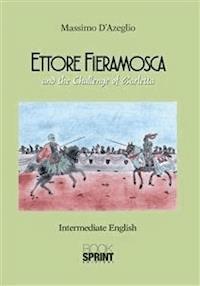
During the conquest war of the Kingdom of Naples (1502-1504) between Spain and France, in the course of the siege of Barletta by the French, the captain Guy de la Mothe, who was the prisoner of the Spanish troops, insulted the honour of Italians fighting on the Spanish side. What followed was the tournament of Barletta on the thirteen of February 1503 between thirteen French champions, led by Guy de la Mothe, and thirteen Italians, led by Ettore Fieramosca from Capua.
Das E-Book können Sie in Legimi-Apps oder einer beliebigen App lesen, die das folgende Format unterstützen:
Veröffentlichungsjahr: 2016
Ähnliche

















Massimo D’Azeglio
ETTORE FIERAMOSCA
AND THE CHALLENGE
OF BARLETTA
Intermediate English
Adaptation in English: Luca Nava
Language consultant: Regina Goretti Meehan
Acquista la versione cartacea adesso in 48 ore a casa tua:
Clicca qui
Massimo D’Azeglio
Massimo d’Azeglio was statesman, novelist and painter. He was from a noble class background, born in Turin on October 24, 1798. At the age of sixteen whilst spending a period in Rome with his father he developed a love for art from which he decided to become a painter. In Rome, he led an abstemious life, maintaining himself by painting with historical subjects Romantic landscapes. He constantly meditated on the political state of Italy. In 1830, he returned to Turin, and, after his father’s death in 1831, moved to Milan. There he remained for twelve years, moving in the literary and artistic circles of the city. He became good friend with Alessandro Manzoni, whose daughter he eventually married.
Literature became his chief occupation and he produced two historical novels, Ettore Fieramosca (1833) and Niccolò de’ Lapi (1841), an imitation of Walter Scott, with pronounced political tendencies: his object being to point out the evils of foreign domination in Italy and to reawaken national feeling. Like Vincenzo Gioberti he believed in an Italian confederation under papal auspices, and was opposed to the radical wing of the Liberal party. His political activity increased, and he wrote many pamphlets, among which was I lutti di Lombardia (1848).
On the outbreak of the first war of independence, D’Azeglio attired with the papal uniform took part in the defense of Vicenza, where he was severely wounded. After the defeat of Novara (March 23, 1849), Victor Emmanuel II, King of Sardinia, called D’Azeglio on to form a cabinet. He concluded a treaty of peace, dissolved the Chamber, and summoned a new one to ratify it. The treaty was accepted, and D’Azeglio continued in office for the next three years. He conducted Piedmont affairs with tact and ability, improving its diplomatic relations, and opposing the claims of the Roman Curia. He invited Count Cavour, then a rising young politician, to enter the ministry in 1850.
In October 1852, owing to ill-health and dissatisfaction with some of his colleagues, he resigned and retired into private life, appointing Cavour to the king as his successor.
For the next four years, he lived modestly at Turin, devoting himself once more to art, although he also continued to take an active interest in politics. In 1855, he was appointed director of the Turin art gallery. In 1859, he was given various political missions. In 1860, Cavour appointed him governor of Milan, evacuated by the Austrians after the battle of Magenta, a position that he held with great ability. But, disapproving of the government’s policy with regard to Garibaldi’s Sicilian campaign and the occupation by Piedmont of the Kingdom of Naples as inopportune, he resigned from office.
Assisted by his two daughters, he dedicated his last years passed on the Lake Maggiore to his autobiography I miei ricordi (posthumous 1867), important witness of the Risorgimento.
He died of fever in Turin on January 15, 1866.
I
At the close of a beautiful April day in the year 1503, the bell of St Domenico in Barletta rang the last tolls of the avemaria. In the square near the sea were Spanish and Italian soldiers, some of them were walking, others were seated on the boats hauled ashore. As it was custom of the soldiery – of every age and nation – their demeanour{1} seemed to say: we are the masters of the world. They were men of Consalvo Fernandez from Cordova, a brave leader, called “the great captain of Spain.” They wore no uniform and everyone, both infantryman and cavalryman, got dressed and took up arms as he liked, so that from the mob a remarkable range of costume came up. The Spaniards were mostly serious, motionless, like shrewd bravos, wrapped in their national capa; the Italians were talkative and ready to use the Pistoiese dagger (a double-edged weapon made in Pistoia). At that time, Consalvo had been waiting for the Spanish reinforcements before attacking the French army, which was in greater numbers.
At sunset as the soldiers began to withdraw into their quarters and lodgings, a vessel slowly approached the seashore. A little boat with two men aboard was set afloat in the direction of the shore. Afterwards the vessel in full sail went off and vanished. Gone on shore, the two men made for the inn of Baccio from Rieti, nicknamed “Venom” because he was a suspicious fellow. Here were the soldiers of Prospero Colonna company, who was in Consalvo’s pay lodged. Not one of them cared about the newcomers arrival except Boscherino, who excitingly exclaimed: ‘Oh, the duke!‘
Boscherino had been squad leader to valiant captains of venture, who had fought for the Italian lordships, and he had always stood out{2} because of his valour. Now he was in the company of Prospero Colonna’s pay.
One of the two newly arrived strangers, Sir Michael, asked the host for supper. After having eaten, he demanded two rooms for the night. Boscherino still sat in the tavern when suddenly he felt a tug{3} at his cloak, and turning he recognized Sir Michael. Though the soldier was steady and self-confident, he felt a sense of weakness in oblivion as to what was to come. He would have rather brave ten rival swords than face the duke. The two went upstairs into the room reserved for the duke. Being alone in the presence of that fearless man stroke terror into Boscherino. The room was crowded with small pieces of furniture, whatnots, cupboards, and little table. The quilt{4} of a high, white feather-bed was just visible behind a screen. The duke sat on the edge of the bed. Tall, lean, with a dagger in his belt, the sword on the table, a hat with a single black feather, he looked like a man who did not know what rest of mind and body was. His look was now more striking than a viper, now as sweet as a child’s eye, now as terrifying as the bloody pupil{5} of a hyena was. He faced up to Boscherino, who looked visibly anxious, as if he was awaiting his death sentence.
‘Do you recognize me?’ the duke asked, ‘Do not disclose my presence. You are a brave soldier and serve well of which you can be rewarded.’
‘Your illustrious Excellency can count on me’ responded Boscherino, earnestly attentive and obsequious. These words were enough for the duke to dismiss Boscherino, who was then relieved from that dreadful presence.
Lesen Sie weiter in der vollständigen Ausgabe!
Lesen Sie weiter in der vollständigen Ausgabe!
Lesen Sie weiter in der vollständigen Ausgabe!
Lesen Sie weiter in der vollständigen Ausgabe!
Lesen Sie weiter in der vollständigen Ausgabe!
Lesen Sie weiter in der vollständigen Ausgabe!
Lesen Sie weiter in der vollständigen Ausgabe!
Lesen Sie weiter in der vollständigen Ausgabe!
Lesen Sie weiter in der vollständigen Ausgabe!
Lesen Sie weiter in der vollständigen Ausgabe!
Lesen Sie weiter in der vollständigen Ausgabe!




