


9,99 €
Mehr erfahren.
- Herausgeber: BrightSummaries.com
- Kategorie: Bildung
- Serie: BrightSummaries.com
- Sprache: Englisch
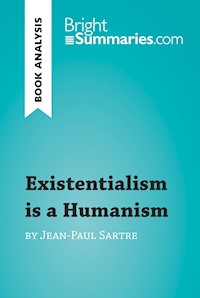
Unlock the more straightforward side of Existentialism and Humanism with this concise and insightful summary and analysis!
This engaging summary presents an analysis of
Existentialism and Humanism by Jean-Paul Sartre, a text which focuses on the philosopher’s idea of existentialism in a more accessible and simplified manner than ever before. By directly addressing the main criticisms levelled against his work, Sartre dispels many of the misconceptions surrounding his ideas and proves, once and for all, that existentialism is neither pessimistic nor depressing, but rather “a doctrine of action”. However, the work received mixed reviews, with many readers challenging its factual and philosophical accuracy. Sartre himself later agreed with this criticism, and dismissed many of the arguments he had made in
Existentialism and Humanism. A prominent French philosopher and novelist, Sartre was also well known for his relationship with Simone de Beauvoir, as well as being the first person to ever turn down a Nobel Prize.
Find out everything you need to know about
Existentialism and Humanism in a fraction of the time!
This in-depth and informative reading guide brings you:
• A complete plot summary
• Character studies
• Key themes and symbols
• Questions for further reflection
Why choose BrightSummaries.com?
Available in print and digital format, our publications are designed to accompany you on your reading journey. The clear and concise style makes for easy understanding, providing the perfect opportunity to improve your literary knowledge in no time.
See the very best of literature in a whole new light with BrightSummaries.com!
Das E-Book können Sie in Legimi-Apps oder einer beliebigen App lesen, die das folgende Format unterstützen:
Seitenzahl: 25
Veröffentlichungsjahr: 2016
Ähnliche












Jean-Paul Sartre
French writer and intellectual
Born in Paris in 1905.Died in Paris in 1980.Notable works:Nausea (1938), novelNo Exit (1944), playThe Words (1964), autobiographyJean-Paul Sartre was a French writer and philosopher. He was born in Paris in 1905 and died in 1980. Celebrated and at the same time rejected for his existentialist thinking, he is the author of several essays, such as Being and Nothingness (1943) and Existentialism and Humanism (1946). He also wrote several literary texts in which his philosophy and his definition of literature have a strong presence, including Nausea, a novel published in 1938, The Flies, a play which first came out in 1943, and No Exit, published in 1944.
In 1964, he turned down the Nobel Prize in Literature and published The Words, an autobiographical story about his youth. Also known as the partner of Simone de Beauvoir (French writer, 1908-1986), Sartre made a strong impression on his audience both with his writings and with his far-left political views.
Existentialism and Humanism
Understanding Sartrean existentialism
Genre: philosophical essayReference edition: Sartre, J.P. (1948) Existentialism and Humanism. Trans. Mairet, P. London: Meuthen & Co. Ltd.1st edition: 1946Themes: philosophy, liberty, responsibility, commitment, atheismExistentialism and Humanism (1946, first published in English in 1948) is the retranscription, with some minor edits by Sartre, of a lecture he gave in 1945 at the Club Maintenant, which was set up after the Liberation of France. The lecture was extremely successful, which speaks volumes about Sartre’s fame, although this fame was often accompanied by a poor comprehension of the philosopher himself. This is one of the reasons Sartre decided to make this speech.
In it, Sartre explains what his philosophy truly consists of, responds to criticisms which had been levelled against him, presents man in the full extent of his freedom and responsibilities, and proves that, far from being pessimistic, existentialism advocates action and commitment.
Summary
Existence precedes essence
Sartre lays out the main criticisms made of existentialism:
Communists see it as a bourgeois philosophy of unrealistic actions;Catholics see it as a pessimistic philosophy which denies the importance of human efforts while also eliminating divine values.Everyone accuses existentialism of disregarding human solidarity through a subjectivity which isolates the individual. Generally speaking, people find existentialism sad and ugly, even if the “wisdom of the people” (p. 24) seems just as depressing to Sartre.




