


Erhalten Sie Zugang zu diesem und mehr als 300000 Büchern ab EUR 5,99 monatlich.
- Herausgeber: Paraclete Press
- Kategorie: Religion und Spiritualität
- Serie: Paraclete Poetry
- Sprache: Englisch
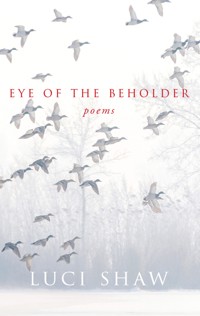
Luci Shaw is now 90 years old. The author of more than 35 collections of poetry and creative non-fiction over the last five decades, she describes her dedication to this art as a burden to "speak into a culture that finds it hard to listen." This collection of new poems—all composed over the last two years—is in many ways the culmination of a stunning career. The joy and responsibility of the poet is to focus on particulars within the universe, finding fragments of meaning that speak to the imagination. Ordinary things may reveal the extraordinary for those willing to take time to investigate and ponder. In this fresh collection of poems, Luci Shaw practices the art of seeing, and then writing what she sees, realizing that beauty is often focused in the Eye of the Beholder. Eye of the Beholder is meant to awaken in readers awareness of the extraordinary in the ordinary. They will find in this collection a focus for meditation and be excited into their own imaginative writing.
Sie lesen das E-Book in den Legimi-Apps auf:
Seitenzahl: 60
Veröffentlichungsjahr: 2018
Das E-Book (TTS) können Sie hören im Abo „Legimi Premium” in Legimi-Apps auf:
Ähnliche












EYE OF THE BEHOLDER
poems
LUCI SHAW
2018 First Printing
Eye of the Beholder:Poems
Copyright © 2018 Luci Shaw
ISBN 978-1-64060-085-0
The Paraclete Press name and logo (dove on cross) are trademarks of Paraclete Press, Inc.
Library of Congress Cataloging-in-Publication Data
Names: Shaw, Luci, author.
Title: Eye of the beholder / Luci Shaw.
Description: Brewster, MA : Paraclete Press, [2018] | Series: Paraclete poetry
Identifiers: LCCN 2018031364 | ISBN 9781640600850 (paperback)
Subjects: | BISAC: RELIGION / Christianity / Literature & the Arts. | POETRY / Inspirational & Religious.
Classification: LCC PS3569.H384 A6 2018 | DDC 811/.54—dc23
LC record available at https://lccn.loc.gov/2018031364
10 9 8 7 6 5 4 3 2 1
All rights reserved. No portion of this book may be reproduced, stored in an electronic retrieval system, or transmitted in any form or by any means—electronic, mechanical, photocopy, recording, or any other—except for brief quotations in printed reviews, without the prior permission of the publisher.
Published by Paraclete Press
Brewster, Massachusetts
www.paracletepress.com
Printed in the United States of America
to Jeanne Murray Walker,companion in writing and life
Paraclete Poetry Series Editor,
Mark S. Burrows
CONTENTS
Introduction: Prophets and Poets
Eye of the Beholder
I THE PULSE of the WORLD
Trail
Writing the Vision
Take these Words
Tree
Signs
Snow Geese
November 2
Anew
Prints
Walking, October
Emergence
Cataract
Signals
Reversals
Leaf
Riverside
Chalices
Bird Psalm
Dogwood Season
Poetry Workshop
Full Moon
Camping, Nooksack South Fork
Somewhere
II A WEB of LONGING
Filaments
Refuge
Sinai
Darkroom
Uncovering
Clear/Transparent
Regrettable
Sometimes a Prayer
Jungle Surgery
Attending
After a Time
Whelm
Where Color Is Spare
Stone Seeker
As the World Turns
At the Edge, Semiahmoo Spit
The White Moth of Ashland
Moon Power, Whidbey Island
Pond in Winter
Short Takes
Sunday in Advent
Rescue
The Many, the One
Before There Was Stuff
Treasury
The Germination
Organics
Summons
How to Grasp and Hold
Our Prayers Break on God
III EVERYTHING BELONGS
January
New Every Morning
Cloth and Cup
Sugar Pea
French Lessons
Testify
Gratitude
The Lust for Astonishments
Road to Tofino, British Columbia
January 25
Increments
Separation
Affirmation
Ceremony of Silence
True-ing
Expectation
For the Love of Logs
Dinner with the Cousins
Goldfish
Signs & Signatures
Yield
Contemplation
God’s Loaf
The Genius of Snow
God’s Act in Acts
Epilogue: To What End This First and Final Life
Acknowledgments
INTRODUCTION:
PROPHETS & POETS
With feet in two worlds—the earth-bound reality and the unseen but utterly real transcendent sphere—Biblical prophets were specially chosen individuals. As commandeered by a divine call, they spoke to the people from God, and to God from the people, inhabiting the tricky threshold between heaven and earth. Their calling was to hear divine words, see divine visions, and then speak the prophetic message to their listeners, linking the transcendent and immanent. As a poet I have felt drawn to a somewhat similar task. Having ideas that seem to come from beyond me, and writing about them, seeing “pictures in my head,” images and words to describe them, have haunted me from early childhood, encouraged by my writer father. As an adult I pray and dream that the words and ideas given me might say something true and meaningful to a reader, a listener.
Presented with visions, permitted to see what others could not, prophets in Scripture were called to proclaim in human language what was “un-seeable” to their audience. Some of the most lasting and vivid poetry in Scripture came from the mouths of these prophets. Throughout biblical history there were many of them, nearly always sent by God to speak words of correction, warning or foretelling.
Ezekiel, Jeremiah, Daniel, and Isaiah were known as the Major Prophets because of the length, complexity, and duration of their prophecies, containing as they did image after image of blazing intensity. The so-called Minor Prophets also had this gift of perception, these glimpses of unseen reality, to be conveyed in words and actions. Habakkuk’s vision was called “a burden,” something so heavy with portent that expressing it, living it out, was a divine message on which the welfare of God’s people depended. Being called as a prophet was not an easy assignment. It set the seer apart from and often against those he was required to challenge. Presented in the language of the people, using earthy metaphors to express divine realities, many visions were written in the form of Hebraic poetry, with brilliant imagery reflecting their own settings and cultures.
The young boy Samuel, with his responsive spirit, woken from sleep three times by God, was the one chosen to call out the high priest Eli, who had grown old and tired and had forgotten to listen and obey, to the detriment of the people he was meant to lead. The proverb says it: “Where there is no vision, the people perish.” Through Samuel, the vision came alive and real in the lives of the people.
Perhaps this is where I find myself, like young Samuel responding as best I can to the voice, listening for messages clear enough to transmit, recording them in their primitive forms in a notebook, then in my computer where they call for revision, revision, revision. I read them aloud to catch the rhythms I hear in my head. I have done this all my life. It is my greatest joy, for which I give glory to the Great Poet who created me as part of his universe, a shard of his seventh day.
These biblical prophecies bristle with colorful imagery reflecting the settings and cultures of the hearers. Much of it follows the forms of Hebraic poetry in couplets that reiterate or contrast. Take Isaiah, whose words describe what he saw of the Mighty One: “I saw the Lord. He was high and lifted up and his throne filled the temple.” The exalted vision that follows is pure poetry. (Somehow it reaches me most powerfully when expressed in the King James Version with its grand sonorities.) Many of the prophecies were more earthbound than Isaiah’s. Think of Jeremiah’s dream of a basket of rotten figs, inedible like the people whom he was castigating. Think of Ezekiel, who literally lived his metaphor, required by God to lie, bound with cords for months, to illustrate the bondage of the people of Judah. The prophetic vision was often heavy, a prediction of imminent destruction and calamity. In Jeremiah’s time, his message of doom so angered the people that they put him in a deep, muddy pit to think it over.
At Saul’s conversion on the Damascus Road, God flung him from his horse and claimed him in unmistakable terms. The vision was blinding and unspeakable, the life-change of the man who became the apostle Paul dramatic.
In the Revelation John the Divine, exiled on Patmos, saw the blazing image of “One like the Son of Man” who transmitted to him prophetic messages for the Christian believers in seven communities of the early church. He was told, “Write what you see.” “Listen to the wind-words,” is how a contemporary translation puts it. With its brilliant and mystical metaphors, John’s vision continues with some of the most arresting and high-flown language and imagery in the Bible. It is both daunting and beatific.




