


1,99 €
Mehr erfahren.
- Herausgeber: Quickie Classics
- Kategorie: Gesellschafts- und Liebesromane
- Sprache: Englisch
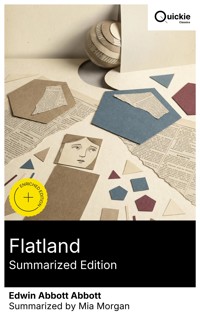
Flatland (1884) is a mathematico-philosophical satire narrated by A. Square, an inhabitant of a two‑dimensional world whose rigid social order maps neatly onto Victorian hierarchies. Through visits to Lineland and an irruption of Spaceland, Abbott fuses Euclidean exposition, parable, and speculative fiction to probe perception, orthodoxy, and the limits of inductive reason. The prose oscillates between pedagogical clarity—complete with geometric taxonomies and diagrams—and allegorical wit, situating the novella within the era's "scientific romance" alongside higher‑dimensional debates stirred by Riemann and popularized in periodicals. A classicist, theologian, and long-serving headmaster of the City of London School, Edwin Abbott Abbott coupled humanistic breadth with practical pedagogy. His educational treatises and liberal Anglican criticism reveal a reformer alert to entrenched dogma; his daily work teaching mathematics supplied the exact vocabulary of angles, polygons, and proof. Flatland emerges from this nexus: a classroom thought experiment sharpened into social critique, indicting gender prejudice and class stratification while modeling how imagination can overturn epistemic complacency. Readers of philosophy of science, mathematics, and Victorian studies will find this slim book inexhaustible: a lucid primer on dimensionality, a witty anatomy of ideology, and a cautionary tale about authority. Approach it as an elegant demonstration and enduring provocation. Quickie Classics summarizes timeless works with precision, preserving the author's voice and keeping the prose clear, fast, and readable—distilled, never diluted. Enriched Edition extras: Introduction · Synopsis · Historical Context · Brief Analysis · 4 Reflection Q&As · Editorial Footnotes.
Das E-Book können Sie in Legimi-Apps oder einer beliebigen App lesen, die das folgende Format unterstützen:
Veröffentlichungsjahr: 2026
Ähnliche












Flatland (Summarized Edition)
Table of Contents
Introduction
At once a geometric parable and a social satire, Flatland dramatizes the clash between what a society permits its citizens to perceive and what reality might contain, showing how habits of sight, status, and language can compress the mind to a single plane even as curiosity presses outward toward other measures of truth. In a world where angles are ancestry and straight lines are peril, the narrative follows the pressure exerted by custom upon imagination, mapping the distance between lived conventions and latent possibilities, and making the reader feel how questioning a boundary—of class, of knowledge, of dimension—can be both an intellectual awakening and a dangerous affront to order.
Published in 1884 during the late Victorian era, Edwin Abbott Abbott’s Flatland: A Romance of Many Dimensions is a concise satirical novella that fuses mathematical imagination with social critique. Its setting is a two-dimensional realm inhabited by geometric figures, and its narrator, known as A Square, speaks in the first person. The book belongs to a lineage of speculative fiction that uses invented worlds to expose the assumptions of the real one, while also anticipating strands of popular science writing. Readers encounter a work that is at once an allegory of class and convention and an exploratory exercise in dimensional thinking.
At the outset, the narrator undertakes a calm survey of his country’s geometry and customs, explaining how shapes identify one another, how dwellings are constructed for safety, and how education, law, and ceremony are organized around angles and sides. The prose adopts the manner of a patient instructor, with playful asides and a methodical precision that turns abstract principles into concrete social facts. The tone alternates between comic exactness and quiet unease, inviting the reader to enjoy the ingenious world-building while sensing its constraints. Gradually, questions about what cannot be seen begin to complicate what is assumed to be known.
One of the book’s central themes is the relationship between perception and truth: if senses and conventions are calibrated to a plane, what methods can enlarge understanding without proof from experience? Abbott stages this problem through geometry, but the inquiry reaches into language, pedagogy, and the politics of knowledge. The shapes’ rules for recognition show how communities manufacture certainty; the penalties for deviation show how institutions defend it. The reader confronts the difference between describing a world accurately and imagining a larger one responsibly, and is encouraged to consider how humility, inference, and analogy become tools for thinking beyond immediate evidence.
Equally salient is the social satire: status in Flatland is formalized by geometry, with more sides implying higher rank, and with severe limitations imposed upon those deemed irregular. Women are depicted as line segments whose treatment exposes fears, anxieties, and controls embedded in the society’s laws. Through such details, the narrative scrutinizes hierarchy, respectability, and the rhetoric of safety used to justify exclusion. The result is a critique of rigid stratification that mirrors debates of its time while speaking beyond them, asking readers to examine how authority clothes itself in scientific language and how conformity can masquerade as moral or practical necessity.
Flatland remains vital today because it models how to question a frame without discarding the discipline that gives thought its rigor. In classrooms, its dimensional conceit offers an intuitive gateway to abstraction, from coordinate systems to higher-dimensional reasoning. Beyond mathematics, the fable invites readers to consider blind spots produced by culture, technology, and ideology, encouraging curiosity about perspectives our tools do not capture. The novella’s satire on status and orthodoxy resonates in discussions about expertise, censorship, and social mobility, while its invitation to intellectual humility equips readers for pluralistic debate and for scientific inquiry that welcomes the unforeseen.
Approached as a tale, a treatise, and a thought experiment, the book rewards close attention to its orderly explanations and the tensions they conceal. Readers may find it helpful to picture the diagrams the prose suggests, to linger over the narrator’s assumptions, and to notice how small logical steps can open a conceptual vista. The language reflects its century yet remains clear and spry, and the brevity invites a single sitting. Without revealing its developments, it is fair to say that Flatland enlarges the imagination, not by spectacle, but by precision, patience, and the courage to ask another question.
Synopsis
Flatland: A Romance of Many Dimensions (1884) by Edwin Abbott Abbott introduces a two‑dimensional world narrated by A. Square, a respectable citizen explaining his country’s nature and customs. In Flatland, all inhabitants are polygons whose edges lie in a plane; existence is confined to length and breadth without height. The narrator adopts a didactic approach, describing how direction, movement, and perception work when thickness is unknown. He frames his account as both travelogue and cautionary exposition, preparing readers to consider the limits of their own knowledge. The opening establishes a stable, orderly society whose geometric constraints shape every aspect of life and thought.
Social order in Flatland is tightly correlated with geometry. Women are line segments, considered both fragile and dangerously sharp; men range from irregular triangles at the bottom through regular triangles and quadrilaterals to many‑sided polygons approaching circles, who serve as priests and rulers. Rank follows regularity and number of sides, shaping education, employment, and civic privilege. Because visual cues are limited in a plane, citizens identify one another by touch and by carefully controlled vocal inflections, practices codified to prevent confusion and injury. The narrator details manners, orientation, and spatial hazards, revealing a culture that treats mathematical form as destiny and moral worth.
Domestic arrangements and law reinforce this geometry-bound hierarchy. Dwellings and streets are regulated to minimize collisions, and women must follow strict protocols to signal their approach. Education emphasizes angle, regularity, and obedience; birth largely determines a polygon’s prospects, though incremental improvement is possible across generations. The state monitors irregularity as a civic threat, with severe remedies justified in the name of order and health. Through such details, the narrative satirizes rigid class systems and gender doctrines, exposing how purportedly scientific rationales can sanction prejudice. The narrator’s matter‑of‑fact tone underscores a society confident in its axioms, even when they conceal cruelty.




