


0,49 €
Mehr erfahren.
- Herausgeber: Quickie Classics
- Kategorie: Abenteuer, Thriller, Horror
- Sprache: Englisch
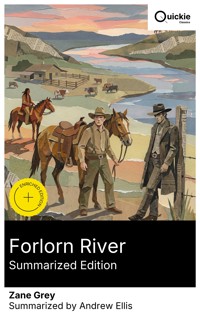
Forlorn River condenses Zane Grey's mature Western into a taut tale of ranching peril and moral trial on the Great Basin's rim. A young cattleman's bid for lawful work collides with rumor, rustlers, and range monopolies; loyalties coalesce around an enigmatic gunman—later famed as Nevada—while a quiet romance tests silence and fidelity. Grey's hallmark mix of panoramic description, brisk action, and ethical melodrama balances river valleys and sagebrush mesas with procedural attention to tracking and stock-work, refining the late‑1920s Western toward psychological and ecological texture. A former dentist turned bestseller, Grey drew on long Southwestern travels, ranch stays, and meticulous field journals that seeded his scenes. His conservationist bent and fascination with the clash between open range and consolidating capital shape the plot's pressures. His serial imagination also anticipates Nevada's rise as a mythic counterbalance. Recommended to readers of classic Westerns, landscape writing, and American popular fiction, Forlorn River offers romance braided with frontier suspense and a lucid study of loyalty under pressure. Begin here; the companion novel Nevada then feels like a necessary return. Quickie Classics summarizes timeless works with precision, preserving the author's voice and keeping the prose clear, fast, and readable—distilled, never diluted. Enriched Edition extras: Introduction · Synopsis · Historical Context · Brief Analysis · 4 Reflection Q&As · Editorial Footnotes.
Das E-Book können Sie in Legimi-Apps oder einer beliebigen App lesen, die das folgende Format unterstützen:
Veröffentlichungsjahr: 2026
Ähnliche







Forlorn River (Summarized Edition)
Table of Contents
Introduction
At its core, Forlorn River traces the perilous passage between who a person knows himself to be and what a restless frontier insists he must become, a crossing where honor contends with scarcity, friendship is tested by rumor and pursuit, and the raw solitude of the range exposes every secret as surely as the sun scours the canyon walls, as the river’s current carves its channel and carries lives toward reckonings shaped by land, law, and longing, until reputations harden, loyalties bend, and the stubborn question of what it means to belong refuses any easy answer.
Zane Grey’s Forlorn River is a Western novel set in the American West, first published in the late 1920s. Grey, among the most widely read authors of his era, helped consolidate the Western as a popular form, and this work reflects that influence through rugged landscapes, moral tests, and swift reversals of fortune. The setting is a world of ranches, river bottoms, and open range where isolation shapes character and community. Readers encounter a frontier in transition, where the promise of opportunity collides with suspicion and scarcity, capturing a moment when the mythic West still felt immediate yet was already slipping into memory.
Without revealing later turns, the novel introduces a hardworking rancher determined to stake an honest claim and a wary outsider whose skills and secrets make him both asset and risk, alongside others whose resilience anchors a community under strain. Pressures mount—economic hardship, contested grazing, and the specter of outlawry—drawing ranch hands, neighbors, and lawmen into uneasy alignment and sharper conflict. What begins as a bid for livelihood becomes a struggle to protect reputation and livelihood against forces that work in daylight and shadow. Action sequences punctuate quieter stretches of watchfulness, creating a steady, suspenseful rise without sacrificing character.
Grey’s narrative voice is third-person and observant, alternating plainspoken dialogue with sweeping descriptions of wind, water, and distance. The prose lingers on ridgelines, hoofprints, and the turn of a river, using the landscape as both canvas and conscience, yet it moves with clarity when chase or confrontation demands speed. The tone balances stoic restraint with romantic intensity, attentive to codes of loyalty while aware of the costs they exact. Scenes of campfire quiet and dawn rides counterpoint bursts of danger, and the novel’s structure favors mounting pressure over surprise twists, so momentum builds from place, choice, and character rather than contrivance.
Among its strongest themes is the contest between wilderness and settlement, not as simple opposition but as a negotiation of belonging: whether a person earns a place by labor, lineage, or conduct. Reputation—how a name travels—is as consequential as evidence, and the book probes how rumor can injure as surely as a bullet. Loyalty and friendship confront the practical demands of survival, while law, custom, and self-made codes jostle for authority. The river itself suggests resilience and boundary, promising renewal yet threatening to isolate, and the story explores whether redemption arrives through escape, endurance, or a hard-won openness to trust.
For contemporary readers, Forlorn River matters because it illuminates continuing dilemmas: how communities weigh suspicion against fairness; how work, land, and identity intertwine; and how myths shape choices in real lives. Its attention to fragile ecologies and contested resources resonates amid current debates about drought, stewardship, and extraction in the American West and beyond. The book also tests inherited models of toughness and care, inviting reflection on masculinity, friendship, and the costs of pride. Read as cultural history, it shows how the Western became a vessel for ideals and anxieties that still circulate, even as it invites critical, thoughtful engagement.
Approached on its own terms, this novel offers a compelling blend of atmosphere, tension, and emotional stakes that rewards slow attentiveness as well as appetite for action. As a product of its time, it reflects early twentieth-century perspectives while granting readers the space to consider what endures and what deserves to be questioned. Forlorn River thus stands as both adventure and inquiry, a story whose riverine patience and sudden floods mirror the choices its characters face. Enter it for the vistas and the drama; stay for the moral weather that gathers, breaks, and clears with the light of a Western dawn.
Synopsis
Forlorn River is a Western novel by Zane Grey set in the remote borderlands of the American West. It follows Ben Ide, a young man determined to make an honest start on rugged range country where desert, timber, and river meet. Returning to a country he loves, he is both at home in the wild and out of step with neighbors who prize hard-nosed pragmatism. The landscape is both adversary and refuge, and Grey uses its distances to frame questions of reputation and endurance. From the outset, Ben’s hopes collide with community skepticism, setting a measured, tension-building course for the narrative.
Ben’s attempts to ranch and trade stock place him squarely in a conflict over cattle, land, and trust. Rumors spread that he is mixed up with thieves who haunt the lonely trails, and the whispering hardens into watchful hostility. Among those whose regard matters to him is a young woman from a neighboring outfit, whose loyalty is complicated by family interests and local politics. As Ben works to prove himself by lawful means, economic pressures tighten, and the line between caution and accusation blurs. Grey traces how reputations are made and unmade in a country where evidence is scarce and tempers quick.
Into this fragile balance rides a drifter known as Nevada, a superb horseman with a guarded past and a stray’s hunger for belonging. He signs on with Ben, lending quiet skill, humor, and a gun-hand’s calm to a camp that attracts other restless men. Their friendship anchors the story, tempering Ben’s idealism with Nevada’s wary realism. Nevada’s presence also unsettles the district, which reads any capable stranger as a threat. Grey shades the newcomer with hints of former trouble without pinning him to a single legend, using the mystery to explore whether a person can outrun a name in a small country.
To outflank suspicion and make a stake, Ben turns to hard, legitimate work in remote places: scouting high ranges, trailing scattered stock, and breaking wild horses along hidden watercourses. The men carve out a lean, disciplined outfit that treats the backcountry as partner rather than quarry. Long rides, scant forage, and sudden storms test their cohesion, while small successes kindle the hope that patient labor can undo rumor. Grey lingers on craft—tracking sign, reading weather, handling stringy broncs—to show a frontier code grounded in competence. The camp’s rough fraternity, and the river valley that shelters it, become a proving ground for character.
Pressure mounts as thefts increase and ranchers organize to stop the losses. Lacking clear culprits, some turn their suspicion on Ben’s operation, convinced that remoteness hides wrongdoing. Watchers shadow the camp, threats accumulate in town, and a posse’s interest sharpens into peril. At the same time, a quiet, more dangerous network of rustlers tightens its grip on the range, exploiting fear and divided loyalties. Nevada’s enigmatic history draws hostile attention, complicating his vow to stand by Ben. Trust becomes precious and fragile, and the difference between law and vengeance narrows, pushing every character toward choices that will bind or break them.
Grey stakes the novel’s rising action on chases, close calls, and tense encounters in canyon and sage, while reserving decisive revelations until late. As the circle tightens, Ben’s standing with the woman he admires depends on whether he can clear his name without abandoning his principles. Nevada’s code—half outlaw, half knight-errant—bears its own cost, especially when truth and safety diverge. The wilderness itself becomes an ally, offering concealment and ordeal in equal measure. Patterns of theft, rivalry, and pride begin to point toward concealed hands, and the narrative drives toward a reckoning that promises justice without fully foreclosing the cost.
Forlorn River endures for its fusion of outdoor narrative, slow-burn romance, and a study of how frontier communities mete out honor and blame. Grey’s emphasis on friendship and personal codes balances his critique of suspicion as a kind of frontier contagion. The book also introduced a memorable wanderer whose later story would continue in a sequel, underscoring the character’s hold on readers. Without depending on a single twist, the novel leaves space for reflection on what it takes to belong—and what must be risked to be free—in a land where silence, rumor, and the long horizon shape every choice.
Historical Context
Forlorn River, published in 1927, is one of Zane Grey’s Western novels rooted in the arid interior of the American West during the closing decades of the long frontier era. The story unfolds in sparsely settled ranch country where small towns, isolated ranches, and open rangeland defined daily life. Institutions were local and lean: county sheriffs, justices of the peace, and brand registries carried much of the legal burden, while distant state capitals and federal land offices set broad rules. Grey situates conflicts amid deserts, mountain basins, and scarce waterways, a landscape whose distances and limited infrastructure shaped commerce, mobility, and the administration of justice.
Grey’s setting aligns with the Great Basin and adjoining borderlands, where the California–Nevada interior was being knit to national markets by late nineteenth- and early twentieth-century railroads. Cattle and horse ranching dominated livelihoods, supplemented by small-scale farming in irrigated valleys. Territorial expansion had yielded to statehood, but governance remained thin outside county seats. General land policy flowed from the Homestead Act of 1862 and the Desert Land Act of 1877, encouraging settlement on arid tracts if water could be developed. These conditions fostered a culture of self-reliance, neighborly dependence, and recurring disputes over grazing, brands, and access to scarce resources.
The open range was transformed by barbed wire, patented in the 1870s and widely adopted in the 1880s, which allowed private control of pastures and water. Fencing ended seasonal drift and protected hay meadows, but it also intensified quarrels as lines crossed customary trails and public domain. The catastrophic winter of 1886–87, remembered for massive cattle losses on the northern plains, accelerated a shift toward smaller, fenced herds and more intensive management. Across the West, stockgrowers’ associations, brand books, and roundup crews professionalized the industry. Those changes magnified the stakes of trespass, rustling, and reputation—persistent pressures in frontier communities.
Scarcity of water governed settlement in interior basins. Western states embraced prior appropriation—first in time, first in right—separating water rights from land ownership and privileging beneficial use. Small streams, springs, and meadows thus carried outsized legal and economic value. The 1902 Reclamation Act created a federal program to build dams and canals, spurring projects across the Intermountain West and reorganizing who could farm, graze, or homestead. Meanwhile, forest reserves and, after 1905, the U.S. Forest Service introduced grazing permits on public lands. These policies sharpened local debates over claims, leases, and authority, framing conflicts that Grey channels into personal dramas.




