


0,49 €
Mehr erfahren.
- Herausgeber: Quickie Classics
- Kategorie: Sachliteratur, Reportagen, Biografien
- Sprache: Englisch
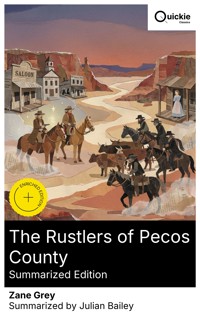
The Rustlers of Pecos County thrusts readers into a Texas community riven by cattle theft and civic collusion, where Texas Rangers struggle to restore lawful order. Grey shapes the drama with panoramic landscape writing and taut, suspenseful set pieces—dusty chases, moonlit vigils, courtroom reckonings—threaded with a restrained romance. High-romance diction meets laconic frontier talk as the book stands between dime-novel sensation and the codifying modern Western. Terrain—canyons, arroyos, river bottoms—functions as moral cartography in a study of vigilantism, corruption, and the fraught emergence of institutional justice. Zane Grey (1872–1939), a dentist turned bestselling novelist and avid outdoorsman, drew this material from pack trips through the Southwest and West Texas, field notebooks, and conversations with ranch hands and Rangers. He habitually transmuted travel diaries and oral lore into narrative, fusing documentary impulse with romance and exploring how harsh landscapes forge character and law. Readers seeking a foundational Western will find brisk plotting, vivid scenery, and moral complexity in abundance. The Rustlers of Pecos County is both an inviting entry to Grey's oeuvre and a revealing artifact for scholars of frontier myth, legal formation, and popular narrative. Quickie Classics summarizes timeless works with precision, preserving the author's voice and keeping the prose clear, fast, and readable—distilled, never diluted. Enriched Edition extras: Introduction · Synopsis · Historical Context · Brief Analysis · 4 Reflection Q&As · Editorial Footnotes.
Das E-Book können Sie in Legimi-Apps oder einer beliebigen App lesen, die das folgende Format unterstützen:
Veröffentlichungsjahr: 2026
Ähnliche










The Rustlers of Pecos County (Summarized Edition)
Table of Contents
Introduction
Between the law’s badge and the outlaw’s brand lies a frontier where justice is measured by nerve, resolve, and risk. Zane Grey’s The Rustlers of Pecos County stands as a defining American Western, set amid the vast rangeland and rough-hewn settlements of Pecos County in West Texas. Written and first published in the early twentieth century, the novel helped consolidate the durable contours of the genre: relentless landscapes, moral conflict, and the collision of community with predation. Grey stages these forces within a world teetering between anarchy and order, inviting readers into a narrative that tests the meaning of authority at the edge of a changing frontier.
At the story’s outset, a determined lawman rides into a county where cattle rustling has become an industry and intimidation a civic habit. He finds a populace divided between weary citizens, emboldened thieves, and powerful interests who benefit from confusion and fear. The initial mission is clear—curb the raids, expose the network, restore lawful norms—but the path is fraught by shifting loyalties and the perils of open country. Grey keeps the stakes intimate even as horizons expand, giving readers a suspenseful, spoiler-safe trajectory: an investigation that deepens into a reckoning, punctuated by tense standoffs, silent trails, and decisions that cannot be delayed without cost.
Grey’s style blends panoramic description with muscular pacing, balancing moments of austere beauty against bursts of sudden action. The voice is steady and economical, yet attentive to atmosphere, the scrape of wind across grass, the geometry of a canyon, the weight of a campfire silence before dawn. Characters take shape through gesture and choice more than exposition, with dialogue that is plainspoken and edged by wariness. The tone is serious without self-importance, disciplined yet responsive to surprise. The effect is an immersive reading experience: a novel that moves quickly while lingering just long enough to let geography and conscience imprint themselves on the page.
Central to the book is the theme of law challenged by lawlessness, not as an abstract opposition but as a lived struggle over land, livelihood, and trust. Grey examines how corruption gathers in the space between fear and ambition, how communities become compromised, and how reform depends on both courage and restraint. Justice emerges as a process rather than a single act, requiring patience, witness, and the unglamorous work of persuading the doubtful. The novel also treats the frontier as a moral pressure chamber, compressing choices until their consequences ring clear, reminding readers that survival and integrity often run on converging but not identical tracks.
The narrative’s human fabric extends beyond pursuit and gunfire to include the fragile bonds that form under threat. Affections, guarded confidences, and uneasy alliances lend the story emotional ballast without diluting its momentum. A romantic current runs through the book, framed by the conventions of its era and filtered through the ethical tests facing its protagonists. Grey’s treatment of attachment is less ornament than trial, placing characters’ loyalties under scrutiny when principles and personal hopes collide. The result is a sober counterbalance to heroics: feeling becomes another terrain to cross with care, and trust, once offered, becomes a stake as consequential as land or livestock.
For contemporary readers, the novel’s conflicts echo debates about public safety, institutional legitimacy, and the temptations of vigilantism. The portrait of a county where private advantage bends public rules remains recognizably modern, mapping how power accrues in shadows and how resilient communities can nonetheless be manipulated. Grey’s attention to landscape carries its own relevance, foregrounding a sense of place that shapes conduct and limits choice, a reminder that environments condition ethics as much as they inspire resolve. The book invites reflection on leadership, accountability, and the costs of force, asking how order can be restored without becoming merely another mask for domination.
Reading The Rustlers of Pecos County today reveals not only a suspenseful tale but a cornerstone of the Western’s enduring architecture. Grey’s influence helped set expectations for frontier storytelling—its cadence, imagery, and moral stakes—while leaving space for readers to question and reinterpret those expectations. The novel’s staying power lies in its disciplined clarity: a hard test of character played out against relentless terrain, told with spare vigor and steady focus. It rewards both first-time visitors to the genre and longtime admirers seeking its foundational notes, offering an experience that is brisk, resonant, and resistant to the expiration of time.
Synopsis
The Rustlers of Pecos County, a Western novel by Zane Grey published in the early twentieth century, unfolds in a law-ridden corner of West Texas where cattle theft has become a system rather than a crime. Ranchers, cowhands, and townsfolk live under the shadow of organized rustling that thrives on fear and complicity. Into this charged setting rides a determined lawman, tasked with restoring order where official authority has failed. Grey establishes a stark landscape and a tense civic mood, balancing the sweeping vistas of Pecos County with the closed rooms where decisions are made and avoided, setting the stage for a test of frontier justice.
The narrative centers on the arrival of a veteran Texas Ranger who takes stock of a border town governed as much by unwritten rules as by statutes. He observes that outlaws and respectable figures overlap in troubling ways, making direct arrests risky and perhaps futile. Choosing discretion over spectacle, he adopts a careful, partially covert approach, mapping alliances and studying the flow of cattle, money, and influence. From saloon thresholds to dusty corrals, he notes how fear polices the streets more effectively than the sheriff, and how power hinges on information as much as on guns.
Soon the Ranger finds a capable, younger ally who shares the badge’s ideals but must learn the patience the situation requires. Grey threads this partnership with the town’s domestic rhythms: dances, church gatherings, and ranch suppers where loyalties are tested in smiles and small talk. A prominent family’s household becomes a focal point, reflecting broader tensions between duty and kinship. The Ranger’s presence unsettles entrenched interests, and his measured inquiries expose fractures in the community. Cattle disappear in the night, witnesses recant by day, and the line between caution and cowardice narrows, heightening pressure on all involved.
Evidence grows that the rustling is not a loose band of thieves but an organized enterprise shielded by civic influence. Grey builds momentum through night rides, fraught meetings, and sudden skirmishes that reveal a choreography behind the crimes. The Ranger cultivates informants, tests alibis, and quietly documents patterns the town prefers to ignore. What seems like simple theft reveals a network that profits from intimidation and official inaction. Stakes rise as raids become bolder and tempers fray. The question becomes not only who is guilty but who will stand up, as the cost of speaking out comes due for more than one citizen.
Personal stakes complicate the investigation. The Ranger carries a hard-earned code that forbids shortcuts even when violence tempts a quicker solution. A developing attachment to a principled local woman, intertwined with influential ranching interests, forces him to weigh transparency against safety. Grey uses this relationship to explore how affection and honor can coexist with secrecy, and how trust must be earned when motives are suspect. Meanwhile, friendships in the town strain under rumor and retaliation. A misjudged word or a misplaced loyalty might turn allies into liabilities, sharpening the moral dilemma at the heart of the conflict.
As the rustlers sense their exposure, reprisals escalate: ambushes on lonely trails, fires intended as warnings, and coordinated distractions that test the Ranger’s reach. With limited official support, he relies on discipline, timing, and a few steadfast partners to narrow the suspects and isolate the ring’s core. Public sentiment begins to shift as the pattern becomes undeniable, and quiet courage emerges among citizens who had long kept their heads down. Grey steers the narrative toward a decisive confrontation that promises to clarify roles and responsibilities, while withholding the final balances of justice and mercy until the closing movement.
The Rustlers of Pecos County endures for its clear-eyed portrait of law facing layered corruption, and for its insistence that order, to be legitimate, must be earned rather than imposed. Grey’s evocation of the Texas borderland—its distances, codes, and silences—grounds a story about institutions and individuals learning how to resist intimidation. The novel’s controlled suspense, measured investigation, and tension between patience and action exemplify the classic Western’s moral architecture. Without revealing its ultimate resolutions, the book’s lasting resonance lies in its exploration of courage that moves from private conviction to public stance.
Historical Context
The Rustlers of Pecos County is set in West Texas’s Trans‑Pecos, centered on Pecos County and nearby settlements in the late nineteenth century. Pecos County, created in 1871 and organized in 1875, was sparsely populated ranch country anchored by Fort Stockton, a U.S. Army post reoccupied in 1867 to protect the San Antonio–El Paso Road and local springs. Civil institutions—county courts, sheriffs’ offices, and justices of the peace—operated across vast distances with limited resources. The region’s isolation, arid environment, and dispersed ranches made law enforcement difficult and afforded opportunities for organized theft, creating conditions that historical contemporaries widely described as lawless.
After the Civil War, Texas experienced a cattle boom that sent longhorns north on trails skirting the Pecos River, notably the Goodnight–Loving Trail from the late 1860s. Open‑range practices relied on brands, roundups, and customary codes, but they also enabled cattle rustling, a persistent crime across West Texas. The introduction and rapid spread of barbed wire after Joseph Glidden’s 1874 patent began to close the range in the 1880s, provoking the Fence‑Cutting Wars in Texas between roughly 1883 and 1888. These conflicts, alongside falling cattle prices and overstocked ranges, intensified disputes between ranchers, smallholders, and professional thieves.
Central to order on the frontier were the Texas Rangers, reconstituted after Reconstruction into the Frontier Battalion in 1874 under John B. Jones. Operating in companies across the plains and border, Rangers pursued rustlers, fugitives, and raiders with mobility unmatched by county posses, though their methods sometimes drew controversy. As settlement advanced, the Frontier Battalion was disbanded in 1901 and replaced by a state Ranger force under the Adjutant General. Throughout the late nineteenth century, Ranger patrols worked in the Trans‑Pecos and Big Bend, reinforcing or supplanting local law officers when county institutions proved too weak to confront entrenched criminal networks.




