


0,49 €
Mehr erfahren.
- Herausgeber: Quickie Classics
- Kategorie: Lebensstil
- Sprache: Englisch
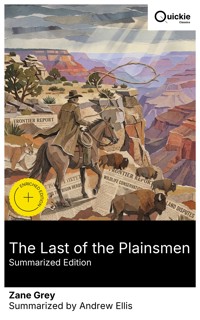
THE LAST OF THE PLAINSMEN recounts Zane Grey's expedition with the game warden "Buffalo" Jones across the Arizona–Utah plateau, from the Kaibab forests to the North Rim of the Grand Canyon. A hybrid of travelogue, natural history, and adventure reportage, it tracks cougar hunts, rare bison, desert storms, and settlements at the edge of empire. Grey's vivid, sometimes purple prose is balanced by field observation, placing the book at the hinge between dime‑novel romance, documentary realism, and Progressive‑Era conservation. Grey, an Ohio‑born dentist turned novelist and ardent outdoorsman, pursued authenticity through direct experience. Traveling with C. J. "Buffalo" Jones gave him access to techniques of roping predators alive and to Roosevelt‑era ideas about preservation. The journey furnished notebooks and scenes later refined in Riders of the Purple Sage. Readers of Western history, environmental studies, and narrative nonfiction will find this an invaluable, if morally conflicted, document. Approach its portrayals of wildlife and Indigenous peoples critically, yet savor its canyon vistas and kinetic chases. As frontier elegy and genre seedbed, THE LAST OF THE PLAINSMEN remains bracing and essential. Quickie Classics summarizes timeless works with precision, preserving the author's voice and keeping the prose clear, fast, and readable—distilled, never diluted. Enriched Edition extras: Introduction · Synopsis · Historical Context · Brief Analysis · 4 Reflection Q&As · Editorial Footnotes.
Das E-Book können Sie in Legimi-Apps oder einer beliebigen App lesen, die das folgende Format unterstützen:
Veröffentlichungsjahr: 2026
Ähnliche












The Last of the Plainsmen (Summarized Edition)
Table of Contents
Introduction
This is a story about the West at a crossroads, where mastery over the land contends with the duty to preserve it. Zane Grey’s The Last of the Plainsmen is narrative nonfiction in the Western tradition, set in the American Southwest around the turn of the twentieth century. First published in the early 1900s, it chronicles field expeditions at a moment when open ranges were closing and ideas about wildlife were shifting. Grey writes as observer and participant, fusing travelogue, natural history, and adventure into a clear, steady account that recognizes both the grandeur of a famous landscape and the pressures that were remaking it.
At its core, the book follows Grey as he accompanies Charles Jesse "Buffalo" Jones, a celebrated plains hunter who became a prominent advocate for preserving the American bison. Their small party ventures into desert and canyon country, tracking wary predators and reading the signs of a rugged, sparsely settled land. Episodes of pursuit, roping, and campcraft alternate with quiet observation of weather, stone, and animal habit. The narrative is built from trails ridden and ledges tested rather than melodrama, and it favors measured, firsthand experience over spectacle, allowing the country itself to set the pace and shape the dangers encountered.
Grey writes in a first-person voice that favors clarity over flourish, yet his descriptive passages carry a restrained lyricism. He attends to the textures of sand, snow, wind, and sage, and to the practical demands of horses, hounds, and gear. The pacing is episodic, shaped by long approaches, sudden bursts of action, and evenings of reflection by the fire. Dialogue is spare and purposeful; the tone is observant, respectful, and occasionally awed. Readers encounter a hybrid of field journal and adventure tale, where credibility and atmosphere outweigh conventional plot twists and where suspense emerges from terrain, weather, and endurance.
The book’s themes gather around extinction and endurance, the uneasy transformation of hunter into steward, and a cherished myth tested against stubborn fact. Grey considers how skill and daring, once used to conquer, might be redirected toward protection, and how that redirection remains partial and morally complicated. He explores companionship under hardship, the discipline required to operate in severe environments, and the limits of human control before wind, stone, and animal agency. The result is not triumphalism but a meditation on courage and restraint, and on the human urge to make legends from living creatures and contested places.
Historically, the narrative stands at a hinge point. Written in the first decade of the twentieth century, after federal acknowledgment that the frontier had closed in the 1890s, it registers the rise of conservation alongside the persistence of showmanship and risk. It belongs to Grey’s early career, before the Western novels that would make his name, and it uses a real figure—Buffalo Jones, widely associated with efforts to protect bison—to anchor its observations. The book captures the collision of memory and modernization, as scientific management, tourism, and regulation began to reshape how Americans imagined and used western lands.
For contemporary readers, the work resonates beyond its period detail. Its questions about predator management, wildlife recovery, and human responsibility remain urgent, and its portraits of vast public landscapes remind us how policy and perception can alter a place. The book also offers a chance to read critically across time: its values are sometimes dated, its assumptions imperfect, and yet its attention to animals and habitats points toward a more cautious ethic. Engaging it as both document and narrative helps illuminate how environmental thought has evolved and how stories shape the choices we still face.
Approached in this spirit, The Last of the Plainsmen rewards patience and curiosity. It provides a spoiler-safe invitation to ride along with a mixed company of hunter, writer, dogs, and horses, to see famous country under the strain of weather and work, and to consider what it means to be the last of anything. Grey delivers an immersion in skill, landscape, and ambiguity rather than a tidy fable. The book matters because it captures a turning point with unusual clarity, asking readers to weigh daring against care and to imagine futures worthy of the lands it describes.
Synopsis
Published in 1908, Zane Grey’s The Last of the Plainsmen is a nonfiction chronicle that profiles Charles Buffalo Jones and records an expedition into the American Southwest. Grey, a newcomer to the harsh country he describes, accompanies Jones to observe a method of pursuing large predators that aims at capture rather than killing. The narrative opens by situating Jones as a figure shaped by the open range, already receding into memory. Grey frames the journey as both an adventure and an inquiry into a vanishing way of life, using his outsider’s perspective to introduce the landscapes, skills, and values he hopes to understand.
Early chapters sketch Jones’s evolution from frontier hunter to ardent believer in saving wildlife through capture and relocation. Grey presents him as a disciplined, practical strategist whose codes of endurance and restraint reflect the ethos of the plains. A small party forms around these aims, gathering equipment, dogs, and pack animals before setting out from established settlements toward remote canyon country. Grey’s role is that of observer-participant: he joins the work yet keeps a careful, sometimes skeptical, eye on risk, ethics, and technique, establishing a measured tone that balances admiration for prowess with questions about its purpose.
The expedition pushes through deserts and broken plateaus toward the rim of one of the continent’s great chasms. Logistics dominate: managing water, protecting mounts’ hooves, and plotting routes around impassable cliffs. Grey records the routine of camp life—night watches, scant rations, the discipline of early starts—alongside vivid impressions of silence, wind, and vast distances. Occasional visits to ranch outposts provide supplies and local intelligence. The narrative emphasizes the teamwork required to move safely and efficiently through harsh terrain, laying groundwork for the intense pursuit scenes that follow and underscoring the balance between preparation and improvisation in wilderness travel.
At the heart of the book are extended episodes tracking cougars through rugged country with dogs and ropes, a method meant to test skill more than to take life. Grey details how men read tracks, gauge weather, listen for hounds’ voices, and position themselves to avoid perilous leaps and sheer drops. The effort requires patience, sudden speed, and coordination, and it places human ambition against the instincts of elusive predators. Grey’s descriptions stress process over outcome, showing how near-misses, false leads, and quick reversals are integral to the work, while keeping final results secondary to the learning and discipline involved.
Setbacks and hazards accumulate: storms sweep across high country, trails vanish into loose rock, and animals bolt into mazes of ledges and timber. Injuries are narrowly avoided, and fatigue becomes a constant companion. Yet the group’s cohesion grows through shared hardship—men pacing their effort to protect the dogs, trading tasks, and reading each other’s limits. Grey highlights the practical intelligence that underwrites survival, from quiet decisions about retreat to meticulous gear care. The portrait that emerges is less about feats than about sustained attention, measured daring, and the willingness to accept nature’s terms without grandstanding.
Interludes of reflection widen the lens to the fading era that shaped Jones. Grey notes the thinning of once-vast game herds and the spread of fenced ranges, arguing that the old model of boundless pursuit has closed. He presents Jones as a paradox of his time: a man forged by hunting who turns toward preservation through capture, raising questions about what conservation meant in that transitional moment. Observations of changing land use and the practical needs of frontier communities deepen this tension, suggesting that responsibility to wildlife can coexist uneasily with economic realities and inherited habits of mastery.
The Last of the Plainsmen endures as an early example of Grey’s blend of reportage and evocative landscape writing, documenting techniques, personalities, and attitudes at the close of the American frontier. Without relying on sensational revelations, it offers a steady account of risk, restraint, and respect for skill, while probing the obligations humans owe to wild creatures. Its restraint keeps the outcomes of specific pursuits in the background, guiding attention to character and context. The book’s broader significance lies in how it frames courage and conservation as intertwined, a lens still relevant to contemporary debates about wildlife and the stories Americans tell about the West.
Historical Context
Published in 1908, The Last of the Plainsmen is Zane Grey’s nonfiction account of an expedition with Charles Jesse “Buffalo” Jones into the Arizona Territory’s canyon and plateau country. Set chiefly around the Kaibab Plateau and the North Rim of the Grand Canyon, the narrative records travel, tracking, and encounters with wildlife at a moment when federal land policy and tourism were reshaping the region. Railroads had recently made the South Rim accessible, but the North Rim remained remote, reached by wagon and pack animals. Grey situates his journey within an American West transitioning from open-range improvisation to regulated conservation and scientific management.
Buffalo Jones, born in 1844, embodied the turbulent transformation of the Plains. After participating in the commercial buffalo hide trade that devastated herds in the 1870s, he became a prominent advocate for preservation, capturing calves to rebuild numbers and attempting bison–cattle hybrids. He helped establish Garden City, Kansas, and by the early twentieth century was nationally known for audacious captures and game protection. In 1902 he was appointed a special game warden for Yellowstone National Park. Grey’s portrait of Jones draws on this arc—from market hunting to preservationist experimenter—to frame a figure who claimed continuity with frontier skills while embracing emerging conservation goals.
The expedition unfolded amid Progressive Era conservation, championed by President Theodore Roosevelt and allies such as Gifford Pinchot. Federal authority expanded through the Lacey Act of 1900 (curbing interstate trade in illegally taken wildlife), creation of the U.S. Forest Service in 1905, and the Antiquities Act of 1906, enabling presidential proclamation of national monuments. Roosevelt established the Grand Canyon Game Preserve in 1906 to protect deer and other species on the Kaibab Plateau; he designated the Grand Canyon National Monument in 1908. Grey’s narrative intersects these policies, documenting a landscape newly under federal protection yet still managed with utilitarian, game-focused priorities.




