


6,99 €
Mehr erfahren.
- Herausgeber: Chorabooks
- Kategorie: Religion und Spiritualität
- Sprache: Englisch
Anti-Christian propaganda is spreading a completely false image of St. Francis of Assisi across the world, as it has been adapted to fit the demands of the ‘modern spirit’.
As such, the mass media present us with an image of Francis as meek, a pacifist, an ecumenist, a libertarian, a revolutionary, and an enemy of culture and civilisation. A certain form of historiography, preaching and Franciscan propaganda have been accomplices in this shameless falsification.
It is therefore urgent to rediscover the person, the example and the message of the true St. Francis, for which there is a pressing and current requirement precisely because they constitute “a challenge to the modern world”, as Chesterton observed.
In order to rediscover this, we must return to the contemporary historical sources, to the testimonies of the early Franciscans and to the teachings of the Church.
This is what this short but deeply researched book has done – written through posing questions and providing answers – in order to restore truth and honour to St. Francis, taken away from him by his many false followers and apologists.
Guido Vignelli was born in 1954 in Rome, where he currently lives. A scholar of history, political philosophy and communication science, he is dedicated to defending the principles and institutions of the Christian world, following the school of the Catholic counter-revolutionary apostolate. He was a founding member of the Lepanto Cultural Centre in 1982 and of the Associazione Famiglia Domani in 1987, and from 1993 to 2013 he was the director of the SOS Ragazzi project. He is the author of books and articles, and works with associations, magazines, radio stations and websites inspired by traditional Catholicism.
TABLE OF CONTENTS
The Testimony of Saints Today.
Was St. Francis a ‘do-gooder’?
Was St. Francis a pacifist?
Was St. Francis against the Crusades?
Was St. Francis an ‘ecumenist’?
Was St. Francis a friend of Islam?
Was St. Francis a libertarian?
Did St. Francis object to ecclesiastical authority?
Was St. Francis a revolutionary?
Was St. Francis egalitarian?
Was St. Francis an ecologist?
Was St. Francis against culture?
Was St. Francis opposed to civilisation?
What is the real meaning of Franciscan poverty?
What is the real Franciscan spirit?
Das E-Book können Sie in Legimi-Apps oder einer beliebigen App lesen, die das folgende Format unterstützen:
Veröffentlichungsjahr: 2019
Ähnliche


















Guido Vignelli
FRANCISCAN CATECHISM
Copyright © 2019 Chorabooks, a division of Choralife Publisher Ltd.
All rights reserved.
14/F office A. Bangkok Bank Building
No.28 Des Voeux Road Central
Hong Kong
Visit our website at www.chorabooks.com
First eBook edition: May 2019
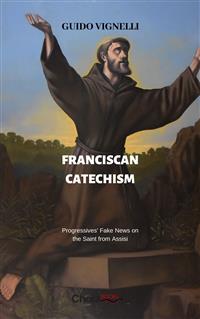
Cover: Rodolfo Papa, Stimmate di san Francesco, olio su tela 260x200, chiesa di san Giulio I papa, Roma 2014
Indice dei contenuti
The Testimony of Saints Today
Was St. Francis a ‘do-gooder’?
Was St. Francis a pacifist?
Was St. Francis against the Crusades?
Was St. Francis an ‘ecumenist’?
Was St. Francis a friend of Islam?
Was St. Francis a libertarian?
Did St. Francis object to ecclesiastical authority?
Was St. Francis a revolutionary?
Was St. Francis egalitarian?
Was St. Francis an ecologist?
Was St. Francis against culture?
Was St. Francis opposed to civilisation?
What is the real meaning of Franciscan poverty?
What is the real Franciscan spirit?
The Testimony of Saints Today
What is the biggest obstacle that prevents the people of today from understanding and loving the precious message left to us by the saints?
The Christian message is currently being subjected to falsification, promoted by the ‘spirit of the world’ and its subversive agents both outside and inside the Church. When they are unable to slander the figures of the saints, they at least try to diminish their supernatural value, either by reducing them to a natural aspect or by adapting them to the ideologies, fashions and illusions of the modern mentality.
In this way, as has also happened to Jesus Christ, some of the saints are often falsified in order to spread an evangelical message that conflicts with the truth. Pope Pius XI issued a warning about this:
"…in our times, many infected by the false spirit of secularism, habitually attempt to strip our saintly heroes of the true light and glory of their sanctity. These writers view the saint merely as models of human excellence or as professors of an empty spirit of religion, praising and magnifying them exclusively because of what they have done for the progress of arts and sciences, or because of certain works of mercy which they have accomplished and which have proven helpful to the fatherland and to mankind." [1]
Therefore, historians and Catholic apologists have a serious duty to unmask, refute and condemn this scandalous falsifying manoeuvre in order to restore the original and authentic values of the examples and messages of the saints.
"The saints are not just part of history, but they create holy history. (…) Those who want to depict the figure of a saint (…) must have the eye of faith, otherwise he does not glimpse what happens by divine initiative, and the image that he paints becomes a mere human form, which more often than not is problematic." [2]
What is the most serious case where falsification has distorted the image of a popular saint?
The most serious case of the falsification of a saint is certainly that of the very well-known son of Pietro di Bernardone and Pica de Bourlemont: that is, the John the Baptist of Assisi, who has been known throughout history by the name ‘Francis’, which derives from his maternal Franco-Provençal origins.
For almost a century, his figure has been distorted by a kind of conspiracy that has taken shape in all sorts of mass media: books, newspapers, films, TV shows, musicals, theatrical performances, even comics and cartoons aimed at children.
As a result, St. Francis has been presented to the wider public as though he were a ‘do-gooder’, a pacifist, an ecumenist, a revolutionary, egalitarian, permissive, and an enemy of culture and civilisation.
Was St. Francis a ‘do-gooder’?
What do you mean by saying that St. Francis was not a ‘do-gooder’?
The most common of the distorted images listed above, at least in the West, is that which presents us with a version of St. Francis where he is a good-natured person – a ‘do-gooder’, one might say today – that is, a sentimental type, soft, submissive and permissive. This is a person who, in the name of a misunderstood and confused compassion, avoids condemning and manfully fighting error and sin, to which he risks thereby becoming at first a passive and then an active accomplice. It almost seems that, for him, the Christian must not become the salt but the sugar of the Earth.
What does this ‘do-gooder’ distortion entail?
The ‘do-gooder’ distortion attributes the invention of a new form of apostolate to St. Francis: that which is reduced to merely proactive ‘testimony’, in which he thus refuses not only to reproach, condemn and punish the misguided, but even to force or forbid someone to do something, even for moral or religious purposes. This would be the only admissible and practicable paradigm today as we are in an era that rejects any form of criticism detrimental to absolute ‘human dignity’ and therefore to the ‘peaceful coexistence’ between peoples, cultures and religions.
What belies the reputation of St. Francis as a ‘do-gooder’?
This bland image of the Seraphic Father is belied by his demeanour, which was virile and austere, severe and demanding, rigorous and authoritative. His words and deeds were not only kind but also harsh and hard, using whichever was required according to circumstances and his options, thus provoking not only congeniality and affection but also apprehension and fear. His contemporaries report that, while preaching,
"He did not remain silent about the vices of the people who were offending the Lord and his neighbour. God had granted him such grace that just to see him or hear him caused anyone, whether humble or powerful, to fear him for his holiness, but he was so venerated that even though they came away from him rebuked and shamed, they still remained comforted (…) and sometimes they returned to the Lord." [1]
For example, St. Francis warns us that
"there are few who wish to receive Him and to be saved by Him," [2]
because most people – including Christians! – do not adhere to the holy duty to “hate vices and sins” [3]. Moreover, he did not limit himself to deploring evil in the abstract, as is common today in order to avoid criticism and annoyance, but in fact denounced and condemned it in concrete terms, namely, in the errants and in the sinners, especially if they were public figures or responsible for scandals. In fact,
"Francis avoided any compromise. He did not conceal the faults of others, but laid them bare and chastised them with severity; for those who lived in sin, he had no excuses but harsh reprimands. (…) Without fear of reproach, he proclaimed the truth so confidently that even the most learned men, distinguished by their fame and social renown, were struck by a healthy fear in his presence." [4]
Today it is generally said that God neither reprimands nor punishes; how did St. Francis behave in this regard?
The Seraphic Father used to incite the holy fear of God by threatening infernal punishments with his words and pronouncing terrible sentences:
"But all those who do not do penance and … who give themselves to vices and sins and walk after evil concupiscence and bad desires and who do not observe what they have promised, corporally they serve the world and its fleshly desires and cares and solicitudes for this life, but mentally they serve the devil, deceived by him whose sons they are and whose works they do…" [5]
"Woe to those who do not die in penance for they will be sons of the devil whose work they do and they will go into eternal fire." [6]
"…wheresoever or howsoever a man may die in mortal sin … the devil snatches his soul from his body with such violence and anguish as no one can know except him who suffers it. (…) And thus he loses soul and body in this short life and goes into hell, where he shall be tormented without end." [7]
"And if you do not forgive men their sins the Lord will not forgive you your sins. (…) Thy Son Himself is to come again in the glory of His Majesty to put the wicked who have not done penance for their sins, and have not known Thee, in eternal fire…" [8]
Did St. Francis also put curses on people, like an ancient prophet?
St. Francis not only warned and threatened, but sometimes also cursed the enemies of God and the Church, or even of the Franciscan Order and its Rule. Significant curses include, for example, the fiery and violent ones directed at those who provoked scandals, or those who performed sacred works in bad faith or violated the Divine Commandments:
"Those who … love darkness rather than the light, not wishing to fulfil the commandments of God, are cursed…" [9]
"And let all the brothers who have wandered from obedience to the commandments of God know that … they are cursed…" [10]
Finally, the orders he gave to his disciples included admonishing, reprimanding and recalling back to the straight and narrow those who persisted in sinning, especially if they were public or shameful individuals.




