


Erhalten Sie Zugang zu diesem und mehr als 300000 Büchern ab EUR 5,99 monatlich.
- Herausgeber: Sallux Publishing
- Kategorie: Religion und Spiritualität
- Sprache: Englisch
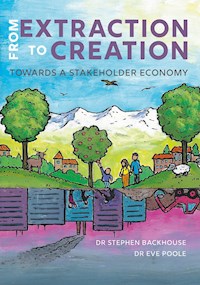
The aim of this report is to help us imagine a better common economic life, one which rewards allthe stakeholders in business, rather than privileging the shareholding few. Such a move can anddoes benefit people, planet and profit, but it will only do so when we move from a story fuelled byextraction to one formed by creation. The authors of this report work in politics, economics andmanagement, but are also trained in theology. As such they are steeped in the deep stories that haveshaped our economic, political and social life. A full consideration of these deeper ideas that underlyour institutions (for good and for ill) is necessary if we are to truly imagine a better way to conductour business and how we shape our economic policies.
Sie lesen das E-Book in den Legimi-Apps auf:
Seitenzahl: 102
Veröffentlichungsjahr: 2022
Das E-Book (TTS) können Sie hören im Abo „Legimi Premium” in Legimi-Apps auf:
Ähnliche
















From
Extraction
to
Creation
Towards a Stakeholder Economy
Dr Stephen Backhouse
Dr Eve Poole
Colophon
From Extraction to Creation: Towards a Stakeholder Economy
Dr Stephen Backhouse
Dr Eve Poole
© 2022 Sallux Publishing. All rights reserved. No part of this publication may be reproduced, stored in a retrieval system, or transmitted, in any form or by any means, electronic, mechanical, photocopying, recording or otherwise, without the prior permission of the publisher.
Unless otherwise stated, scripture taken from The Holy Bible, New International Version® (Anglicised), NIV®. Copyright © 1979, 1984, 2011 Biblica, Inc. Used by permission of Hodder & Stoughton Limited, a division of Hachette UK. All rights reserved worldwide. “New International Version” and “NIV” are registered trademarks of Biblica, Inc. Used by permission.
Contact data:
Sallux Publishing
EPub format ISBN 978-94-92697-28-8
Cover design and lay-out: Reproserve
Cover images: Thijs C Jansen creative
Disclaimer
Since 2011, the activities of Sallux have been financially supported by the European Parliament. The liability for any communication or publication by Sallux, in any form and any medium, rests with Sallux. The European Parliament is not responsible for any use that may be made of the information contained therein.
About
The Jubilee Centre
The Jubilee Centre offers a biblical perspective on social, economic and political issues, and equips Christians to be salt and light in the public square. We believe the Bible describes a coherent vision for society that has enduring relevance for the UK and the world in the twenty-first century. At the heart of this social vision is a concern for right relationships. We seek to study, disseminate and apply this vision in order to provide a positive response to the challenges faced by individuals, communities and policy makers.
Sallux | ECPM Foundation
Sallux is the political foundation for the European Christian Political Movement (ECPM). Sallux means “Salt and Light” and we want to spark a salted debate where needed and shed light on the issues we face. We present solutions by organising events and distributing relevant publications and will not stay on the safe side of the status quo.
www.sallux.eu
About the Authors
Dr Stephen Backhouse (McGill, Oxford) is the founder of Tent Theology where he works as a consultant for entrepreneurs, businesses and charities. He has held positions as Director for Graduates at St Mellitus College and Dean of Westminster Theological Centre. He is the author of numerous books and articles on philosophy, power and politics.
Dr Eve Poole has a BA from Durham, an MBA from Edinburgh, and a PhD in theology and capitalism from Cambridge. She is the author of several books, including Leadersmithing, which was Highly Commended in the 2018 Business Book Awards. She was Third Church Estates Commissioner (2018-2021) and the first female Chairman of the Board of Governors at Gordonstoun (2015-2021). She taught leadership at Ashridge Business School for 15 years, having previously worked for Deloitte Consulting, where she specialised in change management.
Once upon a time there were two Cities.
Creation City was a beautiful place.
It was a complicated place, where animals, plants, things and people all lived together. It was not always easy to see how everyone was related but they knew that they were, and they lived at peace with the complexity.
The City was profitable: people’s ventures left more quality resources behind after they were finished, and places were left better off than how the people had found them.
The humans employed in Creation City were energised by their work, and there somehow seemed to be even more animals, plants and things after coming into contact with their businesses.
The inhabitants of the city thought that if a venture had to break its people or hurt its places in order to be a success, it was not worth doing.
They knew how important it was to maintain relationships, and so they measured the success of their endeavours by how well the people who took part were connected to each other.
Creation City was a beautiful place.
***
Extraction City was not so beautiful.
It too was a complicated place. It too had animals and plants and things and people all related in intricate ways, and yet the rulers of the city kept trying to impose their will on everything.
They applied simplistic solutions and labels onto complex things, and as a result things never behaved quite the way they were supposed to.
People were expected to be self-interested consumers. The environment was expected to perform regularly like clockwork.
Places, animals and things were seen merely as resources from which to extract maximum value.
Humans were considered to be resources too, and they were required to pour their energy and emotions and time into the organisations that they belonged to.
Everything the Extraction City touched was left misunderstood, exhausted and drained.
Extraction City was not so beautiful.
***
This tale of two cities is a true one.
It happens all the time.
It is happening now.
Which City do you want to live in?
Foreword
In August 2022 the Janus Henderson Global Dividend Index (JHGDI) published that the second quarter of 2022 saw the highest record ever of dividends paid out to shareholders1. This comes at a moment when a growing number of people in Europe are experiencing financial hardship due to soaring inflation and extremely rising energy bills. The same index indicated that the key drivers of the unprecedented growth in dividend pay-outs were oil, financials and auto sectors. Clearly, we feel that there is a moral problem if we consider that the term ‘oil’ in this index actually means ‘oil, gas and energy’2. This means that while people struggle to pay energy bills, the companies that create these soaring bills are increasing their dividend pay-outs as never before. That means that people with average or low incomes are forced to pay more for something they need to be able to survive and this ultimately leads to higher dividends for shareholders. At 3 August 2022, UN Secretary-General António Guterres stated ‘It is immoral for oil & gas companies to be making record profits from the current energy crisis on the backs of the poorest, at a massive cost to the climate.3’
Paying more dividend is a choice and not a law of nature. The same companies could have made a choice to use their record profits to decrease the costs for consumers or help them to create more isolation or increase their investments in creating renewable energy sources. Instead these record profits resulted in record payments to shareholders, many of whom already belong to the richest ‘1%’.
These and similar situations have helped more and more people to realize that there is a fundamental problem in our economy that originates from the dominance of shareholders. António Guterres and many policy makers made a plea for a special ‘windfall tax’ for energy companies. This is understandable and may be necessary in order to alleviate the most urgent needs of (especially poorer) energy consumers. At the same time it does not solve the underlying cause that led to this situation.
The core cause is the pressure that originates from the demand of the shareholders that companies continuously increase profits in order to increase their dividends and the value of their shares on the stock markets. In this case it led to extraction of money from the most vulnerable consumers as they often lack the means for modern isolation and generally live in older houses.
The same demand for more profits and higher dividends keeps wages low which means that time and work is extracted from people for a high production at low costs. The European Trade Union Confederation (ETUC) released at 26 August 2022 a statement in which it compared the rise in dividends across the EU with the average rise in salaries across EU Member States4. The conclusion was that dividends rose seven times faster than average wages. Moreover the ETUC stated: ,,The figures show again how excessive corporate profits – not wages – are driving inflation, as stated by the European Central Bank”5. It demonstrates how shareholder profit is seen as the single purpose of companies at the expense of all other stakeholders and society at large.
Other stakeholders equally suffer under this system as many SME’s have to adapt to the demands imposed on them (directly and indirectly) by the large companies and multinationals. Many SME’s face higher energy bills and decreasing margins of profit as the large companies increase their margins of profit by demanding cheaper purchases from smaller companies.
Simultaneously, this pressure for shareholder profit leads to extraction of natural resources at the cost of our environment and climate. The reality is that more sustainable production is costlier. As lower profits and lower dividends is seemingly never a normal option, the choice is completely moved to consumers to choose between their wallet or the planet. The same consumers that are already pressed between lower wages than needed and higher energy costs than necessary. At the same time the whole drive for more consumption is fired forward by the same drive for more profit. More sales means more profit and therefore all must be done to produce and sell more.
This whole economic system enforces individualism and is built around the notion of the autonomous individual. The Sallux publication ‘A Relational Response to Climate Change’ already emphasized and elaborated this and stated: ,,individualism creates consumerism as it focuses on the fulfilment of each person in an autonomous, individualistic way.”6
This system indeed pushes people towards individualism. Not only are people constantly addressed as individual consumers, families and community life face constant pressure. The current economy make families artificially poorer and pressures them to spend more time on the work floor than otherwise needed. As a result family members have less time to contribute to the community.
In every aspect we see that the current economic system results in extraction from individuals, communities and our planet. Our shareholder centred system is an economy of extraction.
In ‘A Relational Response to Climate Change’ the following conclusion is reached: ,,Furthermore, we have seen that an economic system which has as its primary purpose the generation of short-term returns to capital will inevitably be damaging to the natural environment and contribute to climate change. The doctrine of maximising shareholder value was devised in a post-war era when capital was scarce, and thus it seemed to make economic sense. However, we are now in an age when capital is plentiful and natural resources are those that are increasingly scarce. Furthermore, a capital-centred system lacks the holistic foundations for both environmental and human flourishing as has been revealed in recent years. We must rethink our assumptions of what is important in a society and pivot towards an economic system designed to protect and promote both environmental and human flourishing.”7
That is indeed what this publication tries to clarify. How do we translate a different, more relational, purpose in life, into an economy that is not focused on extraction but on creation? How do we move from a shareholder focused economy to a stakeholder economy?
The foundation of this approach is the relational understanding of the human being and human dignity. That is simultaneously the foundation of a revitalized Christian Democracy that has a vision for our societies in the 21st century. Christian-democracy cannot continue to support the existing economic order that is fundamentally set against family, community and creation. Therefore this publication is equally a further step in developing the vision set out in the Sallux publication: ‘A Relational Vision for Europe: Revitalising Christian Democracy Today’8. That publication sets out a relational vision for a flourishing society9




