


9,99 €
Mehr erfahren.
- Herausgeber: Stillpoint Digital Press
- Kategorie: Religion und Spiritualität
- Sprache: Englisch
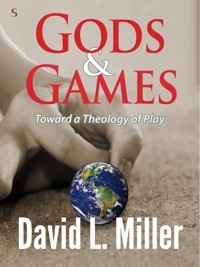
A deeply thoughtful, deeply irreverent look at the mythology of play, Gods and Games ties together Joseph Campbell's approach to myth and religion with Johan Huizinga's view of our species as Homo ludens — "Man the Game-player" — suggesting that play is a central aspect of the human spirit and human culture.
"A comprehensive and clear review.... loaded with quotations both pertinent and entertaining that may be eye-openers both to traditional religionists and readers who may never have thought about play in a philosophical or religious sense." —Publishers Weekly
"The breadth of scholarship and the light-handedness of the author, Professor David L. Miller, make this book a movable, digestible and an enjoyable feast."—David Seiderberg, American Imago
Das E-Book können Sie in Legimi-Apps oder einer beliebigen App lesen, die das folgende Format unterstützen:
Seitenzahl: 362
Veröffentlichungsjahr: 2013
Ähnliche










GODS AND GAMES
toward a theology of play
David L. Miller
Stillpoint Digital Press
Mill Valley, California
Gods and Games
Copyright © 1970, 1973, 2013 by David L. Miller
All rights reserved
Published on Smashwords
No part of this book may be used or reproduced in any manner without written permission except in the case of brief quotations embodied in critical articles and reviews. For information address Stillpoint Digital Press at [email protected]
This book was originally published in 1970 by The World Publishing Company.
Harper Colophon edition (ISBN 06-090306-6) published 1973.
2013 Digital Edition
Designed by David Kudler and Stillpoint Digital Press
ISBN 978-1-938808-08-1Version 1.0.0-publishdrive
Stillpoint Digital Press
StillpointDigital.com
Acknowledgments
I very much wish to acknowledge my debt of gratitude to the Joseph Campbell Foundation for supporting the republication of this book as an eBook, and especially to Robert Walter and David Kudler for their attention to and hard work on the project.
David L. Miller
Introduction to the Ebook Edition (2013)
It has been more than forty years since the first edition of Gods and Games appeared in print. Not surprisingly, some of the theory contained in the book has become dated and has been superseded by later critical studies. It would be impossible in short compass to make the arguments in this book relevant to the contemporary literature. Instead of making a pretence at such an effort, I will simply list some of the literature of the intervening years. It is surely various and marks a plurality of perspectives. For example:
Shirl J. Hoffman, ed., Sport and Religion (Champaign: Human Kinetic Books, 1992)
Diane Ackerman, Deep Play (New York: Random House, 1999)
Barbara Ehrenreich, Dancing inthe Streets: A History of Collective Joy (New York: Metropolitan Books, 2006)
Shirl J. Hoffman, Good Game: Christianity and the Culture of Sports (Waco: Baylor University Press, 2010)
This list is typical, but it only scratches the surface of a large and burgeoning literature, which continues to grow. For example, Philip P. Arnold of Syracuse University has published a book with Cognella Academic Publishers on sports and religion. And doubtless there will be much more.
Also, there has recently been a lively conversation concerning the notion of “play” in the theoretical and critical writings of Jacques Derrida, even after the author’s death in 2004. This stems mainly from Derrida’s 1966 essay:
Jacques Derrida, “Structure, Sign, and Play in the Discourse of the Human Sciences,” Writing and Difference, tr. A. Bass and R. Macksey (Chicago: University of Chicago Press), pp. 278-294
A small sampling of the relevant discussion includes:
James Hans, The Play ofthe World (Amherst: University of Massachusetts Press, 1981)
Robert Wilson, “In Palamedes’ Shadow: Game and Play Concepts Today,” Canadian Review of Comparative Literature, 12 (June, 1985), 190-196.
Mark C. Taylor, Tears (Albany: SUNY Press, 1990), pp. 203-234
John D. Caputo, The Prayers and Tears of Jacques Derrida: Religion without Religion (Bloomington: University of Indiana Press, 1997), pp. 181-188.
Simona Livescu, “From Plato to Derrida and Theories of Play,” CLCWeb:Comparative Literature and Culture, 5.4 (2003). http://docs.lib.purdue.edu/clcweb/vol5/iss4/5, accessed May 19, 2011
Along with the important Derridean discussions, there have been other conversations of a philosophical and critical theoretical nature, indicating the depth as well as of the breadth of contemporary interest in the notion of “play.” This is indicated in the following works:
Bernard Suits, The Grasshopper: Games, Life and Utopia. (Toronto: University of Toronto Press, 1978)
James Carse, Finite and Infinite Games: A Vision of Life as Play and Possibility. (New York: Ballantine Books, 1987)
Mihai Spariosu, Dionysus Reborn: Play and the Aesthetic Dimension inModern Philosophicaland Scientific Discourse (Ithaca: Cornell University Press, 1989)
Mihai Spariosu, God ofMany Names: Play, Poetry and Power in Hellenic Thought from Homer to Aristotle (Durham: Duke University Press, 1991)
Tilman Küchler, Postmodern Gaming: Heidegger, Duchamp, Derrida (New York: Peter Lang, 1994)
Brian Sutton-Smith, The Ambiguityof Play (Cambridge: Harvard University Press, 1997)
Jane McGonigal, Reality is Broken: Why Games Make Us Better and How They CanChange the World. (New York: Penguin, 2011)
Finally, since the first publication of the hardback edition of GodsandGames in 1970, my own writing has included the following essays on the topic of play.
“The Kingdom of Play: Some Old Theological Light from Recent Literature,” UnionSeminary Quarterly Review, XXV, 3 (Spring, 1970), 343-360
“Theology and Play Studies: An Overview,” Journal of the American Academy of Religion, XXIX, 3 (September, 1971), 349-354
“Playing the Mock Game (Luke 22:63-64),” Journal of BiblicalLiterature, XC, 3 (1971), 309-313
“More on Play,” Christianityand Crisis, XXXII, 3 (March 6, 1972), 47-48
“Playing the Game to Lose,” in: Jurgen Moltmann, et al., The Theology of Play (New York: Harper and Row, Publishers, 1972), pp.99-110
“Alienation, Liberation, and Sport,” in: Fernand Landry and William Orban, eds., Études philosophiques, théologiqueset historiques du sport et de l’activitéphysique (Québec: Éditeur official, 1978), pp. 153-159
“From Leviathan to Lear: Shades of Play in Language and Literature,” Eranos 51-1982 (Frankfurt: Insel Verlag, 1983), pp.59-110
“Play Not,” In Good Company, ed. David Jasper and Mark Ledbetter (Atlanta: Scholars Press, 1994), pp. 33-46.
“The Bricoleur in the Tennis Court” http://web.utk.edu/~unistudy/ethics96/dlm1.html Accessed May 19, 2011.
There is much more to this up-grade than can be presented briefly here. But let me add one anecdote in an attempt to help to correct the dated nature of a portion of the original argument.
Gods and Games includes a brief commentary on the philosophical analysis of the notion of play in the work of the Heidelberg philosopher, Hans-Georg Gadamer (see Part One, section two, under “ Philosophy”). Not long after the book’s publication, in the Spring of 1972, Professor Gadamer was appointed a visiting professor at Syracuse University where I was teaching. Every Thursday afternoon after his seminar on Aristotle, he and I would go to a local country club bar to drink German beer and to talk. I had been told by my department chairman that Professor Gadamer had read my book, and it is not difficult to imagine my growing anxiety when week after week went by without his saying a word to me about it.
Finally, after many weeks — what seemed an eternity to a young professor in the thrall of a wise mentor — he turned to the topic of my book. I was full of fear and trepidation, as it turned out that well I should have been. He said: “Professor Miller, you almost got the point!” I was crushed! What was wrong? It did little good for him to say that it was not entirely my fault. “English,” he explained, “has a doublet for the idea: play, the verb, and game, the noun, are different words in English, whereas German says it with one and the same word, ein Spiel spielen, as does French, jouer unjeu.” So, he explained to me that part of the book’s argument wrongly implied that play has something to do with fun and games. “Very American!” he said in a way that was not at all reassuring.
So what was the point of play? Professor Gadamer attempted to explain. He asked me if I rode a bicycle. I said that I did. Then he asked me about the front wheel, the axle, and the nuts. He remarked that I probably knew that it was impossible to tighten the nuts all the way down, because the metal frame was in the way. “But if one could tighten them all the way,” he asked me, “what would happen?” I said that it was obvious that the wheel would not turn. “Exactly! It has to have some play!” he announced in teacherly fashion and a little exultantly, I thought. And then he added, “... and not too much play or the wheel will fall off.” “You know,” he said, “there has to be Spielraum.” Play room!
So that was it. It is not a matter of games. It is rather a matter of what we, in English, call “leeway,” some play, as in a bicycle wheel, a little space, some distance, in relationships, in ideas, in our psychology, in life … so that the wheel will turn. Professor Gadamer was right. This is finally what this book was all about forty years ago. And it is what it is still all about forty years later.
Introduction to the 1973 Edition
The psychologist C. G. Jung called it “synchronicity” when two or more similar events occurred coincidentally without any causal connection warranting the uncanny correspondence. When the original publication of this book coincided, in a space of less than six months, with the publication of three other works on the same theme, one can imagine the effect such synchronicity had on the author! It was not that the subject-matter of “play” has proved to have been of archetypal significance for contemporary American theology; it was rather that four men, some of whom were personally acquainted, all published books within half a year’s time on theology and play, and they did this without the others’ prior knowledge or collusion! I am personally glad that “play theology” or “theology of play” (one hardly even knows what to call it!) has never gained the press and popularity of so many other recent theological movements. Theology is not faddish, or should not be, and it is far better that the remarkable conjunction of a psychological, a philosophical, a sociological, and a cultural approach to theology and play should remain something of an underground current, nurturing where possible a too-often dried-up religious hermeneutic. How play studies may have such a fructifying function can be seen in noting the relationship between theology and play studies, on the one hand, and the death of God theology, on the other. An archimedean point-of-leverage can be obtained on this relationship by observing the American theological scene through the eyes of a European.
Fritz Buri, the noted theologian from Basel, Switzerland, told a Syracuse University audience how it all looked to him as of Spring 1971. He observed that four years earlier when he had been in the United States there had been much talk about, as he called it, “the so-called theology of the death of God.” But on this visit not only did it seem that God was once again alive and well; indeed, he seemed to be dancing and playing in festival and fantasy. ‘The God of whom not long ago it was said that he had died,” said Buri, “seems to have resurrected in a God who is celebrated in a theology of play.” Professor Buri warned the audience not to be misled by this apparently miraculous death and rebirth act, not, that is, to mistake it for sound Christian theology. “Death and resurrection in the Bible mean something other,” he affirmed, “than the change of the dead God of Altizer into the dancing God of Sam Keen.” Buri held on firmly to a traditional distinction: “The death and resurrection with which we are dealing in our understanding of Paul and in our theology of responsibility is much more than a dying of idols or an iconoclasm and it is quite different from a dancing in ecstasy. Sin is death, and resurrection consists in the striving for justice, in the crucifixion of the old Adam and in walking in a new life.” 1
This will do for a leverage point from which we can get a handle on what has been going on in theology and play studies since the original publication of Godsand Games.
In order to see the full force of Buri’s argument, comparing theologies of play and theologies of the death of God, it is appropriate first to locate the various contributors to recent theology and play studies by asking whether it is “theology of play” or “play theology” that is being attempted.2 In the former instance, one presumably confronts an unknown but happy mystery, the phenomenon of play, with something well-known in advance, a viable form of classical theology. By applying the self-understood and well-instantiated categories of the known (theology) to the unknown (play), as if by some modern rational miracle, theology illuminates play and the unknown is baptized with meaning by the known. I think the works by Harvey Cox3 and Robert Neal4 fit this type. A “play theology,” on the other hand, is just the reverse. Here the pheonomenon of play, whose structures and dynamics are apparently not only to be valued without equivocation, but are also obvious for all sane men to see and understand fully — this phenomenon of play is applied to ailing or otherwise obtuse and abstract theology, thereby giving it new life. Itseems that Sam Keen5and Hugo Rahner6adopt such a strategy, although in the case of the latter a Thomist influence side-slips the argumenta bit in the direction of “theology of play.”
If we bracket Rahner from the group just named, it is not difficult to see support for Buri’s formal argument in both “theology of play” and “play theology.” Indeed, Robert Neale writes “in praise of play” as if no death of God, cultural or otherwise, had ever been announced. “Despite a clear call, man has refused to delight in and enjoy his God.”7 Whatever “retreat” from piety there may be is “only temporary” and is a result of “the amalgamation of current ‘religion’ with contemporary work culture.” 8 Though Neale adroitly utilizes a psychology of play and a secular phenomenology of religions to jar us loose from our fixated religious acculturation, when all is said and done traditional theological categories reemerge as having informed the argument Christianly from the beginning. And the same is true of Cox. In his chapter on “Festivity and the Death of God,” Cox argues that “the vivid cultural experience of God’s absence, disappearance, or death occurred in a civilization where festivity in all its forms was in a state of steady decline,”9 as if, had we been fantastic and playful in our cliched rituals, Nietzsche’s prophet would not have gone mad before the sepul- chured Churches. Cox, like Neale, support Buri’s analysis by supposing that though “the death of God cannot be repealed ... it can be transcended.... If God returns we may have to meet him first in the dance....”10 On reading The Feast of Fools one feels that Cox meant to say: if we dance, God will return. And one suspects that the doctrines which are to follow the experience of the dance, as Cox indicates they may, will be remarkably similar if not identical to certain German dogmatic theologies that we have already seen. The theology of “theology of play” is intact and, as Buri suggested, it is an answer to the theology of the death of God.
Bun’s argument gets support from “play theology,” too. And though it is of a slightly different sort, as the typology above gives clue, it has a similar function in the context of Buri’s sermon. In Sam Keen’s sub-chapter on “The Death of God,” Karl Barth and Harvey Cox are mentioned as following a line of argument that “refuses to face the radical nature of the changes in Western self-understanding and hence the seriousness of the issue of the death of God. The God who revealed Himself in history is as vulnerable as the God who revealed himself in nature.”11 Traditional modes of theologizing are now problematic because they cannot support “techniques of transcendence” needed by Homo religiosus; former dogmatics cannot provide such support in our time because, far from affirming techniques of transcendence, they have been party to the three reasons those techniques are no longer viable: namely, radical historical and literary criticism of Scripture, religious pluralism in the midst of rising urban culture, and secularization which brings with it an alienation of religious affection. In Apologyfor Wonder Keen suggests a transformation of man’s self-understanding from Homofaber to Homo ludens as a possible recipe for theology’s diet. One suspects, however, this may shift theology’s anatomy, and, in To a Dancing God, in the section, “A Way beyond the Death of God — or How to Tell Stories,” we see that this is precisely the case. Keen writes: “ The death of God’ is best understood as modern man’s inability to believe that human life is rendered ultimately meaningful by being incorporated into a story.” And then he offers: “I shall try to rehabilitate the story as a basic tool for the formation of identity.”12 How unlike Robert Neale’s saying: “Everyone knows what it would be like to participate in the story and game of the adventure of God in Christ!”13 And yet, how much is Keen’s “play theology” as much a vindication of Buri as the “theology of play” of Neale and Cox! All are solving the problem of the death of God!
Buri’s critique is Pauline. I join him in critique, but I must demur from his orthodox strategy. It is one with which I no longer feel secure. It seems to me that the weakness of a “theology of play” is the same risk as that run by all “of’”-theologies, whether theology of language, of secularity, of the death of God, of revolution, of culture, of literature, or of hope (all of which compel me greatly). They tempt one in the direction of a relevance and thereby present a faddish syndrome in which one suspects the real disease is a hysteria concerning the proper subject-matter of theology. But theology properly so-called, we were all taught once upon a time, is the study of religion: theou logos. And if theos and logos are questionable, as they may well be in our time, then “of’-theologies are all problematic since they may be only expressions that there is no theology that can in any intelligible way be a theology of anything at all, including play. This is why I am relieved that theology of play has never become modish.
“Play theology” may be just as suspect, however, and for a quite similar reason. It attempts to revivify theology by inseminating new formal terminology from “game” and “play” theory and practice. Yet it may be that other disciplines and human experiences (those giving substance and sensitivity to constructs concerning games and play) may now also be suffering identity crises and radical ambiguity not unlike theology’s, in which case the drive toward a humanistic or serendipitous study of religion, expressed in this instance by an appeal from theology to the humanistic and behavioral sciences of play, though formally interesting, is no more nor less forlorn than the theology and the play gasping for resuscitation.
Though I am convinced that theology and play studies are in many ways unique in the American experience,14 it is important to unbracket Rahner at this point in order to see how he, as well as two other Protestant contributors from Tubingen, fit Buri’s scheme. The matter is put simply: God did not die in Europe! Neither Rahner, nor Jürgen Moltmann,15 nor Gerhard Martin,16 intend theology and play studies to be an “answer” to the death of God. Rahner rather takes the clue from the phenomenon of play, especially child’s play, and applies it to his historical researches, discovering that “eutrapelia,” the “forgotten virtue,” has been lurking in the Fathers’ theory and practice all along. Play gives “new” life to theology, its Church and its God, but neither of these was really ever in question. Rahner’s theologia ludens, far from being an “answer” to the death of God, is the continuing answer of the life of God in Christ which is directed supernaturalistically to every question except the question about God and Christ.
It is the supernaturalistic mode, rather than its pre-mortem dei mood, that brings a response to Rahner from Gerhard Martin in his fascinating little book on “the pursuit of pleasure.” “Pleasure” and “play,” according to Martin, are the key-words for a new theology of the seventies, just as “death of God” and “revolution” functioned similarly in the sixties. Martin both carefully and aphoristically presents evidence from “the new sensibility” and, above all, from American culture, placing this evidence alongside the Christian and revolutionary traditions. The result of this suggestive juxtaposition is an argument that “the freedom of the Christian is pleasure (Glück) and the Christian experience of pleasure is play — both the play of the Christian in the world and God’s play with the world.”17 This means that our theology, which has been sociologically informed in the direction of the ethical, must be balanced by a properly religious aesthetic, since “pleasure” and “play” are terms that belong to the realm of aisthanomai, in the widest sense of this Greek word of “sense.”18 Thus, Martin’s argument is informed by Huizinga and Schiller in such a fashion as to stress play’s double-faceted nature: agon and paidia, ethical and aesthetic, social and psychological — it being the drawback of so many theologies, not to mention the many theories of play, that they emphasize one of these dimensions to the exclusion of the other. Martin follows Huizinga in viewing paidia as aesthetic diversion, pure play, and the play of a child, whereas agon is viewed as competitive gaming with more direct ethical and social relevance.19 “Paidia,” writes Martin, “is then the ecstasy of social agon, an enclave over against the kingdom of necessity.”20 Theologically, though Schleiermacher is mentioned, the test cases are Rahner and A. A. van Ruler.21 The former’s paidia-oriented supernaturalism, i.e., interpreting everything as merely the play of God, is offset by the more worldly, agon-oriented Calvinism of van Ruler. Martin finds especially informative the view of world as theatrum gloriæ dei. “The guilt and passion of men and of man’s world are not absolutely self-condemnatory. Out of the wreckage of former fragile and prescriptive catalogings in theological gardens is rising an unheard of question: Are God, Word, and Existence ‘Wilderness and desolation... vortex and nothing,’ or is all of this essentially play? Van Ruler wants to understand the wilderness of experience as the play of love. For him the either/or of wilderness and play is no real alternative. Love is the name of both.”22 This is Martin’s characteristically Protestant answer to Rahner, his way of continuing the theological balancing of paidia and agon. However, as unlike Rahner’s psychologized and mythicized Catholicism as Martin’s revolutionary play may appear, in the end they are at one on the issue of Buri’s schema: the theology of play is not the corrective of the theology of the death of God inasmuch as the latter is not acknowledged as a viable theological reflection at all.
And the same is true for Jürgen Moltmann. In his recent writings on play he is very much in agreement with Martin on the importance of the aesthetic-ethical balance of theological categories, on the view of the world as theatrum gloriæ dei, and on revitalizing a theology of hope and revolution with a doctrine of God that is especially relevant to the contemporary social situation. So, he writes: “God is better understood in categories of pleasure and play than in those of guilt and death.”23 Moltmann welcomes the death of certain concepts of God, namely, those of stop-gap, problem-solver, and need-fulfiller. We needed such spurious pseudo-theology only in order to enjoy a world we found that we, as men, could not enjoy. But the authentic God, according to Moltmann, does not need “to vanish from a world that no longer needs him.” Rather, “we will need the world in order to enjoy God. If we no longer need God as a helper-in-need, as a stop-gap, as a problem-solver, we are finally free for fruitio Dei et seinvicem, in Deo.”24 The rhetoric of the death of God is present here, and it seems to be, if not corrected, at least advanced, a la Buri, by a theology of play rhetoric. And yet the theology that is reinstated by Moltmann — doctrines of God, Christ, Church, Last Things, and so forth — is cast precisely in the logic that the experience of the death of God has made superfluous. As Sam Keen said: “The God who revealed Himself in history is as vulnerable as the God who revealed Himself in nature.” To which Moltmann has a ready response: “The purposeless joy in God then takes the place of the use and misuse of God.” If theology is “unburdened of its former social functions, it becomes indeed superfluous. Yet in a world of burning goals and uses only the superfluous is really fascinating.”25 But if, in theology and play studies, the theology is really anything other than just another form of American immanentism, and the play is anything other than just a new set of European academic games, we may have more seriously to consider the possibility that the superfluity is itself superfluous. The theology and play studies do in no way “answer” the death of God, nor can they successfully avoid its implications. But perhaps theology and play studies can be construed, in a way quite different from the witnesses we have thus far examined, and in a way different too from Buri’s analysis, as a way of going on theologically under the conditions of the death of God.
Already in his essay “From Prufrock to Bingo,” William Hamilton had spoken of going on theologically in our time under the terminology of “A new optimism” post mortem del He indicated, in speaking of this essay, that” ‘optimism’ is not a wholly satisfactory term,”26 and in the essay’s own context he anticipated another terminology from artistic movements: namely, “purposeless play, a play that affirms life and invites other men to wake up to the ordinary life around them that can be lived here and now.”27 The essay concludes with the following sentence: “I think that the new optimism is both a cause and a consequence of the basic theological experience which today we call the death of God.”28 What I intend to do in the second half of this present essay may be stated by substituting in his concluding sentence what I take to be the more satisfactory term, the one Hamilton himself has introduced: I think that theology and play studies may be viewed as both a cause and a consequence of the basic theological experience which today we call the death of God.
Ted Estess has anticipated my argument here in a highly original work on the literature of Samuel Beckett. He writes: “Play, then, becomes a way of going on in a world in which all reasons for action have evaporated, in which the worth of action is itself questioned, in which there is nothing to be done. Play becomes a mode of doing nothing, a mode of action freed from the ‘teleological’ hypothesis.... The other in Beckett’s world is pictured as player, and Beckett’s characters are the play of that Other. The Other, however, is experienced as absent. The play of the Other, then, is ‘play without a player.’”29 Theology and play studies, then, may be viewed as a strategy of the Between, between the no-more of the gods that have died and the not-yet of the gods that may be born. To shift the metaphor from Beckett to Pirandello: “tonight we improvise” after “the six characters” find they have no “author.” Theology and play studies have, therefore, a positive and a negative thrust. Negatively they are a modality of how to do theology when theology cannot be done, that is, something to do in the meantime. Positively they are the “play without a player,”30 the play that plays through man, as opposed to the games man plays hysterically, when the infinite extremes are bracketed by virtue of epistemological failure. This double thrust may be elucidated by taking a brief look at an actual change that has occurred in man’s religious consciousness.
Joseph Campbell has often written about the four-fold function in human consciousness of traditional comprehensive mythologies.31 A viable mythology (1) situates man in the mystery of the awesome and numinous unknown, (2) places man in the order of the cosmos, (3) makes the social order cohere, and (4) introduces the self to the deep dimensions of its own psyche. Comprehensive mythologies, therefore, have a numinological or theological, a cosmological, a social or historical, and a psychological function. The same is true, I suspect, for traditional religious canons and liturgies, indeed, for all truly total meaning- and symbol-systems. At least it was true until recently.
Following the breakdown of the medieval synthesis a process of fragmentation has plagued Occidental meaning and values. Progressively each of Campbell’s four functions has been relegated to the aegis of a separate science and technology. This in itself would be awkward and frustrating to individual egos in quest of significance, but something even more radical occurred. The names of Nietzsche, Darwin, Marx, and Freud may be taken as symbols of this radical “something,” though James Frazer would do as well, and the names may be updated to include Heisenberg, Gödel, Einstein, and others.
When Nietzsche writes theologically, his first principle is “the death of God.” When Darwin writes biologically (and this may be easily extended to other aspects of the cosmos32), his first principle is “random selection.” When Marx writes sociologically and historically, the first principle is “revolution.” And when Freud writes psychologically, the first principle is the “unconscious.” What is characteristically odd about each of these is that a theoretical construct, an ordering hypothesis that will “save the appearances,” takes as its logical starting point an il-logic or ir-rationality whose ontological status is that it is nothing, or no-thing. It is difficult to manage the dynamic of a billiard ball universe when there is no cue stick, or, more precisely, when the cue stick is made of nothing! Ex nihilo nihil fit. Only the mystics and gnostics had risked such ab-surdity during the time of the great living traditions. And no one took them seriously! But now the entire modern sensibility seems to play itself out from a “logic” which may be likened to defining drowning as a mode of swimming since it is one of the ways one can comport oneself in water!
If we are now dependent upon the heirs of Nietzsche, Darwin, Marx, and Freud to provide those functions that will make us at home, respectively, among the gods, in the cosmos, in society and history, and with our very selves, we are in a strange circumstance indeed. Man — it has been said so often of late — is thrown back upon himself for meaning. But certainly he is not thrust upon the same self that traditionally found itself sustained by mythologies, philosophies, political theories, and religious meaning-systems whose function was the integration of a four-fold dimensionality. That former self was doubtless an ego whose place in Being (for “Being” is the name of the whole show under the four-fold schema) was guaranteed ideologically. Now that Nothing has replaced Being as the name of the non-quaternity, ideologies, including the one that could be made of the current argument, will not function at the level required by the self that has been abandoned. It is a deeper self that is disclosed radically by the depth of nineteenth- and early twentieth-century despair.
Thus Campbell closes his own argument about contemporary mythological function by noting that “today all of these mysteries have lost their force; their symbols no longer interest our psyche.... Not the animal world, not the plant world, not the miracle of the spheres, but man himself is now the crucial mystery.”33 We have called this “the death of God” and its implications are radical in the extreme. And one of the implications is that when the rules of the stable order go awry, though one goes through all the old motions, it is not the same game one is playing. It is not a different game, either, since game- playing requires rules that function according to the old logic. It is more like the apocalyptic and eschatological saying of Zechariah: “Old men and old women shall again sit in the streets of Jerusalem, each with staff in hand for very age. And the streets of the city shall be full of boys and girls playing in its streets.”34 The gamesmanship of middle-age simply will not do in the middle-day of the Between. The elders are beyond games and the children have not yet been taught the rules: They simply play.35
One of the characteristics of the doing of theology under the conditions of the death of God is that it turns into the humanistic study of religions. When, as the narrator in Beckett’s TheUnnameable says, “I’m not at home to anything,”36 the self that can say this goes on playfully, that is, in the “logic” of as-if.37 The humanistic study of religion treats its subject matter in precisely this fashion. Not only are ancient mythologies treated as the playthings, toys, and games of primitive man, but traditional religions’ theologies are also handled that way. And when students of religions begin to view former symbol-systems in this fashion, their own incipient mythologem surfaces. We view playfully; then our view is play. Play becomes the root metaphor of the study of religion under the conditions of the death of God. It is what we do in the meantime, and it is also the play that plays through the gameless games of our deepest loves, the “play without a player,” as Eugen Fink put it, basing the phrase on clues from Nietzsche.
What is intended here is a warning and an encouragement concerning theology and play studies. The warning is against a traditionalist “theology of play” and on overly modish “play theology,” both of which may tempt one ideologically in the direction of still one more archaic theological game. In this case Buri’s critique will, I fear, be vindicated, especially when the application of the traditional theological logic is allowed to operate self-reflectively in a condemnatory way. Neither “theology of play” nor “play theology” can resurrect a game whose rules are truly anachronistic.
At the same time, with the going of the games in the radical displacement of the locus of human meaning, the four-functions which the old games performed may be undergoing transformation beneath the ego’s power to control. The interplay of the dynamics of significance and sense in the deep psyche of today’s radical students of religions may, in spite of ideological and programmatic temptations to the contrary, be the recovery of the spirit of innocence and sagacity in the play of freedom’s releasement. Has not Paul Tillich already said: “Play is one of the most characteristic expressions of the freedom of the spirit”? The free spirit of play in the free play of the spirit is that to which we are encouraged profoundly by the death of God.
Introduction“The Care and Feeding of Hobby Horses”
TwoSignificantEvents,orTheRecentBeginningsofIdeasaboutPlay
In 1934 Earnest Elmo Calkins wrote a book called The Care and Feeding of Hobby Horses. It was published by the Leisure League of America and contained seven hundred suggestions for the use of leisure time as well as a bibliography of fifteen hundred books on hobbies and sports. Two thousand and two hundred odd ways to have, as the writer put it, “keen delight”! “How many are there,” Calkins asked, “who can tie a square knot? Why should not more of us know how to make a splice, or a hitch, or a tackle? Why do we not learn the simple laws of mechanics that apply to the things around us, that we use daily? Greater manual dexterity would reduce the friction of living....”38 And so on and on he wrote.
Calkins was serious, of course. That may have been his book’s greatest deficiency: overseriousness and overzealousness about play. But one other deficiency must be noted, also. Neither in the fifteen-hundred-item bibliography nor in the text of the book was reference made to what has come to be a most significant event in the recent history of ideas. The event had occurred the year before Calkins’ book was published. The rector of Leyden University in Holland took for the topic of his annual lecture a subject he had been at work on for some thirty years. The topic was: “The Cultural Limits of Play and the Serious.” This lecture was expanded to book form in 1938, at which time Johan Huizinga’s Homo Ludens became the firm base for a most startling revolution in human meaning. It became the metaphor of — dare we say it? — a new mythology whose components in the world of ideas are game-theory and play-theory.
Huizinga was serious, too, of course. But in a way different from Calkins. Calkins’ book is serious about everyday life, about reducing “the friction of living.” Huizinga, on the other hand, is serious about ideas, about the idea of play which, if properly possessed by the human imagination, may well lead to a playfulness about “the friction of living.”
ByWordofMouse:AParableaboutThisBook
The difference between Calkins and Huizinga may be demonstrated through a parable about the joy of life’s frictions. The time of the parable is thirty-three years after Huizinga’s address and Calkins’ book. It is December, at a winter resort in the Pennsylvania Poconos. Four young university professors — a sociologist, a philosopher, a theologian, and an instructional technologist — are seated at lunch with their wives. The conversation has been lively and nonserious. The philosopher’s wife has been jesting with the theologian about the latter’s apparent disregard for fact and his apparent obsession with fantasy. And now this same woman tells a story, for no apparent reason.
“This is true. It was told to me as a fact,” she alleges, and then goes on. “A below-average high school student in a small community in the west took college entrance tests along with his entire senior class. The school authorities sent his test, along with all the others, to a testing service to be machine-graded. Now the grading machine was very busy at this time of year; it ran all night as well as all day. And one night — it so happened at the precise moment that the dullard westerner’s test was being perused by the machine — a mouse got into the machine’s brain, shorted a circuit, or perhaps two, and caused the school lad to receive, much undeservedly, a near-perfect score. When the result of the boy’s test was returned to the principal and the guidance counselor, it never occurred to them to question the machine. They blamed themselves for not having recognized this genius in disguise, this uncut and unpolished gem. So in order to atone for their sins, and since our young antihero was also a football player of some accomplishment, the principal and the guidance counselor managed to get him accepted into an eastern Ivy-League college. When he did badly in his first semester, the college advisers blamed his poor productivity on the difficult adjustment of moving from rural Montana to, let us say, suburban New Jersey, as well as on the fact of the time-consuming character of playing football. So they assigned him tutors and told him, ‘Everything is really OK; you will be getting A’s in no time at all.’ And to make a long story short, he did. He graduated — this student of quite mediocre intelligence, this one whose life and destiny was based on a fiction — he really graduated with honors!” The philosopher’s wife had concluded what turned out to be a rather long story. But then she added, as a sort of epilogue or moral, “Isn’t that eerie — and all the more so because it is true?”
At this point the quiet wife of the instructional technologist asked with the deftness of an expert with a one-molecule-wide rapier, “How did they know it was a mouse?” There was an awkward pause, a sputter-chuckle, after which the sociologist with great finesse said: “By word of mouse!” A play with words, a pun, a ploy: it produced laughter, much laughter, loud laughter; and it demonstrated the joy of life’s frictions. It had all happened so fast, too fast for squares and for square knots to be of much help. What was needed and what had been supplied was more like the ability to tie a granny with gusto! Homo ludens: Man the player! That is what this book is about. This book’s hobby horse rocks on the revolution in the world of ideas that took place between the formal word from Huizinga in 1934 and the informal “word of mouse” deep in a Pennsylvania December.
AModernMythology?
In the brief span of years after Huizinga, academic disciplines that formerly seemed to have little in common suddenly found themselves doing the same sort of thing: they were structuring their subject matters around a notion of games or play. Game-theory and play-theory sprang up in sociology, philosophy, psychology, mathematics, literature, art, anthropology, communications, and even religion. And the list does not stop there. One might even be led to suspect that a universal metaphor of the theoretical disciplines was emerging. A lingua ludica: an emergent mythology of post-Puritan, post-Christian, postmodern man being spawned in the nova ecclesia, the modern university. In these latter days, it would seem, the game scholars play (including the psychologists who write about the games others play) is the game- theory game. The professoriat is construing all human meaning on the models of games and play. And judging by the way these constructions catch fire with the young generation (the first article in the under-thirty creed is: “All life is a game”), one wonders if the compellingness of this modern myth’s meaning may not have
more than academic significance. Especially, one wonders what religious significance there may be in this modern myth or meaning-system.
TheAnatomyofthePresentWork
In order to meditate on this wonder it may be useful to perform some specific exercises. The specific instances of game-theory and play-theory will be reviewed so that one may check the suspicion about the pervasiveness and persistence of game- and play-ideas in our time (Chaps. 1 and 2). A skeleton of the origin and history of the recent idea-revolution will be traced (Chap. 3). Also, the anatomy of the personal experience of games and play in the human psyche will be noted (Chap. 4). Then some interpretation will be necessary: an interpretation of play-mythology in general (Chap. 5), and a specific application of the significance of play to ideas about traditional religious meaning (Chap. 6).
But this is not all we shall attempt. Since it may well be that the notion of play is a part of a functional mythology or meaning- system and since mythologies of old are the essence of religion, this book’s wonderings become finalized in an attempt at a theology of play: not only a theology about play (that would only be a beginning), but also a theology made up of




