


Erhalten Sie Zugang zu diesem und mehr als 300000 Büchern ab EUR 5,99 monatlich.
- Herausgeber: Nick Hern Books
- Kategorie: Poesie und Drama
- Serie: NHB Modern Plays
- Sprache: Englisch
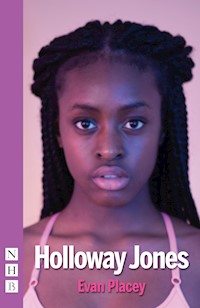
Holloway dreams of being a world-class BMXer, but she is held back by the tough reality of a parent in prison. Evan Placey's play Holloway Jones was commissioned by Synergy Theatre Project, toured schools and the Unicorn Theatre in 2011, and won the 2012 Brian Way Award for Best Play for Young People.
Sie lesen das E-Book in den Legimi-Apps auf:
Seitenzahl: 90
Veröffentlichungsjahr: 2016
Das E-Book (TTS) können Sie hören im Abo „Legimi Premium” in Legimi-Apps auf:
Ähnliche













Evan Placey
HOLLOWAY JONES
NICK HERN BOOKSLondonwww.nickhernbooks.co.uk
Contents
Introduction
Dedication
Acknowledgements
Original Production
Characters
Author's Note
Setting
A Note on Punctuation
Holloway Jones
About the Author
Copyright and Performing Rights Information
Introduction
About eight years ago, I was on the South Bank of the Thames for New Year’s Eve, watching the fireworks. When the clock struck midnight, like the other couples that surrounded us, my boyfriend and I kissed. And then a woman nearby with her two kids calmly said to us: ‘There are kids around.’ I said nothing. If she’d used a homophobic slur or sworn or been angry I quickly would have had a retort. But what she calmly said floored me so much that I didn’t have a response. I’ve unpacked this moment many times over the past eight years. I’ve also replayed it over and over with the aim of replying with what I should have said. But in truth, I still don’t know what I should have said to her, or her kids for that matter. But that woman, whoever and wherever you are, know that I think about you a lot, even though I was probably a barely passing blip in your life. And know also – and this is going to sound weird, particularly as we don’t know each other, and particularly as you’ve only ever said one thing to me, and I haven’t actually ever said anything to you, even when given the chance – that you are part of the reason I write plays for young people. Or more specifically, your kids are. I think about them a lot and wonder – hope – that they’re incidentally in the audience of one of my plays. If I had a better sense of humour I would have dedicated this collection to you. Because you made me realise why we need theatre for young audiences. Adults, for the most part, have made up their mind about the world around them. But young people are still questioning it and making up their own minds. But, and I say this as a parent myself, we can’t always trust our parents to foster these questions, and encourage us to see the world in new ways. And that’s why we need plays for young people. To ask the questions that no one else is asking. To challenge the world as we think we know it. To help us make sense of the moment we see two blokes kissing by the river and our mum thinks she should shield our eyes.
Fast-forward several years…
‘But how did you know?’ It was after a readthrough for the first draft of Girls Like That with a group of young people to elicit their feedback. The boy asking stared at me with genuine curiosity. He wanted to know how i, a fully grown man, had penetrated the secret world of teenagers. And the answer is simple: i was a teenager once too. The world has changed, the clothes, the language, the technology, the social attitudes, but the fundamental shape of the teenage experience has remained the same for decades. it’s the details that make each of our experiences unique during those formative years, but deep down at its roots, we’ve all lived the same experience, the one that teens will continue living until the end of time: a collection of moments and choices in which we begin forming the person we want to be. (And spoiler for young readers: it really is just the beginning. You never stop trying to figure out who you want to be. I’m certainly still trying.) When people say ‘Write what you know’, I very much agree. But perhaps not in the conventional sense. Not in a write-about-a-world-or-story-you-literally-know way. For me it’s about what you know emotionally, and in your heart. I know about feeling like I don’t fit in; I know about heartbreak; I know about not living up to family’s expectations, about losing friends, about not standing up to the group, about regret, and loss, and lust, and love. I am not and have never been captain of the football team, or part of a gang of girls. I’ve not had a parent in prison, and I’m not transgender. But I am Cameron from Banana Boys, and the Girls in Girls Like That, and Pronoun’s Dean, and I am Holloway Jones. Their experience is one I know: the outsider.
Whilst I was doing my MA, we had a guest workshop with Kate Leys, a film script editor. She talked about the story structure as ‘A stranger came to town’. I don’t remember what kinds of stories she was talking about or how widely she was applying it. I don’t remember anything about how she elucidated this, but ‘A stranger came to town’ stuck. And it’s the same play I’ve been writing and rewriting over and over one way or another. Perhaps because I have always felt like a stranger. As an immigrant, as a gay man, as a Jew. And I think that maybe we all feel like strangers when we’re teenagers – to the parents and friends who don’t understand us; to our changing bodies which aren’t doing what we want them to; to ourselves as we try to understand why we do the things we do. To be a young person is to be a stranger to the wider world who never quite gets you. All of the plays in this collection are about the stranger who came to town. Cameron, Holloway, scarlett and Dean are all strangers: because of their sexuality, gender identity, or family background.
When writing for young people I think a lot about the characters I wish i’d seen as a kid. and those characters and stories are still the ones i’m not seeing on stage. it’s my desire to bring those people to life that inspired these four plays. No, it’s the responsibility I feel to tell the stories that has pulled me to table and chair and forced me to write them. For the other strangers in the audience. Since becoming a dad, it’s a responsibility I feel more acutely than ever. My son is a child of colour, with two dads, and the sad truth is there will come a day when he too feels like a stranger in the country he calls home. What plays do I want him to see? Because art has a responsibility to reflect the world of its audiences. But also it should go one step further. It should show them the world they don’t know, tell them the stories they haven’t heard, and ask them the questions they haven’t thought of. I don’t write just for the strangers in the audience, I write for the town.
My favourite films and plays as a kid were worlds and stories run by children, void of adults. And this has permeated not only the worlds of the plays I write for young audiences, but the way I approach writing them too. I ignore the adults: the parents and the teachers. I’m not writing for the gatekeepers, but for the young people in the audience, and the young people performing in the play. The main characters in my plays are always young people, but beyond that there is no difference in how I approach writing a play for young people versus how I write plays for adults. Because unlike that woman on the South Bank eight years ago, I don’t censor the world for young people. They encounter it in their daily lives, so why shouldn’t they encounter it in the theatre?
There isn’t a moral or message in these plays, so don’t try to find one. There aren’t any answers either. I don’t have them. But maybe these plays can act as provocations for young people to find the answers. It’s they who must find them. It’s their future.
* * *
Banana Boys came about because of a lovely man named Neil Grutchfield from that lovely breed of people writers depend on – the silent partner, the dramaturg. He was the literary manager at Hampstead Theatre and we were having a chat about another play of mine, and I’d mentioned that my job – since at the time I was not making any money from playwriting – was running educational theatre projects for young people. But I’d never combined my two passions. So he put me up for a commission to write for heat&light, the theatre’s youth theatre, for which young people decide upon the selected writer. Which luckily was me. Once I’d landed the gig to write for a big cast of teenagers, I didn’t have any idea what to write. So I read the back catalogue of plays they’d done and noticed that not a single one mentioned sex. At all. Which I’d found odd since when I was sixteen that was pretty much all I thought about. And none of the plays had a single gay character. So I decided to bring both to the forefront of the play.
Growing up queer there weren’t many young gay role models to look up to. So instead I looked up to music divas. I’m not sure what it was, but there was something about their power, their confidence, and their absolutely being at ease in their own skin that left me in awe. And so the opportunity to create my very own group of divas, The Banana Girls, was irresistible. My favourite films as a teen were the romcoms, except the queer characters didn’t exist in them, never mind being forefront. So it was my chance to rectify the past.
But as is often the case when I write a play, I start off writing one thing and end up writing something else. I think I started thinking I would write a coming-out story. And then that I’d write a love story. But that’s not really what I wrote in the end. Instead I wrote a play about friendship. With maybe a little coming-out and love story on the side.
* * *
In the midst of Banana Boys rehearsals, Neil moved to Synergy Theatre Company and introduced my work to Esther Baker, the artistic director. And Synergy, in many ways, has become a home away from home for me. They do work across the criminal justice system, and their attitude and outlook – which is no bullshit, and all about the art – is very inspiring. They asked me to write a play for a schools’ tour. To discover what I wanted to write about, i worked with people who were parents while in prison, young people in prison, young people at risk of offending, and young people in care. i was interested in how young people are set up to do bad and how difficult it is to break away from what people expect of you. ‘snitches get stitches,’ said a young man to me as i was running a workshop in a school. When i questioned the statement further, it became clear the class was united on this law, and i was the ignorant outsider who had somehow gone through life without an understanding of the code. A code which was more than about loyalty, about friendship, about right and wrong – a code which is simply an unquestioned tenet of life. It just is.




