


Erhalten Sie Zugang zu diesem und mehr als 300000 Büchern ab EUR 5,99 monatlich.
- Herausgeber: Oldcastle Books
- Kategorie: Religion und Spiritualität
- Sprache: Englisch
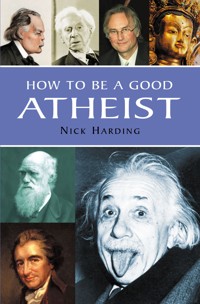
Join the fastest growing minority there is and become an atheist. Fed up of religion telling you it has all the answers when it doesn't? Tired of hearing about divine mysteries when there aren't any? Irritated by the pious evangelistas telling you you're going to hell when you're obviously not? Exhausted by creationists...for simply being creationists? Want to know more about the so-called atheist conspiracy? Then this book is for you. For millennia priests and holy men have told countless conflicting tales about humanity's genesis and fate. Is it all nonsense? You bet it is. For round about the same amount of time they have also been saying that anyone devoid of faith is evil, immoral and responsible for all of society's ills. How wrong they are. This book contains all you need to know about what to pack for your journey on the enlightening road to atheism including a brief history of free thought - it goes back further than you think - all the way to an introductory who's who in purgatory for knowing there isn't a god. Learn that there are five types of atheism. Find out the difference between an atheist and an agnostic - a term invented by T.H.Huxley, famous for his defence of Darwin and how a deist differs from a theist. Discover the oxymoronic fact that Christians were originally called atheists. Read who Lucretius was and what his fellow materialists were about. And revel in the fact that atheists have nothing to defend but are happy that way...
Sie lesen das E-Book in den Legimi-Apps auf:
Seitenzahl: 221
Veröffentlichungsjahr: 2012
Das E-Book (TTS) können Sie hören im Abo „Legimi Premium” in Legimi-Apps auf:
Ähnliche




















How to Be a Good Atheist
NICK HARDING
OLDCASTLE BOOKS
Acknowledgements
For font dodgers everywhere – there are more of us than we think.
For her compassion and love, Andrea Bertorelli who patiently listens to my settee-based lectures on the subject. Dr. Jerry ‘Stubby’ Kaye, Nick Richards and Tim Calvert, fellow nonbelievers. Sean Martin who puts the boot in from the other direction. Ion Mills for the first rungs up the long ladder, the creators of Family Guy, The Pythons and XTC, who were Jumping in Gomorrah and religion free.
For their continuing inspiration: Richard Dawkins, Charles Darwin, Carl Sagan, Michael Shermer, James Randi, Thomas Paine, AC Grayling, Christopher Hitchens, Sam Harris, Derren Brown, Daniel Dennett, Douglas E. Krueger, George H. Smith and to the freethinkers of the Enlightenment – voices of reason all.
Special thanks to Richard Dawkins for his generosity.
Libertas per scientiam naturae rerum.
Tantum religio potuit suadere malorum…
(Such are the heights of wickedness to which men are driven by religion…)
Lucretius, De Rerum Natura
Wandering in a vast forest at night, I have only a faint light to guide me. A stranger appears and says to me: ‘My friend, you should blow out your candle in order to find your way more clearly.’ This stranger was a theologian.
Diderot, Addition aux pensées philosophiques
God is my favourite fictional character
Homer Simpson
‘What about us atheists? Why should we have to listen to that sectarian turmoil?’
Monty Python, Bells, Contractual Obligation Album.
Contents
Introduction
1: What is Atheism?
The Blindingly Obvious; Atheism and Morality; Are Atheists Happy?; Nothing to Defend
2: Atheism: A Brief History
Atheism: The Early Years; The Egyptians; India; Materialism; The Cynics; The Stoics; The Sceptics; Euhemerism; Lucretius; The Late Classical Era and the Dark Ages; The Middle Ages; The Renaissance; The Age of Enlightenment; The Nineteenth Century; The Twentieth Century to the Present Day
3: Defending Atheism
Accusations of Fundamentalism; Atheism as Conspiracy?; Guilt by Association; The Religious Wrong; Religion in Mind; Atheism as Narrow-mindedness and the Poetic Tradition; Science and the Quest for God; Objections to Blasphemy
4: What Is Wrong with Religion?
Objections to ‘Faith’; God’s Benevolence?; Religion as a False Construct of Myth; Just Why Does the Church Fear Atheism?; Conclusion
5: A Few Famous Atheists
David Hume; Thomas Paine; Karl Marx; Robert Green Ingersoll; Charles Bradlaugh; Friedrich Nietzsche; Sigmund Freud; Joseph McCabe; Madalyn Murray O’Hair; Bertrand Russell; Richard Dawkins; Sam Harris
Glossary
Bibliography
Introduction
‘It is clear as the sun, and as evident as the day, that there is no god.’
Ludwig Feuerbach, The Essence of Christianity
‘Illusions, fulfilments of the oldest, strongest and most
urgent wishes of mankind…’
Freud, on religion, The Future of an Illusion
‘That father, son and holy ghost
Is just somebody’s unholy hoax
And if you’re up there you’d perceive
That my heart’s here upon my sleeve
If there’s one thing I don’t believe in
It’s you… Dear god.
XTC, Dear God
How to be an atheist? Well, for a start, the answer is rather easy. Stop believing in any nonsense that has not one scrap of evidence to back it up. Like a deity. Religion is an obstruction to clear thinking, the destruction of rationality. So, in order to think straight, give up any idea of the big ghost. Rationality is far preferable to irrationality. How could it not be? The whole religious enterprise is somewhat silly and it’s the insanity of religion that irritates atheists… we are worth more than that, so…
Be a non-believer.
Throughout the long and troubled history of religion, that buzzing wasp’s nest of baseless vitriol, the one constant crown of thorns in its ecumenical backside has been non-belief, i.e. atheism. Nothing else summons up so much fire and brimstone from the depths of ignorance than that one seven-letter word. The individual who has chosen to ignore the absurdities and innate contradictions of theological teachings by exercising free thought has been criticised, ostracised and even burnt at the stake for knowing that religious faith is a non-starter. That same individual who has chosen a life free of theistic tyranny has also had to face some pretty daft and lame accusations directed at him by the faithful, from cavorting with Old Nick to absence of morals, from encouraging nudity through to mental illness, political subversion and revolution. ‘What have atheists not done to humanity?’, comes the cry from frenetic bigots. People are swift to denounce atheism for what it isn’t rather than what it is – they simply don’t know what disbelief entails. But their religion, (from the Latin word religare, meaning ‘to bind’, a definition which sums things up rather nicely) has itself a lot to defend – a lot of contradictory, nasty, bloodthirsty and very silly things as it happens. Their last redoubt is ‘faith’, the idealistic notion that insubstantial hope and wishful thinking (which is all religion comes down to anyway) will see a believer through.
God is nothing more than nature viewed in anthropomorphic terms. God is nature in man’s image. Children ascribe emotions to inanimate objects and, in many individuals; this practice stays with them into adulthood, when it is called religion. Also the notion that we call a god, ‘father’, or a goddess, ‘mother’ is more revealing than perhaps first appears, especially in Freudian terms. Religion treats people like children and tends to encourage the mind to stay in an infantile state. Atheism is the mind ‘growing up’.
Religion is like that old joke, which has numerous variations:
‘By wearing this bright hat, I keep lions away.’
‘But there aren’t any lions in Romford.’
‘There you go, it works…’
Recently theistic apologists like Alister McGrath have attempted to beat us limply over our collective heads with the wet sock of falsehood, claiming that Richard Dawkins and other atheists are horribly wrong. Hence the title of McGrath’s peculiar and (thankfully) slim book The Dawkins Delusion. Dawkins is not wrong nor is he shallow, as writer and columnist AN Wilson once described him in a juvenile Daily Mail article. If anything theists are shallow, preferring the perfunctory and trivial world of silly rituals, insubstantial doctrines and fantasy realms that are so flimsy they can be swept away by papal whim. McGrath, a one-time atheist who gave up thinking to turn to faith, has convinced himself that atheism is on the decline. (It isn’t.) By doing this he reveals that he prefers a world of theistic despotism and repression to free thought and reason. He thinks we should all bow before the supernatural as slaves to ghosts. All he has done is sell himself to the devil of religious defeatism.
Literary critics who use ad hominem attacks when launching feeble broadsides at the likes of Dawkins or atheists in general reveal the fact that they are both anti-reason and anti-rationality. All critics of atheism are swift to lumber it with the epithet ‘bombastic’ as well as blaming it for all the horrors of the twentieth century. This is just nonsense. The great conflicts of the twentieth century were not down to atheism – if anything they were the result of the ‘army states’, a creation of nineteenth century European imperialism and of course the bellicose tendencies of religion.
What is it about atheism that sparks so much antagonism? It is, after all, only the refusal to accept silly beliefs about the nonexistent. It should be, by all rights, regarded as what it is, the highest form of rationality and reason to which humanity can aspire. Instead, it suffers at the wringing hands and frothing mouths of hypocritical priests, journalists, politicians and filmmakers who make ridiculous claims that atheism is responsible for the perceived moral decline and social destruction of our world. The fact is that we have had religion, in all its forms, for millennia and it has proved useless in steering morality but religious apologists are selectively blind to this.
When the Archbishop of York, John Sentamu, a man who makes a protest about an illegal war by sleeping in a tent in front of his altar, utters his vapid and tiresome claims that society is falling apart because of atheists and (horror of horrors!) liberals, his personal scapegoats, he should not be allowed to get away with it. Sentamu and others should use their dictionaries to look up the meaning of liberal, i.e. open minded, generous, abundant, unprejudiced, progressive, favouring individual liberty, democratic and so on. (He may, of course, be criticising Liberals with a capital L who, as Sam Harris shows in his book The End of Faith, have been guilty of tolerating the excesses of religion.) Sentamu seems to forget that we have had around 1,200 years, since at least the time of Alfred the Great, in which Christianity has been the national religion. When exactly, during this period, was there a golden age when Britain shone like a beacon as a glorious example of an upright, moral, crime-free society? In fact, when has any country that claims religion to be its focus? The answer is, of course, never. As if to contradict himself, the Archbishop of York has made claims, more recently, that we are heading towards ‘illiberal secularism’, whatever that may be. If we are this is due; in part to the bigoted views his fellow theists have about homosexuals and women priests – prehistoric ideas and baseless taboos that are starting to tear the Anglican Church apart. And, when this happens, we’re all going to hell! This is medieval and archaic thinking writ large. Of course, the Bishop and his chums could make the vacuous statement that, without Christianity, the world might have been a much worse place but the truth is that theism, in all its forms, has been responsible for endless bloodshed throughout history. It’s rather difficult to mount a defence of faith as a redoubt of decency. We are better off without religion.
Theists are very good at pointing their holier-than-thou fingers at the rest of us and are quick to blame everyone but themselves for the way of the world. (The term ‘theist’ will be used throughout this book to mean anyone who believes in a deity or who adheres to a religion whatever form that takes.) All they see is mortal corruption and godless immorality. How negative. How dull and, more importantly, how narrow-minded. Certainly, the human world is not perfect but, god or no god, it never has been. Theists tell us that the bible, or some other so-called holy book, is the only source of moral teaching but then they busily pick and choose which bits to accept and which bits to reject as just metaphor. If they can do this so easily, does this not suggest that people already have an inbuilt moral code and that they don’t need a religious screed to teach them what’s right and wrong? Surely, they must have if, working counter to the wishes of their capricious deity, they can decide which bits of biblical morality can be used and which can’t. Or is this some form of rebellion?
What prompts theists to believe, if they survive a plane crash in which a hundred or more fellow passengers have perished, that they have been singled out for divine protection? Why didn’t their god help everyone else to survive? Why did he allow the plane to crash? Why did he allow other theists on the plane to die? Come to think of it, where is this all-powerful being during innumerable other disasters that war, earthquake and tsunami create annually around the globe, disasters in which the lives of countless innocent people are lost? Most of them believers in a god…
Why go on trips to Lourdes to seek a cure for some ailment? Shouldn’t a benevolent all-seeing deity be able to cure the afflicted without an uncomfortable coach trip to France? Why did god allow a person to be struck with some medical condition in the first place? More importantly, shouldn’t all the faithful be cured of their particular condition? Shouldn’t there be a long line of joyous people casting away their walking sticks, zimmer frames and wheelchairs in the carparks? Why do people from all round the world travel to this place and come away disappointed yet still don’t seem to be that bothered? They simply continue to believe that the place has curative properties and that it works ‘miracles’ (nothing more than misinterpretations of natural phenomena or outright lies and fantasy), despite all the evidence to the contrary.
While the white man was running riot across the New World, a Navajo chieftain had a vision from his god who told him to gather the tribes and have a dance to see off the invader. The Navajo did so. The palefaces kept on coming. Despite the failure of his god’s plan, that Navajo went right on believing in his sky spirit. Reality cannot change a theist’s mind whatever his particular belief system.
In the face of constant disappointment and a blinkered view of reality, theists just continue to believe in the preposterous idea of a deity. The ghastly misanthropic millenarians and their ilk are the ones guiltiest of harbouring such wide-eyed optimism – if it can be called such – in their desire for elitist ‘rapture’. As Robert Ehrlich wrote in an edition of eSkeptic, Wednesday, 2 May 2007:
On occasion religious figures also make predictions, most notably about the end of the world, but I am unfamiliar with any example where the failure of the world to end on schedule caused a reassessment of the religious leaders in their fundamental beliefs. Instead, the holy man and the faithful sometimes make some recalculations, and come up with a new date for the end of the world, or else give up trying with their faith unshaken – for that is the nature of faith which requires no evidence to justify it, yet somehow paradoxically it craves confirming evidence when it can get it. Hence today it is a matter of legitimate concern that with biblical fundamentalists in control of nuclear arsenals an acceptance of biblical prophecy concerning Armageddon and certain events in the Middle East might well lead to self-fulfilling prophecies.
And people have the cheek to moan about atheists? That last sentence should fill any right-thinking individual with a genuine sense of dread. There are theists who desperately want this to happen and are happy to support and indeed encourage war in the Middle East to bring about the second coming. It beggars belief that thousands might have to die to support a myth.
If god is omnipotent and omniscient, why is there so much corruption and indeed evil in the world? Evil, it should be said, that is often perpetrated by those who claim to serve their god. Just where is god in all this? Why the silence? Why has he allowed millions to die in his name? Why, if he created all of us out of love, is he so enraged by same-sex marriages and women priests? Shouldn’t he take some responsibility for all this wanton destruction and hatred? Where exactly is god? Has he given up on us? Where is the sense in believing in a deity who claims to be all-loving and benevolent but who has created a hell into which he’ll cast you if you are a non-believer? Why did he create us so that we could worship him? Isn’t that a dictatorship, a kind of enslavement? Surely, at the very least, a bad case of narcissism? Why, when devout theists, people who actually believe he’s there, pray, do they receive nothing in return for their efforts? Why do their heartfelt requests go unheard? Does he care?
Or is it, as is undoubtedly the case, that he simply doesn’t exist?
Has religion sold us a big fat shiny celestial lemon? And are some people sucking too hard on it, hence their sour and miserable expressions? Well, atheists think so. Actually, they don’t think so. They know so. The popularity of books like Richard Dawkins’ The God Delusion, Sam Harris’ The End of Faith, the recently published God: The Failed Hypothesis by physicist Victor Stenger and Christopher Hitchens’ God Is Not Great: How Religion Poisons Everything supports the welcome notion that more and more people think so too. These writers, prominent among a growing number of anti-theist authors, continue to push the debate to the fore, much to the alarm of apoplectic and vitriolic clergymen up and down the land. The paranoid Archbishop of Canterbury is even convinced that there’s an atheist conspiracy in which the publishing world is a player! Books like these – and there are more each year – increase the pressure on theists, forcing them to respond with ever-more bitter and empty attacks on atheism. Usually, these take the form of scare tactics – appeals to people’s fear of so-called moral decline. (In fact, if you compare the present to the past, you’ll see that things are better now than they have ever been. At least we no longer hang people or burn them at the stake.) Theists also make great play with the supposedly negative politics of their opponents and utter ridiculous and clumsy statements that atheists are Nazis. Sometimes they allege simultaneously that they are the polar opposite – communists. Like politicians, theists claim, you’re safer with us. But it’s a lie.
We’re worse off with religion. As AC Grayling writes in What Is Good?:
Most human progress has occurred in the face of religious reaction, and most human suffering other than that caused by disease or other natural evils has been the result of religion-inspired conflict and religion-based oppression.
Atheism has come a long way in terms of acceptance in society, although many still despise it, thereby revealing only their deep ignorance of what it actually is. Pierre Bayle, French philosopher, critic and Cartesian fideistic sceptic, argued as long ago as 1681 that atheists could quite easily form a decent society. He also said that, despite its claims to the contrary, religion was next to useless as a moral control. The first openly atheistic book was chemist Matthew Turner’s Answer to Dr Priestley’s Letter to a Philosophical Unbeliever from 1782. It was followed by Shelley’s The Necessity of Atheism in 1811. Both works were roundly denounced. With a typical display of intolerance, theists saw to it that Shelley was swiftly booted out of Oxford for his non-belief.
Literature has less of an anti-atheist stance than was once the case – unless, of course, you look at those theist and creationist books which are full of meaningless, infantile twaddle – but it’s been a long hard slog for atheism to reach the position it is now in. In the early part of the twentieth century, even standard reference books like the Harmsworth and Chambers Encyclopaedias were quite open in their dismissals of the subject. Today there is a broader acceptance. It is correct to say that now atheism has a genuine chance to express itself in the written word without fear of fiery retribution. None the less it still has a long way to go. Most libraries in this country have shelves heaving with theistic ‘truths’ but readers are hard pushed to find a few books on disbelief. European society has softened to the idea of atheism but, in America, it’s still a minority position under constant attack by bible-bashing bigots. As for atheism in the Middle East – rare, if non-existent!
As late as the early twentieth century atheists in America were not allowed to testify in court, which meant they were put at a severe legal disadvantage. The obtuse and facetious reasoning was that, because atheists do not believe in the reward of an afterlife, they could not be expected to tell the truth in court. In some parts of the United States they are still refused jobs, vilified, denounced and have to retreat into enclaves. There are also ongoing investigations into the abuse of atheists in the US military.
These attacks are, of course, nothing new and theists still use the same fruitless and redundant arguments they have employed for over a thousand years. The statement, for example, that atheism causes social collapse is outmoded, demeaning and wrong. There is no evidence to back it up but god-botherers still regurgitate it, usually in the pages of right-wing newspapers or church sermons, convinced they have trumped the atheists’ aces. In all their arguments, the god-fearing have brought no new evidence to the table to support their claims and whenever rational arguments are laid before the feet of theists they resort to tired and meaningless rebuttals.
With atheism, it is often claimed, there is no morality. So atheism destroys morality, does it? Far from it. Religion puts morality in the realm of the supernatural. Atheism brings it back down to earth. To quote George H. Smith in Atheism: The Case Against God: ‘Atheism, however, is not the destruction of morality; it is the destruction of supernatural morality. Likewise, atheism is not the destruction of happiness and love; it is the destruction of the idea that love and happiness can be achieved only in another world.’ Men, of course, wrote the bible so there are bound to be some moral lessons in it but to claim all its morality comes from the sky is idiotic. Man created god and therefore man developed morality. It’s that simple.
In its millions of years on the evolutionary trail, how did humanity survive in a world before Christianity, Buddhism, Judaism and Islam, all of which claim there is no morality but their own? Spectacularly well. So, doesn’t that mean we can live quite happily without ‘supernatural morality’? Without question. Doesn’t that also mean that morality is inbuilt? Yes. If, before organised religions, we were only immoral savages, why didn’t we wipe ourselves out? It’s typical of theists and their racism that early articulate peoples were once perceived as immoral savages. This kind of thinking was later transported all over the British Empire and so-called ‘Christian morality’ was inflicted on indigenous populations who had been managing quite happily without it for thousands of years. The same is true today of elements of US foreign policy. Or think about the so-called morality of the Catholic Church that denies the use of condoms in the developing world that would help stop the spread of AIDS. Millions are doomed to suffer because of idiotic dogma.
Theism is not the source of morality, or indeed ethics, and, whatever theists say, atheism is steeped in morality…
Perhaps, atheism is nihilistic then?
It certainly is not. Atheism allows us to cast off any delusions we have about reality and our place in the universe. Atheists see things as they are. If the universe is amoral – and it is – then so be it. In contrast, ideas of original sin and predestination are nonsensical and the notion, common to most theists, that purpose in life means slavery to a supernatural dictator is idiotic. There is more nihilism in mental domination than in rational thought.
But what of the accusations that atheists can’t lead meaningful lives? That happiness is denied them? That goodness can only be found by behaving like a fawning supplicant and kneeling at the feet of some slave-driving divine presence, benevolent only in his PR, who offers cheesy rewards if his bidding is done but eternal hell if it is not. That the Bible, Koran, or any religious book, is the only source of a moral code? How can we explain the Christian morality of President George Bush Jnr. and ex-Prime Minister Tony Blair who claim belief in the almighty but are seemingly unmoved by the half a million deaths that have occurred in the disastrous invasion of Iraq? How is that Christian? Or consider the piety of an Islamic suicide bomber. How can men and women blow themselves up in the name of their god and believe they are doing ‘good work’? There are plenty of other clearly immoral theists, which means that religion cannot be the universal, ethical fix-all it claims to be. Shouldn’t religion vaccinate people against wrongdoing? Surely theists in all their guises should be beyond reproach but they never are. Even the saintly Mother Teresa had a whole array of idiotic ideas (see Christopher Hitchens’ The Missionary Position: Mother Teresa in Theory and Practice). If even the highly religious behave badly, then does that not mean that religion is pretty useless as a moral guide? It is nonsense to claim that belief in a god makes you automatically a better person. The opposite is often the case. Good and evil do not exist as defi




