


0,49 €
Niedrigster Preis in 30 Tagen: 1,99 €
Niedrigster Preis in 30 Tagen: 1,99 €
Mehr erfahren.
- Herausgeber: Booksell-Verlag
- Kategorie: Gesellschafts- und Liebesromane
- Sprache: Englisch
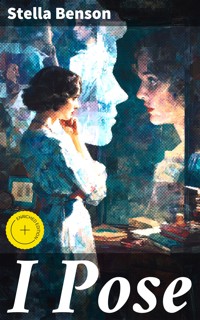
In "I Pose," Stella Benson presents a unique blend of irony and introspection, inviting readers to explore the complexities of self-identity and the performance of social roles. The book, characterized by its modernist style, evokes rich imagery and employs a powerful narrative voice, illustrating the tension between personal authenticity and societal expectations. Set against the backdrop of the early 20th century'—a time of social upheaval and artistic experimentation'—Benson's work transcends conventional narrative structures to delve into the psyche of its characters, ultimately questioning what it means to truly 'pose' in a world defined by appearances. Stella Benson, a pioneering British author and feminist, drew on her own experiences and the evolving role of women in society to inform her writing. Born in 1892, she lived through tumultuous historical moments, including World War I, which deeply influenced her worldview. Benson's keen observations of human relationships and social dynamics are reflective of her engagement with contemporary feminist thought and her desire to challenge the norms of her time, allowing her to craft a narrative that resonates deeply with readers seeking meaning beyond surface-level interactions. As a captivating exploration of identity and societal masks, "I Pose" is a must-read for those interested in early modernist literature and the feminist literary tradition. Benson's skillful prose not only entertains but also encourages readers to ponder their own roles in the intricate dance of personal and social identity, making this work a profound addition to discussions of gender and representation in literature. In this enriched edition, we have carefully created added value for your reading experience: - A succinct Introduction situates the work's timeless appeal and themes. - The Synopsis outlines the central plot, highlighting key developments without spoiling critical twists. - A detailed Historical Context immerses you in the era's events and influences that shaped the writing. - A thorough Analysis dissects symbols, motifs, and character arcs to unearth underlying meanings. - Reflection questions prompt you to engage personally with the work's messages, connecting them to modern life. - Hand‐picked Memorable Quotes shine a spotlight on moments of literary brilliance. - Interactive footnotes clarify unusual references, historical allusions, and archaic phrases for an effortless, more informed read.
Das E-Book können Sie in Legimi-Apps oder einer beliebigen App lesen, die das folgende Format unterstützen:
Veröffentlichungsjahr: 2021



















I Pose
Table of Contents
Introduction
At once playful and piercing, I Pose turns the everyday habit of performing ourselves into a comedy of manners that keeps asking what remains when the poses slip, how conviction survives the urge to appear consistent, and whether the hunger for recognition—social, romantic, or moral—can coexist with the risk of being truly seen, weaving these questions through encounters that are at once airy with humor and edged with unease so that the reader is invited to smile, then pause, and finally consider the fragile boundary between a self we practice and a self we discover by accident.
I Pose, by Stella Benson, is a satirical novel rooted in early twentieth-century British life and first published in the 1910s, when social roles and public ideals were being vigorously renegotiated. The book belongs to the tradition of witty, ironic social fiction that probes the gap between private motives and public masks. Its backdrop reflects the turbulence of late-Edwardian and wartime years, when activism, class expectations, and new forms of self-definition jostled for attention. Without relying on melodrama or heavy polemic, Benson situates her characters in recognizable social spaces—gardens, streets, drawing rooms—and uses those settings to test how people perform principle, tenderness, and ambition.
The premise is disarmingly simple and deliberately emblematic: early chapters bring together a reflective gardener and a purposeful suffragette, whose conversation becomes the spark for a sequence of encounters that examine idealism, vanity, and the comforts of role-playing. Their meeting, at once courteous and combative, supplies the book with a flexible frame for movement and debate rather than a puzzle-box plot. Without venturing into later developments, it is fair to say that readers can expect journeys of mind and place, where talk leads to action and action returns to thought, all filtered through a sensibility that refuses to separate tenderness from teasing.
Benson’s voice blends dry amusement with a precise moral intelligence, favoring lightness of touch over declamation. The narration moves briskly, often pausing for compact, incisive observations that puncture cant while preserving sympathy for human awkwardness. Dialogue carries much of the momentum, but the prose also lingers on small, telling details—postures, hesitations, accidental bravado—that reveal how people announce themselves to one another. The style is urbane without chill, humane without sentimentality, and tonal shifts are deliberately nimble: a scene can begin as farce and end in self-scrutiny, or reverse that trajectory, as if to demonstrate how quickly a pose can turn into a confession.
Key themes are threaded through the book with deceptive ease. It studies performance and authenticity, asking when a mask protects and when it imprisons, and how ideals can be both compass and costume. It looks at the claims of duty—political, romantic, familial—alongside the stubborn privacy of desire. Questions of gender and power surface in how causes are argued and how courtesy is wielded. Class and social aspiration appear not as blunt caricature but as habits of mind: the instinct to arrange oneself attractively, to narrate one’s motives, to defend a charming inconsistency. Throughout, comedy serves as a solvent that reveals and tests conviction.
For contemporary readers, the novel’s preoccupation with self-fashioning feels vividly current. In an age of curated personas and public stances, its gentle skepticism about moral display—and its sympathy for the longing behind it—resonates beyond its historical moment. The book’s attention to the theater of activism, the choreography of flirtation, and the pleasures and perils of irony speaks to ongoing debates about sincerity and performance. Its elegance lies in refusing easy cynicism: it understands why people pose, and it wonders how, and whether, they can stop without losing courage or grace. The result is both socially observant and quietly moving.
Approached as a social comedy with philosophical aftershocks, I Pose offers an experience that is witty, nimble, and unexpectedly tender. Readers who value novels of ideas delivered with charm—where character is tested in talk as much as in deed—will find its pages lively and exact. Its restraint with plot and affection for paradox invite a contemplative pace, yet the humor keeps the surface buoyant. As an artifact of the 1910s and a work that still speaks to questions of identity and commitment, it rewards attentive reading, not by concluding an argument, but by enlarging the terms on which we recognize ourselves.
Synopsis
I Pose introduces two central figures, known more by types than by names: a young woman driven by public causes and a young man earning his living as a gardener. They meet in an English village where her zeal and his irony intersect. The opening establishes their contrasting temperaments and a shared restlessness that neither can easily explain. She wants to change the world through purposeful action; he prefers to watch, question, and deflate certainty. Their early conversations about sincerity, duty, and display give the title its meaning: both recognize that modern life involves adopting roles, yet both doubt how those roles relate to truth.
As their acquaintance grows, the woman’s commitment to reform takes practical shape. Meetings, leaflets, and careful plans mark her days, while the gardener shadows these efforts with amused skepticism. He admires her clarity but distrusts all creeds; she admires his intelligence but worries over his detachment. The chapters balance incidents of small-town life with debates about usefulness, artifice, and moral pose. Gradually, the two become companions in movement rather than converts to each other’s views. The gardener’s wit proves unexpectedly protective; the woman’s purpose becomes unexpectedly elastic. Each begins to test identity by acting it out, rehearsing a future beyond the village.
The narrative follows them to the city, where crowds and causes sharpen their differences and their interdependence. The woman aligns with suffrage activists and social workers, lending her energy to demonstrations and committees. The gardener, refusing to belong, records impressions and quietly negotiates practical obstacles. There are brushes with authority, near-comic setbacks, and glimpses of the costs of reform. Benson presents these episodes in light, observant scenes that avoid caricature while revealing pressures to perform convictions in public. The two learn the limits of slogans and the uses of companionship. A broader horizon beckons, suggesting that their small experiments require a larger stage.
A voyage provides that new stage. On a passenger ship bound away from England, they meet officials, drifters, and idealists who each display a different public mask. Shipboard routines—dinners, lifeboat drills, corridor gossip—become a theater in which the pair refine their views on identity and influence. The woman sees how platforms emerge from accidents and audiences; the gardener sees how institutions conceal personal choices. The sea crossing also equalizes and isolates, pushing them toward tacit dependence. Their compact remains informal: to travel together without promising conformity. The chapters suggest that movement alters character less than it reveals it, bringing roles into clearer, sometimes harsher, light.
They disembark in a small, politically unsettled place, a composite of colony, resort, and nascent state. Here the woman’s activism finds direct application in schools, committees, and public appeals. The gardener, nominally uncommitted, is drawn into administrative errands, ceremonies, and conversations with those who wield power. The setting allows Benson to satirize authority, benevolence, and imported reform. Expectations cling to uniforms and titles; loyalty is counted by appearances. The protagonists discover that local problems are specific, not easily mended by general principles. Yet the scene also opens chances: to test persuasion, to accept responsibility, and to measure the distance between posture and practice.
Tensions accumulate as policies meet realities. The woman’s proposals bring both gratitude and resistance, producing minor victories and unintended consequences. The gardener’s cultivated detachment falters when decisions implicate him. Officials prefer smooth surfaces; petitioners demand visible results. Misunderstandings multiply, not from malice but from incompatible roles and the haste of public life. Benson frames these developments with a light touch, showing how language itself can become a costume. The protagonists respond differently: she by redoubling effort and seeking clearer procedure, he by questioning premises and protecting the private self. Friendship becomes a buffer and a test, as each weighs what to risk and what to reserve.
Their relationship, always candid but undefined, moves toward a choice about commitment. Practicalities—work, shelter, status—force questions that their earlier intellectual debates had postponed. The woman values independence and an undivided loyalty to her cause; the gardener values freedom from fixed answers and claims. Affection deepens, yet neither wants to be remade by it. Public attention complicates matters, as any partnership might be read as a symbol. The chapters explore this negotiation without melodrama, tracing adjustments and retreats. The possibility of a private life within public work appears, if precariously. The idea of mutual promise becomes another form of posing unless anchored by tested action.
A crisis in governance brings the book to its turning point. External pressures—factional rivalry, policy reversals, and a volatile crowd—compress time and narrow choices. The woman must decide how far to press her program when institutions shift beneath her. The gardener must choose whether to continue observing from the margin or to act with consequences he cannot fully foresee. Their decisions are shaped less by declarations than by accumulated habits of care and refusal. Action exposes motives, and silence acquires weight. Benson presents the climax without sensationalism, letting implication and aftermath speak. The themes of identity, responsibility, and performance meet their severest test here.
The closing movement rebalances the story, acknowledging gains, losses, and ambiguities without tidy consolation. The protagonists emerge altered but recognizable: the woman still purposeful yet tempered by limits; the gardener still ironic yet engaged by obligation. The book’s message is not a verdict on reform or detachment but a portrait of how people construct selves among demands to be visible, useful, and sincere. Posing, it suggests, is inevitable; the task is to discover which poses are true enough to live by. With wit and restraint, the novel leaves room for the reader’s judgment, ending on a note that honors both hope and complexity.
Historical Context
Stella Benson’s I Pose is set in the last years of Edwardian Britain and the opening of the Georgian era, roughly the decade before and just into the First World War. Its scenes move between the enclosed world of an English country house, where class hierarchies govern labor and leisure, and metropolitan spaces suggestive of London, where reform, spectacle, and modernity collide. The novel’s whimsical travel later in the narrative gestures to the era’s fascination with voyages and far-flung locales shaped by empire. The time and place are those of mounting social contest: women’s political agitation, labour unrest, and a state that is beginning to expand welfare while policing dissent.
The most immediate historical backdrop is the British women’s suffrage movement. The Women’s Social and Political Union (WSPU), founded in Manchester in 1903 by Emmeline Pankhurst and her daughters Christabel and Sylvia, escalated from peaceful tactics to civil disobedience and property damage after 1908 when parliamentary reform repeatedly stalled. Key flashpoints included “Black Friday” on 18 November 1910, when police assaulted protestors after the Conciliation Bill faltered, and the death of Emily Wilding Davison, injured at the Epsom Derby on 4 June 1913 and dying four days later. The Prisoners (Temporary Discharge for Ill Health) Act 1913—the “Cat and Mouse Act”—cycled hunger‑striking suffragettes in and out of prison. I Pose, with its central figure of “the Suffragette,” directly dramatizes this agitation, filtering it through satire to expose both heroic resolve and the absurdities of public pose, police tactics, and media caricature.
Alongside WSPU militancy ran constitutional campaigns by the National Union of Women’s Suffrage Societies (NUWSS), led by Millicent Garrett Fawcett since 1897, which pursued lobbying, petitions, and electioneering. Parliament’s failure to pass limited franchise bills in 1910–1912 set the stage for intensified confrontation, but war changed the landscape: many suffragist groups suspended campaigns in August 1914; in 1918 the Representation of the People Act enfranchised women householders aged 30 and over, and in 1928 the Equal Franchise Act granted voting rights on the same terms as men. Although published in 1915, the novel registers the years of ferment just prior to the war, and its suffragette figure embodies the pre‑1914 debates over tactics, respectability, and the meaning of citizenship.
The Great Unrest (c. 1910–1914) saw a surge of labor militancy across Britain. The 1911 transport strikes in Liverpool culminated in clashes and the deployment of troops; the Llanelli railway strike in August 1911 resulted in two civilian deaths when soldiers fired on crowds. The 1912 national coal strike involved over a million miners pressing for a minimum wage. These conflicts unfolded under a Liberal government wrestling with industrial relations and social reform. In I Pose, the “Gardener” stands within a working‑class milieu that makes the etiquette of employers, servants, and wage labor visible. The novel’s comedy of manners maps the class fault lines revealed by strikes—deference, bargaining, and the fragile civility of country‑house employment.
The Liberal welfare reforms (1906–1914) reshaped everyday life and politics: the 1906 Education (Provision of Meals) Act, the 1908 Old Age Pensions Act, Labour Exchanges in 1909, and the 1911 National Insurance Act (sickness and unemployment) advanced a new social contract. David Lloyd George’s 1909 People’s Budget, contested by the House of Lords, precipitated the 1911 Parliament Act, curbing the Lords’ veto and enabling reform. These measures intersected with philanthropic activism in London’s East End. Benson herself had experience in charitable work among the urban poor, which informs the book’s scrutiny of “benevolence” as performance. I Pose repeatedly lampoons well‑heeled do‑gooders and the rituals of respectability, asking who benefits from charity and who gets to define social need.
The novel’s playful excursion beyond Britain reflects early‑twentieth‑century imperial and transatlantic politics that saturated news and travel writing. Between 1898 and 1917, the so‑called “Banana Wars” saw repeated U.S. interventions: Cuba (occupation 1898–1902; Platt Amendment 1901), Panama’s separation from Colombia (1903) and Canal opening (1914), Nicaragua (1912–1933), Haiti (occupation beginning 1915), and the Dominican Republic (1916–1924). Britain maintained extensive Caribbean colonies and cultivated informal influence elsewhere. Though Benson sets her scenes in a fictionalized destination, the burlesque of coups, officials, and expatriate adventurers mirrors contemporary reportage about fragile republics, foreign tutelage, and the comic‑tragic theater of imperial tourism and revolution.
The outbreak of the First World War in August 1914 altered the political climate. The Defence of the Realm Act (DORA) 1914 expanded state powers of censorship and control; many suffrage leaders redirected efforts to recruitment and relief. Economic dislocation, rationing, and mass mobilization recast class and gender relations, accelerating but also disciplining change. Published in 1915, I Pose hails from this hinge moment. Its lightness and irony, pointed at pre‑war pretensions, carry a sharper edge when read against wartime regimentation. The book’s insistence on personal autonomy and skepticism toward public postures resonates with a society suddenly awash in uniforms, propaganda, and enforced conformity.
As social and political critique, the novel exposes the theatricality of power in Edwardian‑Georgian Britain. By pairing a working gardener with a suffragette, it dramatizes the traffic between class hierarchy and gender exclusion, showing how both are maintained by ritual, sentiment, and law. Its mockery of philanthropic display indicts systems that prefer moralizing over material justice, while the overseas episode lampoons imperial hubris and the fashionable appetite for other people’s revolutions. The recurrent theme of “posing” implicates politicians, police, patrons, and activists alike, yet the satire is ethically angled: it defends women’s civic agency and working‑class dignity against the era’s inequities and the coercive performances demanded by state and society.
I Pose
CHAPTER I
There was once a gardener[1]. Not only was, but in all probability is, for as far as I know you may meet him to this day. There are no death-bed scenes in this book. The gardener was not the sort of person to bring a novel to a graceful climax by dying finally in an atmosphere of elevated immorality. He was extremely thin, but not in the least unhealthy. He never with his own consent ran any risk of sudden death. Nobody would ever try to introduce him into a real book, for he was in no way suitable. He was not a philosopher. Not an adventurer. Not a gay dog. Not lively: but he lived, and that at least is a great merit.
In appearance the gardener was a fairly mediocre study in black and white. He had a white and wooden face, black hair as smooth as a wet seal's back, thin arms and legs, and enormous hands and feet. He was not indispensable to any one, but he believed that he was a pillar supporting the world. It sometimes makes one nervous to reflect what very amateur pillars the world seems to employ.
He lived in a boarding-house[2] in Penny Street[3], W. A boarding-house is a place full of talk, it has as many eyes as a peacock, and ears to correspond. It is lamentably little, and yet impossible to ignore. It is not a dignified foundation for a pillar.
The gardener was twenty-three. Twenty-three is said to be the prime of life by those who have reached so far and no farther. It shares this distinction with every age, from ten to three-score and ten.
On the first of June, in his twenty-fourth year, the gardener broke his boot-lace[4]. The remains of the catastrophe dangled from his hand. String was out of the question; one cannot be decent dressed in string, he thought, with that touch of exaggeration common to victims of disasters. The world was a sordid and sardonic master, there was no heart in the breast of Fate. He was bereft even of his dignity, there is no dignity in the death of a boot-lace. The gardener's twenty-three years were stripped from him like a cloak. He felt little and naked.[1q]
He was so busy with his emotions that he had forgotten that the door of his room was open.
It was rather like the girl Courtesy[5] to stand on the landing boldly staring in at a man sitting on his bedroom floor crushed by circumstances. She had no idea of what was fitting. Any other woman would have recognised the presence of despair, and would have passed by with head averted.
But the girl Courtesy said, "Poor lamb, has it broken its boot-lace?"
The gardener continued in silence to watch the strangling of his vanity by the corpse of the boot-lace. His chief characteristic was a whole heart in all that he did.
A tear should have appeared in Courtesy's eye at the sight of him. But it did not.
"Give me the boot," she said, advancing into the room in the most unwomanly manner. And she knotted the boot-lace with a cleverness so unexpected—considering the sort of girl she was—that the difference in its length was negligible, and the knot was hidden beneath the other lace.
"Women have their uses," thought the gardener. But the thought was short-lived, for Courtesy's next remark was:
"There, boy, run along and keep smilin'. Somebody loves you." And she patted him on the cheek.
Now it has been made clear that the gardener was a Man of Twenty-three. He turned his back violently on the woman, put on his boot, and walked downstairs bristling with dignity.
The girl Courtesy not only failed to be cut to the heart by the silent rebuke, but she failed to realise that she had offended. She was rather fat, and rather obtuse. She was half an inch taller than the gardener, and half a dozen years older.
The gardener's indignation rode him downstairs. It spurred him to force his hat down on his head at a most unbecoming angle, it supplied the impetus for a passionate slamming of the door. But on the doorstep it evaporated suddenly. It was replaced by a rosy and arresting thought.
"Poor soul, she loves me," said the gardener. He adjusted his hat, and stepped out into London, a breaker of hearts, a Don Juan[6], unconscious of his charm yet conscious of his unconsciousness. "Poor thing, poor thing," he thought, and remembered with regret that Courtesy had not lost her appetite. On the contrary, she had been looking even plumper of late. But then Courtesy never quite played the game.
"I begin to be appreciated,[2q]" reflected the gardener. "I always knew the world would find out some day . . ."
The gardener was a dreamer of dreams, and a weaver of many theories. His theories were not even tangible enough to make a philosophy, yet against them he measured his world. And any shortcomings he placed to the world's account. He wrapped himself in theories to such an extent that facts were crowded from his view, he posed until he lost himself in a wilderness of poses. He was not the victim of consistency, that most ambiguous virtue. The dense and godly wear consistency as a flower, the imaginative fling it joyfully behind them.
Imagination seems to be a glory and a misery, a blessing and a curse. Adam, to his sorrow, lacked it. Eve, to her sorrow, possessed it. Had both been blessed—or cursed—with it, there would have been much keener competition for the apple.
The million eyes of female London pricked the gardener, or so he imagined, as he threaded the Strand. He felt as if a glance from his eye was a blessing, and he bestowed it generously. The full blaze of it fell upon one particular girl as she walked towards him. She seemed to the gardener to be almost worthy. Her yellow hair suffered from Marcelle spasms at careful intervals of an inch and a half, every possible tooth enjoyed publicity. The gardener recognised a kindred soul. A certain shade of yellow hair always at this period thatched a kindred soul for the gardener.
He followed the lady.
He followed her even into the gaping jaws of an underground station. There she bought cigarettes at a tobacco stall.
"She smokes," thought the gardener. "This is life."
He went close to her while she paid. She was not in the least miserly of a certain cheap smell of violets. The gardener was undaunted.
"Shall we take a taxi, Miss?" he suggested, his wide eager smile a trifle damped by self-consciousness. For this was his first attempt of the kind. "They say Kew[7] is lovely just now."
It was his theory that spoke. In practice he had but threepence[8] in his pocket.
She replied, "Bless you, kid. Run 'ome to mammy, do."
Her voice sounded like the scent she wore. It had a hard tone which somehow brought the solitary threepence to mind.
The gardener returned at great speed to Penny Street.
It was lunch-time at Number Twenty-one. The eternal hash[9] approached its daily martyrdom. Hash is a worthy thing, but it reminds you that you are not at the Ritz[12]. There is nothing worse calculated to make you forget a lonely threepenny bit in your pocket.
The gardener had a hundred a year. He was apparently the only person in London with a hundred a year, for wherever he went he always found himself the wealthiest person present. His friends gave his natural generosity a free rein. After various experiments in social economy, he found it cheapest to rid himself of the hundred a year immediately on its quarterly appearance, and live on his expectations for the rest of the time. There are drawbacks about this plan, as well as many advantages. But the gardener was a pillar, and he found it easier to support the world than to support himself.
It was on this occasion that his neighbour at luncheon, unaware of his pillar-hood, asked him what he was doing for a living.
"Living," replied the gardener. He was not absolutely sure that it made sense, but it sounded epigrammatic[10]. He was, in some lights, a shameless prig. But then one often is, if one thinks, at twenty-three.
"It's all living," he continued to his neighbour. "It's all life. Being out of a job is life. Being kicked is life. Standing's life. Dying's life."
The neighbour did not reply because he was busy eating. One had to keep one's attention fixed on the food problem at 21 Penny Street. There was no time for epigrams. It was a case of the survival of the most silent. The gardener was very thin.
The girl Courtesy, however, was one who could do two things at once. She could support life and impart information at the same time.
"I do believe you talk for the sake of talking," she said; and it was true. "How can dying be living?"
It is most annoying to have the cold light of feminine logic turned on to an impromptu epigram. The gardener pushed the parsnips towards her as a hint that she was talking too much. But Courtesy had the sort of eye that sees no subtlety in parsnips. Her understanding was of the black and white type.
"Death is the door to life," remarked Miss Shakespeare, nailing down the golden opportunity with eagerness. 21 Penny Street very rarely gave Miss Shakespeare the satisfaction of such an opening. There was, however, a lamentable lack of response. The subject, which had been upheld contrary to the laws of gravitation, fell heavily to earth.
"Is this your threepenny bit or mine?" asked the girl Courtesy. For that potent symbol, the victim of its owner's absence of mind, in the course of violent exercise between the gardener's plate and hers, had fallen into her lap.
Whose idea was it to make money round? I sometimes feel certain I could control it better if it were square.
"It is mine," said the gardener, still posing as a philosopher. "A little splinter out of the brimstone lake. Feel it."
Courtesy smelt it without repulsion.
"Talk again," she said. "Where would you be without money?"
"Where would I be without money? Where would I be without any of the vices? Singing in Paradise, I suppose."
"If I pocket this threepenny bit," said Courtesy, that practical girl, "what will you say?"
"Thank you—and good-bye," replied the gardener. "It is my last link with the world."
Courtesy put it in her purse. "Good-bye," she said. "So sorry you must go. Reserve a halo for me."
The gardener rose immediately and walked upstairs with decision into his bedroom, which, by some freak of chance, was papered blue to match his soul. It was indeed the anteroom of the gardener's soul. Nightly he went through it into the palace of himself.
He took out of it now his toothbrush, a change of raiment, and Hilda. It occurs to me that I have not yet mentioned Hilda. She was a nasturtium in a small pot.
On his way downstairs he met Miss Shakespeare, who held the destinies of 21 Penny Street, and did not hold with the gardener's unexpected ways.
"Your weekly account . . ." she began.
"I have left everything I have as hostages with fate," said the gardener. "When I get tired of Paradise I'll come back."
On the door-step he exclaimed, "I will be a merry vagabond, tra-la-la . . ." and he stepped out transfigured—in theory.
As he passed the dining-room window he caught sight of the red of Courtesy's hair, as she characteristically continued eating.
"An episode," he thought. "Unscathed I pass on. And the woman, as women must, remains to weep and grow old. Courtesy, my little auburn lover, I have passed on—for ever."
But he had to return two minutes later to fetch a pocket-handkerchief from among the hostages. And Courtesy, as she met him in the hall, nodded in an unsuitably unscathed manner.
The gardener walked, with Hilda in his hand. It became night. Practically speaking, it is of course impossible for night to occur within three paragraphs of luncheon-time. But actually the day is often to me as full of holes as a Gruyère cheese.
To the gardener the beginnings of a walk which he felt sure must eventually find a place in history were torn ruthlessly out of his experience. He was thinking about red hair, and all things red.
He hoped that Hilda, when she flowered, would be the exact shade of a certain head of hair he had lately seen.
"Hoping and planning for Hilda like a mother-to-be," he thought, but that pose was impossible to sustain.
Red hair.
He did not think of the girl Courtesy at all. Only her hair flamed in his memory. The remembrance of the rest of her was as faint and lifeless as a hairdresser's dummy.
It struck him that auburn, with orange lights in the sunlight, was the colour of heat, the colour of heaven, the colour of life and love. He looked round at the characteristic London female passer-by, the thin-breasted girl, with hair the colour of wet sand, and reflected that Woman is a much rarer creature than she appears to be.
He recovered consciousness in Kensington Gardens at dusk. He remembered that he was a merry vagabond.
"Tra-la-la . . ." he sang as he passed a park-keeper.
People in authority seem as a rule to be shy of the pose. The park-keeper was not exactly shy, but he made a murmured protest against the Tra-la-la, and saw the gardener to the gate with most offensive care.
In theory the gardener spent the night at the Ritz. In practice he slept on the Embankment. He was a man of luck in little things, and the night was the first fine night for several weeks. The gardener followed the moon in its light fall across the sky. Several little stars followed it too, in and out of the small smiling clouds.
The moon threaded its way in and out of the gardener's small smiling dreams. Oh mad moon, you porthole, looking up into a fantastic Paradise!
The gardener did not dream of red hair. That subject was exhausted.
When an undecided sun blinked through smoked glasses at the Thames, and at the little steamers sleeping with their funnels down like sea-gulls on the water with their heads under their wings, the gardener rose. He had a bath and a shave—in theory—and walked southward. Tra-la-la.
He walked very fast when he got beyond the tramways, but after a while a woman who was walking behind him caught him up. Women are apt to get above themselves in these days, I think.
"I'm going to walk with you," said the woman.
"Why?" asked the gardener, who spent some ingenuity in saying the thing that was unexpected, whether possible or impossible.
"Because you're carrying that flower-pot," replied the woman. "It's such absurd sort of luggage to be taking on a journey."
"How do you know I'm going on a journey?" asked the gardener, astonished at meeting his match.
"By the expression of your heels."
The gardener could think of nothing more apt to say than "Tra-la-la . . ." so he said it, to let her know that he was a merry vagabond.
The woman was quite plain, and therefore worthy only of invisibility in the eyes of a self-respecting young man. She had the sort of hair that plays truant over the ears, but has not vitality enough to do it prettily. Her complexion was not worthy of the name. Her eyes made no attempt to redeem her plainness, which is the only point of having eyes in fiction. Her only outward virtue was that she did not attempt to dress as if she were pretty. And even this is not a very attractive virtue.
She carried a mustard-coloured portmanteau.
"I know what you are," said the gardener. "You are a suffragette[11], going to burn a house down."
The woman raised her eyebrows.
"How curious of you!" she said. "You are perfectly right. Votes for women!"
"Tra-la-la . . ." sang the gardener wittily.
(You need not be afraid. There is not going to be so very much about the cause in this book.)
They walked some way in silence. The gardener, of course, shared the views of all decent men on this subject. One may virtuously destroy life in a good cause, but to destroy property is a heinous crime, whatever its motive.
(Yes, I know that made you tremble, but there are not many more paragraphs of it.)
Presently they passed a car, pillowed against a grassy bank. Its attitude, which looked depressed, was not the result of a catastrophe, but of a picnic. In the meadow, among the buttercups, could be seen four female hats leaning together over a little square meal set forth in the grass.
"Look," said the suffragette, in a voice thin with scorn.
The gardener looked, but could see nothing that aroused in him a horror proportionate to his companion's tone.
"Listen," said the suffragette half an octave higher.
The gardener listened. But all he heard was, "Oh, my dear, it was too killing . . ."
Then, because the chauffeur on the bank paused in mid-sandwich, as if about to rebuke their curiosity, they walked on.
"One is born a woman," said the suffragette. "A woman in her sphere—which is the home. One starts by thinking of one's dolls, later one thinks about one's looks, and later still about one's clothes. But nobody marries one. And then one finds that one's sphere—which is the home—has been a prison all along. Has it ever struck you that the tragedy of a woman's life is that she has time to think—she can think and organise her sphere at the same time. Her work never lets her get away from herself. I tell you I have cried with disgust at the sound of my own name—I won't give it to you, but it might as well be Jane Brown. I have gasped appalled at the banality of my Sunday hat. Yet I kept house excellently. And now I have run away, I am living a wide and gorgeous life of unwomanliness. I am trying to share your simplest privilege—the privilege you were born to through no merit of your own, you silly little boy—the privilege of having interests as wide as the world if you like, and of thinking to some purpose about England's affairs. My England. Are you any Englisher than I?"
"You are becoming incoherent," said the gardener. "You are enjoying a privilege which you do not share with me—the privilege of becoming hysterical in public and yet being protected by the law. You are a woman, and goodness knows that is privilege enough. It covers everything except politics. Also you have wandered from the point, which at one time appeared to be a picnic."
(Courage. There is only a little more of this. But you must allow the woman the privilege of the last word. It is always more dignified to allow her what she is perfectly certain to take in any case.)
"The picnic was an example of that sphere of which 'Oh, my dear, too killing . . .' is the motto. You educate women—to that. I might have been under one of those four hats—only I'm not pretty enough. You have done nothing to prevent it.[3q] I might have been an 'Oh, my dear' girl, but thank heaven I'm an incendiary instead."
That was the end of that argument. The gardener could not reply as his heart prompted him, because the arguments that pressed to his lips were too obvious.
Obviousness was the eighth deadly sin in his eyes. He would have agreed with the Devil rather than use the usual arguments in favour of virtue. That was his one permanent pose.
A little way off, on a low green hill, the suffragette pointed out the home of a scion of sweated industry, the house she intended to burn down. High trees bowed to each other on either side of it, and a little chalky white road struggled up to its door through fir plantations, like you or me climbing the world for a reward we never see.
"I'm sorry," said the gardener. "I love a house that looks up as that one does. I don't like them when they sit conceitedly surveying their 'well-timbered acres' under beetle brows that hide the sky. Don't burn it. Look at it, holding up its trees like green hands full of blessings."
"In an hour or two the smoke will stand over it like a tree—like a curse . . ."
When they parted the gardener liked her a little because she was on the wrong side of the law. There is much more room for the wind to blow and the sun to shine beyond the pale—or so it seems to the gardener and me standing wistful and respectable inside. It is curious to me that one of the few remaining illusions of romance should cling to a connection with that most prosy of all institutions—the law.
I forgot to mention that the gardener borrowed a shilling from the suffragette, thus rashly forming a new link with the world in place of the one he had relinquished to the girl Courtesy. The worst of the world is that it remains so absurdly conservative, and rudely ignores our interesting changes of pose and of fantasy. I have been known to crave for a penny bun in the middle of a visit from my muse, and that is not my fault, but Nature's, who created appetites and buns for the common herd, and refused to adapt herself to my abnormal psychology.
It was interesting to the gardener to see how easily the suffragette parted with such an important thing as a shilling. Superfluity is such an incredible thing to the hungry. The suffragette gave Holloway Gaol as her permanent address.
Thus accidentally bribed, the gardener, feasting on a cut from the joint in the next village, refrained from discussing women, their rights or wrongs, or their local intentions, with the village policeman. "She won't really dare do it," he thought.
(I may here add that I was not asked by a militant society to write this book. I am writing it for your instruction and my own amusement.)
The gardener did not sleep under a hedge as all merry vagabonds do—(Tra-la-la)—but he slept in the very middle of a large field, much to the surprise of the cows. One or two of these coffee-coloured matrons awoke him at dawn by means of an unwinking examination that would have put a lesser man out of countenance. But the gardener, as becomes a man attacked by the empty impertinences of females, turned the other way and presently slept again.
He washed next morning near to where the cows drank. He had no soap and the cows had no tumblers,—nothing could have been more elemental than either performance.
"I am very near to the heart of nature—tra-la-la," trilled the gardener. But the heart of nature eludes him who tries to measure the distance. The only beat that the gardener heard was the soft thud of his own feet along the thick dust of the highway.
About the next day but one he came to a place where the scenery changed its mind abruptly, flung buttercups and beeches behind it, and drew over its shoulders the sombre cloak of heather and pines.
Under an unremarkable pine tree, listening to the impatient summons of the woodpecker (who, I think, is the feathered soul of the foolish virgin outside the bridegroom's door), sat a man. He was so fair that he might as well have been white-haired. His eyes were like two copper sequins set between white lashes, beneath white brows, in a white face. His lips were very red, and if he had seemed more detached and less friendly, he would have looked like harlequin. But he rose from his seat on the pine needles, and came towards the gardener, as though he had been waiting for him.




