


1,99 €
Mehr erfahren.
- Herausgeber: Quickie Classics
- Kategorie: Gesellschafts- und Liebesromane
- Sprache: Englisch
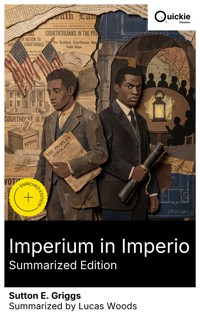
Imperium in Imperio imagines a clandestine Black government within the United States, using the entwined fates of Belton Piedmont and Bernard Belgrave to test accommodation against separatist revolt. Griggs splices sentimental romance with political tract and conspiracy thriller, scattering speeches, minutes, and trials that expose the Imperium's constitution. Composed amid the collapse of Reconstruction and the rise of Jim Crow, it adapts fin-de-siecle utopian/dystopian forms to interrogate citizenship, state power, and the ethics of resistance. Sutton E. Griggs, an African American Baptist minister and organizer, wrote in the key of pulpit and platform. Educated in Black institutions and active in Baptist networks, he established a Black press to reach readers excluded from white markets. Witnessing disenfranchisement and racial terror, he turned fiction into program, using oratorical cadence and debate to model strategies for survival and sovereignty. Readers of political fiction, African American studies, and speculative traditions will find Imperium in Imperio indispensable. It is audacious, analytically sharp, and eerily contemporary, compelling us to weigh pragmatism against militancy and to reconsider loyalty, citizenship, and power. Few novels better illuminate the possibilities and perils of Black sovereignty. Quickie Classics summarizes timeless works with precision, preserving the author's voice and keeping the prose clear, fast, and readable—distilled, never diluted. Enriched Edition extras: Introduction · Synopsis · Historical Context · Brief Analysis · 4 Reflection Q&As · Editorial Footnotes.
Das E-Book können Sie in Legimi-Apps oder einer beliebigen App lesen, die das folgende Format unterstützen:
Veröffentlichungsjahr: 2026
Ähnliche
















Imperium in Imperio (Summarized Edition)
Table of Contents
Introduction
At the heart of Sutton E. Griggs’s Imperium in Imperio stands the unsettling question of whether a people denied full citizenship should seek redemption within a hostile republic or claim sovereignty by building a covert nation of their own, a political and moral dilemma that animates every scene, propels every conversation about duty and survival, and forces readers to weigh the promises and perils of assimilation against the galvanizing, risky allure of separatist power in a landscape shaped by post-Reconstruction backlash, institutional racism, and the urgent desire to imagine mechanisms of justice where the law has repeatedly failed to protect Black life.
First published in 1899, Imperium in Imperio is a work of political fiction that blends dystopian anxiety with utopian speculation, situating its drama in the United States after Reconstruction, particularly in the South where new systems of control replaced the old. Sutton E. Griggs, an African American minister and novelist, uses the conventions of the era’s problem novel to probe how power might be organized when democratic promises are betrayed. The book imagines a sophisticated underground polity formed by Black citizens, not as mere fantasy, but as a rigorous thought experiment about governance, loyalty, and the meaning of citizenship under duress.
The plot traces two talented Black classmates from youth into public life, charting their education, ambitions, and divergent temperaments as they navigate opportunity and exclusion. Their paths converge within a secret organization that has built parallel institutions—schools, treasuries, councils, and chains of command—promising protection and self-determination amid violent repression. Griggs stages revelations carefully, moving from familiar scenes of study and courtship to clandestine assemblies where speeches, votes, and oaths carry grave consequence. The reading experience is at once propulsive and didactic, combining oratorical set pieces with conspiratorial momentum, so that political argument and narrative suspense sharpen one another rather than compete.
As a political novel, Imperium in Imperio places fundamental themes in the foreground: the fragility of citizenship, the ethics of secrecy, and the tension between reform and revolution. It interrogates strategies that dominated Black leadership in the era, from patient accommodation to uncompromising resistance, challenging readers to consider not just ends but means. Griggs also examines how education, class aspiration, and institutional competence can serve liberation while reproducing hierarchy. The clandestine state becomes a mirror for the republic it shadows, revealing how constitutions, elections, and militaries can both safeguard and imperil freedom depending on who wields them and to what purpose.
Stylistically, the book marries the sentimental and the procedural: intimate scenes of friendship and ambition stand beside constitutional language, roll calls, and set speeches. The oratorical voice reflects Griggs’s public life and the period’s taste for moral suasion, yet the pacing remains brisk, driven by intrigue and bold designs. Readers will notice how the novel assembles evidence like a brief, advances claims like a sermon, and stages debate like a legislative session. Rather than striving for detached realism, it embraces clarity of argument and urgency of tone, using heightened stakes to compel readers toward serious contemplation of political choice.
For contemporary readers, its questions remain immediate: What forms of solidarity can withstand repression, what kinds of institutions deserve our trust, and how should patriotism be measured when equal protection is unevenly applied. The novel speaks to ongoing debates over civil rights, voter suppression, mutual aid, and the balance between reformist and separatist strategies. It illuminates how states and counter-states surveil, negotiate, and compete, and how rhetoric can mobilize communities toward action. By dramatizing the imaginative labor of building alternative structures, Griggs offers a lens on resilience and risk that continues to inform conversations about justice, safety, and belonging.
Approached today, Imperium in Imperio rewards both political curiosity and narrative appetite, inviting readers to inhabit the pressures that shape choice without foreclosing debate about outcomes. Griggs builds a world precise enough to feel administratively real and morally contested, yet open enough to serve as a forum for the reader’s judgment. The novel’s lasting power lies in how it transforms a historical crisis into a live argument about duty, strategy, and hope. Read as parable, thriller, and treatise at once, it urges a clear-eyed reckoning with power while honoring the courage it takes to imagine freedom otherwise.
Synopsis
In Sutton E. Griggs’s 1899 political novel Imperium in Imperio, two gifted Black youths in post-Reconstruction Texas come of age under the shadow of disenfranchisement and mob violence. Early chapters trace their schooling, ambition, and the faith placed in them by families and teachers who see education as a path to collective advancement. Their friendship is built on rivalry and mutual admiration, yet tempered by differing temperaments toward the white-dominated order. Griggs establishes a social landscape of segregated institutions, fickle legal protections, and precarious safety, against which the protagonists’ promise appears both inspiring and burdened. The stage is set for divergent strategies of survival and leadership.
As they enter adulthood, each man’s experiences with humiliation, blocked opportunity, and the spectacle of racial terror sharpen his political instincts. Public speaking, classroom excellence, and community service draw them into networks of Black civic life—newspapers, churches, and fraternal circles that transmit news and strategy. They encounter debates over emigration, legal petitions, armed self-defense, and patient accommodation. Griggs dramatizes how personal slights harden into convictions: one protagonist leans toward reform within the nation that denies him; the other begins to doubt that appeals will suffice. Their paths remain entwined, but their answers to the same injuries increasingly diverge.
Against this backdrop, a clandestine organization reveals itself: a secret Black polity, the Imperium in Imperio, operating within the United States. It is portrayed with startling bureaucratic detail—officers, deliberative procedures, revenue collection, and disciplined cadres—promising protection and coordinated purpose. The Imperium recruits talented youth, gathers intelligence on hostile actors, and debates whether sovereignty can be exercised without open war. Its very existence reframes the protagonists’ ambitions, offering a structure in which leadership might be realized outside white oversight. Griggs uses the Imperium to test the feasibility, ethics, and risks of parallel governance in a hostile democracy.
As the men rise within public and clandestine spheres, their ideological fault line widens. One argues for patient advancement inside American institutions, staking hope on persuasion, law, and exemplary citizenship. The other presses the Imperium to assert autonomous power, including measures that would compel recognition if peaceful petition fails. Their eloquence animates formal debates and secret councils, where policies touching land, defense, and education are proposed with procedural gravity. Griggs juxtaposes oratory and organization to explore whether dignity can be secured through incremental reform or must be seized through separatist resolve, leaving personal loyalties increasingly strained.
Outside the Imperium’s chambers, the surrounding society grows more hostile. New barriers to the ballot, discriminatory statutes, and organized vigilante violence constrict avenues for lawful redress. Economic dependency and the threat of sudden accusation enforce daily submission. These pressures give the Imperium urgency and peril; secrecy protects members, yet also isolates them from broader Black publics whose consent they claim to represent. Plans for revenue, training, and coordinated defense advance alongside fears of infiltration and reprisal. Griggs emphasizes how structural injustice narrows choices until every path—appeal, migration, resistance—carries grave costs, making strategy a question of survival as much as principle.
The narrative tightens around a dramatic convocation of the Imperium, where accusations, policy resolutions, and tests of allegiance converge. A solemn proceeding places a leading figure’s convictions under scrutiny, and the assembly weighs whether loyalty to the United States can coexist with loyalty to the secret state. Legalistic argument, historical grievance, and moral appeal collide as votes are counted and punishments contemplated. The two protagonists, bound by history yet divided by vision, confront choices that may cost reputation, freedom, or life. Griggs sustains suspense while foregrounding the stakes: representation, security, and the legitimacy of wielding power in self-defense.
Imperium in Imperio endures as an audacious early exploration of Black political imagination, probing the limits of American citizenship and the appeal of organized separatism. Without resolving every tension, Griggs stages a searching inquiry into whether alternative institutions can protect a despised minority when law fails. The book’s blend of social realism and speculative statecraft influenced later discussions of nationalism, civil rights strategy, and the ethics of resistance. Its questions about surveillance, parallel governance, and democratic consent remain pressing. As a pioneering work by an African American author in 1899, it continues to challenge readers to confront power’s uses and perils.




