


1,99 €
Mehr erfahren.
- Herausgeber: Quickie Classics
- Kategorie: Wissenschaft und neue Technologien
- Sprache: Englisch
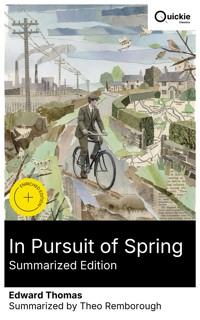
In Pursuit of Spring (1913) follows Edward Thomas's bicycle ride from London to the Quantock Hills of Somerset as winter loosens. In lucid, finely cadenced prose, he records lanes, hedgerows, inns, birdsong, weather, and place-names, blending topographical exactitude with lyrical restraint. Set within the English peripatetic tradition of Cobbett, Borrow, and Jefferies, the book also registers the modern—roads, telegraph wires, the bicycle itself—with poised ambivalence, reading the countryside as both archive and living present. Thomas (1878–1917), a London-born critic of Welsh parentage, had long written about the countryside while burdened by hackwork. Walking and cycling were his release; soon after this journey, friendship with Robert Frost would usher his turn to poetry. His love of maps and place-names, and his minute knowledge of birds and rural labor, shape the book's inquiry into language, memory, and belonging. For readers of nature writing, travel literature, and the environmental humanities, this is a quietly bracing companion: attentive, unsentimental, and restorative. Whether cyclist, walker, or armchair traveler, you will find a luminous meditation on how to see a landscape in time, and why such seeing matters. Quickie Classics summarizes timeless works with precision, preserving the author's voice and keeping the prose clear, fast, and readable—distilled, never diluted. Enriched Edition extras: Introduction · Synopsis · Historical Context · Brief Analysis · 4 Reflection Q&As · Editorial Footnotes.
Das E-Book können Sie in Legimi-Apps oder einer beliebigen App lesen, die das folgende Format unterstützen:
Veröffentlichungsjahr: 2026
Ähnliche


















In Pursuit of Spring (Summarized Edition)
Table of Contents
Introduction
Poised between the last austere light of winter and the first intimations of renewal, In Pursuit of Spring follows Edward Thomas as he sets out to discover whether the season’s quiet transformations can still be read in the hedgerows, lanes, and market towns of southern England, testing the resilience of old routes and rural habit against the quickening pace of the twentieth century, and exploring how a simple journey by bicycle can mirror an interior passage from weariness to attentiveness, so that the act of moving westward becomes a way of keeping faith with time, memory, and the promise of return.
Published in 1913, on the eve of the First World War, In Pursuit of Spring is a travel narrative and a work of nature writing set across southern England, tracing a bicycle journey from London toward the Quantock Hills in Somerset. Thomas observes the final days of late winter and the first signs of the season that gives the book its title, noting roads, villages, fields, and weather as they present themselves over several days. The result is at once topographical and reflective, an Edwardian cross-country passage attentive to ordinary detail, vernacular landscapes, and the continuities of place that endure beneath change.
The premise is disarmingly simple: a rider heads west to meet spring as it advances, keeping company with hedgerows, parish churches, inns, and open sky. The reading experience is capacious and unhurried, moving through descriptions that balance clear sight with meditative pause. Thomas’s voice is steady, curious, and exact, favoring patient noticing over spectacle and finding value in stray talk, local custom, and the shapes of roads. The style blends lyrical compression with straightforward reportage, while the tone remains humane and quietly skeptical, alive to pleasure but alert to loss. The journey’s unfolding invites attention rather than suspense.
What emerges is a study of renewal and its limits, an inquiry into how seasonal change may steady a life and a culture unsettled by modern acceleration. Thomas tracks the fragile seam between continuity and alteration: the way an old milestone or a field boundary holds a memory, the way new surfaces and speeds redraw a map of belonging. Travel becomes a form of reading, with lanes as text and weather as commentary. The book asks how far movement clarifies perception, and whether attention to the near-at-hand can withstand the pull of distraction and haste.
Although Thomas is now widely recognized as a major poet, this prose work appeared shortly before he began writing poetry and already bears the precision and humility that characterize his later verse. The sentences prize exact naming and the felt cadence of walking and cycling, yet they resist ornament for its own sake. In Pursuit of Spring occupies a distinct place in early twentieth-century English nature and travel writing, notable for joining patient observation to a quietly historical sense of landscape. It is less a survey than a companionable witness, giving weight to what is often overlooked and refusing to separate beauty from use.
Contemporary readers will find in these pages a model for slow attention at a moment when the pace of life, and of travel, can flatten experience. Thomas’s way of noticing birdsong, weather fronts, soils, and roadside talk speaks to present concerns about ecological awareness and the care of ordinary places. His route by bicycle emphasizes frugal movement and local knowledge, aligning with current interests in low-impact travel and accountable pleasure. The book’s sensitivity to working landscapes—fields, commons, and paths—also resonates with debates about access, preservation, and the cultural memory embedded in everyday terrain.
To approach In Pursuit of Spring is to enter a season in motion and to accept that the richest discoveries are often marginal and cumulative. The narrative offers no contrived drama and needs none; its satisfactions come from the depth of looking and the measure of time kept by a moving body in a living countryside. For readers today, the book remains a companion for attentive travel and a testament to how literature can honor the ordinary without diminishing it. Thomas’s westward ride affirms that renewal is not merely an event but a practice, sustained by curiosity, patience, and care.
Synopsis
In Pursuit of Spring, published in 1913, records Edward Thomas’s bicycle journey from London toward the western sea as winter yields to early spring. The book unfolds as a continuous sequence of days on the road, combining close observation of weather, plants, and birds with reflections on roads, history, and the texture of ordinary life. Thomas’s purpose is simple yet expansive: to follow the season’s advance across southern England and discover how place and time meet along lanes, commons, and hills. The narrative’s momentum arises from movement itself, each stage gathering impressions that connect landscape, memory, and the evolving promise of spring.
He departs through the outskirts of London, where suburban streets, workshops, and traffic yield by degrees to hedgerows and market gardens. Early in the journey the weather is unsettled and light low, so signs of spring appear tentative: damp fields, swelling buds, birds beginning to test their voices. Thomas reads the road as archive and guide, noticing milestones, bridges, parish boundaries, and the sociable pattern of inns. The tension between older rhythms of horse and foot and the growing presence of motors sets the book’s historical register, as he weighs speed against attention and lets the slower pace draw out detail.
The route carries him west across a mosaic of fields, commons, and woods, where villages present a mixture of continuity and change. He pauses to speak with farm workers, carters, and publicans, listening to local knowledge about weather, crops, and byways. Churches, green lanes, and cottage gardens appear and vanish with the bends of the road, and different soils underwheel mark quiet transitions between counties. Industrial signs never vanish entirely—railway cuttings, telegraph wires, and an occasional car—but they remain counterpoints to the older fabric rather than its replacement. Thomas steadies his gaze on the ordinary, letting it accumulate meaning.
Language becomes one of his instruments. Place-names, field-names, and odd survivals of dialect open paths into a landscape layered by memory. He navigates with maps yet prefers the corroboration of hedgebank, stile, and skyline, comparing printed lines with what the senses yield. Spring advances fitfully: catkins and early flowers show between showers, while winds change and clouds continually redraw distance. Thomas braids natural notice with allusion to earlier travelers and rural traditions, not to assert authority but to set companionship across time. The result is a record of attention in which naming, seeing, and cycling keep company.
As the miles accrue, the journey’s physical demands surface without drama: the weight of the machine on hills, the minor repairs, and the need for shelter from sudden showers. High ground opens long views and reveals the skeleton of roads, while river valleys close in and solicit slower travel. Thomas is drawn to traces of old routes and boundaries, sensing how movement has shaped the land for centuries. Villages offer hospitality that anchors the day’s end, and brief conversations illuminate local economies. The book treats such particulars not as digression but as the substance through which spring and place become legible.
Nearer the West Country the atmosphere shifts. Lanes grow more deeply banked, farms closer to hill and heath, and the nearness of the sea is sometimes guessed before it is seen. The light sharpens, birdsong gathers confidence, and colors strengthen, though changes remain incremental rather than dramatic. Thomas recognizes that arrival is less a single moment than a sequence of recognitions: a gate half-open, a gust carrying salt, a village adjusting its routines to lengthening days. By now the narrative has exchanged the uncertainty of departure for an assured gait, so that the book’s closing stages feel like a recognition withheld, not announced.
The book’s significance lies in its measured portrait of southern England on the eve of profound twentieth-century change. Without polemic, Thomas offers a durable method for seeing: move slowly, attend to names and textures, distinguish what is transient from what endures. As travel writing, it shows how narrative can be paced by weather and light; as nature writing, it resists spectacle in favor of the ordinary made exact. Readers return to it for a snapshot of a pre-war countryside and for a prose that keeps company with maps, lanes, and modest thresholds, leaving discovery for the reader to complete.




