


0,49 €
Niedrigster Preis in 30 Tagen: 1,99 €
Niedrigster Preis in 30 Tagen: 1,99 €
Mehr erfahren.
- Herausgeber: DigiCat
- Kategorie: Poesie und Drama
- Sprache: Englisch
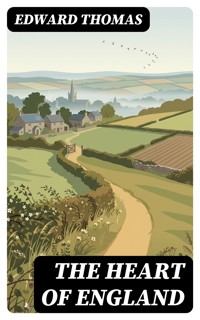
In "The Heart of England," Edward Thomas weaves a rich tapestry of prose that captures the essence of the English landscape and its profound impact on the human spirit. This contemplative work merges memoir with poetry, employing vivid imagery and a lyrical style that invites readers to explore the interplay between nature and the psyche. As Thomas reflects on various locations, the book emerges not just as a geographical journey but as an exploration of identity and belonging, offering insights into the social and cultural context of early 20th-century England, a time marked by rapid change and introspection. Edward Thomas, a key figure in the early modernist movement, was a poet and essayist who often drew upon his deep love for nature and personal experiences in his writings. His own struggles with identity and purpose, amplified by the tumultuous backdrop of World War I, imbued his work with a sense of urgency and introspection. Thomas's life, marked by a passion for walking and observing the English countryside, inevitably shaped the heartfelt observations and philosophical musings that characterize this seminal work. I highly recommend "The Heart of England" to readers seeking to connect with nature and reflect on their own emotional landscapes. Thomas's evocative prose not only invites appreciation of the natural world but also encourages a deeper understanding of one's place within it, making this a timeless read for both lovers of literature and nature.
Das E-Book können Sie in Legimi-Apps oder einer beliebigen App lesen, die das folgende Format unterstützen:
Veröffentlichungsjahr: 2022
Ähnliche


















The Heart of England
Table of Contents
Introduction
At the quiet intersection where old lanes, working lives, and the quickening pace of the modern world meet, The Heart of England traces how a landscape becomes a mindscape, and how attention—patient, scrupulous, unsentimental—can still recover the living center of a country often spoken of in abstractions, through walks, pauses, and close looks at fields, hedges, tracks, and dwellings, setting a measure of human memory against seasonal change, local habit against national myth, and the layered textures of place against the flattening promises of speed, convenience, and forgetfulness, and inviting readers to feel how names, paths, and weather quietly assemble a durable, enlivening home.
Edward Thomas’s The Heart of England is a work of nonfiction travel and topographical writing from the early twentieth century, composed in the years before the First World War, when British readers were avid for portraits of the countryside and its regional character. Set across the English countryside rather than a single plotted route, the book surveys villages, lanes, rivers, commons, and farms, attentive to the ordinary fabric that makes a place cohere. Written during the Edwardian era, it draws on observation, local history, and the author’s experienced eye as a walker and critic to present a quietly radical portrait of place.
The premise is disarmingly simple: a writer goes out into the country and looks long enough for it to speak back, letting roads, hedgerows, and weather set the pace of discovery. The reading experience is immersive yet unforced, with prose that balances lucidity and lyric feeling, and a tone that refuses both nostalgia and boosterism. Thomas notices surfaces—the grain of a gate, the slant of a path—and the human practices that sustain them, but he also leaves interpretive room, trusting readers to make connections. Episodes accumulate rather than climax, so that the book moves by resonance, clarity, and quiet surprise.
Among its central themes is the reciprocity between land and labor: fields and footpaths are shown as the record of human use, while human character is shown as shaped by soil, distance, and season. Thomas explores continuity and change without sentimentality, registering repair and decay, solitude and sociability, the local and the national. He considers how roads hold memory, how names and boundaries encode long histories, and how attention itself becomes an ethic. The book suggests that care begins with looking closely, and that to understand a country one must accept its patchwork—its seams, rests, and repetitions—as a form of strength.
For contemporary readers, this matters because the pressures Thomas observed—standardization, speed, and the casual erasure of the ordinary—have only intensified. The Heart of England models a way of inhabiting landscape that resists distraction: it values slowness, attention to the built and the grown, and an ethic of stewardship rooted in knowledge rather than slogan. In an age debating environmental policy, regional inequality, and the meaning of national belonging, his patient, ground-level view widens perspective without inflaming it. The book offers a language for care that does not romanticize, and a sense of place that does not close the door on change.
The book also helps situate Edward Thomas within the long tradition of British nature and travel writing, alongside authors who treat walking as a way of thinking and description as a form of inquiry. Written before he became known for poetry, it shows his characteristic precision, scepticism, and responsiveness to weather, light, and speech, qualities that later appear in verse with distilled intensity. Readers familiar with his other prose journeys will recognize the same methodical curiosity and moral tact here. Without polemic, Thomas assembles a mosaic of observation that invites reflection, and in doing so he renews an old genre for modern attention.
Approached slowly, a chapter at a time, The Heart of England rewards rereading and roving, because its meaning accumulates in the interstices—between field and road, dwelling and horizon, memory and sight. There is no secret to decode and no narrative trick awaiting revelation; the book’s pleasures lie in exactness, cadence, and a kind of ethical hospitality extended to places and people alike. Readers today will find their own routes through its pages, but the thread that holds remains the same: an invitation to measure life not by haste or novelty, but by the depth of relation a landscape can still sustain.
Synopsis
The Heart of England by Edward Thomas is a work of nonfiction travel writing that surveys the landscapes and settlements commonly associated with England’s central regions. Written in the early twentieth century, it blends close observation with reflective commentary to ask what constitutes the country’s “heart” beyond cartographic centers. Thomas proceeds by walking and journeying through ordinary places, attending to roads, fields, and villages rather than celebrated vistas. His method is patient and cumulative: sights, textures, and encounters become evidence for a larger portrait of continuity. Without polemic, he situates the reader at ground level, inviting attention to detail as a way of understanding place.
Thomas organizes his progress as a loosely linked sequence of excursions, moving from outskirts and approaches into more settled interiors. He studies the articulation of land and life: hedgerows framing meadows, lanes bending to follow soil and water, farmsteads gathered around work and worship. Market days, inns, and small trades supply rhythm and social bearings. He notices how footpaths hold memory in their worn lines, and how a village’s shape reflects its economy and history. Though unhurried, his narrative accumulates purpose, suggesting that the “heart” is sensed in ordinary continuities rather than spectacular scenes.
Historical depth appears not as grand chronicle but as traces embedded in the ground. Thomas reads the lie of a road, the siting of a bridge, the stone of a church, and the pattern of fields as documents. He weighs the claims of maps against the authority of the path underfoot, showing how names and alignments preserve earlier uses of land. Antiquity and the recent past coexist in modest artifacts—boundaries, mills, green spaces—that keep memory active without display. This manner of looking resists nostalgia by insisting on evidence, yet it recognizes how long habitation confers a distinctive character on even the smallest district.
Nature is a partner in this inquiry, not a backdrop. Thomas attends to season and weather as conditions that define work and perception: mist binding valleys, wind in hedgerow trees, light on plough and pasture. He notes birds and plants as faithfully as cottages and barns, charting the shared rhythm of labor and growth. The cultivated and the “wild” interpenetrate, so that a copse, a ditch, or an unused field margin becomes a record of both intention and accident. His observations remain concrete and unsentimental, aligning the moods of the countryside with the practical routines that keep it alive.
Modern change is measured in gradients rather than shocks. Thomas marks the presence of improved roads, railways, and other infrastructures that redraw distances and habits. He assesses new pressures on villages—commercial connections, commuting, altered farming methods—without forecasting catastrophe or offering idylls. Industrial edges and arterial routes enter the narrative as facts to be weighed against the tenacity of local patterns. Where novelty brings convenience or risk, he records both, keeping judgment provisional. The book’s balance lies in showing how old and new interlock, and how the central counties retain identity even as their margins and tempos shift.
People anchor the landscape’s meanings. Thomas listens to farmers, innkeepers, and artisans, registering reserve, humor, and the practical intelligence that grows from close acquaintance with land and weather. He observes how custom shapes courtesy, how speech reflects place, and how communities negotiate privacy and solidarity. Education, worship, fairs, and shared workrooms provide institutions and occasions where continuity is enacted. Without profiling individuals at length, he draws composite portraits of manners and expectations, suggesting an ethic of patience, measure, and stewardship. In these encounters, the book’s central question—what is the nation’s “heart”?—becomes inseparable from lived character.
The closing movement gathers these strands into a durable image of England’s middle landscapes: neither dramatic nor remote, yet formative. Thomas leaves major assertions unstated, allowing the reader to infer that the “heart” lies in relationships—between path and parish, labor and season, habit and change. As a contribution to topographical writing and nature literature, the book models a way of seeing that privileges exactness over rhetoric. Its significance endures in the invitation to know places by walking, looking, and listening, and in the reassurance that careful attention can still locate meaning within a countryside subject to continual, manageable transformation.
Historical Context
Edward Thomas’s The Heart of England, first published in 1906, is a prose travel book set in the Edwardian period, when Britain was under Edward VII. Thomas, a critic and essayist who later became known as a poet, roams the central counties often termed the Midlands, recording villages, by-roads, churches, inns, farms, and market towns. Written before the First World War, the book captures an England balancing long-established rural patterns with the pressures of modern life. Its method is observational and topographical, informed by walking and close attention to place, and it participates in a broader late Victorian and Edwardian boom in domestic travel writing.
The countryside Thomas observes had been reshaped by the long nineteenth century. Parliamentary enclosure, completed in most regions by the mid‑1800s, left characteristic hedged fields and lanes that frame his routes. Agriculture was still largely mixed and seasonal, yet it was recovering unevenly from the late‑Victorian agricultural depression of the 1870s–1890s, which had depressed prices and encouraged rural out‑migration. Nearby, Midlands industrial centers such as Birmingham and the Black Country were expanding, drawing workers and capital. Thomas’s pages reflect the coexistence of agrarian traditions with the reach of factories and markets, as rural producers supplied urban populations while seeking stability after decades of volatility.
Transport networks define the book’s terrain. By 1906, railways linked even small market towns through main lines and branches operated by companies such as the Great Western Railway and the Midland Railway, while canals from the eighteenth‑century network still carried goods. The bicycle boom of the 1890s had made independent travel affordable, and motor traffic was newly regulated by the Motor Car Act of 1903, which introduced registration and speed limits. Footpaths and bridleways, mapped by the Ordnance Survey’s one‑inch series, enabled Thomas’s pedestrian itineraries. His contrasts between the pace of walking and mechanical speed register a society negotiating mobility and access.
Preservation and heritage movements were shaping public attitudes to landscape. The National Trust, founded in 1895, was acquiring beauty spots and historic sites for public benefit. The Commons Preservation Society (established 1865) and the Society for the Protection of Ancient Buildings (1877) campaigned to safeguard open spaces and vernacular structures. Country Life magazine, launched in 1897, popularized the ideal of the English country house, village, and parish church. The Garden City movement began at Letchworth in 1903, proposing planned settlements that reconciled town and country. Thomas’s depictions of churches, cottages, greens, and lanes converse with these contemporaneous efforts to define national rural character.
Thomas wrote within a lineage of English nature and travel prose. Gilbert White’s eighteenth‑century Natural History of Selborne set a model for close observation of locality. In the nineteenth century, Richard Jefferies and W. H. Hudson deepened rural and pastoral writing; Thomas admired both and later published a study of Jefferies in 1909. As a literary critic, he valued precision, cadence, and the textures of speech, and his prose notices dialect, field‑names, and place‑lore. The Heart of England thus engages contemporary readers attuned to essays, county books, and guidebooks that combined natural history, antiquarian interest, and reflective description.
Rural institutions structure Thomas’s itinerary. The Church of England parish, with medieval or early‑modern churches, defined community geography and calendars through services and festivals. Market towns organized exchange via weekly markets and seasonal fairs under charters centuries old. Inns and alehouses served travelers along former turnpike roads and by‑roads, while village schools—expanded after the Elementary Education Act of 1870 and reorganized by the Education Act of 1902—shaped literacy and local horizons. Parish and district councils, created in the 1890s reforms of local government, oversaw rights of way and commons. Thomas records these settings as enduring frameworks amid change in work and leisure.
Debates over land, economy, and empire formed the national backdrop. Joseph Chamberlain, based in Birmingham, launched his Tariff Reform campaign in 1903, advocating protective duties and imperial preference; the controversy divided parties and voters through the 1906 general election. Liberal social reforms, from education to licensing, were being contested locally and in Parliament. Agricultural interests pressed for smallholdings and allotments, themes soon addressed by legislation after 1906. In this climate, Thomas’s attention to tenant farms, estate policies, and rural labor echoes wider arguments about who should benefit from the countryside’s resources and how national prosperity ought to be organized.
Although not a polemic, The Heart of England registers tensions characteristic of its era. Thomas favors footpaths, hedgerows, birdsong, and the individuality of villages, and he notes the encroachment of noise, standardized building, and commercial signage. His measured prose often contrasts continuity—parish stones, old roads, local customs—with the displacements brought by speed and centralized markets. Published on the eve of upheavals that would transform Britain, the book preserves a pre‑war snapshot without romantic immunity to change. It reflects an Edwardian search for national identity in landscape, and it critiques modernity chiefly by dwelling on the value of attentive, local seeing.




