


0,99 €
Mehr erfahren.
- Herausgeber: Klaus
- Kategorie: Religion und Spiritualität
- Sprache: Englisch
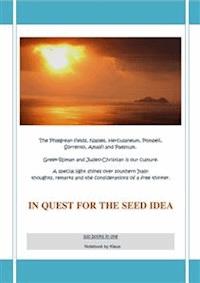
100 books in oneThe question of creation involves a costant reflection on our natural or/and divine origin. At the same time, we analyse the never-ending circle of life transformation, from birth to death to rebirth
Das E-Book können Sie in Legimi-Apps oder einer beliebigen App lesen, die das folgende Format unterstützen:
Veröffentlichungsjahr: 2014
Ähnliche











First print July 07th 2010
Reviewed December 07 2013
Preface by the Author
In my 40 years in the tourism industry, I had the opportunity to entertain myself among most of the archaeological sites and museums within the Campania region (Italy South) and I had the pleasure to discuss of art, myths, religions and other sciences with hundreds of educated people coming from different countries of mother earth.
The questions I have been asked throughout my activity triggered my curiosity in careful research and exciting cultural discoveries.
These notes are meant to be a tribute to anyone who has ever been interested in reading about our origins, function and end of things. In particular, to those scholars whose works I have read. They all share an irrepressible and sometimes obsessive curiosity in our past, present and future: J. Campbell, with his universal way of conceiving the human needs of the soul, with no distinction of colour or race, A. Morelli, as a field expert with a clear vision of Egyptian and Greek-Roman Mythology, L. De Crescenzo, with his simple comparisons between the software of our ancestors and contemporary man’s, S. Hawking, as a man of science searching for the invisible and visible Universe – a Universe where man has been conceived and is now living in spite of its mysteries and yet, achieving some scientific certitudes; G. Ravasi, whose works should be read in total silence, just as when listening to your favourite music, for his wonderful descriptions of the ancient world, his consideration of ancient transcriptions and translations, and the related interpretations of the sacred writings.
Mythology is the story of our identity, an organization of symbolic narratives and images, which are often metaphorical, but still providing a complete picture of the cultural repertoire of a given society at any given time. When Religions are studied and become a set of theological works in which everything is reduced to a code, Mythology turns into Theology. The question of creation involves a constant reflection on our natural or/and divine origin. At the same time, we analyse the never-ending circle of life transformation, from birth to death to rebirth.
In this notebook I discuss several instances of symbols dealing with mysteries and philosophical questions that have been fascinating humankind since the very beginning.
A book of meditations and notes like this, couldn’t avoid to dwell for some pages on one of the most difficult words in any human language : freedom.
We start our overview of Mediterranean written culture from the Trojan conflict. Its violence is the natural consequence of an explosive combination of love and hatred. Later, In the Æneid, Virgil narrates how these events apparently led to the foundation of Roman civilization.
..at a certain point along the Tiber river, the basket was stranded and the crying of the children in it caught the attention of a she-wolf or..
In a proper chapter on Greater Greece, I look at the relationships between classical culture and ours. In here, I have the opportunity to describe some wonderful sites in Southern Italy which represent the living proof of our close relationship with classical Greek culture.
Great credit to the Ancient Greeks, the brightest civilization that ever flourished on earth.
All civilisations have developed inventions and experiences which have naturally spread in the world, thus achieving the first purpose of culture, i.e. progress.
The last chapter deals with the mysterious and fascinating nature of woman. It deals with topics such as love, pleasure and family relations. Here you can read the story of many mythological female figures involved in the eternal adventure of love.
All in all the reader will encounter some physical principles giving answers to what our ancestors could not explain at that stage of their cultural development.
These notes address a reader who has not spent much time on the topics treated.
They are written in a very simple English, every now and then with a bit of humour and satire.
In here you will find hints to some conclusions and meditate on, at some point in our life. At any point in these notes, I refer to our ancestors' lives, to their awareness and knowledge of their world and to the mysteries and expectations involved in the human vision of the future.
I believe everyone can recognize some of his/her thoughts at some point of this note book.
The most important myth/stories related to the oldest colonizers and heroes/deities were mainly connected to the search of immortality or metals, in particular gold, for its hypnotic power.
In the translation of the Sumerian clay tablets dating back to 6,000 years ago, we read the word DIN.GIR, meaning: “the pure ones of the blazing rockets”. The Akkadians later named those creatures ILU: “those who are in the heights”. From this word came the biblical EL.
Phoenicians called them BA’AL.
In Sanskrit the word DIVO-GA means “born in the sky”.
Zeus in Greek is Djeus, the genitive is Diòs, meaning “shining sky”. Dium in Latin means Day or Sky, while Dyàus means light.
Thus, Deity is a pagan concept, whose development dates back to post-Sumerian civilizations.
The Hebrew word YHW was conceived not to be pronounced.
(From Hera 55/2004, Alfredo di Pinzio).
How could one call something considered invisible but divine?
Only through the explanation of what one thinks is the influence of the Almighty?
Or through the explanation of what one thinks he-she is and what it will cause?
We have to use different terms then from one event to another.
At the same time we have to consider that any linguistic attempt to describe the concept of “the whole” may not be adequate.
Below are some of the words I use to mention the unmentionable:
Supreme Being
Singularity
The Whole
Creator
Conceiver
Almighty
Divine will
Omnipotent
Ubiquitous
Creative thought
Divine Spirit
Creative breeze
Of course, more and more terms were and will be used throughout the different civilizations, scientific trends and cultural evolution.
A civilization is a territory where a considerable number of people develops various forms of art, literature, science, politics, trade and communications.
It is beyond the purposes of these notes to classify chronologically ancient records in order to distinguish between civilizations, tribal societies and farming villages. Ethnic minorities have been marginalized as their historical territories became part of a state.
Puma Punku and Tiwanaku in Bolivia are said to be city states of about 12 millennia ago.
The Natufian culture in Eastern Mediterranean dates back to 11,000 years ago.
Jerico on the West Jordan River is today Palestinian territory. This settlement is 9,000 years old.
Katak Huyuk in Turkey is 8,000 years old.
Mehrgar is a farming village in Pakistan dating back to 8,000 years ago.
Sumer civilization in Southern Mesopotamia dates back to 6,000 years ago.
Egyptians in North Africa is a civilization of 5,500 years ago.
Harappa civilization in Punjab developed around 5,500 years ago on theIndu river.
The Caral-Supe settlement in Peru dates back to 5,500 years ago.
Akkadian civilization in Mesopotamia flourished 5 thousand years ago.
Minoians from Crete island lived 4,500 years ago.
Assyriawas a SemiticAkkadian kingdom, 4,500 year ago.
Yezidis Kurdish in Iraq was an Indo-Arian ethnic group of 4,000 ago.
Hebrew civilization dates back to 4,000 years ago.
Hittites from Turkey flourished 3,800 year ago.
Maya civilization in Onduras Guatemala and Mexico flourished 4,000 years ago. Palenque used to be one of the capitals.
Henan Xia Dynasty in China dates back to 3,700 year ago.
Phoenicians, an ancient Semitic population from the early Canaanite flourished 3,500 year ago.
Etruscan civilization was based in the Central Northern Italy 2,900 year ago.
Chapter one
Introduction
How do we position ourselves, from the spiritual and material point of view with the macro and micro universes?
The earliest theoretical attempts to describe and explain the universe involved the idea that spirits inhabited natural objects, such as rivers and mountains, including celestial bodies, like the sun and moon and they acted in a very humanlike and unpredictable manner.
These spirits had to be placated and their favors sought in order to ensure fertility of the soil and rotation of the seasons. Gradually, however, someone must have been noticed that there were certain regularities: the sun always rose East and set West, whether or not a sacrifice had been made to the sun deity. At first, these regularities and laws were obviously found only in astronomy and a few other fields.
In ancient Egypt, for instance, the Sun was considered the primary energy creating life and was associated with the male. The second energy was the female creating
duality, when this energy was fecundated by the first energy, the third energy was given birth, the child, the triangle, that is, the sum of the primary and secondary energy. The fourth energy, the square, is the family, the solid base of the pyramid of future.
(NOTA: See Pandora).
However, as civilization developed, and particularly in the last 300 years, more and more regularities and laws were discovered.
TIME
How do we reckon years BC and AD?
Was Jesus born in the year 0? Month and day are also unknown.
The year 1 AD corresponds to:
3761 years after the beginning of the Jewish calendar, which supposedly started the first full moon after the creation of the world, according to the Torah, it was midnight, October 6th.
2637 years after the beginning of the Chinese calendar, which starts on the date of the traditional invention of the calendar.
776 years after the beginning of the Greek calendar, starting from the first Olympic game. The year 1 AD was the 194th Olympic game.
753 years after a.u.c. (ab urbe condita) since the foundation of the city of Rome, (according the tradition April 21st).
622 AH (Anno Hegirae) years before Hegirae, when Mohamed entered Medina, supposedly July 16th.
The concept of a year "zero" is a modern myth.
Roman numerals do not have a figure designating zero.
Our present year was established by Dionysius Exiguus. Dionysius let the year 1 AD start one week after what he believed to be Jesus' birthday.
Therefore, 1 AD follows immediately 1 BC with no intervening year zero. So a person who was born in 10 BC and died in 10 AD, would have died at the age of 19, not 20.
Furthermore, Dionysius' calculations were wrong: it is written in the Gospel of Matthew that Chrestòs was born under the reign of king Herod the Great (son of Antipatro), Herod died in 749 a.u.c. this means that Jesus was born at least 2 years before, probably 747 a.u.c., whereas Exiguus had established the year zero in 753 a.u.c.
The result is that the year 2014 is at least the year 2020.
(Monk from latin monos, one, he who lives in solitude). (NOTE: I Vangeli, new version from the original. Edizioni Paoline 1985).
The story is as follows:
In about 523 AD, the papal chancellor, Bonifacius, asked monk Dionysius Exiguus – in English known as Denis the Little – of the Roman Curia, to make calculations in order to establish dates for Easter.
Dionysius wrongly set Jesus' birth with respect to Diocletian's reign in such a manner that it falls on 25 December 753 a.u.c., thus making the current era start with 1 AD on 1 January 754 a.u.c.
How Dionysius Exiguus reached this conclusion is unknown.
Does the lack of the year zero cause a problem?
Yes it does, to astronomers who frequently use another way of numbering the years BC. Instead of 1 BC they use 0, instead of 2 BC they use -1, instead of 3 BC they use -2, and so on.
In ancient Rome, December 25th used to be the festivity in honor of Saturn. He was the deity who revealed the secrets of agriculture so bringing healthiness, wealth, peace and love. During these festivities all social diversities were abolished.
According to tradition, some deities like Horus, Mithras and Dionysus were born in December, due to the winter solstice, considered as the date when light begins to return.
780 a.u.c. Tiberius emperor wrote a dispatch to the Roman senate, concerning the trial against a certain Chrestòs in Judea.
(NOTE: sources Tacitus and Svetonio).
MYTHOLOGY
Introduction
Mythology is the story of our identity, an organization of symbolic narratives and images that are sometime metaphorical, recounting of the possibilities of human experience in a given society at a given time.
In order to find something new, one has to leave the old and go in quest of the seed idea, an idea that would have the potentiality of bringing forth the new.
(J.Campbell, The Hero’s Journey).
Myths have to do with the serious matters of living life in terms of the order of society and nature, whereas fairy-tales are told for entertainment.
Religions are stories that connect us to “the divine”.
The mystery is a versatile tool for the creation of stories, faith, dominions, philosophies and religious systems, but you need the right social position to have time enough to experience meditation, pleasures, conversations, journeys, observations and to learn how to use it at right moment in the right place.
(J. Campbell).
“”Faith and reason are the wings taking to truth.”” St. John.
The question is;
A world without suffering and solitude would it still require a religion?
In Athens in order to ensure that all the deities were represented they even built a temple dedicated to the unknown one.
LEGENDS AND HISTORY
Fecundity, birth, fertility, thunder, lightning, cyclones, earthquakes, eruptions, fire, day, night, sun, moon, stars and others, are phenomena that had no scientific answers for thousand years.
Men could find no answers to questions such as: why crops die every winter or where the sun goes at night. These incomprehensible phenomena were often associated with idols. Once you have deities, you can influence them in different ways. They were then venerated in the attempt to appease them and catch their favours, and decrease or increase their activity.
In the mythological tradition of Polynesian culture, the moon was the delight of man, providing the tepid and natural light, useful not only for the sentimental aspect of human life, but also for planting the “Taro” (potato), the nutrition base for Polynesians, that needed full moon in order to ensure an abundant harvest.
Each civilisation has had its own ceremonies and sacrifices to the different deities. The first inhabitants of the Earth who started the tales of myth also customized the practices for venerating their idols. Those people who stood out from the others, because of either their intelligence or special gifts, became the interpreters of divine responses. These "priests" handed down from generation to generation, by word of mouth, the roots of mythology.
Lesen Sie weiter in der vollständigen Ausgabe!
Lesen Sie weiter in der vollständigen Ausgabe!
Lesen Sie weiter in der vollständigen Ausgabe!
Lesen Sie weiter in der vollständigen Ausgabe!
Lesen Sie weiter in der vollständigen Ausgabe!
Lesen Sie weiter in der vollständigen Ausgabe!
Lesen Sie weiter in der vollständigen Ausgabe!
Lesen Sie weiter in der vollständigen Ausgabe!
Lesen Sie weiter in der vollständigen Ausgabe!
Lesen Sie weiter in der vollständigen Ausgabe!
Lesen Sie weiter in der vollständigen Ausgabe!
Lesen Sie weiter in der vollständigen Ausgabe!
Lesen Sie weiter in der vollständigen Ausgabe!
Lesen Sie weiter in der vollständigen Ausgabe!
Lesen Sie weiter in der vollständigen Ausgabe!
Lesen Sie weiter in der vollständigen Ausgabe!
Lesen Sie weiter in der vollständigen Ausgabe!
Lesen Sie weiter in der vollständigen Ausgabe!
Lesen Sie weiter in der vollständigen Ausgabe!
Lesen Sie weiter in der vollständigen Ausgabe!
Lesen Sie weiter in der vollständigen Ausgabe!




