


Erhalten Sie Zugang zu diesem und mehr als 300000 Büchern ab EUR 5,99 monatlich.
- Herausgeber: Echter
- Kategorie: Religion und Spiritualität
- Serie: Religion in der Moderne
- Sprache: Englisch
This work is a philosophical investigation into the argumentative conditions for intercultural dialogue in Latin America. Through a critical discussion of some key theories of argumentation and intercultural dialogue and a thoughtful analysis of the Latin-American context of diversity, this book develops an intercultural model of argumentation based on the criteria of Intercultural Reasonableness and Discursive Interpellation. These criteria, which have a contextual and dialogical character, aim to offer the appropriate normative ground for a polylogical argumentative dialogue, in which the parties can make use of their own types of language and rationality without presupposing a common standard for the rational evaluation of arguments.
Sie lesen das E-Book in den Legimi-Apps auf:
Seitenzahl: 622
Veröffentlichungsjahr: 2012
Das E-Book (TTS) können Sie hören im Abo „Legimi Premium” in Legimi-Apps auf:
Ähnliche




















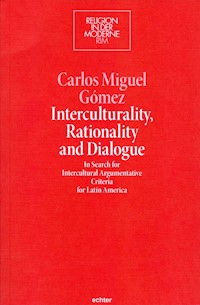
Carlos Miguel GómezInterculturality, Rationality and Dialogue
Religion in der Moderne
Herausgegebenvon Matthias Lutz-Bachmann,Thomas M. Schmidtund Michael Sievernich
RIM Band 23
Carlos MiguelGómez
Interculturality,Rationalityand Dialogue
In Search forIntercultural ArgumentativeCriteriafor Latin America
echter
Bibliografische Informationder Deutschen Nationalbibliothek
Die Deutsche Nationalbibliothekverzeichnet diese Publikationin der Deutschen Nationalbibliografie;detaillierte bibliografischeDaten sind im Internet überhttp://dnb.d-nb.de abrufbar.
©2012 Echter Verlag, Würzburgwww.echter-verlag.de
Druckerei:Difo-Druck, Bamberg
ISBN978-3-429-03461-0 | Print978-3-429-04624-8 | PDF978-3-429-06009-1 | ePub
A los pueblos originarios de Abya Yala, nuestra América.Como el maíz menospreciados, rechazados como la quinua,fuente de vida para el mundo.
CONTENTS
Acknowledgements
Note on the Quotation of Sources in Spanish
List of Diagrams
Introduction
PART I: DIVERSITY AND THE CHALLENGES TO DIALOGUE
1.
The Argumentative Dimension of Intercultural Dialogue
1.1.
Introduction
1.2.
The Context for Dialogue
1.2.1.
Between Inculturation and Dialogue: The Challenges of the Latin American Catholic Church
1.2.1.1.
The Commitment of the Church with Indigenous Peoples
1.2.1.2.
The Gospel and the Cultures
1.2.2.
The Struggles for Recognition of Indigenous Peoples and the Emergence of Multicultural Models
1.2.2.1.
Indigenous Reconstructed Claims and Regained Rights
1.2.2.2.
Democratic Participation as Intercultural Deliberation
1.2.2.3.
Legal Pluralism and The Resolution of Intercultural Conflicts
1.3.
The Borders of Dialogue
1.3.1.
The Normative Base of Intercultural Dialogue
1.3.2.
Grice’s Conversational Maxims Interculturally Examined
1.4.
Difficulties for Establishing Intercultural Normative Criteria for Dialogue
1.4.1.
The Objection of Incommensurability as Radical Relativism
1.4.2.
The Objection of Normativity as Neo-Colonialism
1.4.2.1.
Interculturality as a Critique to Illegitimate Universalization
1.4.2.2.
Between Dialectical and Dialogical Dialogue
1.5.
Conclusion: A first Insight into the Function and Shape of the Intercultural Normative Criteria for Dialogue
2.
Heterogenic Rationalities
2.1.
Introduction
2.2.
Rationalities as Culturally Relative Types of Logic
2.2.1.
Problems with the Hypothesis of Logical Relativism
2.3.
Rationalities as Incompatible Worldviews
2.3.1.
The Case of Andean Rationality
2.3.2.
Criticisms of the Idea of Different ‘Conceptual Schemes’
2.4.
Rationalities as Alternative Reasoning Patterns
2.4.1.
Rival Explanatory Patterns
2.4.1.1.
Mythical Causality
2.4.1.2.
Non Causal Explanatory Principles
2.4.2.
Competing Patterns of Justification: the Word of Origin as Primary Ground
2.5.
Conclusion
3.
Towards an Intercultural Reasonableness
3.1.
Introduction
3.2.
From an Intercultural Theory of Rationality to a Notion of Intercultural Reasonableness
3.3.
Assessing Reasonableness Interculturally: The Pragma-Dialectical Model
3.3.1.
Does the Pragma-Dialectical Approach offer an Interculturally Valid Model of Reasonableness?
3.3.1.1.
The Pragma-dialectical Reasonableness is Mono-cultural
3.3.1.2.
The Pragma-dialectical Reasonableness does not avoid Relativism
3.3.1.3.
A Critical Discussion does not fit the needs of Intercultural Dialogue
3.4.
Rethinking Reasonableness Interculturally
3.4.1.
Rationality and Reasonableness
3.4.2.
Intercultural Reasonableness as Multi-logical Recognition and Interaction
3.4.3.
Some Interculturally Unreasonable Moves in Dialogue
3.4.3.1.
Appeal to radical difference
3.4.3.2.
Illegitimate Universalization
3.4.3.3.
Fictitious consensus
3.4.3.4.
Argumentative violence
3.5.
Conclusion
PART II: BUILDING INTERCULTURAL CHAKANAS
4.
The Interconnection of Traditions I: An Interpretation of Intercultural Disagreements
4.1.
Introduction
4.2.
What is a Claim?
4.2.1.
Claims as Complex Speech Acts
4.3.
Types of Claims
4.3.1.
Types of Conflicting Claims in Latin American Intercultural Dialogues
4.3.2.
Habermas’ Argumentation Theory Interculturally Revisited
4.4.
Types of Disagreements
4.5.
Presuppositions of Disagreement
5.
The Interconnection of Traditions II: Discursive Interpellation
5.1.
Introduction
5.2.
Challenge
5.3.
Demand
5.4.
Offering
5.5.
‘Oppression’ and ‘Shared Problems’ as Factors of Interdependence
Conclusion: Pluralistic Argumentation
1.
The Justification of Argumentative Intercultural Criteria
2.
The Process of Intercultural Dialogue in Latin America
3.
The Outcome of Dialogue
4.
The Limits of the Argumentative Dimension of Intercultural Dialogue
Appendix: List of Intercultural Argumentative Criteria
Bibliography
Acknowledgements
Research is always a collective activity. The commitment and support of many people have made this investigation possible. I want to express my thanks to the Katholischer Akademischer Ausländer-Dienst (KAAD), particularly to Dr. Thomas Krüggeler and Renate Flügel, for their support which has been always much more than financial. The KAAD granted me a PhD Scholarship that allowed me to conduct research in Frankfurt am Main for three years, but most importantly, they have offered me the opportunity to join a vibrant international community of scholars and friends committed to the search for a just future for the so-called developing countries, based on solidarity and self-awareness. The willingness of my Doktorvater, Prof. Dr. Thomas Schmidt, as well as his insights and comments have been decisive for my work. I highly appreciate the freedom he has given me to develop my intuitions and to follow my own path. The generosity of my wife Susana, who agreed to leave her career, friends and family and to move to Germany, and her loving companionship have provided me with the appropriate atmosphere for deep study and reflection. She has been my first partner in dialogue, always ready to discuss my ideas and to encourage me to think harder. In times of confusion and confrontation she has found the way to bring me back to my fundamental ideas, making me remember where I come from and in which behalf I want to speak. Oscar Ardila and Terence Holden proofread the manuscript. For their help I am also very grateful.
A.M.D.G.
Note on the Quotation of Sources in Spanish
The author has translated all quotations from documents in Spanish for which there is no English translation available. To avoid repetition, this is only indicated in the footnotes by “cf.,” before the bibliographical information.
List of Diagrams
Diagram 1:
Arguments of “the U’wa Case”, Colombia, 90’s
Diagram 2:
The elements of intercultural disagreements
Diagram 3:
The structure of claims
Diagram 4:
The illocutionary dimension of claims
Diagram 5:
Interpellation
Diagram 6:
Factors of interdependence
Diagram 7:
Stages and dimensions of the practice of intercultural dialogue
Introduction
This work is committed to a single question: What are the conditions for the possibility of intercultural dialogue in Latin America? This is a question that takes priority over the many issues raised in Latin America by the polyphony of voices, the conflict between different pictures of the world and the rivalry among life projects that struggle to reach social articulation in the midst of awfully asymmetric socio-political and cultural-epistemological conditions. Indeed, the need for intercultural dialogue is currently emphasized in almost every sphere from political philosophy to missiology and pedagogy; it is recommended as the appropriate means for conflict resolution, democratic deliberation and peaceful coexistence in our multicultural and pluriethnic societies; it is sometimes even regarded as the inescapable method for the social sciences as well as for the transformation of Latin American philosophy. However, even though this urgency for intercultural dialogue expresses a new awareness of the demands of interculturality, it is accompanied by a certain obscurity regarding the practice of dialogue. We need to enter into dialogue, but what does that mean?
Appealing to intercultural dialogue does not provide by itself the solution to the challenges of cultural and religious diversity. It may represent a gesture of good will and certainly points in the right direction, but such an appeal does not yet indicate how to make communication possible between members of heterogenic traditions, or what such communication means. Think for example of one of the following typical cases in which dialogue is suggested as the proper alternative: a legal dispute over the rights to territory between a multinational company that wants ‘to exploit natural resources for the sake of national progress’ and an indigenous community that opposes such attempt as ‘a sacrilege to Mother Earth and a threat to cosmic balance’; the conflict between a local court that sees lashing people as a violation of fundamental human rights and the indigenous authorities that order such traditional measure as a purifying thunder able to reestablish harmony in the community; the quarrel between an officer of the Education Ministry that claims there are fundamental and universal pieces of knowledge that all secondary students, regardless of their cultural affiliation, should learn, and the elders of an indigenous community that demand the right to educate their children according to their own cultural patterns and forms of knowledge; a Christian missionary that condemns the use of certain plant as demoniac, and a traditional indigenous healer that claims that such sacred plant is the book of knowledge given to his people by God. In such cases, how can the parties in dialogue consider, evaluate and (when necessary) make a decision on their claims, each of which makes sense according to a particular worldview and is appropriately justified according to the standards of its own reasoning pattern?
In our view, this question summarizes the problem of the conditions for the possibility of intercultural dialogue in Latin America. In such cases there is no common standard to proffer rational judgments and evaluate positions. The criteria of one system of argumentation cannot be imposed on the other without wronging those who argue according to it, that is, without depriving them of their own voice and way of seeing the world. That which counts as a good reason differs for each party and thus opting for one standard of evaluation and one type of argumentation implies already choosing a particular tradition. How can we then determine in dialogue which of the reasons presented to support the claim of each side is “better”, “more reasonable”, “preferable”, and the like? Intercultural dialogue has to face the challenge of granting every party the possibility to express itself in its own terms, but it also has to offer a procedure for the evaluation, coordination and mutual transformation of different projects of life in order to serve as a means for the construction of pluralistic societies. This implies that one of the major tasks of intercultural dialogue is mediating between rival positions by offering a way to resolve conflicts and to make decisions about incompatible claims. Which are the communicative criteria for such mediation, that is, for making a judgment over rival incommensurable claims?
This work attempts to offer an answer to this question. Succinctly presented, our argument runs as follows: In Chapter 1, based both on an initial approach to Latin American diversity and on a discussion of certain descriptive models of intercultural (and in particular interreligious) dialogue, we will suggest that intercultural dialogue implies an argumentative dimension. This means that a communicative practice, in order to be properly called dialogue, should involve a collaborative and reciprocal exchange of reasons by means of which the parties pursue a communicative goal. Such an exchange of reasons, in contrast with some other forms of non-binding intercultural communication (e.g. shared ritual and prayer, aesthetic forms of communication, informal conversation, academic symposiums, etc.), requires a set of normative criteria in order to be possible. These criteria should offer a way to consider, evaluate and judge rival positions, each of which is presented and justified according to heterogeneous forms of rationality. In the second part of the chapter, we will respond to two main objections against the possibility of finding appropriate intercultural criteria: the position that equates incommensurability with radical relativism and impossibility of communication; and the position that sees every attempt to establish normative criteria as suspicious of neo-colonialism.
In Chapter 2 we will then offer a consideration of the hypothesis that there are different types of rationality. After discussing two possible interpretations of the hypothesis (that it means logical relativism, and that it refers to different paradigms for representing the world and organizing reality) we will show that the best manner of understanding this heterogeneity is in terms of a diversity of patterns of explanation and justification of beliefs and actions; that is, as different methods to account for why things are as they are, as well as alternative ways of supporting claims, which evolve in the history of each tradition and are integral to their worldviews. Each pattern generates the conditions under which a proposition is a candidate for truth or falsehood,1 and produces its own standards to evaluate what counts as a good reason. In order to explore this hypothesis, we will present some patterns of explanation and justification that are frequently used in current indigenous discourses and which represent part of the cultural legacy and life project of indigenous peoples. We will maintain that the diversity of forms of rationality does not imply that rationalities are self-enclosed systems, but rather that they are in a process of mutual interaction through which they are affected and transformed. Such interaction cannot be identified with intercultural dialogue, since, on the one hand, it does not occur by means of pluralistic argumentative exchanges, and on the other, it often implies the marginalization of certain traditions.
Nonetheless, the state of mutual affectation between rival claims allows for developing normative argumentative criteria for dialogue that neither belong to only one tradition, nor are imposed on all. Moreover, this state of mutual interaction in which traditions are already immersed permits developing normative criteria that, contrary to what other theories of intercultural dialogue propose, do not rest on any supposedly common element shared by all (e.g. a universal form of rationality, some common moral values or principles, a notion of humanity, a common referent or reality, etc.). Rather they can be conceived as contextual and dialogical criteria. This means that they can be created to face particular contexts and problems to which dialogue has to respond; and that they may be derived from the very characteristics of dialogue as a particular form of communication suitable for the needs of a context.
In Chapter 3 we will develop an initial set of intercultural argumentative criteria based on the notion of intercultural reasonableness. These criteria allow us to identify some common argumentative moves (intercultural fallacies) that should be avoided and corrected, since they neither allow for the recognition of heterogenic positions in their own terms, nor grant them the opportunity to participate in dialogue. Accordingly, the criteria of intercultural reasonableness allow for a judgment over the way in which heterogenic reasons are used in dialogue and represent the conditions for a pluralistic model of argumentation; that is, an exchange of reasons in which it is both possible to use heterogenic forms of argumentation and to decide between them. However, even though these criteria represent a necessary condition for dialogue in Latin America, they are not yet sufficient.
In order to supplement them, Chapter 4 offers an analysis of the structure of the conflict between claims in Latin America. This analysis shows that on account of their conflicting claims, traditions are interconnected and interconnecting forces. The claims of one tradition are not neutral, unimportant to or unrelated with those of others, even if the ways in which the connections are established depend on the inner characteristics of each form of rationality and life project. Conflicting claims appeal to each other. This leads us to the notion of interpellation, which we develop in Chapter 5: when making their claims, traditions affect each other. This affectation, that is, what is done to others through what is claimed, can be analyzed at three clearly defined levels: in intercultural contexts rival claims (1) challenge each other, (2) demand something from the others, and (3) offer something to them. The way in which participants in dialogue respond to these three levels of interpellation can be evaluated by means of criteria that derive from the very state of conflictive interaction between traditions and make it possible to coordinate heterogenic reasons and actions. We will call these criteria openness, intercultural resonance, creative fidelity to a tradition, respect, solidarity, intercultural coherence and contextual relevance.
Finally, in the Conclusion, we will offer some reflections on how to justify our intercultural argumentative criteria and a few indications of their possible application. This will allow us to make some suggestions regarding the structure and process of intercultural dialogue as a poly-logical argumentative practice, as well as concerning its possible outcomes and limits. We hope this work can contribute to the clarification of some central theoretical problems of intercultural dialogue, and offer concrete insights for its practice in Latin America.
1 Ian Hacking, “Language, Truth and Reason”, in Rationality and Relativism, ed. Martin Hollis and Steven Lukes (Oxford: Blackwell, 1982), 48-66.
PART IDIVERSITY AND THE CHALLENGES TO DIALOGUE
1. The Argumentative Dimension of Intercultural Dialogue
1.1. Introduction
The first difficulty one finds when asking about the conditions for the possibility of intercultural dialogue is that the word ‘dialogue’ is used in so many different senses that it is not always easy to know what is meant by it. The fact that this ambiguity was already noticed thirty years ago,1 and it has not been yet resolved after decades of work on the subject, indicates that the use of the word ‘dialogue’ responds to quite diverse practices, interests and cultural-theoretical backgrounds, which in turn aim to face the complexities and challenges that religious and cultural diversity raises in the contemporary world. The problem is, of course, that the diversity of models and projects of dialogue renders the term indiscernible from some much more general and imprecise notions such as ‘encounter’, ‘sharing’, ‘meeting’, ‘conversation’, ‘mutual transformation’, ‘interaction’ and so on. But even if dialogue entails some of these features, it cannot be simply identified with them. What are the defining characteristics of intercultural dialogue, those which differentiate it from other forms of communicative encounter?
In this chapter we will attempt a characterization of dialogue based both on a first approach to the Latin American context of diversity and on the analysis of some models of intercultural dialogue proposed, especially, in the literature about interreligious dialogue. While, it is the characteristics of concrete contexts of religious and cultural diversity that can offer the best point of departure in the search for the structure, principles and goals of dialogue; a close look into what can be considered the most prominent instance of intercultural dialogue, the dialogue between religious traditions, should make us aware of the thorniest difficulties and fundamental issues that must be considered in its definition. Accordingly, our approach will be both contextual and analytical. The main assumption of this chapter, which will have to wait until the next chapter for a detailed exploration and justification, is that no common standard of rationality can be presupposed as the normative basis for intercultural dialogue in Latin America. Here the partners in dialogue belong to heterogeneous cultural traditions, which involve not only rival life projects that struggle to reach historical articulation in the midst of strong epistemological, social and political asymmetries; but also diverse forms of rationality. That is, different forms of structuring reality as a meaningful world and (often) incompatible methods of explanation and justification of beliefs and actions. The participants in dialogue in Latin America have diverse worldviews and rely on heterogeneous principles to determine what counts as a good reason. Since the idea of heterogenic rationalities will only be developed in the next chapter, we should take it in this initial part of our work as a working hypothesis. Presupposing it, we shall suggest that if intercultural dialogue is to respond to the challenges raised by religious and cultural diversity, it has to offer a way of dealing with positions made according to heterogenic rationalities. This means that it has to offer a way to consider, analyze and evaluate rival (and sometimes incompatible) reasons and thus that it implies a fundamental argumentative dimension. This, on the one hand, situates intercultural dialogue in a very specific field of action: the exchange of reasons by means of which the participants pursue certain communicative goals; and on the other, indicates that dialogue has an essentially normative core: a set of criteria to determine what may count as a good reason when no common standard of rationality is available.
Lesen Sie weiter in der vollständigen Ausgabe!
Lesen Sie weiter in der vollständigen Ausgabe!
Lesen Sie weiter in der vollständigen Ausgabe!
Lesen Sie weiter in der vollständigen Ausgabe!
Lesen Sie weiter in der vollständigen Ausgabe!
Lesen Sie weiter in der vollständigen Ausgabe!
Lesen Sie weiter in der vollständigen Ausgabe!
Lesen Sie weiter in der vollständigen Ausgabe!
Lesen Sie weiter in der vollständigen Ausgabe!
Lesen Sie weiter in der vollständigen Ausgabe!
Lesen Sie weiter in der vollständigen Ausgabe!
Lesen Sie weiter in der vollständigen Ausgabe!
Lesen Sie weiter in der vollständigen Ausgabe!




