


0,99 €
Niedrigster Preis in 30 Tagen: 0,00 €
Niedrigster Preis in 30 Tagen: 0,00 €
Mehr erfahren.
- Herausgeber: DigiCat
- Kategorie: Geisteswissenschaft
- Sprache: Englisch
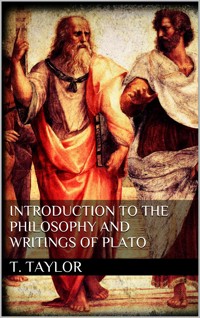
In "Introduction to the Philosophy and Writings of Plato," Thomas Taylor expertly navigates the complex terrain of Platonic thought, elucidating the foundational concepts and dialogues that have shaped Western philosophy. Taylor employs a didactic literary style, combining rigorous analysis with accessible prose that invites both scholars and lay readers alike into the intricacies of Plato's ideas. His contextualization of Plato within the broader framework of Ancient Greek philosophy reveals both the interconnectedness of philosophical thought and the relevance of Platonic ideals in contemporary discourse. Through meticulous examination of dialogues such as "The Republic" and "Phaedrus," Taylor offers insight into the allegorical subtleties and metaphysical underpinnings of Plato's work. Thomas Taylor, renowned as one of the foremost Neoplatonist philosophers and translators in the early 19th century, was greatly influenced by both classical thought and mystical philosophy. His extensive background in Ancient Greek literature and dedication to reviving Platonic texts positioned him uniquely to provide readers with a richly informed perspective on Plato's philosophies. This work reflects Taylor's passion for uncovering the spiritual dimensions of Plato's dialogues, which resonates with his own philosophical inquiries. I highly recommend "Introduction to the Philosophy and Writings of Plato" to anyone interested in the enduring legacy of Platonic thought. Whether you are a seasoned philosopher seeking a deeper understanding or a newcomer curious about the origins of Western philosophy, Taylor's comprehensive guide will illuminate the nuances of Plato's writings and inspire further exploration into the philosophical dialogue that continues to shape our world. In this enriched edition, we have carefully created added value for your reading experience: - A succinct Introduction situates the work's timeless appeal and themes. - The Synopsis outlines the central plot, highlighting key developments without spoiling critical twists. - A detailed Historical Context immerses you in the era's events and influences that shaped the writing. - A thorough Analysis dissects symbols, motifs, and character arcs to unearth underlying meanings. - Reflection questions prompt you to engage personally with the work's messages, connecting them to modern life. - Hand‐picked Memorable Quotes shine a spotlight on moments of literary brilliance. - Interactive footnotes clarify unusual references, historical allusions, and archaic phrases for an effortless, more informed read.
Das E-Book können Sie in Legimi-Apps oder einer beliebigen App lesen, die das folgende Format unterstützen:
Veröffentlichungsjahr: 2022
Ähnliche








Introduction to the Philosophy and Writings of Plato
Table of Contents
Introduction
This book stages a meeting between Plato’s living dialogues and a Neoplatonist’s urge to systematize them, asking how ancient wisdom can guide modern minds. Thomas Taylor, a devoted interpreter of Greek philosophy, offers here a sustained orientation to Plato’s thought and literary craft. Rather than treating the dialogues as isolated texts, he frames them as parts of a coherent philosophical pursuit. Readers are invited into a disciplined path, where argument, myth, and moral formation cooperate. The result is not a summary of conclusions but a map of approaches, designed to equip newcomers and practiced readers alike with principles for entering Plato’s world responsibly.
Introduction to the Philosophy and Writings of Plato is an expository work of philosophical criticism and pedagogy. Written by the English translator and scholar Thomas Taylor, it appeared as a prefatory essay to his English renderings of Plato in the early nineteenth century. Its publication context reflects a renewed Anglophone engagement with classical Greek thought, in which Taylor sought to make Plato accessible beyond specialist circles. As an introduction, it does not reproduce the dialogues; instead, it situates them, articulates key terms, and defines a way of reading that respects both the literary form and the metaphysical ambitions of Plato’s corpus.
The reading experience is guided and ceremonious, marked by a confident, instructive voice that balances textual attentiveness with synoptic vision. Taylor writes in a formal, sometimes ornate style that mirrors his conviction that philosophy is as much a mode of elevation as of analysis. The tone is reverent without being opaque: technical matters are framed as aids to understanding rather than barriers to entry. He privileges clarity of method over polemic, pacing the reader through concepts, genres of dialogue, and purposes of inquiry. The prose aims to cultivate patience, inviting contemplation as the appropriate posture for entering Platonic conversation.
Without narrating the dialogues’ outcomes, Taylor emphasizes themes that organize a reader’s progress. He underscores the kinship of ethics and metaphysics, in which questions of virtue are inseparable from accounts of being and knowledge. He treats dialectic as a disciplined ascent that begins with everyday opinions and rises toward intelligible order. He attends to the roles of myth, imagery, and dramatic setting, showing how these elements educate the imagination alongside reason. And he presents philosophy as a way of life, where intellectual refinement and moral formation mutually support the search for wisdom.
For contemporary readers, this introduction remains valuable as both historical document and practical guide. It models how to read Plato’s dialogues as integrated works rather than repositories of isolated doctrines, resisting reductive summaries. By articulating principles for approach—attention to form, patience with aporia, sensitivity to gradations of argument—it equips students, general readers, and scholars with habits that travel across texts. The book also illuminates a pivotal moment in the reception of Plato, when English prose sought to carry Greek philosophical ambition, reminding us that translation is interpretation and that every era must earn its access to the classics.
Taylor’s perspective is shaped by the later Platonic tradition, and he makes that lineage a resource for understanding rather than a constraint on inquiry. The advantage of this lens is a coherent picture that honors the dialogues’ spiritual seriousness as well as their logical rigor. The task for today’s reader is to use his synthesis as a set of hypotheses to test against the texts, not as a substitute for them. In doing so, one encounters Plato as simultaneously ancient and timely: demanding in method, generous in vision, and perpetually reawakening questions of truth, goodness, beauty, and the formation of the soul.
Approached in this spirit, Introduction to the Philosophy and Writings of Plato serves as a gateway to disciplined reading and as an invitation to philosophical life. It prepares the reader to navigate the dialogues with a steady compass, alert to structure and symbol, argument and aspiration. Its continuing relevance lies in the promise that careful attention can still transmute perplexity into understanding, and that the classics endure not by authority alone but by their capacity to renew inquiry. Taylor’s essay offers orientation without closure, urging us to read widely, think slowly, and let ancient conversation shape contemporary judgment.
Synopsis
Thomas Taylor’s Introduction to the Philosophy and Writings of Plato serves as a comprehensive preface to his translations, designed to orient readers to Plato’s scope, aims, and interpretive challenges. Taylor situates Plato within the lineage of ancient philosophy, contending that the dialogues form a coherent system rather than a set of occasional pieces. Drawing on late antique commentators, he proposes that careful attention to method, symbolism, and dramatic setting is essential for understanding Plato’s arguments. The introduction sets expectations for readers entering a demanding corpus, emphasizing disciplined study, philosophical practice, and a readiness to move from ethical and political questions to metaphysical and theological inquiry.
Taylor sketches a biographical and intellectual portrait of Plato that emphasizes formation under Socrates, engagement with earlier Greek wisdom, and the founding of the Academy. Rather than compiling disparate anecdotes, he uses these elements to clarify Plato’s guiding intention: the cultivation of the soul through philosophy. The focus remains on the character of inquiry itself—how dialectic, mathematics, and rigorous discussion purify and elevate the mind. Taylor treats biography as a frame that illuminates the stakes of the dialogues, proposing that Plato’s life exemplifies the possibility of turning from mutable opinions to stable, intelligible principles without reducing the dialogues to memoir.
A central portion outlines how the dialogues may be grouped and approached. Taylor reviews ancient classifications, including arrangements attributed to Peripatetic and later Platonist scholarship, and discusses traditional reading orders that move from ethical and political conversations to more exacting logical and metaphysical investigations. He stresses that dramatic variety does not undermine systematic intent; rather, it addresses different audiences and stages of learning. Modes of discourse—argument, narrative, and myth—are examined as pedagogical instruments. This prepares readers to navigate shifts in tone and method without assuming inconsistency, and frames the dialogues as a curriculum in intellectual and moral formation.
Taylor then introduces Plato’s metaphysical architecture in broad outline. He explains the doctrine of intelligible Forms, the role of the Good as the highest principle, and the relation between intellect, soul, and the cosmos. Discussions of causation and participation are linked to dialogues where these themes are prominent, and Taylor uses insights from late Platonists to clarify difficult passages without claiming to finalize debated questions. The result is a map for approaching topics such as unity and multiplicity, being and becoming, and the ordering of nature, presented as mutually reinforcing strands rather than isolated theses.
The ethical and political dimensions are treated as integral to metaphysics. Taylor highlights the cultivation of virtue, the ordering of desire through reason, and the practice of civic prudence as preparatory to higher contemplation. Education, music, and mathematics are presented as instruments of character formation that harmonize the soul with intelligible order. In political discussions, he emphasizes the ideal of law and statesmanship as reflections of a prior moral measure, while cautioning that institutional arrangements must be read alongside Plato’s analysis of the soul. Throughout, ethics appears not as an independent sphere but as a path oriented toward intellectual vision.
Taylor devotes sustained attention to myth, symbolism, and theology. Myths are read as vehicles that articulate truths resistant to purely discursive treatment, inviting ascent from images to causes. He addresses recurrent objections that Plato’s myths and metaphors signal inconsistency, arguing instead for their deliberate use within a graded pedagogy. With support from ancient commentators, Taylor maintains that theological language in Plato seeks to safeguard transcendence while guiding inquiry. He also briefly defends translation choices and terminology, aiming to preserve technical precision and suggest the texture of the original, while acknowledging the limits of any rendering into modern idiom.
The introduction closes by defending the coherence and enduring relevance of Plato’s project. Taylor urges readers to approach the dialogues as a mutually illuminating whole, to balance patient exegesis with philosophical exercise, and to resist reducing Platonic thought to any single doctrinal fragment. Without resolving live controversies, he underscores Plato’s power to provoke inquiry into the highest causes and the best human life. The work thus functions as both guide and invitation, offering a structured pathway into a complex corpus and arguing for its capacity to inform moral, civic, and contemplative life across changing intellectual climates.
Historical Context
Thomas Taylor's Introduction to the Philosophy and Writings of Plato emerged in London during the early nineteenth century, when Britain's print culture and classical scholarship were expanding under late Georgian patronage. Taylor (1758-1835), known as the Platonist, issued the first complete English translation of Plato in 1804, with this Introduction as its programmatic preface. The publication coincided with the Napoleonic Wars, which intensified interest in the heritage of classical civilizations even as they strained Britain's economy and book trade. Taylor operated outside university posts, relying on booksellers, subscribers, and sympathetic patrons to circulate an ambitious, learned defense of Platonic wisdom to an English readership.
At the turn of the century, England's leading institutions of higher learning, Oxford and Cambridge, were Anglican in governance and largely closed to nonconformists until later nineteenth-century reforms, shaping both access and intellectual tone. University curricula emphasized classical languages and Aristotelian logic, while British philosophy remained dominated by empiricism and Scottish Common Sense realism. The prestige of Baconian and Newtonian science encouraged cautious metaphysics and suspicion of speculative systems. Against this backdrop, systematic engagement with Plato's metaphysical and theological themes was uncommon in English. Taylor's Introduction presents Platonism as a coherent, rigorous tradition, challenging prevailing assumptions about the limits of reason and the scope of ancient philosophy.
Late Enlightenment debates in Britain pitted empiricist accounts of knowledge, associated with John Locke and David Hume, against their critics, while moral philosophy increasingly turned toward utility and political economy through the influence of Jeremy Bentham. Scottish thinkers such as Thomas Reid and Dugald Stewart advocated common-sense principles and careful introspection. In that intellectual climate, Plato's metaphysics of immaterial forms and his theology of a first principle could appear remote or obsolete. Taylor's project sought to rehabilitate Plato as a guide to first philosophy, contending, through learned apparatus and framing, that ancient wisdom addressed perennial questions left unresolved by modern empiricism.
English readers before 1800 had access only to scattered renderings of Plato's dialogues. The most substantial were by the classicist Floyer Sydenham (1710-1787), who translated several dialogues with notes. After Sydenham's death, Taylor edited, supplemented, and eventually issued a collected edition that combined Sydenham's work with his own new translations. Such large classical folios were expensive to produce; Taylor relied on subscription lists and aristocratic patronage to finance printing and plates. His Introduction therefore also functioned as a manifesto to attract readers and supporters, justifying a comprehensive English Plato with extensive annotations and a clearly stated interpretive orientation.
Taylor's approach was shaped by late antique Neoplatonist commentators, notably Plotinus, Porphyry, Iamblichus, Syrianus, and Proclus, many of whom he translated into English. He treated their exegetical traditions as authoritative guides to Plato's theology, cosmology, and ethics, favoring allegorical and hierarchical readings. His Greek text resources predated later standardized editions; the great nineteenth-century philological projects that stabilized classical texts, including critical editions by scholars such as Immanuel Bekker and later Gottfried Stallbaum, were only just emerging. Consequently, the Introduction situates Plato within a continuous metaphysical lineage more than within philological debates, proposing a structured vision of ancient philosophy aimed at coherence rather than modern textual minimalism.
Britain's political atmosphere after the French Revolution mixed reformist currents with governmental reaction. War with France, the suspension of habeas corpus, and restrictions on assembly shaped public discourse from the 1790s through 1815. Taylor kept his scholarship separate from party politics, yet he published A Vindication of the Rights of Brutes (1792), a satirical tract that parodied contemporary rights rhetoric to skeptical effect. He also defended ancient religious traditions against modern materialism. In this climate, the Introduction's reverent treatment of Plato's theology and virtue ethics appears as a learned counterpoint to utilitarian and reductionist trends in British intellectual life.
Across the same decades, European culture moved from neoclassical restraint toward Romantic enthusiasm, and a wave of philhellenism celebrated Greek art, language, and liberty, especially during the Greek War of Independence (1821-1830). Taylor's translations circulated among poets and essayists searching for ancient sources of insight. Percy Bysshe Shelley read Taylor's versions of Platonic and Neoplatonic texts, and Ralph Waldo Emerson later acknowledged debts to Taylor in shaping American Transcendentalist discourse. The Introduction's exalted picture of Plato as a sage of divine philosophy resonated with readers who associated Greek antiquity with imaginative freedom and moral elevation.
Although later Victorian scholarship, especially Benjamin Jowett's translations from 1871 onward, eclipsed Taylor's mannered prose and Neoplatonic emphases, his Introduction belongs to a formative moment in Anglophone reception of Plato. It fuses Enlightenment erudition, subscription publishing, and a Romantic hunger for spiritual coherence. By presenting Plato through the lens of ancient commentators and resisting contemporary materialism, the work both reflects and critiques its age: it exploits the era's expanding access to classical texts while urging readers to recover a theologically inflected, virtue-centered philosophy as an antidote to utilitarian calculation and the narrowing of speculative ambition.




