


28,79 €
Mehr erfahren.
- Herausgeber: Packt Publishing
- Kategorie: Wissenschaft und neue Technologien
- Sprache: Englisch
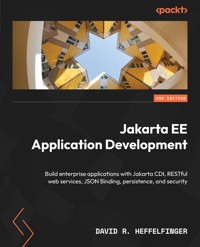
Jakarta EE stands as a robust standard with multiple implementations, presenting developers with a versatile toolkit for building enterprise applications. However, despite the advantages of enterprise application development, vendor lock-in remains a concern for many developers, limiting flexibility and interoperability across diverse environments.
This Jakarta EE application development guide addresses the challenge of vendor lock-in by offering comprehensive coverage of the major Jakarta EE APIs and goes beyond the basics to help you develop applications deployable on any Jakarta EE compliant runtime.
This book introduces you to JSON Processing and JSON Binding and shows you how the Model API and the Streaming API are used to process JSON data. You’ll then explore additional Jakarta EE APIs, such as WebSocket and Messaging, for loosely coupled, asynchronous communication and discover ways to secure applications with the Jakarta EE Security API. Finally, you'll learn about Jakarta RESTful web service development and techniques to develop cloud-ready microservices in Jakarta EE.
By the end of this book, you'll have developed the skills to craft secure, scalable, and cloud-native microservices that solve modern enterprise challenges.
Das E-Book können Sie in Legimi-Apps oder einer beliebigen App lesen, die das folgende Format unterstützen:
Seitenzahl: 341
Veröffentlichungsjahr: 2024
Ähnliche
















Jakarta EE Application Development
Build enterprise applications with Jakarta CDI, RESTful web services, JSON Binding, persistence, and security
David R. Heffelfinger
Jakarta EE Application Development
Copyright © 2024 Packt Publishing
All rights reserved. No part of this book may be reproduced, stored in a retrieval system, or transmitted in any form or by any means, without the prior written permission of the publisher, except in the case of brief quotations embedded in critical articles or reviews.
Every effort has been made in the preparation of this book to ensure the accuracy of the information presented. However, the information contained in this book is sold without warranty, either express or implied. Neither the author, nor Packt Publishing or its dealers and distributors, will be held liable for any damages caused or alleged to have been caused directly or indirectly by this book.
Packt Publishing has endeavored to provide trademark information about all of the companies and products mentioned in this book by the appropriate use of capitals. However, Packt Publishing cannot guarantee the accuracy of this information.
Group Product Manager: Kunal Sawant
Publishing Product Manager: Akash Sharma
Book Project Manager: Prajakta Naik
Senior Editor: Esha Banerjee
Technical Editor: Vidhisha Patidar
Copy Editor: Safis Editing
Indexer: Hemangini Bari
Production Designer: Shankar Kalbhor
DevRel Marketing Coordinator: Samriddhi Murarka
First published: December 2017
Second edition: February 2024
Production reference: 1160224
Published by
Packt Publishing Ltd.
Grosvenor House
11 St Paul’s Square
Birmingham
B3 1RB, UK
ISBN 978-1-83508-526-4
www.packtpub.com
Contributors
About the author
David R. Heffelfinger is an independent consultant based in the Washington D.C. area. He is a Java Champion and Apache Netbeans Project Management Committee.
He has written several books on Java EE, application servers, NetBeans, and JasperReports. His previous titles include Java EE 8 Application Development, Java EE 7 Development with NetBeans 8, Java EE 7 with GlassFish 4 Application Server, JasperReports 3.5 For Java Developers, among others.
David has spoken at various software conferences, including JavaOne and Oracle Code One, multiple times. He has also presented at NetBeans Day in both San Francisco and Montreal.
About the reviewers
Amol Gote is a seasoned technology professional adept at building scalable, resilient microservices in both Java and .NET. He excels in deploying and managing microservices in AWS and Azure environments, boasting technical proficiency across multiple applications and tools. His expertise spans full-stack capabilities, from designing to constructing end-to-end solutions that include databases (SQL/NoSQL), back-end services, messaging services, and modern interactive web applications using web sockets.
Currently serving as a Solutions Architect at a Fintech startup, Amol has built the underwriting platform from scratch, along with multiple horizontal and vertical business domain-specific microservices. Previously, he has engaged in consulting roles with major clients like Bank of America, Morgan Stanley, and the Associated Press, and has worked with Microsoft for seven years.
With over 18 years of experience, Amol is passionate about writing blogs and technical articles for online platforms like DZone, Baeldung, and InfoQ. He has also served as a judge and mentor at various Hackathon events. Amol’s commitment to excellence is evident in his multiple certifications, including AWS Certified Solutions Architect and various Microsoft certifications.
Edwin Derks is a Java Champion from The Netherlands who loves solving complex and strategic IT challenges. He is passionate about gathering and sharing knowledge about anything related to the Java ecosystem, composable architectures, and cloud-driven development in general. He contributes to MicroProfile and Jakarta EE and often speaks at conferences, passionately sharing his knowledge and experience.
In his spare time, he is a loving husband and a father of three. He can often be found in the gym or having a good time at dance parties or heavy metal concerts.
Table of Contents
Preface
1
Introduction to Jakarta EE
Introduction to Jakarta EE
Contributing to Jakarta EE
Jakarta EE APIs
One standard, multiple implementations
Jakarta EE, Java EE, J2EE, and the Spring Framework
Summary
2
Contexts and Dependency Injection
Named beans
Dependency injection
Qualifiers
CDI bean scopes
CDI events
Firing CDI events
Handling CDI events
Asynchronous events
Event ordering
CDI Lite
Summary
3
Jakarta RESTful Web Services
Introduction to RESTful web services
Developing a simple RESTful web service
Configuring the REST resources path for our application
Developing a RESTful web service client
Seamlessly converting between Java and JSON
Query and path parameters
Query parameters
Path parameters
Server-sent events
Testing server-sent events
Developing a server-sent events client
JavaScript server-sent events client
Summary
4
JSON Processing and JSON Binding
Jakarta JSON Processing
The JSON Processing Model API
The JSON Processing Streaming API
Jakarta JSON Binding
Populating Java objects from JSON with JSON Binding
Generating JSON data from Java objects with JSON Binding
Summary
5
Microservices Development with Jakarta EE
An introduction to microservices
The advantages of a microservices architecture
The disadvantages of a microservices architecture
Microservices and Jakarta EE
Developing microservices using Jakarta EE
Developing microservices client code
The controller service
The persistence service
Summary
6
Jakarta Faces
Introduction to Jakarta Faces
Facelets
Optional faces-config.xml
Standard resource locations
Developing our first Faces application
Facelets
Project stages
Validation
Grouping components
Form submission
Named beans
Static navigation
Dynamic navigation
Custom data validation
Creating custom validators
Validator methods
Customizing default messages
Customizing message styles
Customizing message text
Summary
7
Additional Jakarta Faces Features
Ajax-enabled Faces applications
Jakarta Faces HTML5 support
HTML5-friendly markup
Pass-through attributes
Faces Flows
Faces WebSocket support
Additional Faces component libraries
Summary
8
Object Relational Mapping with Jakarta Persistence
The CUSTOMERDB database
Configuring Jakarta Persistence
Persisting data with Jakarta Persistence
Entity relationships
One-to-one relationships
One-to-many relationships
Many-to-many relationships
Composite primary keys
Jakarta Persistence Query Language
Criteria API
Updating data with the Criteria API
Deleting data with the Criteria API
Bean Validation support
Final notes
Summary
9
WebSockets
Developing WebSocket server endpoints
Developing an annotated WebSocket server endpoint
Developing WebSocket clientsin JavaScript
Developing JavaScript client-side WebSocket code
Developing WebSocket clients in Java
Summary
10
Securing Jakarta EE Applications
Identity stores
Setting up an identity store stored in a relational database
Setting up an identity store stored in an LDAP database
Custom identity stores
Authentication mechanisms
Basic authentication mechanism
Form authentication mechanism
Custom form authentication mechanism
Summary
11
Servlet Development and Deployment
What is a servlet?
Writing our first servlet
Testing the web application
Processing HTML forms
Request forwarding and response redirection
Request forwarding
Response redirection
Persisting application data across requests
Passing initialization parameters to a servlet via annotations
Servlet filters
Servlet listeners
Pluggability
Configuring web applications programmatically
Asynchronous processing
HTTP/2 server push support
Summary
12
Jakarta Enterprise Beans
Session beans
A simple session bean
A more realistic example
Invoking session beans from web applications
Singleton session beans
Asynchronous method calls
Message-driven beans
Transactions in enterprise beans
Container-managed transactions
Bean-managed transactions
Enterprise bean life cycles
Stateful session bean life cycle
Stateless and singleton session bean life cycle
Message-driven bean life cycle
Enterprise bean timer service
Calendar-based enterprise bean timer expressions
Enterprise bean security
Summary
13
Jakarta Messaging
Working with message queues
Sending messages to a message queue
Retrieving messages from a message queue
Browsing message queues
Working with message topics
Sending messages to a message topic
Receiving messages from a message topic
Creating durable subscribers
Summary
14
Web Services with Jakarta XML Web Services
Developing web services with Jakarta XML Web Services
Developing a web service client
Sending attachments to web services
Exposing Enterprise Beans as web services
Enterprise Beans web service clients
Summary
15
Putting it All Together
The sample application
The landing page
Creating customer data
Viewing customer data
Updating customer data
Deleting customer data
Implementing pagination
Summary
Index
Other Books You May Enjoy
1
Introduction to Jakarta EE
Jakarta EE consists of a set of Application Programming Interface (API) specifications used to develop server-side enterprise Java applications. Most chapters in this book will cover a single Jakarta EE specification, such as Contexts and Dependency Injection (CDI), which is used to integrate different parts of an application, or Jakarta RESTful Web Services, which is used to develop RESTful web services. We also cover Jakarta EE APIs for processing data in JSON format, as well as Jakarta Faces, which is used to develop web-based user interfaces. We also delve into how to interact with relational databases, implementing two-way communication between clients and servers in web applications, security, and messaging.
In this chapter, we will cover the following topics:
Introduction to Jakarta EEJakarta EE, Java EE, J2EE, and the Spring FrameworkIntroduction to Jakarta EE
Jakarta EE is a collection of API specifications designed to work together when developing server-side enterprise Java applications. Jakarta EE is a standard for which there are multiple implementations. This fact prevents vendor lock-in since code developed against the Jakarta EE specification can be deployed in any Jakarta EE-compliant implementation.
Jakarta EE is an Eclipse Software Foundation project. Since the Jakarta EE specification is open source, any organization or individual wishing to contribute is free to do so.
Contributing to Jakarta EE
There are many ways of contributing, including participating in discussions and providing suggestions for future versions of Jakarta EE. To do so, one simply needs to subscribe to the appropriate mailing list, which can be done by visiting https://jakarta.ee/connect/mailing-lists/.
In order to subscribe to the mailing list, you need to create a free Eclipse.org account at https://accounts.eclipse.org/user/register.
To go beyond participating in discussions and actually contribute code or documentation, the Eclipse Contributor Agreement must be signed. The Eclipse Contributor Agreement can be found at https://www.eclipse.org/legal/ECA.php.
Jakarta EE APIs
As previously mentioned, Jakarta EE is a collection of API specifications designed to work together when developing server-side enterprise Java applications.
In addition to the full Jakarta EE platform, there are two Jakarta EE profiles that contain a subset of the specifications and APIs included in the full platform. The Jakarta EE Web Profile contains a subset of specifications and APIs suitable for developing web applications. The Jakarta EE Core Profile contains an even smaller subset of specifications and APIs more suitable for developing microservices.
The Jakarta EE core profile APIs include the following:
Jakarta Context and Dependency Injection Lite (CDI Lite)Jakarta RESTful Web ServicesJakarta JSON ProcessingJakarta JSON BindingThe version of Contexts and Dependency Injection API included in the core profile is a subset of the full specification. The Jakarta EE Web Profile APIs include the full CDI specification instead of CDI Lite, plus all other specifications and APIs in the core profile, along with some additional ones:
Jakarta Context and Dependency InjectionJakarta FacesJakarta PersistenceJakarta WebSocketJakarta SecurityJakarta ServletJakarta Enterprise Beans LiteThe version of Jakarta Enterprise Beans included in the Web Profile is a subset of the full enterprise beans specification.
The full Jakarta EE Platform includes the full Jakarta Enterprise Beans spec, plus all other specifications and APIs included in the Web Profile, along with some additional ones:
Jakarta Enterprise BeansJakarta MessagingJakarta Enterprise Web ServicesFull list of Jakarta EE APIs
The preceding list is not exhaustive, and only lists some of the most popular Jakarta EE APIs. For an exhaustive list of Jakarta EE APIs, please refer to https://jakarta.ee/specifications/.
Application server vendors or the open-source community need to provide compatible implementations for each Jakarta EE API specification in the preceding list.
One standard, multiple implementations
At its core, Jakarta EE is a specification, a piece of paper, if you will. Implementations of Jakarta EE specifications need to be developed so that application developers can actually develop server-side enterprise Java applications against the Jakarta EE standard.
Each Jakarta EE API can have multiple implementations. The popular Hibernate Object-Relational Mapping tool, for example, is an implementation of Jakarta Persistence, but it is by no means the only one. Other Jakarta Persistence implementations include EclipseLink and Open JPA. Similarly, there are multiple implementations of every single Jakarta EE specification.
Jakarta EE applications are typically deployed to an application server. Some popular application servers include JBoss, Websphere, Weblogic, and GlassFish. Each application server is considered to be a Jakarta EE implementation. Application server vendors either develop their own implementations of the several Jakarta EE specifications or choose to include an existing implementation.
Application developers benefit from the Jakarta EE standard by not being tied to a specific Jakarta EE implementation. As long as an application is developed against the standard Jakarta EE APIs, it should be very portable across application server vendors.
Application server vendors then bundle a set of Jakarta EE API implementations together as part of their application server offerings. Since each implementation is compliant with the corresponding Jakarta EE specification, code developed against one implementation can run unmodified against any other implementation, avoiding a vendor lock-in.
The following table lists some popular Jakarta EE implementations:
Jakarta EE Implementation
Vendor
License
URL
Apache Tomee
Tomitribe
Apache License, Version 2.0
https://tomee.apache.org/
Eclipse GlassFish
Eclipse Foundation
Eclipse Public License - v 2.0
https://glassfish.org/
IBM Websphere Liberty
IBM
Commercial
https://www.ibm.com/products/websphere-liberty
JBoss Enterprise Application Platform
Red Hat
Commercial
https://www.redhat.com/en/technologies/jboss-middleware/application-platform
Open Liberty
IBM
Eclipse Public License 2.0
https://openliberty.io/
Payara Server Community
Payara Services Ltd
Dual licensed :CDDL 1.1 / GPL v2 + Classpath Exception
https://www.payara.fish/products/payara-platform-community/
Payara Server Enterprise
Payara Services Ltd
Commercial
https://www.payara.fish/products/payara-platform-community/
Wildfly
Red Hat
LGPL v2.1
https://www.wildfly.org/
Table 1.1 – Popular Jakarta EE Implementations
Note
For the full list of Jakarta EE-compatible implementations, please refer to https://jakarta.ee/compatibility/.
For most examples in this book, we will be using GlassFish as our Jakarta EE runtime. This is because it is a high-quality, up-to-date, open-source implementation not tied to any particular vendor; all examples should be deployable to any Jakarta EE-compliant implementation.
Jakarta EE, Java EE, J2EE, and the Spring Framework
In 2017, Oracle donated Java EE to the Eclipse Foundation and as part of the process, Java EE was renamed Jakarta EE. The donation to the Eclipse Foundation meant that the Jakarta EE specification became truly vendor-neutral, with no single vendor having control over the specifications.
Java EE, in turn, was introduced back in 2006 by Sun Microsystems. The first version of Java EE was Java EE 5. Java EE replaced J2EE; the last version of J2EE was J2EE 1.4, released back in 2003. Even though J2EE can be considered obsolete technology, having been superseded by Java EE several years ago and then renamed Jakarta EE, the term J2EE refuses to die. Many individuals to this day still refer to Jakarta EE as J2EE and many companies advertise on their websites and job boards that they are looking for “J2EE developers”, seemingly unaware that they are referring to a technology that has been obsolete for several years. The current correct term for the technology is Jakarta EE.
Additionally, the term J2EE has become a “catch-all” term for any server-side Java technology; frequently Spring applications are referred to as J2EE applications. Spring is not and never has been J2EE. As a matter of fact, Spring was created by Rod Johnson as an alternative to J2EE back in 2002. Just as with Jakarta EE, Spring applications are frequently erroneously referred to as J2EE applications.
Summary
In this chapter, we provided an introduction to Jakarta EE, outlining a list of several technologies and APIs included with Jakarta EE:
We covered how Jakarta EE is openly developed both by software vendors and the Java community at large via the Eclipse Software FoundationWe explained how there are multiple implementations of Jakarta EE, a fact that avoids vendor lock-in and allows us to easily migrate our Jakarta EE applications from one implementation to anotherWe cleared up the confusion between Jakarta EE, Java EE, J2EE, and Spring, explaining how Jakarta EE and Spring applications are frequently referred to as J2EE applications, even though J2EE has been obsolete for several yearsNow that we’ve had a general overview of Jakarta EE, we are ready to start learning how to use Jakarta EE to develop our applications.




