


Erhalten Sie Zugang zu diesem und mehr als 300000 Büchern ab EUR 5,99 monatlich.
- Herausgeber: Kohlhammer Verlag
- Kategorie: Religion und Spiritualität
- Sprache: Englisch
This commentary illumines Jer 26-52 through historical, literary, feminist, and postcolonial analysis. Ideologies of subjugation and resistance are entangled in the Jeremiah traditions. The reader is guided through narratives of extreme violence, portrayals of iconic allies and adversaries, and complex gestures of scribal resilience. Judah's cultural trauma is refracted through prose that mimics Neo-Babylonian colonizing ideology, dramatic scenes of survival, and poetry alight with the desire for vengeance against enemies. The commentary's historical and literary arguments are enriched by insights from archaeology, feminist translation theory, and queer studies.
Sie lesen das E-Book in den Legimi-Apps auf:
Seitenzahl: 1223
Veröffentlichungsjahr: 2021
Das E-Book (TTS) können Sie hören im Abo „Legimi Premium” in Legimi-Apps auf:
Ähnliche















International Exegetical Commentary on the Old Testament (IECOT)
Edited by:
Walter Dietrich, David M. Carr, Adele Berlin, Erhard Blum, Irmtraud Fischer, Shimon Gesundheit, Walter Groß, Gary Knoppers (†), Bernard M. Levinson, Ed Noort, Helmut Utzschneider and Beate Ego (Apocrypha/Deuterocanonical books)
Cover:
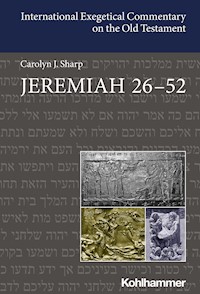
Top: Panel from a four-part relief on the “Black Obelisk of Shalmaneser III” (859–824 BCE) depicting the Israelite king Jehu (845–817 BCE; 2 Kings 9f) paying obeisance to the Assyrian “King of Kings.” The vassal has thrown himself to the ground in front of his overlord. Royal servants are standing behind the Assyrian king whereas Assyrian officers are standing behind Jehu. The remaining picture panels portray thirteen Israelite tribute bearers carrying heavy and precious gifts. Photo © Z.Radovan/BibleLandPictures.comBottom left: One of ten reliefs on the bronze doors that constitute the eastern portal (the so-called “Gates of Paradise”) of the Baptistery of St. John of Florence, created 1424–1452 by Lorenzo Ghiberti (c. 1378–1455). Detail from the picture “Adam and Eve”; in the center is the creation of Eve: “And the rib that the LORD God had taken from the man he made into a woman and brought her to the man.” (Gen 2:22)Photograph by George ReaderBottom right: Detail of the Menorah in front of the Knesset in Jerusalem, created by Benno Elkan (1877–1960): Ezra reads the Law of Moses to the assembled nation (Neh 8). The bronze Menorah was created in London in 1956 and in the same year was given by the British as a gift to the State of Israel. A total of 29 reliefs portray scenes from the Hebrew Bible and the history of the Jewish people.
Carolyn J. Sharp
Jeremiah 26–52
Verlag W. Kohlhammer
Editorial collaboration: Jonathan M. Robker
1. Edition 2022
All rights reserved
© W. Kohlhammer GmbH, Stuttgart
Production: W. Kohlhammer GmbH, Stuttgart
Print:
ISBN 978-3-17-020083-8
E-Books:
pdf: ISBN 978-3-17-040081-8
epub: ISBN 978-3-17-040082-5
All rights reserved. This book or parts thereof may not be reproduced in any form, stored in any retrieval system, or transmitted in any form by any means—electronic, mechanical, photocopy, recording, microfilm/microfiche or otherwise—without prior written permission of W. Kohlhammer GmbH, Stuttgart, Germany.
Any links in this book do not constitute an endorsement or an approval of any of the services or opinions of the corporation or organization or individual. W. Kohlhammer GmbH bears no responsibility for the accuracy, legality or content of the external site or for that of subsequent links.
This commentary illumines Jer 26-52 through historical, literary, feminist, and postcolonial analysis. Ideologies of subjugation and resistance are entangled in the Jeremiah traditions. The reader is guided through narratives of extreme violence, portrayals of iconic allies and adversaries, and complex gestures of scribal resilience. Judah's cultural trauma is refracted through prose that mimics Neo-Babylonian colonizing ideology, dramatic scenes of survival, and poetry alight with the desire for vengeance against enemies. The commentary's historical and literary arguments are enriched by insights from archaeology, feminist translation theory, and queer studies.
Carolyn J. Sharp is Professor of Homiletics at Yale Divinity School in New Haven, Connecticut.
Contents
Editors’ Foreword
Author’s Preface
Abbreviations
Map of the Ancient Near East
Introduction to Jeremiah 26–52
The Formation of Jeremiah 26–52
Redactional Theories
Oracles Concerning the Nations
Further Methodological Observations
Themes and Structural Foci in Jeremiah 26–52
Retributive Justice
A Community Divided
Structural Signs of Textual Resilience
Feminist Commentary
Feminist Convictions
Feminist Hermeneutics
Translation Practices
Commentary in a Postcolonial Key
Subalterns mimic their oppressors
Subaltern hope interrupts imperial domination
Jeremiah 26: Incendiary Words of Destruction
Overview
Translation
Notes on the Text and Translation
Interpretation
Diachronic Analysis
Synchronic Analysis
Integrative Reading
Jeremiah 27–29: The Yoke of Nebuchadnezzar
Overview
Translation
Notes on the Text and Translation
Interpretation
Diachronic Analysis
Synchronic Analysis
Integrative Reading
Jeremiah 30–31: Radical Words of Consolation
Overview
Translation
Notes on the Text and Translation
Interpretation
Diachronic Analysis
Synchronic Analysis
Integrative Reading
Jeremiah 32–34: Land Claimed in Hope and Abjection
Overview
Translation
Notes on the Text and Translation
Interpretation
Diachronic Analysis
Synchronic Analysis
Integrative Reading
Jeremiah 35–36: Enduring Tradition, Indelible Word
Overview
Translation
Notes on the Text and Translation
Interpretation
Diachronic Analysis
Synchronic Analysis
Integrative Reading
Jeremiah 37–39: Sedition, Siege, and Survival
Overview
Translation
Notes on the Text and Translation
Interpretation
Diachronic Analysis
Synchronic Analysis
Integrative Reading
Jeremiah 40–45: Resistance and Resilience
Overview
Translation
Notes on the Text and Translation
Interpretation
Diachronic Analysis
Synchronic Analysis
Integrative Reading
Jeremiah 46–47: Oracles about Egypt and Philistia
Overview
Translation
Notes on the Text and Translation
Interpretation
Diachronic Analysis
Synchronic Analysis
Integrative Reading
Jeremiah 48–49: Oracles about Moab and Other Adversaries
Overview
Translation
Notes on the Text and Translation
Interpretation
Diachronic Analysis
Synchronic Analysis
Integrative Reading
Jeremiah 50–51: Oracles about Babylon
Overview
Translation
Notes on the Text and Translation
Interpretation
Diachronic Analysis
Synchronic Analysis
Integrative Reading
Jeremiah 52: The Ruination of Jerusalem
Overview
Translation
Notes on the Text and Translation
Interpretation
Diachronic Analysis
Synchronic Analysis
Integrative Reading
Bibliography
Indexes
Index of Biblical Citations
Hebrew Scriptures
Genesis
Exodus
Leviticus
Numbers
Deuteronomy
Joshua
Judges
Ruth
1 Samuel
2 Samuel
1 Kings
2 Kings
1 Chronicles
2 Chronicles
Ezra
Nehemiah
Esther
Job
Psalms
Proverbs
Ecclesiastes
Song of Solomon
Isaiah
Jeremiah
Lamentations
Ezekiel
Daniel
Hosea
Joel
Amos
Obadiah
Micah
Nahum
Habakkuk
Zephaniah
Haggai
Zechariah
Malachi
Apocrypha
Pseudepigrapha
New Testament
Matthew
Mark
Luke
John
Acts of the Apostles
Romans
1 Corinthians
2 Corinthians
Galatians
Ephesians
Colossians
1 Timothy
Titus
Hebrews
1 Peter
1 John
Revelation
Index of Key Terms
Plan of volumes
Editors’ Foreword
The International Exegetical Commentary on the Old Testament (IECOT) offers a multi-perspectival interpretation of the books of the Old Testament to a broad, international audience of scholars, laypeople and pastors. Biblical commentaries too often reflect the fragmented character of contemporary biblical scholarship, where different geographical or methodological sub-groups of scholars pursue specific methodologies and/or theories with little engagement of alternative approaches. This series, published in English and German editions, brings together editors and authors from North America, Europe, and Israel with multiple exegetical perspectives.
From the outset the goal has been to publish a series that was “international, ecumenical and contemporary.” The international character is reflected in the composition of an editorial board with members from six countries and commentators representing a yet broader diversity of scholarly contexts.
The ecumenical dimension is reflected in at least two ways. First, both the editorial board and the list of authors includes scholars with a variety of religious perspectives, both Christian and Jewish. Second, the commentary series not only includes volumes on books in the Jewish Tanach/Protestant Old Testament, but also other books recognized as canonical parts of the Old Testament by diverse Christian confessions (thus including the deuterocanonical Old Testament books).
When it comes to “contemporary,” one central distinguishing feature of this series is its attempt to bring together two broad families of perspectives in analysis of biblical books, perspectives often described as “synchronic” and “diachronic” and all too often understood as incompatible with each other. Historically, diachronic studies arose in Europe, while some of the better known early synchronic studies originated in North America and Israel. Nevertheless, historical studies have continued to be pursued around the world, and focused synchronic work has been done in an ever greater variety of settings. Building on these developments, we aim in this series to bring synchronic and diachronic methods into closer alignment, allowing these approaches to work in a complementary and mutually-informative rather than antagonistic manner.
Since these terms are used in varying ways within biblical studies, it makes sense to specify how they are understood in this series. Within IECOT we understand “synchronic” to embrace a variety of types of study of a biblical text in one given stage of its development, particularly its final stage(s) of development in existing manuscripts. “Synchronic” studies embrace non-historical narratological, reader-response and other approaches along with historically-informed exegesis of a particular stage of a biblical text. In contrast, we understand “diachronic” to embrace the full variety of modes of study of a biblical text over time.
This diachronic analysis may include use of manuscript evidence (where available) to identify documented pre-stages of a biblical text, judicious use of clues within the biblical text to reconstruct its formation over time, and also an examination of the ways in which a biblical text may be in dialogue with earlier biblical (and non-biblical) motifs, traditions, themes, etc. In other words, diachronic study focuses on what might be termed a “depth dimension” of a given text—how a text (and its parts) has journeyed over time up to its present form, making the text part of a broader history of traditions, motifs and/or prior compositions. Synchronic analysis focuses on a particular moment (or moments) of that journey, with a particular focus on the final, canonized form (or forms) of the text. Together they represent, in our view, complementary ways of building a textual interpretation.
Of course, each biblical book is different, and each author or team of authors has different ideas of how to incorporate these perspectives into the commentary. The authors will present their ideas in the introduction to each volume. In addition, each author or team of authors will highlight specific contemporary methodological and hermeneutical perspectives—e.g. gender-critical, liberation-theological, reception-historical, social-historical—appropriate to their own strengths and to the biblical book being interpreted. The result, we hope and expect, will be a series of volumes that display a range of ways that various methodologies and discourses can be integrated into the interpretation of the diverse books of the Old Testament.
Fall 2012 The Editors
Author’s Preface
This volume is the product of many years of feminist collaborative work with my esteemed colleague and cherished friend, Christl Maier, who has written the commentary on Jeremiah 1–25 in this series. Our thanks are due the Alexander von Humboldt Foundation for a grant that enabled us to host Jeremiah consultations at the Philipps-Universität Marburg and Yale Divinity School during the early stages of our work. We learned much from scholars who shared their expertise in those consultations: Ulrike Bail, Gerlinde Baumann, Mark Brummitt, Mary Chilton Callaway, Steed Davidson, Irmtraud Fischer, Wilda Gafney, Michaela Geiger, Alexandra Grund, Else Holt, Judith McKinlay, and Ulrike Sals. Wise counsel was offered as well by Jens Herzer and Rainer Kessler, and the consultations were facilitated by the unflagging administrative assistance of Michaela Geiger, Alexandra Grund, and Heather Vermeulen. I was inspired by those lively intellectual exchanges, which have been catalytic for my thinking about tensions generated by the traditional authority of the commentary writer over against the feminist valorizing of collaboration and the decentering of power, as well as ways in which feminist and postcolonial interpretive strategies should deepen the research questions that have shaped my work.
The IECOT/IEKAT commentary series is not intended primarily as a receptionhistory series. Entire volumes have been devoted to reception of motifs and passages in Jeremiah in particular historical periods. The space constraints confronting me have been acute, given the complexity of Jer 26–52 and the fact that feminist, postcolonial, and queer engagements needed articulation in these pages, something core to the purpose of this commentary. Thus I am grateful to four experts whose labors have made possible the glimpses into reception of Jeremiah texts that I could afford here: Mary Chilton Callaway, Joy Schroeder, Seth Tarrer, and J. Jeffery Tyler.
Warm thanks are due to Harold Attridge, dean of Yale Divinity School during the inception of this project, who generously supported our research. That support has been vital for nine years of transatlantic collaborative meetings in Marburg, in New Haven, and at annual meetings of the Society of Biblical Literature. I offer my gratitude as well to the current Henry L. Slack Dean of Yale Divinity School, Gregory Sterling, whose unstinting support of faculty research and generosity regarding a new trajectory in my professional formation have been enormously important to me.
I am grateful for the scholarship fostered by the Israelite Prophetic Literature section and the Writing/Reading Jeremiah section of the Society of Biblical Literature, two professional groups with which I first became involved early in my career. Thanks go to Jeremiah scholars who have been special mentors and friends for many years: Walter Brueggemann, Julie Claassens, Else Holt, and Louis Stulman. Other Jeremiah scholars who have inspired me include Mark Brummitt, Corrine Carvalho, Georg Fischer, Rhiannon Graybill, Amy Kalmanofsky, Mark Leuchter, Jack Lundbom, William McKane, Kathleen O’Connor, Hermann-Josef Stipp, and Robert Wilson. I honor the memory of Leo Perdue, whom I never met, for his lifegiving candor about oppressive dimensions of the book of Jeremiah. I learned much from a Jeremiah conference in Ascona, Switzerland in June 2014 and thank the colleagues who hosted that gathering, Hindy Najman and Konrad Schmid. The wisdom and patience of our excellent editors, Walter Dietrich and David Carr, have been indispensable to this commentary work. I am grateful as well for the superb technical assistance and unfailing kindness of Florian Specker, and for outstanding copy-editing by Jonathan Miles Robker.
In North American universities, land acknowledgement statements have become important to keep us mindful of indigenous peoples whose ancestors were harassed, forcibly displaced, tortured, and killed in militarized colonization processes initiated by settlers of European heritage. The persistent economic, social, and political challenges with which Native groups have contended to the present day are due in no small part to that history of injustice and cultural trauma, and to the failure of governmental and other agencies to make meaningful reparations. Yale University acknowledges that indigenous peoples and nations, including Mohegan, Mashantucket Pequot, Eastern Pequot, Schaghticoke, Golden Hill Paugussett, Niantic, Quinnipiac, and other Algonquian-speaking peoples, have stewarded through generations the lands and waterways of what is now Connecticut. My offices, the Yale libraries that support my research, and the classrooms in which I teach are located on unceded land of the Quinnipiac and Niantic peoples.
I have been emboldened in the writing of this commentary by the conviction of homiletician Frank Thomas that writing can be an act ofresistance. I heard Dr. Thomas insist on this at the biennial meeting of the Societas Homiletica in Durham, North Carolina in 2018: “Writing is resistance!” Writing unquestionably constituted resistance for some in the scribal circles of ancient Judah, as for other poets, novelists, essayists, and scholarly writers through the centuries. Writing remains a powerful mode of resistance for feminist writers, queer theorists, and others who craft insights aimed at dismantling patriarchy and white supremacy, cis-hetero violence and the erasure of queer realities, economic injustice, and other terrors. Such writing can be prophetic indeed. Among those who have helped me to understand the creative power of writing as resistance are feminist writers and artists who gather regularly at the Trinity Center in Salter Path, North Carolina under the auspices of a remarkable grassroots organization, the Resource Center for Women & Ministry in the South. I offer my warm thanks to the women of Pelican House, especially Jeanette Stokes, Cathy Hasty, Marcy Litle, Joyce Ann Mercer, Beverly Mitchell, Mary Clark Moschella, Márcia Rego, Marion Thullbery, Rebecca Wall, and Rachael Wooten.
Words cannot express my debt to Christl Maier, whose friendship means the world to me. Working collaboratively with her has been beautiful and instructive in ways I have only begun to measure. Our analytical and constructive feminist work unfolds in differing ways in our two volumes, as is entirely appropriate for feminist discourse. Our deployment of differing hermeneutical models, different ways of probing the significance of history, and different varieties of feminist analysis speaks authentically to our lived experience and to the audiences, scholarly and other, that we aim to engage. Christl’s brilliant work on this Jeremiah project and her guild leadership as a feminist scholar have provided continual inspiration and renewed energy in my intellectual life.
My family has been stalwart in supporting me, observing with amusement my spates of joyous productivity and sustaining me during difficult moments when I was overwhelmed by the magnitude of the work. Our offspring, Dinah and Jake, have been loving and sardonic in just the right measure to help me maintain perspective during this arduous process. Nothing would have been possible, on this commentary or anything else, without the love and counsel of my beloved life partner, Leo Lensing. It is to Leo that I dedicate this volume.
CJSFeast of the Nativity of John the BaptistJune 2021
Abbreviations
ANEATP James B. Pritchard, ed., The Ancient Near East: An Anthology of Texts and Pictures (Princeton: Princeton University Press, 2011)
ATSAT Arbeiten zu Text und Sprache im Alten Testament
BCT The Bible and Critical Theory
BigS Die Bibel in gerechter Sprache (Gütersloh: Gütersloher Verlagshaus, 2006)
BMW Bible in the Modern World
CrStHB Critical Studies in the Hebrew Bible
Dtr-Jer Deutero-Jeremianic
fp feminine plural
fs feminine singular
HALOTThe Hebrew and Aramaic Lexicon of the Old Testament. Ludwig Koehler, Walter Baumgartner, and Johann J. Stamm. Translated and edited under the supervision of Mervyn E. Richardson. 5 vols. Leiden: Brill, 1994–2000.
IBHS Waltke, Bruce K. and M. O’Connor, An Introduction to Biblical Hebrew Syntax (Winona Lake, IN: Eisenbrauns, 1990)
JAJ Journal of Ancient Judaism
JerLXX the Septuagint text of Jeremiah
JerMT the Masoretic text of Jeremiah
JSJSup Supplements to the Journal for the Study of Judaism
mp masculine plural
ms masculine singular
NEAEHLNew Encyclopedia of Archaeological Excavations in the Holy Land, ed. Ephraim Stern (Jerusalem: vols. 1–4, The Israel Exploration Society and Carta, 1993; vol. 5, The Israel Exploration Society, 2008)
NZB Zürcher Bibel, 2nd ed. (2007)
OEANEThe Oxford Encyclopedia of Archaeology in the Near East,Eric M. Meyers, editor in chief (New York: Oxford, 1997), 5 vols.
PGOT Phoenix Guides to the Old Testament
RRBS Recent Research in Biblical Studies
RVR Reina-Valera Revision (1995)
SBTS Sources for Biblical and Theological Study
SSLL Studies in Semitic Languages and Linguistics
TCT Textual Criticism and the Translator
W/O Waltke, Bruce K. and M. O’Connor, An Introduction to Biblical Hebrew Syntax (Winona Lake, IN: Eisenbrauns, 1990)




