


1,99 €
Mehr erfahren.
- Herausgeber: Quickie Classics
- Kategorie: Gesellschafts- und Liebesromane
- Sprache: Englisch
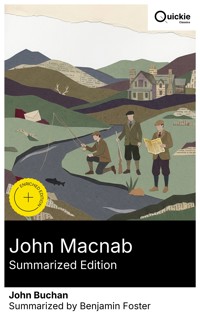
John Macnab is an interwar Highland caper: three distinguished but jaded friends, adopting the collective pseudonym "John Macnab," challenge nearby estates to stop them as they sportingly poach a stag or salmon under self-imposed rules of fair play. Buchan turns his shocker's pace to pastoral-comic ends, mixing hillcraft and fly-water with courtroom wit and country-house intrigue. Crisp prose, dry understatement, and exact topographical sense frame themes of honor, sportsmanship, class obligation, and the landscape's power to cure modern ennui. Scottish scholar-statesman and historian John Buchan drew on legal training, wartime intelligence work, and a lifelong intimacy with Highland estates. Writing in the mid-1920s, he transmuted postwar restlessness among Britain's governing class into playful ordeal, trusting sport and companionship to redeem fatigue. His humane Tory temper and exact knowledge of stalking, river lore, and rural society give the book its genial satire and its confidence that character, not bureaucracy, still governs a civilized commonwealth. Recommended to readers of classic British adventure and pastoral comedy, John Macnab offers a tonic blend of suspense, manners, and landscape: risk without malice, wit without cynicism, and friendship recovered on heather and riverbank. Quickie Classics summarizes timeless works with precision, preserving the author's voice and keeping the prose clear, fast, and readable—distilled, never diluted. Enriched Edition extras: Introduction · Synopsis · Historical Context · Brief Analysis · 4 Reflection Q&As · Editorial Footnotes.
Das E-Book können Sie in Legimi-Apps oder einer beliebigen App lesen, die das folgende Format unterstützen:
Veröffentlichungsjahr: 2026
Ähnliche








John Macnab (Summarized Edition)
Table of Contents
Introduction
At the heart of John Buchan’s John Macnab lies the exhilarating paradox that freedom may be rediscovered not by breaking away from rules but by consenting to a perilous game that pits ingenuity and nerve against landscape, custom, and chance, as accomplished men who have exhausted ordinary successes wager their composure, reputations, and comfort on a contest whose sole prize is renewed vitality and whose chief danger is the revelation that identity itself can become a mask, so that in chasing a quarry through moor and forest they hunt, with equal seriousness, the hard truth of what makes a life feel fully lived.
First published in 1925, John Macnab is an adventure novel with the supple ease of a sporting caper, set largely in the Scottish Highlands during the interwar period. The book belongs to Buchan’s body of fast-moving tales that combine outdoor action with civilized good manners, but its atmosphere is less wartime espionage than pastoral pursuit. Stags on the hill and salmon in bright rivers supply the practical obstacles, while the etiquette of estates and the watchfulness of keepers shape the field of play. The result is a countryside novel of stratagems, chases, and narrow margins rather than duels or pitched battles.
At its outset, three well-known friends, comfortably successful yet inwardly stalled, decide to recover their edge by creating a joint persona, John Macnab, and issuing challenges to select Highland landowners. In polite, audacious letters, they announce that within a fixed period they will take a stag or a salmon from each property and escape undetected, subject to self-imposed conditions that keep the venture sporting rather than predatory. The owners, in turn, prepare to foil the attempt. From this compact premise flows a sequence of ventures planned with care, narrated in an urbane, witty voice that prizes craft as much as courage.
Readers encounter a narrative that moves briskly between tactics and topography, with Buchan’s economical description opening the moor, corrie, and river pool as vividly as a map. He favors clean sentences, dry understatement, and a gentlemanly irony that keeps danger taut without turning grim. Scenes of stalking or casting are built as problems to be solved—wind, light, water, footfall—so that each chapter’s suspense grows from the friction between plan and weather, will and terrain. Conversation sparkles with courtesy and needling wit, and the camaraderie among principals provides warmth, even as the surrounding households, keepers, and neighbors sharpen the contest’s edges.
Behind the sport lies a meditation on modern restlessness: achievement without risk can dull perception, and ritualized peril can reawaken attention to place, time, and other people. John Macnab also probes honor, asking what it means to test limits while remaining scrupulous toward opponents, property, and game. Masks and roles matter; a signature invented for mischief becomes a discipline, pressing the men to match their self-image with their conduct. The Highlands are not mere scenery but an ethical gradient, where privilege, hospitality, and vigilance meet. Friendship anchors the enterprise, turning private boredom into a shared, accountable search for meaning.
These concerns retain bite today. Many readers will recognize the fatigue of abundance and the wish to rekindle attention through challenge, as well as the relief of games whose rules create intensity without malice. The novel’s courteous rivalry models how competition can honor opponents while revealing character, an antidote to zero-sum postures. Its fascination with pseudonyms and agreed constraints anticipates contemporary questions about identity, consent, and the ethics of play. It also brushes, without preaching, against issues of land, access, and stewardship, inviting reflection on who may use a landscape and on the responsibilities of those who claim it.
John Macnab endures because it marries verve with restraint, making adventure feel both civilized and vital. The capers are clever, but the deeper satisfaction comes from watching intelligence applied to terrain, tradition, and self-command, a combination as appealing now as in 1925. Buchan offers a compact study in how rules, imagination, and friendship can convert anxiety into purpose, and how attention to the natural world can steady the modern mind. For contemporary readers, the novel is both an elegant entertainment and a thoughtful prompt, suggesting that the right kind of game can become a rehearsal for better living.
Synopsis
John Macnab by John Buchan, first published in 1925, opens with three prosperous friends—jaded by postwar routine and success—recognizing a creeping sense of futility. Seeking a remedy more bracing than conversation or travel, they decide that only risk, discipline, and purposeful play can restore their nerve. Their weariness is presented not as melodrama but as a malaise of modern achievement, the loss of frontier in settled lives. The Scottish Highlands beckon as both proving ground and cure: a landscape of difficult ground, intricate customs, and exacting weather that promises to test skill without tipping into outright villainy or scandal.
They construct an alter ego, “John Macnab,” and send formal, courteous letters to three Highland estate owners. The notice proposes a sporting trial: within a set period, John Macnab will take a stag or a salmon on the owner’s ground and deliver proof, all without being caught. The authors of the letter emphasize strict rules—no violence, no damage, and respect for people and property—aiming to transform trespass into a contest of wits. Each landowner’s consent and response shape the ground rules, setting varied constraints, timetables, and watchfulness that will measure not only fieldcraft but nerve, discretion, and teamwork.
The first enterprise turns reconnaissance into narrative momentum. The friends study maps, learn watercourses, and chart patrols, discovering that the estate’s keepers and tenants are neither fools nor villains but skilled custodians of a hard country. The preparation highlights the story’s interest in tactics: wind, scent, cover, and the practicalities of carrying quarry without noise. A local intermediary—sharp-eyed, underemployed, and proud of the glen—offers guidance that blurs the line between aiding mischief and defending tradition. When the attempt begins, weather, surprise movements, and small errors produce a chain of narrow escapes that test their compact and force quick rethinking.
For the second challenge, a river becomes the chief antagonist. Timing must match the water’s mood, and the estate’s watchers adapt with their own counters: moving sentries, arranged signals, and sudden sweeps. The narrative trades on endurance and judgment—when to cast, when to wait, and how to retreat without leaving a trace. Strain within the trio surfaces in small disagreements about caution versus audacity, yet their complementary skills keep the operation balanced. The owner’s response, more imaginative than expected, turns the contest into a duel of patience, with both sides attempting to read the other’s habits and conceal intentions.
The final undertaking raises the temperature. Word of the earlier letters circulates informally, drawing curious visitors and sharpening the vigilance of gamekeepers and local authorities. A perceptive outsider, quick to sense a game afoot, complicates secrecy and brings a fresh moral lens to what began as private sport. Logistics grow intricate: transport, decoys, and safe houses must be arranged without betraying patterns. The estate’s leadership, more personal and less procedural than elsewhere, treats the challenge as a matter of honor, tightening the pursuit while avoiding excess. Near collisions of plans and personalities push the venture toward decisive, but spoiler-safe, outcomes.
Threaded through these episodes are reflective pauses that give the caper weight. The men confront the ethics of rule-bending and the difference between theft and a declared, consented trial. They encounter proud local knowledge, discover how quickly a landscape punishes carelessness, and reassess notions of class, ownership, and belonging. A note of tentative romance and friendship broadens the emotional palette, while humor keeps the tone buoyant. Above all, the Highlands are treated as a demanding teacher: beautiful, indifferent, and exacting. The restorative aim behind John Macnab’s exploits takes shape as a search for proportion, humility, and earned self-belief.
Without leaning on revelations, the book resolves its tensions by reaffirming codes of fair play and mutual respect, suggesting that renewal comes from chosen difficulty and communal trust rather than spectacle. John Macnab endures as a nimble blend of adventure and social comedy, a portrait of interwar leisure that questions what it means to test oneself when conventional battlefields have receded. It also exemplifies Buchan’s gift for landscape as action and for camaraderie under pressure. The story’s lasting resonance lies in its invitation to recapture purpose through disciplined fun, while recognizing the responsibilities owed to those who share the ground.
Historical Context
John Macnab was published in 1925 by the Scottish-born author John Buchan (1875–1940), a figure entwined with Britain’s governing and cultural elite. Educated at Oxford, Buchan worked in publishing and law, wrote widely read adventure fiction, and served as Director of Information during the First World War. The novel belongs to his interwar output, when Britain was adjusting to post-1918 realities: bereavement, economic volatility, and shifting class relations. Buchan’s intimate familiarity with the Scottish countryside and with Westminster’s habits informs a narrative that moves between London’s institutions and Highland estates, drawing on the period’s fascination with outdoor sport, masculine camaraderie, and public-service ideals.
The book’s Highland setting reflects a landscape shaped since the mid-nineteenth century by the growth of sporting estates. After the Clearances and agricultural change, vast deer forests replaced former grazing in many glens, leased during late summer to wealthy tenants for stag stalking, grouse shooting, and salmon fishing. Estate villages relied on ghillies, keepers, and seasonal staff. Railways such as the Highland and West Highland lines, and, by the 1920s, motorcars, brought parties north with ease. The resulting economy and etiquette—private rights over game and rivers, strict seasonal calendars, and elaborate hospitality—frame the challenges, risks, and social negotiations that animate Buchan’s tale.
Underlying the story are distinctive features of Scots law and rural governance. While wandering on open land was generally a civil matter, taking protected game or salmon without right was a criminal offense under nineteenth-century game and fisheries legislation. Estates employed professional keepers to enforce these rules, often coordinating with county constabularies. Riparian rights and river management were overseen locally by proprietors and district fishery boards. The cultural ideal of the fair stalk or fair cast combined skill, restraint, and respect for property boundaries—expectations keenly policed in both social and legal terms. These institutions supply the novel’s realistic constraints and its code of conduct.




