


1,99 €
Mehr erfahren.
- Herausgeber: Quickie Classics
- Kategorie: Abenteuer, Thriller, Horror
- Sprache: Englisch
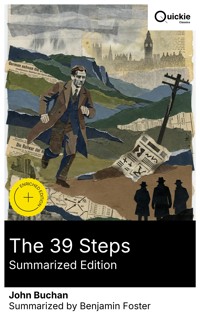
First published in 1915, The 39 Steps inaugurates Richard Hannay, a mining engineer whose London boredom detonates into flight after a murdered freelance spy leaves him custodial to a secret warning of a German plot. Told in taut first-person, Buchan's self-styled "shocker" blends picaresque pursuit across the Scottish Highlands with codes, disguises, and the shadowy cabal of the Black Stone. Its clean, propulsive prose, episodic set pieces, and cartographic detail marry romance and reportage, crystallizing pre–First World War invasion anxieties and helping codify the modern espionage thriller. Buchan—a Scottish scholar, civil servant, and later Governor General of Canada—brought to the novel a lifetime's exposure to imperial politics, Highland topographies, and, during the war, official information work. Convalescing in 1914, he conceived The 39 Steps to test the limits of plausibility in popular romance. His South African service and propagandistic acumen underpin the novel's geopolitical crispness, while his Presbyterian stoicism molds Hannay's resourceful, decent amateurism. Readers of Le Carré and Fleming alike will find in this foundational text both the genre's seed and a bracingly undated pleasure: landscape-driven suspense, moral clarity without naïveté, and a prototype hero worth rediscovering. Start here to see how the spy thriller learned to run. Quickie Classics summarizes timeless works with precision, preserving the author's voice and keeping the prose clear, fast, and readable—distilled, never diluted. Enriched Edition extras: Introduction · Synopsis · Historical Context · Brief Analysis · 4 Reflection Q&As · Editorial Footnotes.
Das E-Book können Sie in Legimi-Apps oder einer beliebigen App lesen, die das folgende Format unterstützen:
Veröffentlichungsjahr: 2026
Ähnliche






The 39 Steps (Summarized Edition)
Table of Contents
Introduction
In a world on the brink of war, a solitary newcomer to London finds himself hunted by both the authorities and shadowy agents, and discovers that survival—and the safety of a nation—depend on his ability to read a landscape of lies, decode chance encounters, and keep moving faster than a conspiracy designed to erase him, as he navigates stations and moors, safe rooms and open roads, reading newspapers as carefully as faces, trusting luck only when nerve and wit are not enough; the ordinary routines of travel become camouflage, the talk of strangers a code, and the choice between anonymity and responsibility sharpens into action.
John Buchan’s The Thirty-Nine Steps is a landmark spy thriller first published in 1915, set in Britain on the eve of the First World War and across the rugged spaces of Scotland. Composed in a taut first-person voice, it established a template for the man-on-the-run narrative: rapid movement, improvised disguises, and escalating peril threaded through ordinary places. The novel’s world is recognizably modern, with trains, newspapers, and public opinion shaping the stakes, yet its atmosphere retains the crisp directness of an adventure tale. Its compact length, quick chapters, and clear stakes produce a reading experience of mounting urgency and relentless momentum.
The premise is spare and electrifying. Richard Hannay, recently returned to London after years abroad, is restless with peacetime routine when a frightened stranger entrusts him with disturbing information about an impending crisis. When events take a violent turn, Hannay becomes a suspect and a target, compelled to vanish from the city and lose himself among farms, railways, and remote uplands. Pursued by officials and by men who do not announce themselves, he follows a trail of hints and patterns that point toward a plot with international implications. The chase drives the narrative, but curiosity and conscience give it its center.
Buchan’s style is economical and swift, favoring clean description, decisive verbs, and the immediacy of first-person testimony. The tone balances cool observation with the physicality of flight: mud on boots, wind on moorland, the perils and consolations of weather and terrain. Episodes unfold like linked set pieces—encounters in rooms, on platforms, and along hedgerows—each demanding a new improvisation. The novel’s restraint avoids melodrama while retaining an exuberant pace, and its occasional dry humor lightens the tension without puncturing it. Above all, the voice privileges clarity and momentum, drawing readers into a consciousness that measures risk quickly and acts without bravado.
Themes surface through motion rather than sermon. The novel explores the vulnerability of an open society to covert manipulation, the uneasy interface between civilian life and state security, and the temptations and costs of anonymity. Identity is elastic—assumed, traded, and tested—while landscapes become both refuge and trap, teaching that knowledge of place can be as decisive as knowledge of codes. Chance intervenes, but improvisation and judgment determine outcomes, suggesting a moral universe where courage is practical rather than ceremonial. The story values duty without romanticizing it, asking what an individual owes to a community when threats arrive disguised as routine.
For contemporary readers, its relevance is immediate. The anxiety it registers about misinformation, clandestine networks, and the speed with which rumors become strategy feels strikingly current, as does its portrait of a world where mobility spreads risk alongside opportunity. Its streamlined plotting anticipates later thrillers and shows how tension can arise from ordinary tools—maps, schedules, headlines—rather than elaborate gadgetry. At the same time, some attitudes and assumptions reflect the era of composition, and reading with awareness of those contexts opens useful critical distance. The book rewards that double attention: lingering for craft while interrogating the historical lens through which it looks.
Approached today, The Thirty-Nine Steps offers both a gripping chase and a concise blueprint for a century of suspense fiction, proving that velocity need not exclude intelligence. Its hero’s predicament—an ordinary person learning to see patterns, sift signals, and act under pressure—mirrors challenges that extend beyond espionage into everyday civic life. The novel’s settings remain vivid, its puzzles cleanly framed, and its sense of consequence unflagging. Without disclosing the revelations that await, it is enough to say that the journey clarifies as it accelerates, leaving readers alert to how quickly private choices can ripple through a public crisis.
Synopsis
The Thirty-Nine Steps (1915) by Scottish author John Buchan is a brisk spy thriller set on the eve of the First World War. Its narrator, Richard Hannay, a mining engineer newly back from South Africa, finds London stifling and purposeless after colonial adventures. He longs for diversion, only to stumble into a crisis that thrusts him into clandestine politics and mortal danger. Buchan establishes a mood of nervous pre-war cosmopolitanism, where chance meetings and casual talk conceal larger schemes. The novel’s premise is lean: an ordinary man, armed with practical wits and grit, is forced to act when the professionals are absent or compromised.
Hannay’s quiet life shatters when a stranger named Scudder, claiming to be an independent spy, seeks refuge in his flat. Scudder alleges an international plot involving a secretive group later referred to as the Black Stone, linked to the impending assassination of a prominent statesman, Karolides of Greece, and to the theft of critical British military intelligence. He has compiled notes in a ciphered notebook but fears he will be killed before he can warn officials. When Scudder is found dead under suspicious circumstances, Hannay becomes a hunted man. He takes the notebook and resolves to continue the warning, knowing both police and enemies will pursue him.
To buy time and interpret the cryptic notes, Hannay flees London for the Scottish countryside, counting on anonymity and open ground. He adopts simple disguises, travels by back roads, and survives on quick thinking, while adversaries close in from multiple directions. Buchan’s landscape becomes a strategic chessboard: moors, farms, and railway halts shape every decision. As news spreads and descriptions circulate, Hannay must juggle the threat of arrest for a murder he did not commit with the more insidious danger of trained agents. The chase yields partial insights into Scudder’s code, suggesting a deadline and a coastal connection central to the conspirators’ plan.
Encounters along the way test Hannay’s nerve and his ability to read people. Some acquaintances prove unexpectedly helpful—men of the road, local worthies, and solitary scholars—while others threaten to betray him, whether for fear, money, or ideology. He improvises identities, turns mishaps into cover, and navigates close shaves in isolated cottages, railway carriages, and crowded meeting halls. Each escape sharpens his sense of the plot’s scale and of the professional ruthlessness arrayed against him. The notebook’s clues and his fieldcraft converge into a clearer picture: a small, disciplined ring is poised to exploit political upheaval, provided they can transmit or travel with guarded information.
Concluding that he must secure official attention, Hannay risks a return to authority and meets senior figures in the British government, notably a Foreign Office mandarin who evaluates his story against intelligence already in circulation. The officials are wary yet recognize patterns consistent with a looming crisis involving naval mobilization. Buchan stages an atmosphere of uncertain loyalties, where manners and rank can mask hostile intent. A measured interrogation and a brief deception force Hannay to rely on intuition as much as evidence, and he emerges with conditional trust, a timetable, and a mandate: identify the conspirators’ exit point before a key strategic secret leaves the country.
The mysterious phrase that titles the book focuses Hannay’s search. He reexamines Scudder’s ciphers and stray remarks, narrowing possibilities until a physical location and a window of tides align. From there the narrative tightens into a race against clocks and coastline, with surveillance, feints, and patient watching replacing broader flight. The conspirators aim to vanish at precisely the moment a message or person would be irretrievable. Hannay and his allies mount a discrete, high-stakes intervention that depends on reading small signs correctly. Buchan sustains suspense without lingering on brutality, keeping the final moves clear yet sparing, and stopping short of exhaustive revelation here.
The novel’s enduring power lies in its pattern: an unassuming civilian becomes a decisive actor through initiative, clear sight, and luck, anticipating the modern “man on the run” thriller. It explores how information, mobility, and social connections can be as potent as weapons, while capturing anxieties about shadow conflicts preceding declared war. First in a series featuring Hannay, it set a template for lean pacing, topographical adventure, and amateur ingenuity within espionage stakes. Though written in 1915 and reflective of its time, its core questions—whom to trust, how to act under pressure, and what vigilance demands—continue to resonate far beyond its era.
Historical Context
John Buchan's The Thirty-Nine Steps appeared in 1915, published by William Blackwood and Sons while Britain was at war. The story is set in the anxious months immediately before the First World War, moving from London to the Scottish countryside. Its institutions and backdrop are recognizably Edwardian: gentlemen's clubs, metropolitan newspapers, busy railway termini, and a civil service adapting to new security demands. The Liberal government of H. H. Asquith confronted foreign crises and domestic unrest as Europe slid toward conflict after the assassination of Archduke Franz Ferdinand in 1914. The novel channels this atmosphere of uncertainty, secrecy, and hurried preparation.
Pre-war Britain experienced repeated "spy scares," nourished by tabloids and popular fiction. The Secret Service Bureau was established in 1909 to coordinate intelligence; its domestic and foreign branches evolved into MI5 (under Vernon Kell) and the Secret Intelligence Service (headed by Mansfield Cumming). Parliament reinforced secrecy with the Official Secrets Act 1911, defining offenses of espionage and unauthorized disclosure. These measures reflected anxieties about sabotage, invasion, and the protection of naval and industrial secrets. Works like Erskine Childers's The Riddle of the Sands (1903) and William Le Queux's invasion tales familiarized readers with clandestine plots, priming audiences for Buchan's breathless chase.
From the turn of the century, Britain and Germany engaged in a costly naval arms race. HMS Dreadnought's 1906 launch revolutionized battleship design and compelled both powers to expand fleets and guard maritime approaches. Crises such as Agadir in 1911 deepened suspicion of German intentions. British planners feared surprise attacks, espionage targeting coastal defenses, and leakage of mobilization schedules. Wireless telegraphy, codebooks, and ciphers added new dimensions to secrecy and interception. The Admiralty's concerns filtered into popular discourse, making the theft or transmission of naval intelligence a plausible and urgent premise for fiction set on the eve of war.




