


0,49 €
Niedrigster Preis in 30 Tagen: 1,99 €
Niedrigster Preis in 30 Tagen: 1,99 €
Mehr erfahren.
- Herausgeber: DigiCat
- Kategorie: Religion und Spiritualität
- Sprache: Englisch
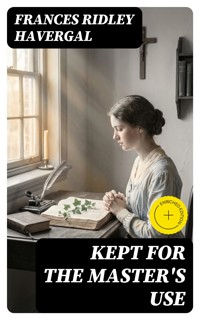
In "Kept for the Master's Use," Frances Ridley Havergal presents a compelling exploration of the spiritual life, shrouded in her characteristic poetic and devotional style. The book intertwines scripture with personal reflection, advocating for a life wholly dedicated to God's service. Havergal's elegant prose and lyrical cadences provide both an emotional and theological depth, framing her insights within the broader context of 19th-century evangelicalism and the Holiness movement, which emphasized the necessity of personal piety and consecration. Frances Ridley Havergal, a talented poet and hymn writer, drew inspiration from her own spiritual journey, marked by a desire for deeper intimacy with Christ. Born in 1836 into a devout family, she was educated in music and literature, which allowed her to articulate her faith with both clarity and artistic flair. Havergal's life experiences and commitment to the ideals of piety and service shaped her writings, making her a prominent voice in Victorian religious literature. "Kept for the Master's Use" is recommended for those seeking spiritual encouragement and renewal. Its heartfelt messages resonate with anyone striving to deepen their faith and understanding of God's purpose for their life. Havergal's work remains a vital resource for both personal devotion and communal worship, inviting readers to embrace a fuller life in Christ. In this enriched edition, we have carefully created added value for your reading experience: - A succinct Introduction situates the work's timeless appeal and themes. - The Synopsis outlines the central plot, highlighting key developments without spoiling critical twists. - A detailed Historical Context immerses you in the era's events and influences that shaped the writing. - A thorough Analysis dissects symbols, motifs, and character arcs to unearth underlying meanings. - Reflection questions prompt you to engage personally with the work's messages, connecting them to modern life. - Hand‐picked Memorable Quotes shine a spotlight on moments of literary brilliance. - Interactive footnotes clarify unusual references, historical allusions, and archaic phrases for an effortless, more informed read.
Das E-Book können Sie in Legimi-Apps oder einer beliebigen App lesen, die das folgende Format unterstützen:
Veröffentlichungsjahr: 2022
Ähnliche














Kept for the Master's Use
Table of Contents
Introduction
Kept for the Master’s Use turns the simple desire to belong wholly to God into a lifelong practice by asking how each faculty, relationship, hour, and coin might be held open for purposeful service, challenging readers to exchange anxious self-keeping for consecrated availability while negotiating ordinary duties, subtle ambitions, and the quiet resistance of the heart that wants both comfort and calling, and it does so through devotional reflection that presses toward a practical holiness neither gloomy nor vague but specific, hopeful, and attentive to the many small thresholds where intention becomes action.
Frances Ridley Havergal, an English hymn writer and poet, composed this work within the flourishing tradition of nineteenth-century Evangelical devotion, and it first appeared in the later Victorian era in Britain, when personal piety and practical mission were widely linked in Christian discourse. Kept for the Master’s Use belongs to the genre of devotional theology, offering brief pastoral expositions rather than narrative. It is closely connected to Havergal’s own hymn on consecrated life, whose phrases structure the book’s movement, yet the volume stands on its own as a compact guide for readers seeking clarity about motive, discipline, and joyful obedience in everyday contexts.
Rather than staging arguments, Havergal proceeds by gentle counsel and closely observed self-examination, inviting the reader to consider what it might mean to dedicate mind, voice, hands, resources, time, and will to sacred purposes without evasion or despair. The chapters are short, often moving from a concrete observation to practical suggestion, and they rely on Scripture as a steady lens. The voice is warm and earnest, with a lyric undertone traceable to the author’s gifts as a hymn writer, while the tone remains candid and hopeful, creating a reading experience that is intimate, meditative, and suited to unhurried, daily reflection.
The book’s central themes revolve around consecration, integrity, and usefulness: the idea that devotion is proved not by intensity of feeling but by a steady readiness to serve in the sphere one already inhabits. Havergal explores the stewardship of abilities and possessions, the ordering of desire, and the formation of habits that align energy with purpose. She treats surrender not as loss, but as the way to become truly available for good. Yet she is attentive to the obstacles—fear, fatigue, and divided motives—and so she frames growth as a gracious process, sustained by divine help rather than achievement alone.
For contemporary readers negotiating distraction, overcommitment, and the pressures of performance, Kept for the Master’s Use offers a humane framework for coherence. Its call to keep one’s capacities available for worthy ends translates into guidance about attention, generosity, vocation, and boundaries. The emphasis on small, repeatable acts of faithfulness resists perfectionism and encourages durable hope. Without prescribing a single path, the book helps readers discern how belief can shape decisions about work, relationships, and stewardship of material goods. In this way it speaks across traditions, offering a vocabulary for purpose that is spiritually grounded yet readily applied to modern, everyday dilemmas.
Stylistically, Havergal’s background as a hymn writer lends the prose a measured rhythm and a fondness for memorable turns that linger without ornament. The scriptural references are woven in as touchstones, encouraging readers to test counsel against a wider canon rather than rely on sentiment. The chapters are well suited for devotional pacing, whether read in sequence or dipped into one at a time, and each section invites response through prayer, journaling, or conversation. The overall effect is pastoral clarity: firm but gentle, specific yet spacious, designed to accompany rather than dazzle, and to cultivate a steady, hopeful imagination for daily faithfulness.
Approached with openness, this book offers both comfort and challenge, inviting readers to test what they keep, why they keep it, and for whom. It does not demand dramatic gestures; it asks for continuity, patience, and a willingness to let purpose inform the smallest choices. Because it arises from lived devotion within a recognizable historical moment yet avoids narrow controversies, the work remains accessible to a wide audience. In receiving it, readers will find not a program but a companionable guide, one that steadies attention and helps translate desire into practice, keeping heart, mind, and means ready for meaningful service.
Synopsis
Kept for the Master’s Use by Frances Ridley Havergal is a devotional work that gathers brief, Scripture-centred reflections on living a wholly consecrated life. Written by a nineteenth-century English hymn writer known for urging practical holiness, the book explores how a believer may be “kept” for Christ’s purposes in ordinary duties as well as explicit service. Its meditative chapters proceed calmly and concretely, translating doctrinal convictions into everyday choices. Rather than presenting a program, Havergal offers guidance that is pastoral and reverent, inviting readers to consider every faculty, resource, and affection as belonging to God and therefore available for obedient, joyful use.
Havergal begins by clarifying the central idea of being kept: the believer’s security and usefulness rest not in self-maintained resolve but in the preserving care of Christ. Consecration, for her, is not anxious striving but trusting surrender that welcomes divine keeping. She draws on biblical assurances to frame holiness as a response to grace, aiming to steady those troubled by instability or fear. The tone is confident yet gentle, urging a clear commitment while guarding against presumption. Throughout, she emphasizes that the privilege of being kept is offered to ordinary Christians, not a select few, and that assurance grows as dependence deepens.
The reflections move from foundation to practice, starting with the body’s capacities. Hands, feet, voice, lips, eyes, and ears are considered as instruments that can either hinder or help a Christward life. Havergal urges guarded speech, truthful testimony, and readiness for service, while valuing quiet restraint as much as eloquence. She portrays holiness as an embodied calling, where habitual actions—work well done, paths chosen, words withheld—reveal inward consecration. The approach is practical and sober, linking personal purity with outward witness. Readers are encouraged to see ordinary tasks as occasions for faithfulness, with the divine keeping shaping both conduct and character.
From the body the focus widens to time and possessions, treating hours, money, and material goods as trusts rather than entitlements. Havergal commends cheerful stewardship: generous giving, simplicity that frees rather than constricts, and diligence that respects both labor and rest. She suggests ordering one’s schedule to accommodate service and prayer, resisting waste and distraction without adopting severity. The aim is alignment—resources arranged under the Master’s claim so that duty and compassion are not competitors. In this frame, small budgeting choices and daily planning become spiritual exercises, expressing loyalty to Christ in measurable patterns of use and restraint.
She then addresses the inner life—intellect, will, heart, and love—urging that thought and desire be brought under Christ’s good rule. Havergal presents a yielded will as the hinge of consecration, transforming ambition into vocation and anxiety into trust. The intellect is to be disciplined, teachable, and truth-seeking, while affections are ordered so that relationships and pursuits reflect a primary devotion to God. Artistic gifts, including music for which she was known, are treated as occasions for praise and service. Joy figures prominently: not mere mood, but the settled gladness that accompanies obedience and sustains endurance.
Recognizing common stumbling points, Havergal attends to temptation, inconsistency, and discouragement. She counsels resisting perfectionism and despair alike, rooting perseverance in God’s faithfulness rather than fluctuating feelings. Practical helps include Scripture meditation, candid confession, grateful praise, and prompt obedience in small matters. She commends fellowship and mutual encouragement, while warning against legalism that mistakes method for life. The tone remains realistic: setbacks are acknowledged, but the promised keeping is held forth as a daily resource. Thus the book frames spiritual growth as steady reliance, with grace supplying both motive and power for continued consecration.
The closing movement gathers these strands into a portrait of whole-life discipleship—kept, not clenched; offered, not hoarded; active, yet at rest in faithful care. Without dramatic flourish, Havergal leaves readers with a durable vision: personal piety oriented toward service, ordinary means sanctified by intention, and hope anchored in divine keeping. As a Victorian devotional classic, the work continues to resonate where believers seek integrated, practical holiness. Its enduring significance lies in the balance it strikes—firm assurance with gentle exhortation—and in its invitation to let every sphere of life be available for the Master’s use, now and onward.
Historical Context
Kept for the Master’s Use, first published in London in 1879 by the evangelical firm James Nisbet and Co, was written by Frances Ridley Havergal, an English hymnwriter and Anglican evangelical born in 1836. Issued shortly after her death, the volume gathers practical devotional counsels that expand themes from her well known hymn Take my life and let it be, composed in 1874. The setting is late Victorian Britain, when domestic piety, parish life, and voluntary religious associations shaped everyday faith. As a compact manual of consecrated living, the book belongs to a flourishing genre of nineteenth century Anglican devotional prose.
In the Church of England during the 1860s and 1870s, the Evangelical party emphasized personal conversion, Bible reading, and active service, drawing on the Authorized Version and the Book of Common Prayer. National attention to revival increased after the campaigns of Dwight L Moody and Ira D Sankey in Britain between 1873 and 1875, which popularized congregational singing and lay testimony. Hymns Ancient and Modern, first issued in 1861, helped standardize hymnody across parishes. Within this climate of Scripture saturated devotion and song, Havergal wrote short, Scripture laced meditations aimed at cultivating daily obedience rather than theological controversy.
The book appeared amid rapid expansion of print culture following the Elementary Education Act of 1870, which created elected school boards and encouraged mass literacy. Cheap editions, lending libraries, and tract societies enabled a vast audience for religious books. Evangelical publishers such as Nisbet and the Religious Tract Society circulated pocket sized manuals for family worship, Sabbath reading, and parish libraries. Women were prominent as authors and readers of devotional literature, supported by organizations like the Young Womens Christian Association founded in 1855. Havergal wrote for this readership in clear, accessible prose designed for private reflection and small group use.
The 1870s also saw the spread in Britain of Higher Life teaching on holiness and consecration, popularized by writers such as William E Boardman and Hannah Whitall Smith, and discussed at the Keswick Convention beginning in 1875. While diverse in expression, these networks urged believers to trust Christ for daily sanctification and to dedicate every faculty to divine service. Havergals stress on wholehearted surrender and practical obedience harmonized with these emphases, yet remained rooted in Anglican evangelical preaching, hymn singing, and Bible study. Her counsel reflects the era’s confidence that earnest piety could yield stable, grateful, useful Christian lives.
Nineteenth century evangelicalism linked personal devotion with philanthropy and mission. British voluntary societies, including the Church Missionary Society and the London Missionary Society, expanded overseas while mobilizing parish auxiliaries and womens associations at home. Appeals for disciplined stewardship and self denial were common in sermons, magazines, and annual meetings. Havergal actively supported missionary and charitable efforts through her writing and personal example as recorded in letters and tracts. In Kept for the Masters Use, reflections on money, time, and talents echo the language of missionary reports and collecting boxes, encouraging readers to consecrate resources to gospel work.
Music was central to Havergals formation and to Victorian worship. Her father, William Henry Havergal, an Anglican clergyman and composer based in Worcestershire, promoted congregational psalmody and wrote hymn tunes. Frances studied languages and music in Germany in her youth and became a skilled performer and translator. She composed widely sung hymns, including I Gave My Life for Thee, Like a River Glorious, and Take my life and let it be. Kept for the Masters Use extends the poetic structure of that hymn into prose chapters, using its clauses as a scaffold for Scripture linked meditations on consecrated service.
Late Victorian piety was sharpened by awareness of mortality and illness, themes familiar to Havergal herself. Often delicate in health, she continued to write short, concentrated pieces suited to daily reading. She died on 3 June 1879 at Caswell Bay near Swansea, Wales, and the book appeared the same year. This proximity lent her counsel a valedictory gravity that resonated with readers accustomed to memorial editions and obituaries in religious periodicals. The emphasis on redeeming time, sanctifying ordinary duties, and holding possessions lightly reflects the period’s sober approach to life’s brevity and the hope of Christian perseverance.
Upon publication, Kept for the Masters Use found a ready audience in Britain through evangelical distribution channels and parish libraries, and it has remained in print in various editions. The book distills late Victorian evangelical confidence in the authority of Scripture, the usefulness of voluntary societies, and the formative power of hymnody and domestic devotion. At the same time, its calls to self examination, simplicity, and generous giving quietly challenge social complacency and material display in industrial Britain. Havergal’s clear, affectionate tone invites readers to embody the era’s ideal of cheerful, disciplined, charitable Christian service.




