


Erhalten Sie Zugang zu diesem und mehr als 300000 Büchern ab EUR 5,99 monatlich.
- Herausgeber: Huia Publishers
- Kategorie: Fremdsprachen
- Serie: Reo Ora
- Sprache: Englisch
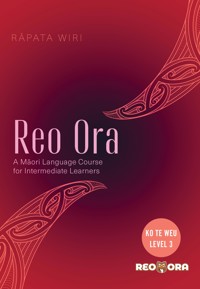
This language course follows on from the Level 1 and 2 course for beginners that taught thirty sentence patterns and commonly used words, giving learners basic conversational Māori. This intermediate level course introduces another twenty sentence patterns that are primary sentence structures of te reo Māori. The book steps through modules that teach the grammar and sentence patterns and show these used in examples. Learning is reinforced through repetition of sentence patterns and written exercises, and in each module learners also access an online episode of a short movie where characters use the sentence structures in the story.
Sie lesen das E-Book in den Legimi-Apps auf:
Seitenzahl: 92
Veröffentlichungsjahr: 2023
Das E-Book (TTS) können Sie hören im Abo „Legimi Premium” in Legimi-Apps auf:
Ähnliche








First published in 2023 by Huia Publishers39 Pipitea Street, PO Box 12280Wellington, Aotearoa New Zealandwww.huia.co.nz
ISBN 978-1-77550-717-8 (print)
ISBN 978-1-77550-790-1 (ebook)
Copyright © Rāpata Wiri 2023Cover image and icons copyright © Jacob Wilkins-Hodges 2023Illustrations copyright © Story Hemi-Morehouse 2023
This book is copyright. Apart from fair dealing for the purpose of private study, research, criticism or review, as permitted under the Copyright Act, no part may be reproduced by any process without the prior permission of the publisher.
A catalogue record for this book is available from the National Library of New Zealand.
Published with the assistance of Creative New Zealand
Ebook conversion 2023 by meBooks
Ngā Tukanga Ako o Reo Ora: Ko Te Weu
The Teaching and Learning Methods of Reo Ora: Ko Te Weu
Te Wāhanga Tuatahi – Module 1
1Ngā RerekōungaQuality Intensifier Sentences
‘Te … hoki … ’ – ‘How …’
2Ngā RerekōungaQuality Intensifier Sentences
‘Kātahi te …’ – ‘What a …’
3Ngā Rereāhua me ōna PūhonoStative Sentences
‘i a …’ or ‘i te …’ or ‘i ngā …’ ‘because of …’ or ‘due to …’
4Te WhakakāhoretangaNegation
‘Kāore anō’ – ‘Not yet’
5Kiriata Poto – Me aha a Hera?Short Movie – What Shall Hera Do?
‘Te Parakuihi’ – ‘The Breakfast Scene’
6WhakapākehātiaTranslate into English
Hei Mahi 1 – Exercise 1
7WhakapākehātiaTranslate into English
Hei Mahi 2 – Exercise 2
8WhakapākehātiaTranslate into English
Hei Mahi 3 – Exercise 3
9WhakamāoritiaTranslate into Māori
Hei Mahi 4 – Exercise 4
Te Wāhanga Tuarua – Module 2
1‘Kātahi anō ...’Introducing ‘Kātahi anō …’
‘Kātahi anō …’ – ‘Has just …’
2‘Pēnei’, ‘pēnā’, ‘pērā’Introducing ‘pēnei’, ‘pēnā’, ‘pērā’
‘pēnei’, ‘pēnā’, ‘pērā’ – ‘like this’, ‘like that’
3Ngā Reremahi WhakaputaActor Emphatic Sentences
‘Mā wai …?’ ‘Nā wai …?’ ‘Who will …?’ ‘Who did …?’
4‘Ā hea?’ me ‘Nōnahea?’Introducing ‘Ā hea?’ and ‘Nōnahea?’
‘Ā hea?’ me ‘Nōnahea?’ ‘When will?’ and ‘When did?’
5Kiriata Poto – Me aha a Hera?Short Movie – What Shall Hera Do?
‘Ka taea e au te hari tō waka?’ ‘May I borrow your car?’
6WhakapākehātiaTranslate into English
Hei Mahi 1 – Exercise 1
7WhakapākehātiaTranslate into English
Hei Mahi 2 – Exercise 2
8WhakapākehātiaTranslate into English
Hei Mahi 3 – Exercise 3
9WhakamāoritiaTranslate into Māori
Hei Mahi 4 – Exercise 4
Te Wāhanga Tuatoru – Module 3
1‘Rite tonu’Introducing ‘Rite tonu’
‘Rite tonu …’ – ‘Just like …’
2Ngā TohutohuBasic Commands
‘Me …’ – ‘Should …’
3‘Kia āta …’Introducing ‘Kia āta …’
‘Kia āta …’ ‘To do something with care …’
4Ngā WhakahauBasic Instructional Sentences
Ngā Whakahau
5Kiriata Poto – Me aha a Hera?Short Movie – What Shall Hera Do?
‘Hei aha mā Hera!’ ‘Never mind about Hera!’
6WhakapākehātiaTranslate into English
Hei Mahi 1 – Exercise 1
7WhakapākehātiaTranslate into English
Hei Mahi 2 – Exercise 2
8WhakapākehātiaTranslate into English
Hei Mahi 3 – Exercise 3
9 WhakamāoritiaTranslate into Māori
Hei Mahi 4 – Exercise 4
Te Wāhanga Tuawhā – Module 4
1Ngā RerehāngūPassive Sentences
Ngā Rerehāngū – Passive Sentences
2Ngā Rerehono me ‘Ka’Joining Sentences with ‘Ka’
Ngā Rerehono me ‘Ka’ Joining Sentences with ‘Ka’
3Ngā ReretaeaIntroducing ‘Ka taea …’
Ngā Reretaea – ‘Can do …’ Sentences
4Ngā RerewhakariteComparative Sentences
Ngā Rerewhakarite Comparative Sentences
5Kiriata Poto – Me aha a Hera?Short Movie – What Shall Hera Do?
‘Me aha ahau?’ – ‘What shall I do?’
6WhakapākehātiaTranslate into English
Hei Mahi 1 – Exercise 1
7WhakapākehātiaTranslate into English
Hei Mahi 2 – Exercise 2
8WhakapākehātiaTranslate into English
Hei Mahi 3 – Exercise 3
9WhakamāoritiaTranslate into Māori
Hei Mahi 4 – Exercise 4
Te Wāhanga Tuarima – Module 5
1Ngā Rerepūtake‘Ki te …’ me ‘Mehemea …’
‘Ki te …’ me ‘Mehemea …’ ‘If’ and ‘When’ Sentences
2Ngā Rerepūwhea me ‘ai’Introducing Anaphoric Sentences with ‘ai’
Te Pūwhea ‘ai’ me te Rerepūwhea ‘kia … ai’ ‘To do something’ and ‘in order to’
3‘He aha ai?’ me ‘He aha i kore ai e?’Using ‘Why?’ and ‘Why not?’ Sentences
‘He aha ai?’ me ‘He aha i kore ai e?’ ‘Why?’ and ‘Why not?’
4Nā te aha ai?Using ‘For what reason?’ in a Sentence
‘Nā te aha ai?’ me ‘Nā te aha i kore ai?’ ‘For what reason?’/‘Why?’ and ‘Why not?’
5Kiriata Poto – Me aha a Hera?Short Movie – What Shall Hera Do?
‘Auē! Kua mate a Paora Waaka?’ ‘OMG! Paul Walker has died?’
6WhakapākehātiaTranslate into English
Hei Mahi 1 – Exercise 1
7WhakapākehātiaTranslate into English
Hei Mahi 2 – Exercise 2
8WhakapākehātiaTranslate into English
Hei Mahi 3 – Exercise 3
9 WhakamāoritiaTranslate into Māori
Hei Mahi 4 – Exercise 4
Ngā Whakautu mō ngā mahi
Answers to the Exercises
He Kāhui Kupu Hōu
A Glossary of New Words
Ngā Tukanga Ako o Reo Ora: Ko Te Weu
The Teaching and Learning Methods of Reo Ora: Ko Te Weu
This Level 3 course, Reo Ora: Ko Te Weu – A Māori Language Course for Intermediate Learners, follows on from the Level 1–2 course, Reo Ora: Ko Te Pū, Ko Te More – A Māori Language Course for Beginners (Wiri 2020). In the Level 1–2 course of Reo Ora: Ko Te Pū, Ko Te More, students learnt the 30 sentence patterns and 329 words that enable them to acquire a sound understanding of basic conversational Māori. In this Level 3 course of Reo Ora: Ko Te Weu, we introduce a further twenty sentence patterns that may be considered among the primary sentence structures of te reo Māori.
This programme has been developed over the last thirty years through rigorous teaching and practice. There are many ways of teaching and learning a language. Learners have different styles of learning, just as teachers have different styles of teaching. There are many ways to learn te reo Māori, ranging from language immersion classes (reo rumaki) to Te Ataarangi method (using coloured rākau or rods), at wānanga-ā-iwi (tribal wānanga), at mainstream wānanga (such as Te Wānanga o Aotearoa) and at polytechnics and universities. Whatever your preferred language learning style is, there is one thing that has not changed, and that is the grammar of the Māori language. In saying that, the main goals of this programme are to ensure that students pronounce Māori words and phrases correctly and that their Māori language grammar is also correct.
Throughout my career as a te reo Māori lecturer, I have worked in all the different tertiary sectors of education, including wānanga, polytechnics and universities. In this time, I was fortunate enough to be given the opportunity to learn and observe the various ways of teaching te reo Māori in a variety of settings. Each of these institutions has its own unique style of teaching, its own curriculum and its own tribal protocol and dialects. However, no matter where you learn or how you learn, the language content and grammar of te reo Māori remain the same. What makes this course unique is that we have developed a strategy and method that will improve your proficiency level (kōunga reo) from beginner (Te Kore) to intermediate (Te Pō) to advanced (Awatea) by teaching seventy-five sentence patterns that will enable you to speak, listen to, read and write te reo Māori with competence and confidence.
How do we teach you these seventy-five sentence patterns? In our beginner level course of Reo Ora, you learn the thirty basic language patterns of te reo Māori. Once you have successfully completed the beginner level course, you can progress to the intermediate level. In that course, you learn a further twenty sentence patterns. Finally, in the advanced level course, you learn the next twenty-five language patterns. We use this book, in conjunction with an online course, to help you become completely proficient in te reo Māori over three progressive twelve-week blocks. Each block requires 100 hours of self-directed learning through our online course of Reo Ora (www.reoora.com) and using the books and resources provided.
What is our method of teaching and learning?
We have a five-step method, which is explained below:
STEP 1
Me whakaatu
First, we show you the Māori sentence pattern.
For example:
Kei te hanga a Heta i te whare.
Heta is building the house.
STEP 2
Me whakahua tika
Second, we teach you how to say the sentence correctly.
For example, please repeat this sentence after me:
Kōrero mai: ‘Kei te hanga a Heta i te whare.’
STEP 3
Me āta whakamārama
Third, we explain the grammar and structure of the sentence in a simple way.
For example:
The structure of this sentence is VSO, which means Verb + Subject + Object:
Kei te hanga a Heta i te whare.
What is the verb in the above sentence?
The correct answer is ‘hanga’, which means ‘build’.
What is the subject in the above sentence?The correct answer is ‘Heta’.
What is the object in the above sentence?The correct answer is ‘whare’.
Now, let’s put it all together with the VSO formula(Verb + Subject + Object):
Kei te hanga a Heta i te whare.
Verb Subject Object
Heta is building the house.
STEP 4
Me whakaharatau
You must practise and repeat this sentence pattern at least three times with different examples of the same pattern and with different words each time.
For example:
Kei te tahitahi a Heta i te whare.
Heta is sweeping the house.
Kei te tahitahi a Heta i te papa.
Heta is sweeping the floor.
Kei te horoi a Heta i te waka.
Heta is washing the car.
Linguists say repetition of sentence structure is the most effective way of learning a language. The more you repeat a sentence pattern the better. The key is to make sure that you can remember examples and use them in everyday situations.
STEP 5
Me whakamāori tika
Next, you need to translate the sentence pattern into Māori correctly and without any help.
For example:
Whakamāoritia tēnei kōrero. Translate this sentence into Māori.
Mere is washing the car.
Example of an incorrect answer:Kei te Mere a horoi i te waka.
The correct answer is:Kei te horoi a Mere i te waka.
A common error that many learners encounter is that they sometimes put the verb and the subject around the wrong way. To explain further, the structure of Māori is different to English. In English, you put the subject (Mere) first and the verb (clean) second. In Māori, we put the verb (horoi) first and the subject (Mere) second.
This explains our simple five-step method.To reiterate:
1.
Me whakaatu
Show the sentence.
2.
Me whakahua tika
Say the sentence correctly.
3.
Me āta whakamārama
Explain the structure of the sentence.
4.
Me whakaharatau
Practise the sentence pattern by repeating it, with different examples, at least three times.
5.
Me whakamāori tika
Translate the sentence patterns correctly into Māori.




