


6,58 €
Mehr erfahren.
- Herausgeber: JL BOOKS
- Kategorie: Fremdsprachen
- Sprache: Englisch
The easiest way to study Hangul!
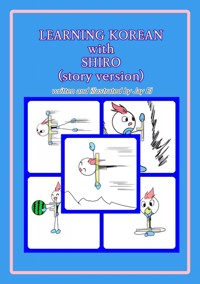
In this book, the paintings in “Learning Korean with Shiro(story version)” are arranged in the order of consonants and vowels in Korean.
Through the combination of pictures, situations, and lines, the book will be the best introduction to your study of Hangul, which will help first-time learners to remember Hangul easily and in a familiar way.
Das E-Book können Sie in Legimi-Apps oder einer beliebigen App lesen, die das folgende Format unterstützen:
Seitenzahl: 17
Veröffentlichungsjahr: 2019
Ähnliche








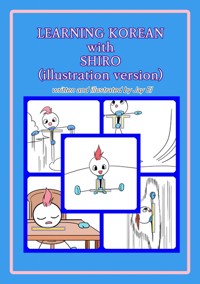
Learning Korean with Shiro (ILLUSTRATION VERSION)
Ebook publication date|18. 7. 2019
Author|Jay El
Publisher|JL BOOKS
Email|[email protected]
ISBN|979-89-6784-241-3
ⓒ Jay El 2019
This book is protected by international copyright treaties. No part of this publication may be reprinted, reproduced or plagiarized in any from.
CONTENTS
Preface
Chapter 1 Basic Consonants
Chapter 2 Basic Vowels
Chapter 3 Double Consonants
Chapter 4 Double Vowels
Chapter 5 Pronunciations
Chapter 6 Writing
Bonus
1. Basic vowels
2. Basic consonants
3. The Korean alphabet
PREFACE
This book is a compilation of the illustrations in "Learning Korean with Shiro(Story Version)" in the order of consonants and vowels in the Korean alphabet.
In addition to the basic consonants and vowels, double consonants(such as "ㄲ") and double vowels(such as "ㅚ") are arranged with interesting pictures. Also, how to pronounce and write Hangul is included.
I hope this book will be a good Korean primer for you.
CHAPTER 1 BASIC CONSONANTS
ㄱ 기역(gi-yeog)
The first consonant of the Korean alphabet. It has (g) sound.
Seri is surprised at the growling(그르렁 거리는1) bear.
Shiro is climbing up with a gasp, sounding "Heok-heok(헉헉2)."
1"그르렁(geu-reu-reong)" or "으르렁(eu-reu-reong)" is a word imitating the sound made when a large and fierce animal roars loudly, strongly, like "grrr" in English.
2"헉헉(heog-heog)" is a Korean onomatopoeia which means the sound of breathless breathing.
ㄴ 니은(ni-eun)
The second consonant of the Korean alphabet. It has (n) sound.
Shiro explains that notebooks(노트3) come out of wood(나무4).
"Hi(안녕5)?"
3The word "notebook" is written in Korean as "노트북(no-teu-bug)."
4"나무(na-mu)" means "a tree" or "wood."
5"안녕(an-nyeong)" means "hi" or "hello."




