


6,99 €
Mehr erfahren.
- Herausgeber: EHS
- Kategorie: Religion und Spiritualität
- Sprache: Englisch
Wilhelm Leibnitz, like Descartes, Hobbes and Spinoza, is convinced of the importance of the mechanical explanation of nature. His three predecessors regarded the mechanical principles as self-evident and as given once for all, and assumed the task of interpreting the various elements of reality in harmony with the principle of mechanical causality. Leibnitz however subjects the principle of causality to a profounder analysis by inquiring into its presuppositions and seeking to refer it back to something still more fundamental. It is only after he has succeeded in this that he proceeds to the definition of the relation between matter and mind. The motive for this investigation was in part purely theoretical, due to the fact that Leibnitz discovered gaps and inconsistencies in his predecessors, in part practical, due to his desire to bring the modern explanation of nature into more perfect harmony with his religious presuppositions. He attempted to accomplish both at a single stroke, by means of a single idea, the idea of continuity…
Leibnitz bases his ethical ideas on the longing for perfection, i.e. for a higher degree of energy and greater spiritual harmony. The sense of pleasure is correlated with an abundance and harmony of energies...
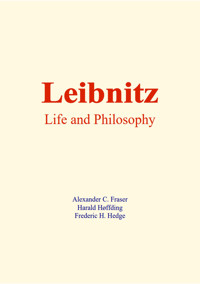
This book deals with the life and thoughts of Leibnitz, the famous German philosopher and scientist.
ABOUT THE AUTHORS
Alexander Campbell Fraser (1819-1914) was a Scottish philosopher and educator known for reviving interest in Bishop Berkeley. Born in Ardchattan, he studied at Glasgow and Edinburgh Universities before entering the Presbyterian ministry. He became the first professor of Logic at New College in 1846 and later succeeded Sir William Hamilton at Edinburgh University. Fraser edited Berkeley’s works, wrote philosophical biographies, and explored the relationship between religion and science. He retired in 1891 but remained active, publishing his Biographia Philosophica in 1904.
Harald Høffding, born in Copenhagen on March 11, 1843 and died in the same city on June 2, 1931, was a Danish philosopher. Throughout his work, he developed a doctrine that was both positivist and critical, a continuation of Kantian criticalism and a break with reductionist materialism. He is associated with the theory of psychophysical parallelism, the dissemination of which he contributed to in late 19th-century Europe.
Frederic Henry Hedge (1805–1890) was a Unitarian minister, Transcendentalist, and leading scholar of German literature in the U.S. A Harvard graduate, he co-founded the Transcendental Club but later distanced himself from the movement. He held pastoral roles in several churches and became a Harvard professor of ecclesiastical history and German literature. Hedge translated Luther’s A Mighty Fortress Is Our God and served as president of the American Unitarian Association. He died in Cambridge and was buried at Mount Auburn Cemetery.
Das E-Book können Sie in Legimi-Apps oder einer beliebigen App lesen, die das folgende Format unterstützen:
Veröffentlichungsjahr: 2022
Ähnliche

















Leibnitz: Life and Philosophy
Leibnitz
Life and Philosophy
Life and Philosophy of Leibnitz{1}
The lately republished philosophical writings of Leibnitz are the productions of a species of intellectual labour that is very rare in this country, but of which, in Germany. France, and America, the press is giving forth some original and many republished specimens. The amount of republished metaphysical literature of the higher kind which has appeared in foreign countries within the last thirty years, is worthy of remark. Some idea of it may be formed from any common catalogue of books recently issued from the press of Leipsic, Berlin, Paris, or Boston. The labours of the illustrious Cousin in this department are well known. The works, in whole or in part, of Plato, Proclus, Abelard, Descartes, André, and Pascal have reappeared under the superintendence of this eloquent founder of the modern eclectic school of France.
Containing as they do the results, and in many respects splendid results, of purely abstract thinking, the works of Leibnitz are singularly fitted for contributing to imbue the mind of an ardent student with comprehensive and lofty speculation. While his writings abound in daring hypotheses, they have, nevertheless, greatly advanced metaphysical science, by rendering current a multitude of new ideas; and the fact of the continued circulation of an amount of abstract thought so great, so peculiar in its kind, and so fitted to set other minds to work, as these books contain, can never be unworthy of the consideration of those who would observe and study literature in its higher relations. Besides their intrinsic value, they are connected with an important epoch in the history of modern speculation. This philosopher looms vast even in the distance, at the entrance of the labyrinth of recent German Philosophy.
Though a curious combination of circumstances has hitherto preserved the surface of the British mind, in a great measure, unruffled by an influence powerful enough to create so much commotion on the continent of Europe, there are signs in the literary horizon which betoken a change, for which society in this country would do well to be prepared. By the well-regulated study of these unwonted topics, we may not merely disarm the enemies of religion, of what in other times has been, and will continue to be, a favourite weapon of assault, but we may even convert that weapon into an instrument of use in the service of an enlightened Christianity. The interest lately revived elsewhere in the life and labours of Leibnitz, and indicated among other means by various recent publications, suggests some meditation upon the leading events in his biography, accompanied with a few historical and speculative notices, as an introduction to that great department of knowledge of which he was so distinguished a cultivator, viz., Metaphysical Philosophy.
Perhaps these two last words are fitted to excite feelings of repugnance in the minds of some readers, as relating to something that is conceived to be at best vague and unproductive. The tendencies of public opinion in Great Britain, in the former half of this century, have evidently been greatly averse from these speculations. The section of society given to abstract meditation has never in any age been a large one; and the recent wide extension of a certain measure of intelligence has perhaps helped to diminish it, by putting the current literature more under the control of a public for the most part necessarily busy with the affairs of practical life. If we except the rising symptoms of a coming change—indicated partly in the poetical contemplations of Coleridge and the logical philosophy and learning of Sir William Hamilton—no literary efforts are even contemplated which involve purely speculative research; and hardly any concern is manifested for the philosophical pursuits of other nations. Metaphysical Science cannot, from its peculiar nature, be made generally popular till the exercise of reflection has become more common; unless, indeed, as sometimes happens, the science itself is degraded, so that (while the name Metaphysic is retained) those who profess to be its votaries are conversant exclusively, not with the most subtle and evanescent, but with the simplest and most generally seductive class of the objects of thought.
The present is a remarkable, and, indeed, anomalous historical epoch. In these islands it is, and has been since the commencement of this century, a period of rapid physical and social progress. Men have gained an increased knowledge of the laws and processes of matter, and thus the world is becoming a more convenient place of habitation. The principle of commerce has been developed to an extent unknown in the ancient world. The present revolution in the means of social intercourse and communication seems to be preparing the way for other changes, about which it is hardly safe to speculate. All the increased "subjection of matter to mind" which the world, and especially this country, has witnessed since the principles of the Baconian philosophy have become popular, must be indeed gratifying to every lover of his race. And in the more sublime departments of Physical Science the same progress is visible. Geology is contributing the details of the past history of the-planet on which we live. The telescope is making magnificent disclosures of the distant regions of the material creation. Nor is public interest confined to what is merely physical. Society itself is undergoing fundamental changes; and the "science of society," under its twofold form of civil and ecclesiastical, is the theme of discussion and controversy.
An age in which controversy turns on first principles needs, and will soon demand, a Metaphysical Literature. That state of knowledge and of general opinion is not a hopeful one, in which the thoughts and energies of men are directed exclusively towards physical or economical science. And when the intellect is in a state of fermentation, bare facts, separated from principles, excite only a feeble interest. Men then feel that beneath the stir occasioned by incessant activity among the outward events of this passing world, there lie hid the invisible elements and springs of those external changes of which this strange and dangerous life is the scene. Within and immediately around that inner circle, is the domain peculiar to Philosophy. The more deeply thought is exerted on any subject, the further is it compelled to go within the dominions of this "science of sciences." The soul there casts about for its anchorage in the ocean of thought.
The need for a First Philosophy, of the kind we have indicated in the foregoing paragraph, is not indistinctly referred to by Lord Bacon:—"Because," says he, "the distributions and partitions of knowledge are not like several lines that meet in one angle, and so touch but in a point, but are like branches of a tree that meet in a stem, which hath a dimension and quantity of entireness and continuance, before it come to discontinue and break itself in arms and boughs; therefore, it is good to erect and constitute one universal science by the name of 'philosophia prima,' primitive or summary philosophy, as the main and common way, before we come where the ways part and divide themselves; which science, whether I should report deficient or no, I stand doubtful."




