


32,99 €
Mehr erfahren.
- Herausgeber: John Wiley & Sons
- Kategorie: Bildung
- Sprache: Englisch
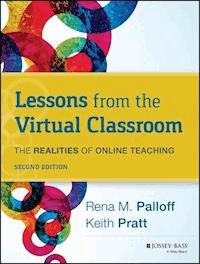
Lessons from the Virtual Classroom, Second Edition The second edition of the classic resource Lessons from the Cyberspace Classroom offers a comprehensive reference for faculty to hone their skills in becoming more effective online instructors. Thoroughly revised and updated to reflect recent changes and challenges that face online teachers, Lessons from the Virtual Classroom is filled with illustrative examples from actual online courses as well as helpful insights from teachers and students. This essential guide offers targeted suggestions for dealing with such critical issues as evaluating effective courseware, working with online classroom dynamics, addressing the needs of the online student, making the transition to online teaching, and promoting the development of the learning community. Praise for Lessons from the Virtual Classroom, Second Edition "Palloff and Pratt demonstrate their exceptional practical experience and insight into the online classroom. This is an invaluable resource for those tasked with creating an online course." -- D. Randy Garrison, professor, University of Calgary, and author, Blended Learning in Higher Education: Framework, Principles, and Guidelines "Faculty will deeply appreciate and make use of the many explicit examples of how to design, prepare, and teach both blended and fully online courses." -- Judith V. Boettcher, faculty coach and author, The Online Teaching Survival Guide: Simple and Practical Pedagogical Tips "Lessons from the Virtual Classroom is filled with insightful caveats and recommendations, pointed examples to enhance your practice, succinct summaries of the research, and engaging visual overviews. Each page brings the reader a renewed sense of confidence to teach online as well as personal joy that there is finally a resource to find the answers one is seeking." -- Curtis J. Bonk, professor of education, Indiana University-Bloomington, and author, Empowering Online Learning: 100+ Activities for Reading, Reflecting, Displaying, and Doing
Sie lesen das E-Book in den Legimi-Apps auf:
Seitenzahl: 447
Veröffentlichungsjahr: 2013
Ähnliche
















Contents
Cover
Series
Title Page
Copyright
Figures, Table, and Exhibits
Figures
Table
Exhibits
Preface to the Second Edition: The Face of Online Learning Today
Online Learning in the Twenty-First Century
Organization of the Contents
The Authors
Acknowledgments
Part One: Rethinking Education for an Online World
Chapter One: Online Learning in the Twenty-First Century
Online Learning Today
Current and Emerging Technologies
Emerging Issues for Both Faculty and Administrators
Recent Developments in K–12 Online Learning
The Effectiveness of Distance Delivery
Chapter Two: The Art of Online Teaching
Lack of Preparation
Who Should Teach Online?
Training, Training, and More Training
Using Mobile Technology in Faculty Training
New Processes, New Relationships
Online Pedagogy
Keys to Success
The Final Transition: Assessing and Evaluating Students and Ourselves
Supporting Instructors to Make the Transition
Chapter Three: Administrative Issues and Concerns
Faculty Time, Compensation, and Questions of Tenure
Program Planning and Development
Another Look at Faculty and Student Support, Training, and Development
Governance and Intellectual Property
Student Retention
Some Last Thoughts on Administrative Issues and Concerns
Chapter Four: The Tools of Online Teaching
Technology in the Twenty-First Century
Matching the Technology to the Course
What Are Web 2.0 Technologies?
Choosing Technology Wisely
When Money Is an Issue
Accessibility Is a Major Concern
Part Two: Teaching and Learning Online
Chapter Five: Transforming Courses for the Online Classroom
Starting Over: Considerations in the Development of an Online Course
The Process of the Course
Chapter Six: Teaching Courses Developed by Others
A Focus on Content
Ability to Adjust the Course
Examples of Customization
When Customizing Is Not Possible
Building Community into the Process
Evaluating a Course Developed by Another
Issues of Intellectual Property
Courses with Rolling Admission
Final Thoughts on Teaching a Course Developed by Another
Chapter Seven: Working with the Virtual Student
If We Build It, They Will Come
The Successful Learner in the Online Classroom
Addressing Different Learning Styles
Recognizing and Working with Those Who Do Not Succeed
The Role of the Learner in the Online Learning Process
Maximizing the Potential of the Virtual Student
Teaching Students to Learn in the Online Environment
Respecting Student Intellectual Property
Chapter Eight: Online Classroom Dynamics
Group Dynamics and Online Classroom Dynamics
Applying What We Understand About Groups to Online Classes
Other Ways of Looking at Online Groups
Conflict Revisited
Working with Difficult Students
When It Simply Isn't Working
Chapter Nine: Lessons Learned in the Virtual Classroom
A Look Back
The Myths
Lessons for Faculty
Lessons for Instructional Designers and Faculty Developers
Lessons for Administrators
A Look into the Near Future
Appendix A: Sample Training for Faculty
Introduction to and Best Practices in Online Teaching
Intensive Training Focused on Collaboration and Building Online Learning Communities
Appendix B: Additional Resources
Communities of Practice
Mobile Applications and Web 2.0 Applications
Certificate Programs in Online Teaching
Online Conferences
Online Journals About Online Teaching
Professional Organizations
Course Evaluation Rubrics
References
Index
Other Books by Rena M. Palloff and Keith Pratt
The Excellent Online Instructor: Strategies for Professional Development
Assessing the Online Learner: Resources and Strategies for Faculty
Building Online Learning Communities: Effective Strategies for the Virtual Classroom, Second Edition
Collaborating Online: Learning Together in Community
The Virtual Student: A Profile and Guide to Working with Online Learners
Cover design by Michael Cook Illustration © Olga Yakovenko/istockphoto Copyright © 2013 by John Wiley & Sons, Inc. All rights reserved.
Published by Jossey-Bass A Wiley Imprint One Montgomery Street, Suite 1200, San Francisco, CA 94104-4594—www.josseybass.com
No part of this publication may be reproduced, stored in a retrieval system, or transmitted in any form or by any means, electronic, mechanical, photocopying, recording, scanning, or otherwise, except as permitted under Section 107 or 108 of the 1976 United States Copyright Act, without either the prior written permission of the publisher, or authorization through payment of the appropriate per-copy fee to the Copyright Clearance Center, Inc., 222 Rosewood Drive, Danvers, MA 01923, 978-750-8400, fax 978-646-8600, or on the Web at www.copyright.com. Requests to the publisher for permission should be addressed to the Permissions Department, John Wiley & Sons, Inc., 111 River Street, Hoboken, NJ 07030, 201-748-6011, fax 201-748-6008, or online at www.wiley.com/go/permissions.
Limit of Liability/Disclaimer of Warranty While the publisher and author have used their best efforts in preparing this book, they make no representations or warranties with respect to the accuracy or completeness of the contents of this book and specifically disclaim any implied warranties of merchantability or fitness for a particular purpose. No warranty may be created or extended by sales representatives or written sales materials. The advice and strategies contained herein may not be suitable for your situation. You should consult with a professional where appropriate. Neither the publisher nor author shall be liable for any loss of profit or any other commercial damages, including but not limited to special, incidental, consequential, or other damages. Readers should be aware that Internet Web sites offered as citations and/or sources for further information may have changed or disappeared between the time this was written and when it is read.
Jossey-Bass books and products are available through most bookstores. To contact Jossey-Bass directly call our Customer Care Department within the U.S. at 800-956-7739, outside the U.S. at 317-572-3986, or fax 317-572-4002.
Wiley publishes in a variety of print and electronic formats and by print-on-demand. Some material included with standard print versions of this book may not be included in e-books or in print-on-demand. If this book refers to media such as a CD or DVD that is not included in the version you purchased, you may download this material at http://booksupport.wiley.com. For more information about Wiley products, visit www.wiley.com.
Library of Congress Cataloging-in-Publication DataPalloff, Rena M., date Lessons from the virtual classroom : the realities of online teaching / Rena M. Paloff, Keith Pratt. – Second edition. pages cm—(The Jossey-Bass higher and adult education series) Rev. ed. of : Lessons from the cyberspace classroom, 2001. Includes bibliographical references and index. ISBN 978-1-118-12373-7 (pbk.); ISBN 978-1-118-22475-5 (ebk); ISBN 978-1-118-23822-6 (ebk); ISBN 978-1-118-26282-5 (ebk) 1. Web-based instruction. 2. Distance education. I. Pratt, Keith, date II. Palloff, Rena M., 1950- Lessons from the cyberspace classroom. III. Title. LB1044.87.P34 2013 371.33'44678–dc23 2013005849
FIGURES, TABLE, AND EXHIBITS
Figures
Table
Exhibits
PREFACE TO THE SECOND EDITION: THE FACE OF ONLINE LEARNING TODAY
The thought of doing a second edition of this book at first seemed to be a daunting task. We asked our editors to seek out prerevision reviews of the original edition because we continued to receive good feedback about its usefulness, although we knew it was somewhat outdated. We worried about how we might stay true to the original work while updating it. We needn't have worried: as we read the book anew and looked at the reviews, it became clear to us that much of the content in the original was woefully out of date. Some of the issues remain current, such as administrative concerns and disparities in technology integration and use. But many new issues and concerns have emerged in the past ten years, some of which we might never have anticipated.
We opened the original Lessons from the Cyberspace Classroom, which has been retitled for this revised edition, with a discussion of how little technology changes had impacted online learning. We did not anticipate any major technological changes at the time that might change the face of this form of education. How wrong we were! For example, the use of mobile technology and social networking are just two technological changes that are significantly changing how education occurs online. These changes, as well as the ways in which online education has evolved and is conducted currently, are the substance of this new edition.
Change is coming fast and furious, and because of that, focusing on a predominant form of a course management system, for example, will date this work before it is even published. Therefore, although we present and discuss many technologies in this edition, our main concern continues to be best practices in the delivery of education online. That is the focus of our work in this edition, along with the questions and issues that continue to arise about this form of education. Consequently, we do not reference or present screen shots of course management systems as we did in the first edition. Who knows what the status of those will be even within the next three to five years?
Online Learning in the Twenty-First Century
Some of the developments that we discussed in the original edition remain worthy of discussion. Updates to those, along with some newer concerns, form the complexion of online learning today. They raise concerns that we considered ten years ago but may have since evolved and therefore discuss in more detail in this edition.
The Costs of Teaching Online
Smaller colleges and universities are entering the online learning market to increase their reach and resultant student base and because both students and faculty are demanding it. Ten years ago, we commented on the disparity between institutions with the budgets to support online learning and those without those resources. This is not as much of an issue today with the advent of open source course management systems, the use of blogs and wikis that are in the public domain, and the use of mobile technologies. These developments may in fact help to shrink what has been termed the digital divide. That said, however, the ability to train and support faculty and students, as well as maintain an increasingly technological environment, are very real costs that institutions with shrinking budgets and enrollments find difficult to maintain.
Faculty Control over the Academic Process
It is rare today to find wholesale faculty objection to the development of online course offerings and programs. However, pockets of faculty resistance to teaching online still exist, and in many cases, faculty are still struggling with decisions about whether to teach online and what technologies to include should they make that decision. In many instances, faculty still have little to no influence over the course management systems in use in their institutions or the technology choices being made in general. Consequently, questions continue to be raised about the degree to which faculty should be involved in these decisions, which have serious implications for course design and delivery.
Course Ownership
Do instructors own the courses they develop, or are these courses institutional property? We raised this question ten years ago, and it remains a question. Increasingly, institutions are moving in the direction of offering prewritten courses that instructors facilitate as a function of the scalability of online programs. However, some of the questions we raised about this issue earlier remain current: Should instructors who teach a course developed by someone else be permitted to alter that course to suit their own teaching styles and both eliminate and include material that they deem either unnecessary or more important? Instructors still need to know who “owns” courses and course material. In the face-to-face classroom, as instructors develop and deliver their own courses, this has not been an issue. In the online classroom, it is.
Continuing Training Needs
Unfortunately, academic institutions assume that if they offer online courses and programs, teachers will know how to teach in that environment and, more important, students will know how to learn or engage with the material. Our experience in both teaching online courses and consulting with instructors, faculty developers, and administrators across the United States continues to show us that the opposite is true. Instructors in fact need training and assistance in making the transition to the online environment, but this is not happening with the frequency or quality that it should. Students also need to be taught how to learn online, although we rarely see orientation programs for online learners.
Teaching and learning through the use of technology requires more than mastery of a software program, although that continues to be the focus of instructor training. It takes an awareness of the impact that this form of learning has on the learning process itself. As more institutions and their instructors enter the online classroom and encounter both successes and difficulties in the process, they are coming face-to-face with the realities of online teaching and asking more, not fewer, questions about how to make this transition successfully. Furthermore, not all instructors enter online teaching at the same point, and rarely, if ever, is training customized to fit the experience level of those who need it. Consequently we offer concrete suggestions for course development and delivery. We also offer suggestions to instructors who are being asked to teach a class they did not create.
Advances in Technology
Although we said that we do not intend to focus on technology in this book, we do need to discuss some of the changes that have occurred and how they are having an impact on online learning today. Mobile technology, such as cell phones and tablet computers, are literally changing the face of online learning. Open source course management systems are making it easier for instructors and their institutions to develop and deliver online offerings. Social networking technologies such as Facebook and Twitter are infiltrating online classes. The use of Web 2.0 technologies is moving us in the direction of learner-generated content and greater empowerment of learners. All of these are important developments that bear exploration.
Advances in K–12 Online Learning
Although not a major focus of this book, online learning is most definitely making an impact in the K–12 sector. As a result, pressure increases on community colleges and higher education to increase and improve online offerings. Students are graduating from high school in search of online courses and are far more skilled in making use of online resources than students in the past. Many institutions are still not up to this challenge and need to understand how to prepare themselves for students who are demanding more in terms of the use of technology and online delivery.
The Regulatory Environment
In recent years, higher education has come under the scrutiny of the U.S. Department of Education, resulting in regulations aimed at reducing time to degree completion and the amount of financial aid required to complete a degree. In addition, there has been concern about the relationship of a degree to graduates' ability to find employment. Online learning has come under additional fire with regard to state authorizations for conducting education, along with concerns about the quality of the courses and programs being offered online. Some of these regulations, such as the one regarding state authorization, have been deferred. However, administrators of online programs or in colleges and universities where online courses are being offered are looking at what it will take to meet that requirement once it goes into effect. If a school is located in California, for example, and admits students from every state in the union, will that school need authorization from every state in order to do so? These unanswered questions for administrators are of concern.
Organization of the Contents
We have not significantly altered the organization of the book from the original edition. However, to assist readers with the ability to navigate the myriad issues we explore in it, each chapter begins with a brief discussion of the issues it addresses. We also present tips at the conclusion of each chapter and have organized them according to the audience they are to serve: instructors, faculty developers, or administrators.
The chapters in part 1 look at the issues involved in rethinking education in an increasingly online world. Chapter 1 reviews the issues that are of greatest concern today to all interested readers. Chapter 2, geared to instructors and faculty developers, explores the delivery of effective online teaching. Chapter 3 is aimed at administrators and addresses current issues in the development and delivery of online education. Chapter 4 focuses on technology and looks not only at the impact of technology but also at the various tools that are shaping online learning now.
The audience for part 2 of this book is primarily instructors, instructional designers, and faculty developers. However, administrators will also benefit from understanding the needs of these groups in transforming and moving classes online (chapter 5), being asked to teach a course developed and designed by another (chapter 6), the issues and concerns of virtual students (chapter 7), and the classroom dynamics that can and do emerge when teaching online (chapter 8). The closing chapter ties together all of the themes presented throughout this book. In so doing, it is meant to support all readers in looking backward at the lessons we have learned over the past ten years and how those may inform the next ten. Appendix A provides two faculty training examples to assist readers in putting the principles presented in this book into practice. The first is a general orientation for instructors who are moving into online teaching, and the second focuses on community building in online classes. Appendix B provides additional resources for instructors and those who support them in their online teaching work. Included are listings of communities of practice, online teaching certification programs, journals, and the like.
When we first presented this book in 2001, it was a logical follow-up to our first book, Building Learning Communities in Cyberspace (Palloff & Pratt, 1999). Since that time, we have revised that first book to look anew at the importance of building a learning community as part of the delivery of online instruction. We also provided a guidebook to the construction of an effective course for those entering the online arena for the first time. As we have continued to write, speak, and consult using the concepts from the first book as well as our others, and to teach online, we have been learning more about the realities of online teaching every day. This second edition should help take instructors, faculty developers, and administrators further into the process as we explore the issues that they face regularly. We have designed this book primarily for these professionals. It will also be helpful to those in the corporate sector who are being asked with increasing frequency to develop employee training programs that are delivered entirely online. Readers will gain greater understanding of the forces that continue to shape education in new and exciting ways. The book also provides readers with new tips, tools, and insights to equip them to enter and participate with greater confidence in this constantly changing environment.
March 2013
Rena M. Palloff Alameda, CaliforniaKeith Pratt Delight, Arizona
THE AUTHORS
Rena M. Palloff is owner of Crossroads West, which works with institutions, organizations, and corporations interested in the development of online distance learning and training programs and conducting faculty development training and coaching. In addition, she has consulted extensively in health care, academic settings, and addiction treatment for well over twenty years. Palloff is faculty at Fielding Graduate University in the master's degree program in organizational management and development and in the School of Educational Leadership and Change, where she designed a master's degree in education program focusing on teaching online, integrating technology in the K–12 classroom, and the use of social media in education. She is adjunct faculty at Capella University as well, in the School of Social and Behavioral Sciences, teaching and mentoring in the professional doctorate in social work. She also conducts faculty development training for the University of the Rockies and mentors doctoral dissertations at Walden University.
Palloff received a bachelor's degree in sociology from the University of Wisconsin-Madison and a master's degree in social work from the University of Wisconsin-Milwaukee. She holds a master's degree in organizational development and a Ph.D. in human and organizational systems from Fielding Graduate University.
• • •
Keith Pratt began his government career as a computer systems technician with the U.S. Air Force. He served in various positions, including supervisor of computer systems maintenance, chief of the Logistics Support Branch, chief of the Telecommunications Branch, and superintendent of the Secure Telecommunications Branch. After leaving the air force, Pratt held positions as registrar and faculty (Charter College), director (Chapman College), and trainer and consultant (the Growth Company). As an adjunct faculty member at Wayland Baptist University and the University of Alaska, Pratt taught courses in communications, business, management, organizational theories, and computer technology. He was assistant professor in the international studies program and chair of the management information systems program, main campus and overseas, at Ottawa University in Ottawa, Kansas. He currently teaches online at Wayland Baptist University, Capella University, and Walden University.
Pratt graduated from Wayland Baptist University with a dual degree in business administration and computer systems technology. He has an M.S. in human resource management from Chapman University, an M.S. in organizational development, a Ph.D. in human and organizational systems from Fielding Graduate University, and an honorary doctorate of science from Moscow State University.
Since 1994 Palloff and Pratt have collaboratively conducted pioneering research and training in the emerging areas of online group facilitation, face-to-face and online community building, program planning and development of distance learning programs, and management and supervision of online academic programs. In conjunction with Fielding Graduate University, they developed the online teaching and learning academic certificate program designed to assist faculty in becoming effective online facilitators and course developers.
ACKNOWLEDGMENTS
Many of our readers have told us over the years that they have used our book originally titled Lessons from the Cyberspace Classroom as a guide to starting their work in online teaching and learning and also as a training manual for other faculty. For a few years, you've been asking us to update it: we heard you and hope that this work helps you to continue yours. Thanks for the encouragement!
Once again, we thank the patient, supportive, and dedicated people at Jossey-Bass. Thanks in particular to Erin Null and Alison Knowles. Thanks also to those of you who have helped make the online presentations of our work possible. It has been a great experience to do the Online Teaching and Learning Conferences and the Wiley Learning Institute.
Thanks to George Engel for introducing us to the wonderful world of mobile technology and for your great contribution to the book in chapter 4. We're looking forward to continuing our work together!
We always thank Fielding Graduate University for supporting our work and for the other universities with which we're affiliated—Capella, Walden, University of the Rockies, and Wayland Baptist—for giving voice to our practice of online teaching. We also warmly acknowledge our students: without you, this book would not be here!
Thanks, of course, to our families. Your patience and love help us to do what we do and push us onward in the exploration of new ways to pursue our passion.
PART ONE
RETHINKING EDUCATION FOR AN ONLINE WORLD
CHAPTER ONE
ONLINE LEARNING IN THE TWENTY-FIRST CENTURY
Because of the changing nature of students today, economic pressures, and rapid implementation of distance learning courses and programs, definitions of what constitutes education and learning are changing too. Whereas years ago instructors viewed their students as blank slates whose minds could be filled with the information they were imparting, current constructivist theory holds that students create knowledge and meaning through their interaction with one another, the instructor, and their environment. A more collaborative approach to learning, such as that promoted by constructivist thought, can yield deeper levels of knowledge creation (Brooks & Brooks, 2000). The use of distance learning technologies and, more specifically, online learning, have both grown out of and contributed to the changes now occurring in the delivery of education.
Lesen Sie weiter in der vollständigen Ausgabe!
Lesen Sie weiter in der vollständigen Ausgabe!
Lesen Sie weiter in der vollständigen Ausgabe!
Lesen Sie weiter in der vollständigen Ausgabe!
Lesen Sie weiter in der vollständigen Ausgabe!
Lesen Sie weiter in der vollständigen Ausgabe!
Lesen Sie weiter in der vollständigen Ausgabe!
Lesen Sie weiter in der vollständigen Ausgabe!
Lesen Sie weiter in der vollständigen Ausgabe!
Lesen Sie weiter in der vollständigen Ausgabe!
Lesen Sie weiter in der vollständigen Ausgabe!
Lesen Sie weiter in der vollständigen Ausgabe!
Lesen Sie weiter in der vollständigen Ausgabe!




