


17,49 €
Mehr erfahren.
- Herausgeber: Free Spirit
- Kategorie: Religion und Spiritualität
- Sprache: Englisch
An autobriography of a Paramedic, who worked at Vietnam during the Vietnamese War.
Das E-Book Lights and Siens wird angeboten von Free Spirit und wurde mit folgenden Begriffen kategorisiert:
vietnam,paramedic,autobiography
Das E-Book können Sie in Legimi-Apps oder einer beliebigen App lesen, die das folgende Format unterstützen:
Veröffentlichungsjahr: 2024
Ähnliche




















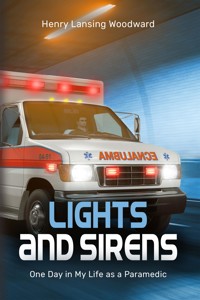
Lights and Sirens
One Day in My Life as a Paramedic
After completing my duties for a call,
I would turn the patient over to the ER staff,
or cover them at the scene with a white sheet from the ambulance,
whichever was appropriate.
Then, I would go to the next one
as if it had just been another thing to do that day,
like picking up my laundry.
Henry Lansing Woodward
Mobile Intensive Care Technician, M.I.C.T.
Paramedic
Published and Distributed By
Poets Choice & Free Spirit LLC
New York, USA
ISBN :978-81-973060-0-6
1st Edition June 2024
The Definition of a Paramedic
A person who must make a correct medical diagnosis in a remote location,
determine and initiate the correct treatments,
do them correctly the first time,
all within the first thirty seconds of arrival,
while everyone is watching.
No pressure there, right?
On October 17, 1977, I began classes in Honolulu, Hawaii, at the Queen’s Medical Center for Mobile Intensive Care Technician, MICT - Paramedic. The first three months, or Phase One, were called the Didactic Phase. The whole time was spent in the classroom for instruction in Medical knowledge.
The next month, or Phase Two, we practiced technical skills by rotating through the various departments within the hospital. We were allowed access to many departments, such as Neo-Natal, Pediatric, the ER, IV therapy, Surgery, OBGYN, Neuro, Psych, etc., to observe and actually practice the skills we would need to use during emergencies as Paramedics.
Following Phase Two, the Internship Phase, or Phase Three, began. It was to be for six months. During this phase, each Paramedic Intern was required to participate in one thousand hours of ride-along” time aboard the 911 emergency ambulances responding to actual emergencies within the City of Honolulu.
We accompanied the regular two-person crew consisting of a Paramedic and an EMT. This program required the Interns to be exposed to the most calls possible during any normal eight-hour shift. Therefore, the ambulances used were always the ones stationed in the most busy areas.
During the “ride-along,” the Inturn was required to take charge of the emergency and to practice the skills that had been learned in Phase Two. Here is the list of those skills that were required for each Intern to perform perform he could graduate and the number of times he was required to perform them.
For the purpose of graduating, it wasn’t required for the patient to survive. All that mattered was for the Intern to practice the specific skills for the specific amount of times required.
Paramedic Intern Criteria
Perform CPR
Adult 12
Child 2
Cardio-Pulmonary Resuscitation
Adult 12
Child 2
Endotracheal Intubation
Adult 12
Child 2
Oxygen Administration
Adult 12
Child 2
Respiratory Arrest
Adult 12
Child 2
Head & Neck Trauma
Adult 12
Child 2
Thoracic Trauma
Adult 12
Child 2
Abdominal Trauma
Adult 12
Child 2
Burns
Adult 12
Child 2
Suicide/Poison ingestion
Adult 12
Child 2
Record/Transmit 12-lead EKG
Adult 12
Child 2
Cardiac Defibrillation
Adult 12
Child 2
Quite a list, isn’t it? Do you see the significance of it? Do you see, as I did not the first time I saw it, that one-hundred-and-sixty-eight real people had to die or have a near-death experience for me to become a Paramedic? I was stunned. Absolutely stunned. If all this had to happen in the next six months, what was in store for the rest of my working life? The bottom line was that a whole lot of people were going to die in my hands. In my hands. And, they did.
About six years later, during one of my bi-annual recertification exams, I scored a ninety-six percent overall final result. It was a ten-hour ordeal, and they let me know my score before I left the exam room. As I was walking out with pride in my heart, one of the physician examiners asked me how I did. I answered with no small amount of arrogance, “I wrote a ninety-six percent final score.”
He responded, “Well, that means only four percent of your patients will die.” I was crushed into humility and continued walking without comment. As it turned out, it was a whole lot more than four percent.
Dedications
My teacher
Ms. Reta Pozzi, RN
Honolulu, HI
Founder and Instructor
Mobile Intensive Care Technician (M.I.C.T.)
Paramedic Training
Hawaii Heart Association, Honolulu, Hawaii
“Welcome to the first day of the rest of your lives.”
(Opening statement on the first day of classes)
My partner
Mr. Mitch Nowicki, EMT-III
Sparks, Nevada
He was always there.
And, to
All the Paramedics, EMTs, and First Responders everywhere who are still,
“On the road.”
Table of Contents
Introduction
The First Call 8:05 am The Vomit Room
The Second Call 8:41 am He Was Out of His Mind
The Third Call 9:35 am The Razorblade Lady
The Fourth Call 10:05 am The Firefighter
The Fifth Call 12:15 pm The Reno Syndrome
The Sixth Call 1:29 pm Horseshoe to Head
The Seventh Call 3:01 pm The Reno Rocks Glass
The Eighth Call 4:15 pm He Blew Off the Top of His Head
The Ninth Call 5:45 pm The Ice Pick Story
The Tenth Call 6:35 pm The Dutiful Nevada Housewife
The Eleventh Call 8:10 pm The Bathroom Birth
The Twelfth Call 9:43 pm One Night in a Reno Parking Lot
The Thirteenth Call 12:05 am The Elevator Game
The Fourteenth Call 3:05 am The Casino Patient
The Fifteenth Call 4:35 am The Good Babysitter
The Sixteenth Call 6:19 am The Red Beanbag Chair
Epilog
Conclusion
Introduction
After completing my duties for a call,
I would turn the patient over to the ER staff,
or cover them at the scene with a white sheet from the ambulance,
whichever was appropriate.
Then, I would go to the next one as if it had just been another thing to do that day,
like picking up my laundry.
I chose to work for private ambulance companies subcontracted to provide 911 emergency responses to the general population. In that capacity, I performed the same duties as a Firefighter Paramedic. However, I had a whole different pay scale. There were no overtime, medical, or 401K benefits, and I was paid about eight dollars an hour.
I did this because I had already spent time as a Navy combat medical corpsman in Vietnam, “boots on the ground,” as they say, and that was enough. I did not want the morning musters, the standing in line in uniform, and the saluting of the officer in charge. This military mentality was no longer for me. The only option remaining was the private ambulance sector and its poor pay and non-existent benefits.
Whether working for a private company or a governmental agency, all Paramedics and EMTs do the same job. We deliver the best medical care possible in any particular emergency whenever we answer the call.
While doing that, my peers and I regularly encountered life-and-death situations. During those situations, we had to make the correct diagnosis, determine and initiate the correct treatments, and do them correctly the first time, all within the first thirty seconds of our arrival while everyone watched. No pressure there, right?
After completing my duties for a call, I would turn the patient over to the ER staff or cover them at the scene with a white sheet from the ambulance, whichever was appropriate. Then, I would go to the next one as if it had just been another thing to do that day, like picking up my laundry.
Today, I realize I would not do it again for that pay. More correctly, I would not do it again, whatever the pay.
Most of my twenty-four-hour shifts passed with four to six dispatches, sometimes as many as eight or nine. On some days, there were none, but that was rare. An average shift consisted of a tragedy or two and a handful of assorted horrors. It was all quite routine. Then there were those shifts that were far more than routine, too much more.
This book is about one of those shifts. Just one. “Just One Day in My Life as a Paramedic.” I leave it to you to decide whether or not I’m just a complainer about the pay and benefits.
Here is how it went.




