


7,99 €
Mehr erfahren.
- Herausgeber: Chorabooks
- Kategorie: Religion und Spiritualität
- Sprache: Englisch
"Finally one may ask: but what do you propose, what do you want? To this I will answer without much hope, I confess, of being heard and understood: we need liturgical theology, viewed not as a theology of worship and not as a reduction of theology to liturgy, but as a slow and patient bringing together of that which was for too long a time and because of many factors broken and isolated – liturgy, theology, and piety, their reintegration within one fundamental vision. In this sense liturgical theology is an illegitimate child of a broken family. It exists, or maybe I should say it ought to exist, only because theology ceased to seek in the lex orandi its source and food, because liturgy ceased to be conducive to theology."Alexander Schmemann
Das E-Book können Sie in Legimi-Apps oder einer beliebigen App lesen, die das folgende Format unterstützen:
Veröffentlichungsjahr: 2018
Ähnliche







David W. Fagerberg
LITURGY OUTSIDE LITURGY
The Liturgical Theology of Fr. Alexander Schmemann
Copyright © 2018 Chorabooks, a division of Choralife Publisher Ltd.
All rights reserved.
4/F, Hong Kong Trade Center
161-167 Des Voeux Road
Central, Hong Kong
Visit our website at www.chorabooks.com
First eBook edition: March 2018
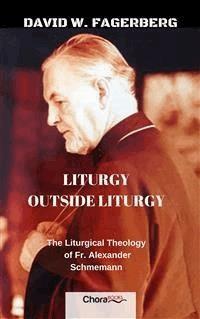
Cover photo taken by Fr. George Gray in 1991 at St. Vladimir's Orthodox Seminary when he was a student with Fr. Schmemann.
Table of contents
Foreword
Introduction
Part I: A Sketch of Alexander Schmemann’s Thought on Liturgy, Theology, and Piety
Chapter 1: Should Liturgy Matter Outside the Church? Schmemann on the Study of Liturgy
Chapter 2: Can Theology be Done outside the Academy? Schmemann’s Concept of Theology
Chapter 3: Do We Need Liturgy in Our Life? Schmemann’s Connection between Liturgy and Spirituality
Part II
Chapter 4: Liturgy and the Consecration of the World
Chapter 5: On Liturgy, Theology and Asceticism
For Kaj & Jennifer and Catherine & Samuel
As they discover joy in the liturgy of their domestic Church
Foreword
Thirty-five years after the repose of Protopresbyter Alexander Schmemann there are those who claim to know the mind of Schmemann and even claim to know what he would say today, if he were still among us. However, I am doubtful that anyone can assume the mantle of Schmemann except the man himself through his writings and legacy. He remains to this day an active voice among us as a liturgist, theologian, preacher, and pastor. He continues to speak for himself to others and his influence is proving to be timeless.
Like David Fagerberg, I did not have the blessing of sitting as one of Fr Alexander’s students. I came to know him through his books, taped homilies and those who cherished him as their teacher and confessor. However, I did have the great privilege of knowing his widow, Matushka Juliana, in her finals years, as she resided near her beloved St. Vladimir’s Seminary in New York. She shared many stories including her husband’s pure joy in being at the altar and his frustration with so much fuss and bother about those things that really don’t matter in the end.
The preface to Fr. Alexander’s book The Eucharist says much about his consistent thinking: it is “not reform, adjustments and modernization that are needed so much as a return to that vision and experience that from the beginning constituted the very life of the Church.” I know of no other author or serious student of the work of Alexander Schmemann who has captured his prophetic vision with more clarity than David Fagerberg: Fr. Alexander’s lucid brilliance and overall vision shine forth in the lectures and reflections chosen by him for this publication.
Still, although Fagerberg is grateful for the foundational influence of Fr. Alexander upon his own academic work as a liturgical theologian, he admits there remains much work to be done in interpreting and building upon Schmemann’s great legacy. In particular, I think there is much work to be done by Orthodox churches and communities in continuing to honestly critique how well they are living our the gospel of Christ.
This book, will be gratefully received by those who knew Fr. Alexander Schmemann, and also by those who have come to know him posthumously through his written word and recorded voice. May it be blessed!
Archpriest Chad Hatfield,
President, St. Vladimir Orthodox Theological Seminary,
Yonkers, New York.
Introduction
This manuscript comes from five lectures given in January of 2017. Three of them were presented at the invitation of Peter Halldorf to a seminar on Alexander Schmemann at The Ecumenical Community of Bjärka-Säby and The Academy of St John in Sweden. Two of them were presented at the invitation of Samuel Rubenson, professor at the University of Lund, to a doctoral seminar and to a group of interested lay people. I have left them in the genre of oral presentation since that was their genesis.
They are published together here, but the reader will notice a gap between the three and the two. In the first three I have stayed as close to Fr. Alexander’s material as possible; in the latter two my own perspective is released. I have therefore decided to place the Schmemann material first, and ask the reader to treat them as laying the foundation for my own work – a metaphor I employ below. Fr. Alexander’s work was tremendously influential on me as a graduate student trying to come to terms with liturgical theology. At that time I searched his writings primarily for what he could teach me about this subject. Writing the talks for the seminar in Sweden gave me the opportunity to read in his corpus more widely, and I commenced by gathering as many of his other essays as I could find (there were quite a number I had overlooked in my required focus on the dissertation). It has been a deep and satisfying pleasure to let him tutor me again, this time on a wider array of subjects that are still somehow all connected, for this is a particular genius of his. To speak about liturgy we must speak about the Church; to speak about the Church we must speak about the world; but the world is in its course of transfiguration, so we are brought to examine our current lives through the eschatological gates to eternity.
I never had the opportunity to meet Fr. Alexander in person; he died the year I began my studies. There are many better books written by people who knew him, but I hope the reader will here profit from hearing his voice in the first three chapters. And any good things I can say about liturgy in the last two chapters seem somehow to trace back to him, even if not directly; any stumbles in them are, of course, mine.
David W. Fagerberg
Professor, Department of Theology
University of Notre Dame
Part I: A Sketch of Alexander Schmemann’s Thought on Liturgy, Theology, and Piety
As much as possible we will convey Schmemann’s varied attempts to connect liturgy, theology, and piety, and find his explanations about why this is important. It is the task, he says, of liturgical theology to reunite these three, but it is not just a personal opinion of his. I believe he finds ecclesiology at stake in the success.
Chapter 1: Should Liturgy Matter Outside the Church? Schmemann on the Study of Liturgy
Schmemann himself is responsible for the structure of my three talks. I don’t mean he spoke to me in my sleep or met me over the Ouija board, I mean that I have long wished to explore one of his clearer statements about what liturgical theology is, and am grateful to this symposium for the opportunity to do so. I began by reimmersing myself in his thought by reading articles I had not previously read when I was more narrowly focused on my dissertation topic. It was a risk to return to an author who was so important to me over three decades ago – will I find him passé? will my interests have moved on? I’m happy to report that Schmemann is as stimulating and fruitful as he ever was.
Lesen Sie weiter in der vollständigen Ausgabe!
Lesen Sie weiter in der vollständigen Ausgabe!
Lesen Sie weiter in der vollständigen Ausgabe!
Lesen Sie weiter in der vollständigen Ausgabe!
Lesen Sie weiter in der vollständigen Ausgabe!




