


6,99 €
Mehr erfahren.
- Herausgeber: resourceinternet
- Kategorie: Geisteswissenschaft
- Sprache: Englisch
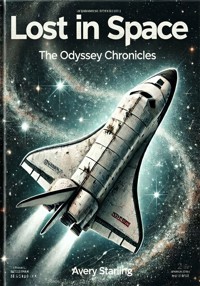
Lost in Space: The Odyssey Chronicles
When a routine return mission collapses into catastrophe, a space shuttle is pulled far beyond known space and crash-lands on Gliese 12b, a frozen world no human was ever meant to reach.
Stranded and cut off from Earth, the crew must fight more than cold, isolation, and failing systems. Beneath the planet’s ice lies something far more unsettling: ancient structures, pulsing energy networks, and symbols that defy human logic. This world was not shaped by chance. It was built.
As exploration turns into confrontation, survival and discovery become inseparable. Intelligent machines stir. Long-buried systems awaken. And a presence woven into the planet itself begins to respond.
The only path home may lie in understanding forces that were never meant to be disturbed. But awakening them comes with a cost.
A harrowing journey into the unknown unfolds, where every step deeper reveals a single, terrifying truth:
They were never alone.
Das E-Book können Sie in Legimi-Apps oder einer beliebigen App lesen, die das folgende Format unterstützen:
Veröffentlichungsjahr: 2026
Ähnliche


















Lost in Space: The Odyssey Chronicle
Avery Starling
Published by Estalontech, 2026.
This is a work of fiction. Similarities to real people, places, or events are entirely coincidental.
LOST IN SPACE: THE ODYSSEY CHRONICLE
First edition. January 28, 2026.
Copyright © 2026 Avery Starling.
Written by Avery Starling.
10 9 8 7 6 5 4 3 2 1
Table of Contents
Title Page
Copyright Page
Lost in Space: The Odyssey Chronicle
Chapter 1: The Icy Descent
Chapter 2:The Cold Reality
Chapter 3: The Search for Warmth
Chapter 4: The Journey to the Warmth
Chapter 5: The Echoes of Life
Chapter 6: The Frozen Labyrinth
Chapter 7: The Shattered Alliance
Chapter 8: The Silent Guardian
Chapter 9: The First Contact
Chapter 10: A Glimmer of Hope
Chapter 11: The Descent into the Abyss
Chapter 12: The Final Countdown
Chapter 13: Surviving the Unknown
Chapter 14: Echoes of the Past
Chapter 15: The Awakening
Chapter 16: Portal to the Unknown
Chapter 17: Into the Unknown
Preface:
By the year 2030, space was no longer distant.
It no longer belonged only to astronauts, countdowns, or grainy footage broadcast to waiting crowds. It had become part of Earth’s extended environment — something managed, measured, and quietly relied upon. The sky was no longer a boundary. It was infrastructure.
The space elevator changed everything.
Rising from the planet’s surface into geostationary orbit, it stood as a vertical artery between Earth and the vastness beyond.
What had once required enormous fuel, risk, and preparation now moved with steady regularity.
Cargo ascended. Crews rotated. Supplies flowed upward and downward in a rhythm that felt almost ordinary.
Almost.
From a distance, the elevator appeared serene — a slender line against the sky, unmoving, permanent. But up close, it hummed with activity. Control rooms never slept. Screens never dimmed.
Data flowed constantly, monitoring forces that could not be seen but were always present.
Gravity, radiation, orbital drift — space remained indifferent to human ambition, no matter how elegant the solutions built to navigate it.
Humanity had not conquered space. It had learned to coexist with it.
That distinction mattered.
Beyond the elevator, beyond the comfort of predictable orbits, space was still vast, silent, and largely unknown. Even with advanced instruments and decades of exploration behind them, there were regions that remained uncharted — pockets of the universe where physics bent strangely, where signals behaved unpredictably, where maps offered only approximations.
Progress had reduced risk. It had not eliminated it.
Every structure placed beyond Earth existed within a balance of forces that could shift without warning. Every system relied on assumptions that were only as reliable as the data supporting them. And every routine depended on the quiet agreement of conditions remaining stable.
Most of the time, they did.
That was the illusion of safety — not ignorance, but familiarity. When systems functioned smoothly, when schedules were met and alarms stayed silent, it became easy to forget how fragile the equilibrium truly was.
Yet space never forgot.
It waited, indifferent to human confidence, unchanged by human presence. It did not resist exploration, but it did not accommodate it either. It revealed nothing willingly and corrected complacency without hesitation.
The age of exploration had not ended. It had simply changed form.
Humanity now stood at a threshold where the extraordinary had become procedural — where boldness was embedded into routine, and where the line between control and uncertainty grew thinner with every expansion outward.
What lay beyond that line was not chaos or destiny.
It was simply the unknown, patient as ever.
And eventually, something would cross it.
Prelude: Earth Control’s Vigil and the Odyssey’s Mission
The control room never slept.
Lights remained dimmed at all hours, calibrated to reduce fatigue rather than darkness.
Rows of monitors lined the curved walls, each displaying a steady stream of data — numbers scrolling, waveforms pulsing, orbital paths updating in near silence.
The soundscape was subdued by design. No alarms. No urgency. Just the constant hum of systems doing exactly what they were meant to do.
For most operators, this was comfort.
Director Henry Sato stood at the center of the room, hands clasped behind his back, eyes fixed on the primary display. He had seen this view countless times, yet tonight he lingered longer than usual. Not because anything was wrong — at least, not yet — but because everything appeared too precise.
Telemetry confirmed stability. External forces registered within acceptable thresholds. No drift. No signal degradation. The readouts suggested calm.
Experience had taught him that calm was not the same as certainty.
“Confirm integrity across all channels,” Sato said, his voice low but deliberate.
A technician responded without looking up. “All channels nominal. No interference detected.”
Another added, “Environmental readings unchanged.”
Sato nodded, but did not move.
On the central display, the Odyssey’s trajectory traced a clean, predictable arc. Every parameter fell within tolerance. Every system behaved as expected.
There was nothing in the data that justified concern — and yet, attention remained fixed on the screens.
It was not procedure that held them there. It was instinct.
Across the room, analysts watched secondary feeds, eyes moving between overlapping layers of information. Gravitational fields.
Background radiation.
Micro-variations most people never thought to question. Space rarely announced itself with dramatic failures. When it shifted, it did so quietly.
“Hold this view,” Sato said, gesturing to the main screen.
The operator complied, enlarging a narrow band of readings that barely differed from baseline.
The variation was slight — easily dismissed.
It could have been noise. It could have been nothing.
But it persisted.
“Log it,” Sato said after a moment. “No action. Just log.”
“Yes, sir.”
The room returned to its steady rhythm, but the sense of watchfulness did not fade. Eyes remained on the data longer than required. Fingers hovered near controls that had not been touched in hours.
Nothing happened.
And yet, no one looked away.
Beyond the screens, beyond the layers of analysis and human oversight, space remained what it had always been — vast, silent, and indifferent. It offered no reassurance. It made no promises.
The Odyssey continued on its path, systems intact, trajectory stable.
From Earth Control’s perspective, everything was proceeding exactly as planned.
Sometimes, that was when attention mattered most.
Chapter 1: The Icy Descent
The year was 2030, a time of unprecedented advancement in space travel. Humanity had finally constructed its first space elevator, a monumental structure that extended from the surface of Earth to a geostationary orbital station high above.
This technological marvel allowed the easy transportation of materials, resources, and personnel between Earth and space. It marked the beginning of a new era in exploration.
At the heart of this new venture was the Odyssey, a state of the art space shuttle designed to support these operations and reach beyond the limits of the solar system.
Captain Lee Andrews, a veteran astronaut with years of experience, commanded the Odyssey. He was joined by Lieutenant Mira Daniels, the shuttle navigator, Dr. Ethan Reyes, an astrophysicist, Dr. Priya Malik, a planetary biologist, Communications Officer Elena Rossi, and Engineer Jake Mason.
This diverse and skilled crew was on a routine mission to return to Earth with critical supplies, including goods nearing their expiration date, and specialized equipment essential for the maintenance of the space elevator.
The mission began like any other. The Odyssey detached from the space elevator, its thrusters firing gently as it began its descent toward Earth. But as the shuttle moved into the atmosphere, something went terribly wrong.
––––––––
The Odyssey was a thing of beauty, a sleek silver vessel designed to cut through the emptiness of space with confident precision.
It was a symbol of human ingenuity, the result of years of research, development, and testing. Hovering near the top of the space elevator, the shuttle reflected the light of the distant sun, its surface gleaming like a quiet promise.
Inside the shuttle, Captain Andrews leaned back in his command chair, hands resting lightly on the armrests. He had been on more missions than he could count, but each one still carried its own weight. Space, with all its danger and uncertainty, was where he felt most alive.
Lieutenant Daniels, status report, Andrews said, his voice calm and measured.
Everything is looking good, Captain, Daniels replied from her station, eyes sharp as she scanned the readouts. We are ready for detachment.
Understood, Andrews said with a small nod. Let us get this bird home.
Daniels fingers moved across the controls, and with a slight shudder, the Odyssey detached from the space elevator. The shuttle drifted slowly away from the towering structure, thrusters firing in short bursts to stabilize its trajectory.
Detachment successful, Daniels reported. We are clear.
Andrews allowed himself a small smile. Good work, everyone. Let us start our descent.
As the shuttle began its descent toward Earth, the crew moved through their routines with the practiced ease of seasoned professionals. Dr. Reyes reviewed mission data with a furrowed brow.
Dr. Malik organized samples and notes, checking and rechecking everything meant to make it back to Earth intact. Rossi monitored the channels, ensuring their connection remained stable.
Jake Mason moved through the shuttle like he belonged to its wiring and panels. He was a man of few words, but his attention to detail spoke for him. The Odyssey was his responsibility, and he guarded it like something alive.
The view from the windows was breathtaking. Below them, Earth appeared as a distant blue marble, its surface brushed with cloud. Space stretched in every direction, an endless sea of stars and darkness.
Cannot wait to be back on solid ground, Rossi said, a hint of anticipation in her voice. I am craving a real cup of coffee.
Don’t we all, Mason muttered, though a small smile tugged at the corner of his mouth.
The descent was smooth, almost routine, until a sudden violent lurch rocked the shuttle.
The steady hum of the engines deepened into an ominous rumble. Warning lights flashed across the consoles, casting a red glow over the crew’s faces.
Calm shattered in an instant as alarms blared and the crew snapped into motion.
The Odyssey shuddered under the strain, caught in the grip of something unseen, something powerful. It felt as if the fabric of space around them had shifted, throwing their journey into chaos.
The gravitational anomaly was far more intense and unpredictable than anyone had anticipated.
The crew had trained for every scenario that could be imagined, but this was not one of them. The fate of their mission, and perhaps their lives, hung in the balance.
What the hell was that, Reyes exclaimed, gripping the edge of his console as the shuttle rocked again.
Gravitational anomaly detected, Daniels shouted, fingers flying over the controls. We are caught in something, something big.
Captain Andrews mind raced. This was not in any simulation. The descent was supposed to be routine, but now the shuttle was spiraling out of control, pulled off course by an invisible force.
Engage the thrusters. Get us stabilized, Andrews commanded, his voice cutting cleanly through the noise.
The thrusters fired, but it was as if they were pushing against an invisible wall. The pull was immense. The Odyssey was dragged farther and farther from its intended trajectory.
Outside the windows, stars blurred. Darkness gave way to a swirling vortex of light and energy. The Odyssey was being pulled into a tunnel of motion and distortion, a phenomenon they had theorized about but never expected to experience.
Andrews knew they had no control now. They were at the mercy of whatever had seized them.
Everyone brace for impact, he said. We are going in.
The shuttle hurtled through the vortex, the view outside a chaotic mix of color and shape.
The ship groaned under the stress, and for a moment it felt as if it might tear apart. Then, just as suddenly as it began, the turbulence stopped.
The Odyssey emerged into unfamiliar space.
Instead of Earth’s welcoming blue, a vast icy planet filled the view below. The instruments struggled to recalibrate, but the readings were clear. They had been transported far beyond anything recorded in their charts.
Where the hell are we, Mason muttered, disbelief tightening his voice.
Reyes scanned the data again, as if repetition might change the truth. We are not anywhere near our mapped corridor. This planet is not in our star charts.
As the shuttle descended, they caught their first clear glimpse of the surface.
A frozen wasteland spread beneath them, ice and snow as far as the eye could reach, jagged mountains rising in the distance. The atmosphere was thin but breathable. The temperature readings were brutal.
We are going to have to land, Andrews said, tone grim but steady. We do not have a choice.
Daniels gripped the controls, knuckles white as she fought to steady the shuttle. The crew debated options fast and tense. The sensors were still struggling to adapt, and the landscape offered few safe places. Time was running out. They needed a landing before the systems failed completely.
The mapping system updated as they circled, scanning for a site that would not kill them on contact. The terrain was harsh and unforgiving, jagged cliffs and deep crevices dominating the surface.
Finally, a large frozen lake came into view, smooth and expansive, their best chance at a controlled landing. But nothing about it was guaranteed.
The ice could be unstable. The water beneath could be treacherous.
It is our best shot, Daniels said, receiving reluctant nods.
She drew a breath and began the descent, guiding the Odyssey toward the lake.




