


1,99 €
Niedrigster Preis in 30 Tagen: 1,99 €
Niedrigster Preis in 30 Tagen: 1,99 €
Mehr erfahren.
- Herausgeber: DigiCat
- Kategorie: Gesellschafts- und Liebesromane
- Sprache: Englisch
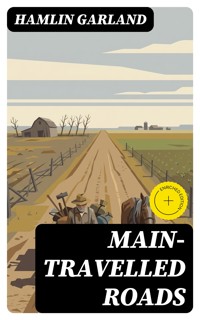
In "Main-Travelled Roads," Hamlin Garland presents a poignant exploration of the American Midwest at the turn of the 20th century, capturing the struggles and aspirations of rural life through vivid realism and lyrical prose. The short stories within this collection delve into themes of disillusionment, poverty, and the relentless search for dignity amid economic hardships. Garland's keen observations and rich descriptions situate his work firmly within the Naturalist literary tradition, reflecting the influence of regionalism while simultaneously challenging the idealized notions of rural existence. His stories reveal the complexities of life on the margins and illustrate the intersecting impacts of environment and social class on human experience. Hamlin Garland was deeply influenced by his upbringing in rural Wisconsin, an experience that shaped his understanding of the agrarian landscape and its inhabitants. His firsthand knowledge of the challenges faced by farmers and laborers inspired his commitment to authentically portray their lives, contributing to the Social Realism movement. Garland's literary journey was marked by a desire to illuminate the struggles of those often overlooked in American literature, making him a pioneering voice for Midwestern narratives. "Main-Travelled Roads" is a vital read for anyone interested in American literature, regional studies, and the socio-economic issues of the early 20th century. Garland's masterful storytelling invites readers to engage with the intricate realities of rural America, offering insights that resonate with contemporary audiences. This collection stands as a testament to the resilience of the human spirit, making it an essential addition to the canon of American literary realism. In this enriched edition, we have carefully created added value for your reading experience: - A comprehensive Introduction outlines these selected works' unifying features, themes, or stylistic evolutions. - A Historical Context section situates the works in their broader era—social currents, cultural trends, and key events that underpin their creation. - A concise Synopsis (Selection) offers an accessible overview of the included texts, helping readers navigate plotlines and main ideas without revealing critical twists. - A unified Analysis examines recurring motifs and stylistic hallmarks across the collection, tying the stories together while spotlighting the different work's strengths. - Reflection questions inspire deeper contemplation of the author's overarching message, inviting readers to draw connections among different texts and relate them to modern contexts. - Lastly, our hand‐picked Memorable Quotes distill pivotal lines and turning points, serving as touchstones for the collection's central themes.
Das E-Book können Sie in Legimi-Apps oder einer beliebigen App lesen, die das folgende Format unterstützen:
Veröffentlichungsjahr: 2022
Ähnliche


















Main-Travelled Roads
Table of Contents
Introduction
Main-Travelled Roads, first published in 1891, is Hamlin Garland’s landmark collection of short fiction about the American Middle Border. This single-author volume brings together the stories and their sectional divisions as a coherent sequence, preceded by brief framing pieces that declare the book’s aims. The roads of the title are both literal and figurative: the rutted routes between farms and towns, and the repeated tracks of labor, duty, and return. The present collection gathers Garland’s essential rural narratives in their prose forms—no dramatizations or verse—so that readers may encounter his vision whole, from opening thought to concluding sketches, without extraneous apparatus.
Within these covers, the primary genre is short story, often organized into numbered parts that pace the action and illuminate character under seasonal and economic pressure. The book also contains brief prefatory materials—an opening thought, a foreword, an introduction—where the author frames his method. There are no poems, diaries, or letters; instead, Garland offers compact realist narratives set among farms, small towns, depots, and crossroads. The pieces vary in length from swift sketches to more layered tales, but all belong to prose fiction, shaped to be read singly or together as a composite portrait of a region and its people.
Garland’s unifying commitment is to unembellished truth-telling about rural life, a mode he championed as veritistic realism. He resists pastoral nostalgia, emphasizing the physical strain of work, the weight of debt and distance, and the constricting force of custom. Yet he also registers the beauty of fields, the cadence of speech, and the steadfastness of bonds formed on shared ground. The main-travelled roads connect soldiers returning to homesteads, tenants to owners, young people to expectations, and neighbors to one another in crisis. Across the collection, necessity and desire intersect, and the moral costs of survival are measured without melodrama.
Several central tales outline the collection’s range. Up the Coolly follows a man who has made a life elsewhere as he revisits his family in the country and confronts altered ties. Under the Lion’s Paw presents a tenant farmer whose toil enlarges a property even as power dynamics tilt against him. The Return of a Private begins with a veteran coming home at the end of war, meeting winter and obligation. A Branch Road traces an encounter that reopens a choice once forsworn. Among the Corn-Rows observes courtship and calculation amid relentless labor, where affection must find space within scarcity.
Other pieces widen the canvas through closely observed character studies. Mrs. Ripley’s Trip and Uncle Ethan Ripley portray an aging couple whose small journeys reveal the distances inside marriage and community. God’s Ravens concentrates on precarious subsistence and the fragile networks that sustain it. A 'Good Fellow’s' Wife follows a woman balancing warmth for her sociable husband with the costs of his geniality. The Creamery Man considers the new economies transforming dairying and the persuasive figures who travel with them. A Day’s Pleasure offers a respite from labor whose amusements, and frictions, mirror the social order that produces it.
Garland’s prose is spare, specific, and grounded in place. He builds scenes from exact topography, seasonal detail, and talk tuned to region without heavy dialect barriers. His narration grants dignity to labor by naming its tools, gestures, and aches, while continually testing romantic myths against lived evidence. Compression is a signature: episodes accumulate into moral pressure rather than erupting into sensational turns. The result is a steady, humane intensity in which weather, roads, and rooms carry ethical charge. Throughout, he writes with sympathy for strivers and clarity about structures that hem them in, seeking justice through accurate depiction.
The ongoing significance of Main-Travelled Roads lies in its clear-eyed mapping of the late nineteenth-century Midwest and in the craft with which it binds individual fates to broader economic currents. Long recognized as a foundation of American realism and regional writing, the book remains pertinent wherever land, labor, and family entangle under stress. Its roads still lead readers to consider how opportunity is distributed, how return alters perspective, and how communities negotiate fairness. This collection preserves Garland’s most influential rural stories with their original tonal balance—unsentimental yet compassionate—so present-day audiences can engage their artistry and their durable social insight.
Historical Context
First published in 1891, Hamlin Garland’s Main-Travelled Roads emerged from the author’s upbringing in the Upper Midwest during the final decades of the nineteenth century. Born in 1860 near West Salem, Wisconsin, Garland migrated with his family across Iowa and into the Dakota Territory amid homesteading and agricultural expansion. After moving to Boston in 1884, he absorbed the realist aesthetics promoted by William Dean Howells and the land-reform ideas of Henry George. The stories, many first appearing in magazines, draw upon Wisconsin, Minnesota, Iowa, and Dakota settings to portray the price of settlement, aligning Garland’s self-described veritism with national debates over progress and equity.
Agriculture in the region shifted dramatically between the Civil War and the 1890s. Early wheat booms exhausted soils and, after chinch bug infestations in the 1870s, Wisconsin and Minnesota farmers increasingly adopted dairying. Technological change accelerated that transition: the centrifugal cream separator, patented by Gustaf de Laval in 1878, and the spread of cooperative creameries in the 1880s reorganized labor, marketing, and household economies. These developments underpin scenes of bargaining, expertise, and suspicion surrounding itinerant agents in The Creamery Man. They also reframed women’s work once done at the churn, a reallocation of time and authority Garland registers in portraits of farm households under strain.
Railroads bound Midwestern farms to national markets while imposing costs that animate many conflicts in the collection. After postwar expansion aided by federal land grants, rate discrimination spurred the Granger movement and state regulation in the 1870s. Munn v. Illinois (1877) briefly upheld such laws, but Wabash v. Illinois (1886) curtailed them, prompting the Interstate Commerce Act of 1887. In towns along trunk lines and on vulnerable branch routes, farmers navigated grain elevator monopolies and freight schedules. The title A Branch Road and episodes of anxious trips to depots register dependence on distant prices, while Under the Lion’s Paw indicts speculation enabled by volatile land markets.
Chronic deflation from the 1870s into the mid-1890s, capped by the Panic of 1893, tightened the vise of mortgages, taxes, and crop liens. The National Farmers’ Alliance and Industrial Union mobilized cooperative buying and political action that fed into the People’s Party in 1892 and its Omaha Platform. Populist rhetoric, from Mary Elizabeth Lease’s 1890 admonition to raise less corn and more hell to the silver crusade of 1896, saturates the era. Garland, influenced by Henry George’s 1879 Progress and Poverty and single-tax agitation, channels agrarian resentments into narratives of foreclosure, tenancy, and exhausted bodies, inviting readers to weigh justice against market orthodoxy.
The Upper Midwest’s social fabric—dense with German, Norwegian, Swedish, and Bohemian settlers—infuses speech, courtship, and work in stories like Among the Corn-Rows. Settlement clustered in coulee country along the upper Mississippi, where deep ravines and bluffs shaped travel, isolation, and land use. As Chicago, Milwaukee, and Minneapolis expanded in the 1880s and 1890s, sons and daughters weighed migration to the city against obligations at home, the tension dramatized in Up the Coolly. Garland records barn raisings, threshing rings, and neighborhood expectations, yet he also tracks how market agriculture and cash wages eroded older reciprocal labor customs, unsettling kinship and community authority.
Women’s burdens in farm households were intensified by limited legal standing and scant public services. Before Rural Free Delivery began experimental routes in 1896, many women depended on rare trips to town for news and goods, a constraint dramatized in Mrs. Ripley’s Trip and A Day’s Pleasure. The Woman’s Christian Temperance Union, founded in 1874, organized across the Midwest, linking domestic distress to temperance reform echoed in A Good Fellow’s Wife. Though Married Women’s Property Acts had expanded rights unevenly by the 1880s, coverture-era habits persisted. Garland’s portraits of drudgery, isolation, and alcohol’s costs intersected with reform networks and stirred debate among readers.
Several narratives hinge on the long shadow of the Civil War within rural communities. The Return of a Private revisits 1865 demobilization, when soldiers came home to mortgages, depleted savings, and pressing harvests rather than lasting reward. The Grand Army of the Republic, founded in 1866, maintained camaraderie, shaped Memorial Day observances after 1868, and lobbied for benefits culminating in the Dependent Pension Act of 1890. Yet many families still struggled. By setting intact patriotic ritual against economic precarity, Garland underscores the distance between national celebration and local hardship, a contrast that informed readers’ sympathies during the veteran-friendly politics of the Gilded Age.
Main-Travelled Roads circulated first through periodicals and then as a 1891 volume associated with Boston’s reformist literary circles, reaching audiences already primed by Howells to value realism. Subsequent editions in the 1890s added stories and revisions as Garland refined his program and reputation. Critics praised the immediacy of his regional scenes while some boosters and editors decried their bleakness. The collection’s emphasis on tenancy, women’s labor, and the pressures of railroads aligned it with contemporary reportage and the era’s naturalist turn. Eastern readers encountered a corrective to pastoral myth, and Midwestern reformers found testimony that buttressed campaigns for regulation and relief.
Synopsis (Selection)
Paratexts: Opening Thought, Foreword, and Introduction (I–IV)
Garland frames the book as a pledge to portray Midwestern farm and small-town life without romance or evasions, centering labor, place, and cost.
The tone is earnest and reform-minded, signaling a signature plainspoken regional realism concerned with debt, weather, and the moral claims of work.
A Branch Road
A chance roadside encounter between former sweethearts reveals how time, duty, and geography have pushed their lives onto diverging paths.
Wistful yet unsentimental, it probes missed opportunity, social expectation, and the limits of mobility in rural communities.
Up the Coolly (I–IV)
A man who left for the city returns to his valley home and discovers the distance between fond memory and the grinding facts his family still endures.
Somber and reflective, it examines estrangement, obligation, and the economic pressures that fracture kinship.
Among the Corn-Rows (I–II)
Courtship unfolds amid harvest labor and community gatherings, as a young woman weighs attention, propriety, and her own aims.
Blending gentle humor with close observation, the story highlights the rhythms of work, the codes of small-town sociability, and quiet agency.
The Return of a Private (I–II)
A soldier comes home from war to fields, debts, and a waiting family, learning that peace brings its own battles.
Spare and compassionate, it honors everyday endurance while critiquing how poverty can blunt the rewards of sacrifice.
Under the Lion's Paw (I–IV)
A tenant family rebuilding after hardship is trapped by a land speculator’s leverage, testing the bounds of patience and justice.
Gritty and indignant, it indicts structural exploitation while keeping focus on toil, family dignity, and simmering restraint.
The Creamery Man
The arrival of a traveling agent and the new dairy economy tempts and unsettles a prairie community.
With wry, workaday detail, it explores commercialization, gossip, and the uneasy trade between livelihood and trust.
A Day's Pleasure (I–II)
A long-promised outing meant to provide rest turns into a sequence of small costs, crowds, and fatigue.
Ironic yet sympathetic, it shows how scarcity can turn leisure into another form of labor.
Mrs. Ripley's Trip
A farm wife takes a rare journey beyond the daily circuit of chores and fences, meeting novelty with equal parts delight and anxiety.
Tenderly comic and humane, it spotlights constrained freedom, frugality, and the craving for small dignities.
Uncle Ethan Ripley
A stubborn old-timer faces tests of pride, thrift, and neighborliness that expose both his blind spots and his bedrock decency.
Laconic humor and precise detail balance satire with affection, sketching a recognizable rural archetype.
God's Ravens (I–II)
In a season of scarcity, a family’s hope rests on hard work, luck, and the moral economy of neighbors.
Grave but not despairing, it considers providence and community aid without sentimental escape from hardship.
A "Good Fellow's" Wife (I–VI)
A genial man’s public warmth leaves private costs that accumulate at home, pressing his wife into quiet crisis management.
Sharp and unsparing, it critiques gendered expectations and the social license that excuses harm done under the banner of good fellowship.




