


0,49 €
Niedrigster Preis in 30 Tagen: 1,99 €
Niedrigster Preis in 30 Tagen: 1,99 €
Mehr erfahren.
- Herausgeber: DigiCat
- Kategorie: Poesie und Drama
- Sprache: Englisch
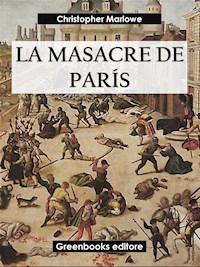
In 'Massacre at Paris,' Christopher Marlowe crafts a compelling historical drama set against the tumultuous backdrop of the French Wars of Religion. This play, characterized by its rich, lyrical language and dynamic characterizations, explores themes of power, betrayal, and the devastating impact of religious fanaticism. Marlowe's use of blank verse and command of dramatic pacing evoke a sense of urgency and tension, as the narrative unfolds with chilling historical accuracy, ultimately leading to the infamous St. Bartholomew's Day Massacre of 1572. Its stark portrayal of political machinations and human cruelty positions it within the context of Elizabethan drama, linking it to broader discussions on governance and morality in the face of chaos. Christopher Marlowe, a contemporary of Shakespeare, was known for pushing the boundaries of dramatic form and content in his works. His own turbulent life—marked by intrigue, supposed espionage, and an untimely death—infuses his writing with a sense of urgency and a deep understanding of the human condition. Marlowe's background, including his education at Cambridge, exposed him to classical texts and contemporary politics, which are reflected in the intricate plot and complex character dynamics of 'Massacre at Paris.' This play is essential reading for those interested in the intersection of history and drama, as well as scholars of the Renaissance period. Marlowe's exploration of power and morality resonates today, offering insight into the perennial struggles of governance and the human psyche. 'Massacre at Paris' invites readers to engage with the darker facets of ambition and the consequences of divisive ideologies, making it a vital addition to the canon of English literature. In this enriched edition, we have carefully created added value for your reading experience: - A succinct Introduction situates the work's timeless appeal and themes. - The Synopsis outlines the central plot, highlighting key developments without spoiling critical twists. - A detailed Historical Context immerses you in the era's events and influences that shaped the writing. - An Author Biography reveals milestones in the author's life, illuminating the personal insights behind the text. - A thorough Analysis dissects symbols, motifs, and character arcs to unearth underlying meanings. - Reflection questions prompt you to engage personally with the work's messages, connecting them to modern life. - Hand‐picked Memorable Quotes shine a spotlight on moments of literary brilliance. - Interactive footnotes clarify unusual references, historical allusions, and archaic phrases for an effortless, more informed read.
Das E-Book können Sie in Legimi-Apps oder einer beliebigen App lesen, die das folgende Format unterstützen:
Veröffentlichungsjahr: 2022
Ähnliche







Massacre at Paris
Table of Contents
Introduction
Fanatic faith turns a great city into a chessboard where belief, ambition, and fear move pieces toward blood. Christopher Marlowe’s The Massacre at Paris sets its action against the upheavals of sixteenth‑century France, presenting power as a performance that devours its actors. The play confronts readers with the spectacle of authority unmoored from conscience, and with the terrifying speed at which rumor can harden into decree. Without leaning on sentiment, Marlowe brings the audience to the threshold of catastrophe and asks them to watch how it is built—gesture by gesture, word by word, and choice by irreversible choice.
Written by Christopher Marlowe near the end of his brief, incandescent career, The Massacre at Paris belongs to the closing years of the 1580s and early 1590s, when English drama was defining its ambitions. The play was printed posthumously in 1594, shortly after Marlowe’s death in 1593. Its historical subject was still close enough to be felt as current affairs, which gives the work a startling immediacy. Marlowe’s reputation as a poet of audacious thought and dramatic intensity frames this play: he brought to the stage the same intellectual daring that animates Tamburlaine, Doctor Faustus, and Edward II, but trained here on sectarian politics.
The premise is stark: in a Paris riven by the French Wars of Religion, faction vies with faction for mastery, and a proposed reconciliation threatens to ignite rather than calm the city. The aftermath of the St. Bartholomew’s Day Massacre haunts every corridor, as the Catholic League gathers force and the Huguenots brace for survival. Figures such as the Duke of Guise, Catherine de’ Medici, and Henry of Navarre step into the dramatic light, their motives tested by circumstance and public expectation. Marlowe sketches a court and capital where ceremony and assassination jostle uncomfortably for the same stage.
The play holds classic status because it distills the Elizabethan stage’s defining qualities—speed, courage, and rhetorical edge—into a concentrated study of political violence. Marlowe’s dramaturgy strips away ornament to reveal how power moves: by oaths taken in public, signals exchanged in private, and crowds stirred with careful calculation. Its potency lies not in elaborate plotting but in relentless focus. The Massacre at Paris shows the theater’s capacity to make history present, not as a chronicle of dates but as an anatomy of decision. That method influenced how later dramatists would handle public events and the psychology behind them.
Enduring themes give the work its continued life. Marlowe probes the uses of religion as a mask and as a weapon, the tension between personal conviction and public allegiance, and the instability of legitimacy when fear governs. The play asks how a society saturated with faction can reimagine common cause, and what happens to truth when political necessity speaks louder than conscience. It also studies spectacle as an instrument of rule—processions, proclamations, and staged reconciliations that manage perception. These questions outlive the particulars of the French court and reach any moment when belief and power become indistinguishable.
Marlowe’s impact on later writers is inseparable from his willingness to dramatize dangerous subjects with lucid ferocity. By setting recent continental turmoil before English audiences, he broadened the scope of what history plays could attempt. The Massacre at Paris, alongside his other works, helped normalize the theater as a forum where policy, theology, and ethics contend in real time. Subsequent dramatists learned from his swiftness, his appetite for high stakes, and his refusal to shield authority from critique. Even when they softened his edges, they wrote in the space he opened for fearless interrogation of rulers and regimes.
The language of this play is direct, concentrated, and mobile, propelling the action through a series of taut confrontations. The surviving text is notably brief, which intensifies its breathless momentum and keeps the focus on decisive acts and public gestures. Marlowe’s speeches compress ideology into barbed phrases and images that move quickly from ceremonial dignity to lethal intent. The effect is theatrical and forensic at once: you watch the blade descend and are asked to consider the argument that raised it. Its compression encourages readers to attend to pattern, cadence, and juxtaposition—the small turns that precipitate large outcomes.
Context heightens the play’s charge. English audiences in the 1590s remembered the threat of continental wars and the volatility of confessional politics. Marlowe writes from a culture anxious about infiltration, alliance, and succession, yet proud of dramatic experiment. The Massacre at Paris feeds that appetite for topicality while refusing the comfort of simple heroes and villains. Its Paris is a mirror, not a pamphlet: recognizable enough to sting, shaped enough to focus. The play’s historical proximity—events still within living memory—made it an act of cultural reckoning as much as an entertainment.
The dramatis personae exemplify politics as an arena of performance. The Duke of Guise strides as a commander who understands crowds and ceremony; Catherine de’ Medici maneuvers within the grammar of dynastic survival; Charles IX strains under the weight of crown and counsel; Henry of Navarre embodies a pragmatism sharpened by danger. Marlowe sets these figures in collision without reducing them to emblems. Their public roles are armor and trap, enabling action while narrowing imagination. Watching them adjust, defy, or yield becomes the engine of suspense, as we trace how self‑fashioning intersects with the demands of statecraft.
Marlowe’s stagecraft amplifies this political anatomy. The play moves rapidly between councils, streets, and chambers, unsettling any boundary between private deliberation and public display. Ceremony serves as prelude to crisis; whispers reverberate as loudly as fanfares. Crowds form, disperse, and re-form, reminding us that policy is measured not only in decrees but in the temperature of the city. The structural economy—scenes that start late and end early—keeps attention on inflection points. What is seen and what is inferred share equal weight, an approach that invites readers to supply the connective tissue of fear, rumor, and ambition.
For modern readers, the play’s compactness is an advantage rather than a limitation. Its urgency puts interpretive pressure on every line, and its open spaces invite historical inquiry. Understanding the French Wars of Religion enriches the experience but is not required; Marlowe’s design guides by energy and contrast. The work’s refusal to preach is part of its power: it shows how conviction can be both admirable and catastrophic, and how the desire for order can summon chaos. When read slowly, scene by scene, it yields a layered picture of political theater at its most combustible.
The Massacre at Paris endures because it speaks to perennial conditions: sectarian passion, strategic disinformation, the seductions of strongman politics, and the fragility of civic trust. In an age grappling with polarized identities and the weaponization of spectacle, Marlowe’s play keeps its edge. It asks readers to examine how leaders manufacture necessity, how crowds are tuned, and how quickly a city can become a stage for ruin. That insistence on clarity amid menace gives the work its lasting appeal, anchoring its status as a classic that still argues, still warns, and still compels attention.
Synopsis
Christopher Marlowe’s The Massacre at Paris dramatizes the convulsions of the French Wars of Religion, charting how sectarian zeal and courtly ambition intertwine. Set largely in Paris, the play follows a rapid succession of councils, ceremonies, and street actions that expose the fragility of royal authority. Key figures include King Charles IX; his politically astute mother, Catherine de’ Medici; the forceful Duke of Guise; Admiral Gaspard de Coligny, a prominent Protestant adviser; and Henry of Navarre, a Huguenot prince whose fortunes rise and fall with each policy shift. Marlowe stages how faith, fear, and the pursuit of power become indistinguishable in moments of crisis.
The opening movement presents a high-stakes bid for reconciliation: the marriage of Henry of Navarre to Margaret of Valois, intended to heal confessional divisions and stabilize the realm. Public rejoicing, processions, and courtly pageantry suggest a fragile hope, yet the dialogue and alliances reveal guarded motives. Coligny’s ascendancy with the king unsettles entrenched interests, while Catherine, protective of royal prerogative, surveys advisers who may curtail her influence. The Duke of Guise, steeped in family claims of Catholic guardianship, reads the atmosphere shrewdly. Even amid oaths of peace, Marlowe lets suspicion seep through the spectacle, showing how performative concord can mask combustible resentments.
Rumors, petitions, and warnings multiply as rival networks within city and court mobilize. Marlowe’s episodic scenes track envoys, letters, and whispered vows that bind confederates more tightly than formal decrees. The Catholic League, aligned with Guise, tests the limits of obedience to the crown, while Protestant leaders place cautious trust in royal assurances. Paris, depicted as both stage and engine of politics, tilts toward confrontation: armed retainers loiter at corners, and municipal authority appears pliable to partisan pressure. The monarchy vacillates between conciliation and coercion, signaling uncertainty that emboldens hardliners and disorients those who hoped the wedding would secure lasting peace.
A violent provocation disrupts this precarious equilibrium: an attack on a leading Huguenot figure sparks panic and accelerates calls for decisive action. Marlowe focuses on the rapid conversion of alarm into strategy, as counselors frame emergency as necessity and necessity as virtue. Appeals to protect the king coexist with arguments to purge perceived enemies, blurring defense with aggression. The rhetoric of safeguarding the realm sanctions plans that reach far beyond punishing a single offense. As courtiers choose sides, the machinery of repression begins to turn, and the play’s tempo quickens from anxious debate to coordinated movement across palace corridors and city streets.
The notorious night of violence known as the St. Bartholomew’s Day Massacre erupts, and Marlowe depicts the breakdown of legal order into orchestrated bloodshed. Targeted lists, sudden arrests, and door-to-door searches transform Paris into a maze of peril where affiliation can mean life or death. The Duke of Guise emerges as a commanding presence in the streets, while the crown seeks to cloak the brutality in proclamations of public safety. Amid cries and confusion, acts of mercy appear sporadically, but the prevailing image is of a city overtaken by sanctioned terror. The massacre’s shock reverberates through court and populace alike.
In the aftermath, Marlowe turns to political justifications and personal reckonings. Royal declarations attempt to frame the violence as preventative statecraft, yet the spectacle of excess cannot be easily contained by edict. Huguenot survivors scatter, disguise themselves, or negotiate fraught accommodations; others look to leaders beyond Paris for direction. Henry of Navarre, bound by ties to the crown yet identified with the persecuted, navigates peril with measured prudence. Catherine’s calculations persist, balancing dynastic security against the risks of empowering any single faction. The play underscores how emergency measures linger, hardening into precedent that shapes the next phase of conflict.
Succession intensifies the drama as the crown changes hands and the political map is redrawn. Under the new regime, the Catholic League expands its leverage, promoting a vision of confessional conformity that challenges royal independence. Public rituals—processions, oaths, and displays of piety—double as assertions of political will. Guise’s stature grows in the streets and parlements, while the court weighs whether accommodation or resistance will preserve sovereignty. Navarre’s position evolves outside Paris, with Protestant forces regrouping and allies courting foreign sympathy. Marlowe stages these shifts swiftly, emphasizing how legitimacy is contested not only on battlefields but also in symbols, speeches, and urban pressure.
The play builds toward confrontations where caution and audacity trade places. Secret councils consider preemptive moves; messengers carry orders whose ambiguity allows deniability; and loyalties are tested by fear of betrayal. Marlowe examines the narrowing choices facing monarch and magnates alike: whether to trust law or force, reconcile or neutralize rivals, and prioritize conscience or survival. Every stratagem risks unintended consequences, and each public gesture is read against a history of broken promises. As the crown and the League edge closer to irreconcilability, the prospect of decisive action looms, promising resolution yet threatening to perpetuate the cycle of reprisal.
Without detailing final outcomes, The Massacre at Paris closes with the sense that violence, once unlocked, reshapes institutions and souls. Marlowe’s portrait of confessional politics suggests that power harnessing faith can both mobilize communities and unmoor justice. The play’s endurance lies in its stark anatomy of fanaticism, expediency, and the tenuousness of tolerance under stress. By tracing how ceremony, counsel, and coercion coalesce, it poses questions about what secures a realm: fear, law, or mutual forbearance. The drama’s broader message warns that victories achieved through terror imperil authority itself, leaving future peace to be earned through choices the play leaves challengingly open.
Historical Context
Christopher Marlowe’s The Massacre at Paris is set amid the violent religious and political upheavals of late sixteenth-century France, chiefly Paris, and was written and staged in Elizabethan London in the early 1590s. The dominant institutions framing its world are the French monarchy of the Valois line, the Roman Catholic Church, emergent Protestant communities known as Huguenots, and the militant Catholic League. Across the Channel, England was a Protestant monarchy under Elizabeth I, with a growing commercial capital, a thriving public theater, and state censorship. Marlowe’s play draws on this Franco-English matrix, using recent French history to speak to English concerns about faith, power, and civic order.
The French Wars of Religion (roughly 1562–1598) provide the play’s broad canvas. After decades of religious ferment and political strain, open conflict followed attempts at limited toleration and flashpoints such as the 1562 violence at Vassy. Civil wars, uneasy truces, and royal edicts punctuated the era, as nobles, urban militias, and foreign backers intervened. The monarchy, seeking stability, oscillated between repression and compromise. Marlowe’s drama compresses and sequences these struggles, emphasizing the volatility of factional politics and the cost in civilian life. Its narrative perspective reflects English Protestant readings of the wars as a cautionary tale of sectarian zealotry undermining royal authority.
Central to the play’s historical referent is the St. Bartholomew’s Day Massacre, which began in Paris in late August 1572. The wedding of the Protestant Henry of Navarre to Margaret of Valois had drawn many Huguenot nobles to the city. After an attempted assassination of Admiral Gaspard de Coligny, violence erupted against Protestant leaders and spread rapidly. Killings in Paris extended into days of street violence and were followed by massacres in provincial towns. Contemporary and later estimates vary, but thousands died across France. Marlowe dramatizes the shock, rumor, and betrayal that contemporaries associated with this episode, embedding it in a narrative of calculated political murder.




