


32,99 €
Mehr erfahren.
- Herausgeber: John Wiley & Sons
- Kategorie: Wissenschaft und neue Technologien
- Sprache: Englisch
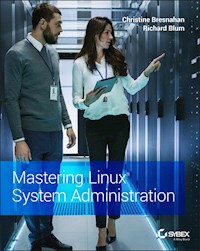
Achieve Linux system administration mastery with time-tested and proven techniques In Mastering Linux System Administration, Linux experts and system administrators Christine Bresnahan and Richard Blum deliver a comprehensive roadmap to go from Linux beginner to expert Linux system administrator with a learning-by-doing approach. Organized by do-it-yourself tasks, the book includes instructor materials like a sample syllabus, additional review questions, and slide decks. Amongst the practical applications of the Linux operating system included within, you'll find detailed and easy-to-follow instruction on: * Installing Linux servers, understanding the boot and initialization processes, managing hardware, and working with networks * Accessing the Linux command line, working with the virtual directory structure, and creating shell scripts to automate administrative tasks * Managing Linux user accounts, system security, web and database servers, and virtualization environments Perfect for entry-level Linux system administrators, as well as system administrators familiar with Windows, Mac, NetWare, or other UNIX systems, Mastering Linux System Administration is a must-read guide to manage and secure Linux servers.
Sie lesen das E-Book in den Legimi-Apps auf:
Seitenzahl: 912
Veröffentlichungsjahr: 2021
Ähnliche















Table of Contents
Cover
Title Page
Copyright
Acknowledgments
About the Authors
About the Technical Editor
Introduction
Who Should Read This Book
The Mastering Series
How to Contact Wiley or the Authors
Part 1: Basic Admin Functions
Chapter 1: Understanding the Basics
What Is Linux?
Linux Distributions
The Bottom Line
Chapter 2: Installing an Ubuntu Server
Pre‐Installation Requirements
Finding the Software
Running the Installation
Checking the Installation
The Bottom Line
Chapter 3: Installing and Maintaining Software in Ubuntu
Exploring Package Management
Inspecting the Debian‐Based Systems
Using Snap Containers
Installing from Source Code
The Bottom Line
Chapter 4: Installing a Red Hat Server
Pre‐Installation Requirements
Finding the Software
Running the Installation
Checking the Installation
The Bottom Line
Chapter 5: Installing and Maintaining Software in Red Hat
Exploring Red Hat Packages
Automated Package Management
Working Directly with Packages
Using Flatpak Containers
The Bottom Line
Chapter 6: Working with the Shell
Exploring the Shell
Working with Commands
Environment Variables
The Bottom Line
Chapter 7: Exploring Linux File Management
Filesystem Navigation
Linux Files
File and Directory Listing
Directory Handling
File Handling
File Features
Finding Files
Archiving Files
The Bottom Line
Chapter 8: Working with Text Files
The
vim
Editor
The
nano
Editor
Working with Data Files
The Bottom Line
Part 2: Intermediate Admin Functions
Chapter 9: Managing Hardware
Device Driver Modules
Communicating with Devices
Working with Devices
Using Hot Pluggable Devices
The Bottom Line
Chapter 10: Booting Linux
Understanding the Boot Process
The GRUB2 Bootloader
Configuring the GRUB2 Bootloader
The systemd Initialization Process
The Bottom Line
Chapter 11: Working with Storage Devices
Storage Basics
Partitioning Tools
Formatting Filesystems
Mounting Filesystems
Managing Filesystems
Storage Alternatives
The Bottom Line
Chapter 12: Configuring Network Settings
Network Settings
Using Network Command‐Line Tools
Basic Network Troubleshooting
Advanced Network Troubleshooting
The Bottom Line
Chapter 13: Managing Users and Groups
Understanding Linux Permissions
Using Access Control Lists
Managing User Accounts
Maintaining the Environment
Managing Groups
The Bottom Line
Chapter 14: Working with Processes and Jobs
Looking at Processes
Monitoring Processes in Real Time
Managing Processes
Running Programs in Background Mode
Running Programs Without a Console
Job Control
Scheduling Jobs
The Bottom Line
Chapter 15: Managing Log Files
The systemd Journaling System
The rsyslog Legacy System
The Bottom Line
Chapter 16: Managing Printers
The Common Unix Printing System
Installing and Configuring CUPS
Using CUPS
The Bottom Line
Part 3: Advanced Admin Functions
Chapter 17: Exploring Ubuntu Security
Locking Down Root
Using OpenSSH on Ubuntu
The AppArmor System
Network Security Using Firewalls
The Bottom Line
Chapter 18: Exploring Red Hat Security
Working with Root Access
Using SELinux
Network Security Using Firewalls
The Bottom Line
Chapter 19: Writing Scripts
Beginning a Shell Script
Using Variables
Adding Conditional Expressions
Using Loops
Using Functions
The Bottom Line
Chapter 20: Managing Web Servers
Linux Web Servers
The Apache Web Server
The nginx Server
The Bottom Line
Chapter 21: Managing Database Servers
Linux Database Servers
Installing and Using MySQL/MariaDB
Installing and Using PostgreSQL
The Bottom Line
Chapter 22: Exploring the Virtualization Environment
Hypervisors
Containers
Software Packaging
The Bottom Line
Appendix: The Bottom Line
Chapter 1: Understanding the Basics
Chapter 2: Installing an Ubuntu Server
Chapter 3: Installing and Maintaining Software in Ubuntu
Chapter 4: Installing a Red Hat Server
Chapter 5: Installing and Maintaining Software in Red Hat
Chapter 6: Working with the Shell
Chapter 7: Exploring Linux File Management
Chapter 8: Working with Text Files
Chapter 9: Managing Hardware
Chapter 10: Booting Linux
Chapter 11: Working with Storage Devices
Chapter 12: Configuring Network Settings
Chapter 13: Managing Users and Groups
Chapter 14: Working with Processes and Jobs
Chapter 15: Managing Log Files
Chapter 16: Managing Printers
Chapter 17: Exploring Ubuntu Security
Chapter 18: Exploring Red Hat Security
Chapter 19: Writing Scripts
Chapter 20: Managing Web Servers
Chapter 21: Managing Database Servers
Chapter 22: Exploring the Virtualization Environment
Index
End User License Agreement
List of Tables
Chapter 1
TABLE 1.1: The SysVinit Runlevels
TABLE 1.2: Linux Filesystems
TABLE 1.3: Other Linux Graphical Desktops
TABLE 1.4: Linux Shells
TABLE 1.5: Core Linux Distributions
TABLE 1.6: Specialized Linux Distributions
Chapter 2
TABLE 2.1: Recommended Server Resources for Ubuntu Server Distribution
TABLE 2.2: Recommended Host Machine Resources for an Ubuntu Server VM
Chapter 4
TABLE 4.1: Recommended Server Resources for CentOS Distribution
TABLE 4.2: Recommended Host Machine Resources for a CentOS VM
Chapter 5
TABLE 5.1: The
rpm
Command Actions
TABLE 5.2: The
rpm
Command Query Action Options
Chapter 6
TABLE 6.1: The Linux Man Page Conventional Section Names
TABLE 6.2: The Linux Man Page Section Areas
TABLE 6.3: A Few
history
Command Options
TABLE 6.4: Linux Standard File Descriptors
TABLE 6.5: A Few Common Default Linux Global Environment Variables
Chapter 7
TABLE 7.1: Common Linux Directory Names
TABLE 7.2: Some Popular
ls
Command Parameters
TABLE 7.3: The
cp
Command Parameters
TABLE 7.4: Useful
find
Command Options
TABLE 7.5: Linux File Compression Utilities
TABLE 7.6: The
tar
Command Functions
TABLE 7.7: The
tar
Command Options
Chapter 8
TABLE 8.1: Commonly Used
vim
Command Mode Moving Commands
TABLE 8.2: Commonly Used
vim
Ex Mode Commands
TABLE 8.3:
nano
Common Control Commands
TABLE 8.4: Commonly Used
sort
Command Options
TABLE 8.5: The
locate
Command's Commonly Used Options
TABLE 8.6: The
find
Command's Commonly Used Options and Expressions
TABLE 8.7: The
grep
Command's Commonly Used Options
TABLE 8.8: The
tar
Command's Commonly Used Archive Creation Options
TABLE 8.9: The
tar
Command's Commonly Used Archive Verification Options
TABLE 8.10: The
tar
Command's Commonly Used File Restore Options
Chapter 9
TABLE 9.1: The
modprobe
Command Options
TABLE 9.2: The
lspci
Command‐Line Options
TABLE 9.3: The
lsusb
Command Options
TABLE 9.4: The
udevadm
Commands
Chapter 10
TABLE 10.1: Commonly Defined
/etc/default/grub
Keys
TABLE 10.2: Commonly Used System Boot Target Unit Files
TABLE 10.3: Commonly Used Service Unit File
[Unit]
Section Directives
TABLE 10.4: Commonly Used Service Unit File
[Service]
Section Directives
TABLE 10.5: Commonly Used Service Unit File
[Install]
Section Directives
TABLE 10.6: Commonly Used
systemctl
Service Management Commands
TABLE 10.7: Convenient
systemctl
Service Status Commands
TABLE 10.8: Operational Statuses Provided by
systemctl is‐system‐running
...
TABLE 10.9: Common
systemd‐analyze
Commands
Chapter 11
TABLE 11.1: Common
fdisk
Commands
TABLE 11.2: Common
gdisk
Commands
TABLE 11.3: The
parted
Commands
TABLE 11.4: Linux Filesystem Stats Commands
TABLE 11.5: Popular
e2fsprogs
Programs
Chapter 12
TABLE 12.1: The
ip
Utility Command Options
TABLE 12.2: Network Interface Bonding Modes
Chapter 13
TABLE 13.1: Octal Mode Permissions
TABLE 13.2: Results from Common
umask
Values for Files and Directories
TABLE 13.3: A Few Vital
/etc/login.defs
Directives
TABLE 13.4: A Few Vital
/etc/default/useradd
Directives
TABLE 13.5: The
/etc/passwd
File's Record Fields
TABLE 13.6: The
/etc/shadow
File's Record Fields
TABLE 13.7: The
useradd
Command's Commonly Used Options
TABLE 13.8: The
passwd
Command's Commonly Used Options
TABLE 13.9: The
usermod
Command's Commonly Used Options
Chapter 14
TABLE 14.1: The
top
Interactive Commands
TABLE 14.2: Linux Process Signals
TABLE 14.3: The
jobs
Command Parameters
Chapter 15
TABLE 15.1: The
journald.conf
File Commonly Modified Directives
TABLE 15.2: The
journalctl
Utility's Commonly Used Options
TABLE 15.3: The Common
journalctl
MATCHES
Parameters Used for Filtering
TABLE 15.4: The syslog Protocol Facility Values
TABLE 15.5: The syslog Protocol Severity Values
Chapter 17
TABLE 17.1: Primary OpenSSH Configuration Files
TABLE 17.2: The
ufw
Commands to Control State and View Status
TABLE 17.3: The
ufw
Command's Commonly Used Arguments
TABLE 17.4: The
ufw
Command's Full Syntax Common Settings
Chapter 18
TABLE 18.1: The Default
firewalld
Zones
Chapter 19
TABLE 19.1: Condition Tests
Chapter 20
TABLE 20.1: The
apache2ctl
Utility Commands
TABLE 20.2: Common Apache Configuration Directives
Chapter 21
TABLE 21.1: RDBMS Data Types
TABLE 21.2: A Few Basic SQL Commands
TABLE 21.3: A Few PostgreSQL Role Access Settings
Chapter 22
TABLE 22.1: Basic
snap
Subcommands
TABLE 22.2: Basic
flatpak
Subcommands
List of Illustrations
Chapter 1
FIGURE 1.1 The Linux system
FIGURE 1.2 The Linux system memory map
FIGURE 1.3 The KDE Plasma desktop on an openSUSE Linux system
FIGURE 1.4 A GNOME 3 desktop on an Ubuntu Linux system
FIGURE 1.5 The Cinnamon desktop from Linux Mint
FIGURE 1.6 The Xfce desktop as seen in the MX Linux distribution
Chapter 2
FIGURE 2.1 Option to choose an Ubuntu Server ISO image file download
Chapter 3
FIGURE 3.1 Upgrading Ubuntu using
apt
Chapter 4
FIGURE 4.1 Option to choose to access the appropriate CentOS ISO image file ...
FIGURE 4.2 Option to choose for CentOS ISO image file download
Chapter 6
FIGURE 6.1 Text mode virtual console login screen
FIGURE 6.2 Manual pages for the
apt
command
FIGURE 6.3 Manual pages for the
uname
command
Chapter 7
FIGURE 7.1 The Linux file structure
Chapter 8
FIGURE 8.1 Using the
vim
text editor
FIGURE 8.2 The
nano
editor window
Chapter 10
FIGURE 10.1 A CentOS GRUB2 boot menu
Chapter 11
FIGURE 11.1 The Linux LVM layout
Chapter 12
FIGURE 12.1 Selecting the network interface during an Ubuntu server installa...
FIGURE 12.2 Setting network information during an Ubuntu server installation...
FIGURE 12.3 The CentOS Network & Host Name dialog box
FIGURE 12.4 The CentOS network settings dialog box
FIGURE 12.5 The Network Manager
nmtui
command‐line tool
Chapter 13
FIGURE 13.1 File information chart
FIGURE 13.2 Permissions with tier identification
FIGURE 13.3 Adding a user account
Chapter 14
FIGURE 14.1 The output of the
top
command
Chapter 16
FIGURE 16.1 The main CUPS web interface page
FIGURE 16.2 The CUPS Administration web page
FIGURE 16.3 The Add Printer web page in CUPS
FIGURE 16.4 The Set Printer Options page in CUPS
FIGURE 16.5 The Printers page in CUPS
FIGURE 16.6 The printer management page in CUPS
Chapter 18
FIGURE 18.1 A Linux server connected to two networks
Chapter 20
FIGURE 20.1 The default Apache web page for Ubuntu
FIGURE 20.2 The default Apache web page for CentOS
FIGURE 20.3 Basic web page authentication
FIGURE 20.4 The nginx default web page in CentOS
Chapter 21
FIGURE 21.1 Apple tree table representation
FIGURE 21.2 App using a database engine to access data stored in a database...
FIGURE 21.3 Apps using a database engine to access data stored in a database...
Chapter 22
FIGURE 22.1 Example of a Type 2 hypervisor
FIGURE 22.2 Oracle VirtualBox Type 2 hypervisor
FIGURE 22.3 Example of a Type 1 hypervisor
FIGURE 22.4 A container example
FIGURE 22.5 Using the
snap find
command
Guide
Cover
Table of Contents
Title Page
Copyright
Acknowledgments
About the Authors
About the Technical Editor
Introduction
Begin Reading
Appendix: The Bottom Line
Index
End User License Agreement
Pages
iii
iv
v
vii
ix
xi
xxv
xxvi
xxvii
1
3
4
5
6
7
8
9
10
11
12
13
14
15
16
17
18
19
20
21
23
24
25
26
27
28
29
30
31
32
33
34
35
36
37
38
39
40
41
42
43
44
45
46
47
48
49
50
51
53
54
55
56
57
58
59
60
61
62
63
64
65
66
67
69
70
71
72
73
74
75
76
77
78
79
80
81
82
83
84
85
86
87
88
89
90
91
92
93
94
95
96
97
98
99
100
101
102
103
104
105
106
107
108
109
110
111
112
113
114
115
116
117
118
119
120
121
122
123
124
125
126
127
128
129
130
131
132
133
135
136
137
138
139
140
141
142
143
144
145
146
147
148
149
150
151
152
153
154
155
156
157
158
159
160
161
162
163
164
165
166
167
168
169
170
171
172
173
174
175
176
177
178
179
180
181
182
183
184
185
186
187
189
191
192
193
194
195
196
197
198
199
200
201
202
203
204
205
206
207
208
209
211
212
213
214
215
216
217
218
219
220
221
222
223
224
225
226
227
228
229
230
231
232
233
234
235
236
237
238
239
240
241
242
243
244
245
246
247
248
249
250
251
252
253
254
255
256
257
258
259
260
261
262
263
264
265
266
267
268
269
270
271
272
273
274
275
276
277
279
280
281
282
283
284
285
286
287
288
289
290
291
292
293
294
295
296
297
298
299
300
301
302
303
304
305
306
307
308
309
310
311
312
313
314
315
316
317
318
319
320
321
322
323
324
325
326
327
328
329
330
331
332
333
334
335
336
337
338
339
340
341
342
343
344
345
347
348
349
350
351
352
353
354
355
356
357
358
359
360
361
362
363
365
366
367
368
369
370
371
372
373
374
375
376
377
378
379
380
381
382
383
384
385
386
387
388
389
390
391
392
393
394
395
396
397
398
399
400
401
403
404
405
406
407
408
409
410
411
412
413
414
415
416
417
418
419
420
421
422
423
424
425
426
427
428
429
430
431
433
434
435
436
437
438
439
440
441
442
443
444
445
446
447
448
449
450
451
453
454
455
456
457
458
459
460
461
462
463
464
465
466
467
468
469
470
471
472
473
474
475
476
477
478
479
481
482
483
484
485
486
487
488
489
490
491
492
493
494
495
496
497
498
499
500
501
502
503
504
505
506
507
508
509
510
511
512
513
514
515
516
517
518
519
520
521
522
523
524
525
526
527
528
529
530
531
532
533
534
535
536
537
538
539
540
541
542
543
544
545
546
547
548
549
Mastering Linux® System Administration
Christine Bresnahan
Richard Blum
Copyright © 2021 by John Wiley & Sons, Inc. All rights reserved.
Published by John Wiley & Sons, Inc., Hoboken, New Jersey.Published simultaneously in Canada.
ISBN: 978‐1‐119‐79445‐5ISBN: 978‐1‐119‐79447‐9 (ebk.)ISBN: 978‐1‐119‐79446‐2 (ebk.)
No part of this publication may be reproduced, stored in a retrieval system, or transmitted in any form or by any means, electronic, mechanical, photocopying, recording, scanning, or otherwise, except as permitted under Section 107 or 108 of the 1976 United States Copyright Act, without either the prior written permission of the Publisher, or authorization through payment of the appropriate per‐copy fee to the Copyright Clearance Center, Inc., 222 Rosewood Drive, Danvers, MA 01923, (978) 750‐8400, fax (978) 750‐4470, or on the web at www.copyright.com. Requests to the Publisher for permission should be addressed to the Permissions Department, John Wiley & Sons, Inc., 111 River Street, Hoboken, NJ 07030, (201) 748‐6011, fax (201) 748‐6008, or online at http://www.wiley.com/go/permission.
Limit of Liability/Disclaimer of Warranty: While the publisher and author have used their best efforts in preparing this book, they make no representations or warranties with respect to the accuracy or completeness of the contents of this book and specifically disclaim any implied warranties of merchantability or fitness for a particular purpose. No warranty may be created or extended by sales representatives or written sales materials. The advice and strategies contained herein may not be suitable for your situation. You should consult with a professional where appropriate. Neither the publisher nor author shall be liable for any loss of profit or any other commercial damages, including but not limited to special, incidental, consequential, or other damages.
For general information on our other products and services or for technical support, please contact our Customer Care Department within the United States at (800) 762‐2974, outside the United States at (317) 572‐3993 or fax (317) 572‐4002.
Wiley also publishes its books in a variety of electronic formats. Some content that appears in print may not be available in electronic formats. For more information about Wiley products, visit our web site at www.wiley.com.
Library of Congress Control Number: 2021938273
TRADEMARKS: WILEY and the Wiley logo are trademarks or registered trademarks of John Wiley & Sons, Inc. and/or its affiliates, in the United States and other countries, and may not be used without written permission. Linux is a registered trademark of Linus Torvalds. All other trademarks are the property of their respective owners. John Wiley & Sons, Inc. is not associated with any product or vendor mentioned in this book.
Cover Image: © gorodenkoff/Getty ImagesCover Design: Wiley
To the Lord God Almighty, “in whom are hidden all the treasures of wisdom and knowledge.”
—Colossians 2:3
Acknowledgments
First, all glory and praise go to God, who through His Son, Jesus Christ, makes all things possible and gives us the gift of eternal life.
Many thanks go to the fantastic team of people at John Wiley & Sons for their outstanding work on this project. Thanks to Kenyon Brown, the acquisitions editor, for offering us the opportunity to work on this book. Also, thanks to Kathryn Duggan, the project editor, for keeping things on track and making this book more presentable. Thanks, Kathi, for all your hard work and diligence. The technical editor, Jason Eckert, did a wonderful job of double‐checking all the work in the book, plus making suggestions to improve the content. Thanks to Barath Kumar Rajasekaran and his team for their endless patience and diligence to make our work readable. We would also like to thank Carole Jelen at Waterside Productions, Inc., for arranging this opportunity for us, and for helping us out in our writing careers.
Christine would like to thank her husband, Timothy, for his encouragement, patience, and willingness to listen, even when he has no idea what she is talking about. Rich would like to thank his wife, Barbara, for the life‐sustaining baked goods she readily prepared to help him keep up his energy while writing!
About the Authors
Christine Bresnahan started working with computers more than 30 years ago in the IT industry as a system administrator. Christine is an adjunct professor at Ivy Tech Community College where she teaches Linux certification and Python programming classes. She also writes books and produces instructional resources. During her downtime, Christine enjoys spending time with her husband and family, hiking, and gardening.
Richard Blum has worked in the IT industry for more than 30 years as both a systems and network administrator, working with lots of different operating systems (including Linux, of course). Over the years, he's also volunteered for several nonprofit organizations to help support small networks that had little financial support. Rich is the author of many Linux‐based books for total Linux geeks and teaches online courses in Linux and web programming. When he's not busy being a computer nerd, Rich enjoys playing piano and bass guitar and spending time with his wife, Barbara, and their two daughters, Katie Jane and Jessica.
About the Technical Editor
Jason W. Eckert is an experienced technical trainer, systems architect, software engineer, and best‐selling author in the technology industry. With 45 industry certifications, more than 30 years of technology and programming experience, 4 published apps, and 25 published textbooks covering UNIX, Linux, Security, Windows Server, Microsoft Exchange Server, PowerShell, BlackBerry Enterprise Server, and video game development, Mr. Eckert brings his expertise to every class that he teaches at triOS College. He was also named 2019 Outstanding Train‐the‐Trainer from the Computing Technology Industry Association (CompTIA). For more information about Mr. Eckert, visit jasoneckert.net.
Introduction
Over the last few decades, the Linux operating system has evolved from being a hobbyist curiosity to becoming the operating system of choice for most servers on the Internet. The explosion in popularity of cloud computing is due to the robustness of Linux servers, and knowing how to install, configure, and manage Linux servers has become a necessary skill for most data center system administrators.
This book covers what you'll need to know to work in a Linux server environment. One of the difficulties of working on Linux servers is that more often than not, you don't have access to a graphical desktop, so knowing how to interact with the server using text commands is a crucial skill to have for Linux system administrators. This book covers all aspects of Linux server management from the command line, from installing the system to configuring and monitoring common software packages found on Linux servers.
One of the confusing aspects of Linux is that there are many different “flavors,” or distributions, of Linux available. However, there are two main Linux server distributions that have risen to the top in popularity in professional data centers. This book covers how to interact with both Ubuntu and Red Hat servers, providing separate instructions for each server environment when necessary.
Who Should Read This Book
This book is intended for the classroom environment, so the primary audience for the book is educators working at the high school, college, or university level. The book provides sufficient exercises, quizzes, and instructor material to create a one‐semester course in Linux system administration.
That said, this book can also be used as a standard reference for any individual wanting to learn more about Linux system administration. There are several ways you can use this book. The most straightforward is to start at the beginning and follow all the steps to install, configure, and use a Linux server as described over the course of the book. Alternately, you can skip around from chapter to chapter and follow only the steps of the individual chapters. The book will also make for a handy reference guide as you work in a Linux server environment, performing your day‐to‐day duties in supporting your system users.
NOTE
This book provides Instructor Materials that include PowerPoints for each chapter, a course syllabus, and bonus questions. Please visit the book page at
www.wiley.com
.
What You Will Learn
This book covers the basics of installing a Linux server, working in a command‐line environment, and managing users, hardware, and software. The book starts by covering the basic Linux skills you'll need to install and work in a Linux server and then goes on to cover more intermediate skills such as configuring and troubleshooting user accounts, storage devices, and networks. Finally, the book finishes by providing advanced system administration skills in writing shell script programs, setting up a web or database server, and even using virtualization in the Linux environment.
What You Need
To follow along in the chapters and complete the exercises in this book, you'll need some type of Linux server environment. The book specifically covers both the Ubuntu and Red Hat servers. If you intend to use the Red Hat server environment, you don't necessarily need to purchase a commercial copy of Red Hat Enterprise Linux. Instead, you can use the open source CentOS Linux server, which is an authorized copy of Red Hat intended for the open source world. At the time of this writing, the current versions of each are Ubuntu 20.04LTS and CentOS 8.1. These are the versions used in the exercises; if you opt to use newer versions of either server, you may experience different results in some exercises.
The best way to learn Linux is to install it on a separate physical system. If you don't plan on having your server host thousands of clients, you can use any old Windows workstation to install Linux (the book covers how to do that). Just remember that if you replace an existing Windows workstation with Linux, you will lose all data currently on the workstation, so make sure you back up any important data first.
Alternatively, you can load a virtualization software package, such as VirtualBox, in an existing Windows workstation. The virtualization software allows you to install and run the Linux server software in a virtual environment on top of Windows, sharing the hardware and disk space with your Windows workstation. In this setup, you don't need to worry about your Windows workstation data—it will remain safely separate from the Linux server.
The Mastering Series
The Mastering series from Wiley provides outstanding instruction for readers with intermediate and advanced skills, in the form of top‐notch training and development for those already working in their field and clear, serious education for those aspiring to become pros. Every Mastering book features the following:
The Wiley “by professionals for professionals” commitment. Mastering authors are themselves practitioners, with plenty of credentials in their areas of specialty.
A practical perspective for a reader who already knows the basics—someone who needs solutions, not a primer.
Real‐World Scenarios, ranging from case studies to interviews, that show how the tool, technique, or knowledge presented is applied in actual practice.
Skill‐based instruction, with chapters organized around real tasks rather than abstract concepts or subjects.
Self‐review test “Master It” problems and questions, so you can be certain you're equipped to do the job right.
How to Contact Wiley or the Authors
Sybex strives to keep you supplied with the latest tools and information you need for your work. If you believe you have found an error in this book and it is not listed on the book's web page, you can report the issue to the Wiley customer support team at wileysupport.com.
You can email the authors with your comments or questions at [email protected].
Part 1Basic Admin Functions
Chapter 1: Understanding the Basics
Chapter 2: Installing an Ubuntu Server
Chapter 3: Installing and Maintaining Software in Ubuntu
Chapter 4: Installing a Red Hat Server
Chapter 5: Installing and Maintaining Software in Red Hat
Chapter 6: Working with the Shell
Chapter 7: Exploring Linux File Management
Chapter 8: Working with Text Files
Chapter 1Understanding the Basics
The Linux operating system has taken the world by storm. Whether it's embedded Linux software operating in phones and refrigerators or full‐blown Linux servers running famous Internet sites, you can find Linux systems just about everywhere. If you've chosen (or have been chosen) to be a Linux system administrator, the task before you can seem daunting at first. But don't panic—while complex, the Linux system is organized and structured. Just knowing the basics of how Linux works will go a long way in helping you with your goals of becoming a Linux system administrator. This chapter walks you through the basics of what Linux is and explains the different versions of Linux that are available.
IN THIS CHAPTER, YOU WILL LEARN TO
List the components of a standard Linux system
Explain how GNU utilities are used in Linux
Describe the various Linux user interface environments
Explain why there are different Linux distributions
What Is Linux?
If you've never worked with Linux, you may be confused as to why there are so many different versions of it available. You've probably heard various terms such as distribution, LiveDVD, and GNU when looking at Linux packages, and may have been confused. Wading through the world of Linux for the first time can be a tricky experience. This chapter takes some of the mystery out of the Linux system before you start working on commands and scripts.
For starters, these four main parts make up a Linux system:
The Linux kernel
The GNU utilities
A user interface
Application software
Each of these four parts has a specific job in the Linux system. Figure 1.1 shows a basic diagram of how the parts fit together on top of the computer hardware to create the overall Linux system.
FIGURE 1.1 The Linux system
This section describes these four main parts in detail and gives you an overview of how they work together to create a complete Linux system.
Looking into the Linux Kernel
The core of the Linux system is the kernel. The kernel controls all of the hardware and software on the computer system, allocating hardware when necessary and executing software when required.
If you've been following the Linux world at all, no doubt you've heard the name Linus Torvalds. Linus is the person responsible for creating the first Linux kernel software while he was a student at the University of Helsinki. He intended it to be a copy of the Unix system, at the time a popular operating system used at many universities.
After developing the Linux kernel, Linus released it to the Internet community and solicited suggestions for improving it. This simple process started a revolution in the world of computer operating systems. Soon Linus was receiving suggestions from students as well as professional programmers from around the world.
Allowing anyone to change programming code in the kernel would result in complete chaos. To simplify things, Linus acted as a central point for all improvement suggestions. It was ultimately Linus's decision whether to incorporate suggested code in the kernel. This same concept is still in place with the Linux kernel code, except that instead of just Linus controlling the kernel code, a team of developers has taken on the task.
The kernel is primarily responsible for these four main functions:
System memory management
Software program management
Hardware management
Filesystem management
The following sections explore each of these functions in more detail.
SYSTEM MEMORY MANAGEMENT
One of the primary functions of the operating system kernel is memory management. Not only does the kernel manage the physical memory available on the server, but it can also create and manage virtual memory, or memory that does not actually exist.
It does this by using space on the hard disk, called the swap space. The kernel swaps the contents of virtual memory locations back and forth from the swap space to the actual physical memory. This allows the system to think there is more memory available than what physically exists (shown in Figure 1.2).
FIGURE 1.2 The Linux system memory map
The memory locations are grouped into blocks called pages. The kernel locates each page of memory either in the physical memory or in the swap space. The kernel then maintains a table of the memory pages that indicates which pages are in physical memory and which pages are swapped out to disk.
The kernel keeps track of which memory pages are in use and automatically copies memory pages that have not been accessed for a period of time to the swap space area (called swapping out), even if there's other memory available. When a program wants to access a memory page that has been swapped out, the kernel must make room for it in physical memory by swapping out a different memory page and swapping in the required page from the swap space. Obviously, this process takes time and can slow down a running process. The process of swapping out memory pages for running applications continues for as long as the Linux system is running.
Real World Scenario
LOOKING AT MEMORY
There are a couple of simple commands you can use to get an idea of just how your Linux system is managing memory. While we'll be exploring these commands in more detail later in the book, here's a quick exercise for you to get started exploring your Linux system:
Log into your Linux system. (If you don't have a Linux system available yet, you can come back to here after going through either
Chapter 2
, “Installing an Ubuntu Server,” or
Chapter 4
, “Installing a Red Hat Server.”)
From the command prompt, enter the command
free
. You should see something similar to this output:
$ free
total used free shared buff/cache available
Mem: 2035504 135668 1449568 1048 450268 1742704
Swap: 2097148 0 2097148
The output from the free command shows the total amount of physical memory installed on the system, as well as the amount of swap space currently configured.
The
free
command just provides an overview of the memory for your Linux system. For a more detailed look, enter the command
cat /proc/meminfo
. You should see a long listing, similar to this:
$ cat /proc/meminfo
MemTotal: 2035504 kB
MemFree: 1449632 kB
MemAvailable: 1742352 kB
Buffers: 25452 kB
Cached: 386028 kB
SwapCached: 0 kB
Active: 166036 kB
Inactive: 290704 kB
Active(anon): 51796 kB
Inactive(anon): 128 kB
Active(file): 114240 kB
Inactive(file): 290576 kB
Unevictable: 18640 kB
Mlocked: 18640 kB
SwapTotal: 2097148 kB
SwapFree: 2097148 kB
Dirty: 156 kB
Writeback: 0 kB
AnonPages: 63940 kB
Mapped: 63344 kB
Shmem: 1048 kB
KReclaimable: 38664 kB
Slab: 74316 kB
SReclaimable: 38664 kB
SUnreclaim: 35652 kB
KernelStack: 2044 kB
PageTables: 1268 kB
NFS_Unstable: 0 kB
Bounce: 0 kB
WritebackTmp: 0 kB
CommitLimit: 3114900 kB
Committed_AS: 376812 kB
VmallocTotal: 34359738367 kB
VmallocUsed: 27676 kB
VmallocChunk: 0 kB
Percpu: 516 kB
HardwareCorrupted: 0 kB
AnonHugePages: 0 kB
ShmemHugePages: 0 kB
ShmemPmdMapped: 0 kB
FileHugePages: 0 kB
FilePmdMapped: 0 kB
CmaTotal: 0 kB
CmaFree: 0 kB
HugePages_Total: 0
HugePages_Free: 0
HugePages_Rsvd: 0
HugePages_Surp: 0
Hugepagesize: 2048 kB
Hugetlb: 0 kB
DirectMap4k: 90048 kB
DirectMap2M: 2007040 kB
$
The kernel continually updates the meminfo file to show exactly what's going on in memory at that moment in time, so the file constantly changes.
SOFTWARE PROGRAM MANAGEMENT
The Linux operating system calls a running program a process. A process can run in the foreground, displaying output on a display, or it can run in background, behind the scenes. The kernel controls how the Linux system manages all the processes running on the system.
The kernel creates the first process, called the init process, to start all other processes on the system. When the kernel starts, it loads the init process into virtual memory. As the kernel starts each additional process, it gives it a unique area in virtual memory to store the data and code that the process uses.
There are a few different types of init process implementations available in Linux, but these days, the two most popular are as follows:
SysVinit
—The
SysVinit
(SysV) initialization method was the original method used by Linux and was based on the Unix System V initialization method. Though it is not used by many Linux distributions these days, you still may find it around in older Linux distributions.
Systemd
—The
systemd
initialization method was created in 2010 and has become the most popular initialization and process management system used by Linux distributions.
The SysVinit initialization method used a concept called runlevels to determine what processes to start. The runlevel defines the state of the running Linux system and what processes should run in each state. Table 1.1 shows the different runlevels associated with the SysVinit initialization method.
TABLE 1.1: The SysVinit Runlevels
RUNLEVEL
DESCRIPTION
0
Shuts down the system
1
Single‐user mode used for system maintenance
2
Multiuser mode without networking services enabled
3
Multiuser mode with networking services enabled
4
Custom
5
Multiuser mode with GUI available
6
Reboots the system
The /etc/inittab file defines the default runlevel for a system. The processes that start for specific runlevels are defined in subdirectories of the /etc/rc.d directory. You can view the current runlevel at any time using the runlevel command, as shown here:
$ runlevel
N 5
$
The systemd initialization method became popular because it has the ability to start processes based on different events such as these:
When the system boots
When a particular hardware device is connected
When a service is started
When a network connection is established
When a timer has expired
The systemd method determines what processes to run by linking events to unit files. Each unit file defines the programs to start when the specified event occurs. The systemctl program allows you to start, stop, and list the unit files currently running on the system.
The systemd method groups unit files together into targets. A target defines a specific running state of the Linux system, similar to the SysVinit runlevel concept. At system startup, the default.target unit defines all the unit files to start. You can view the current default target using the systemctl command.
$ systemctl get-default
graphical.target
$
The graphical.target target defines the processes to start when a multiuser graphical environment is running, similar to the old SysVinit runlevel 5.
Real World Scenario
EXAMINING PROCESSES
In Chapter 14, “Working with Processes and Jobs,” you'll see how to use the ps command to view the processes currently running on the Linux system. You can use it now to take a quick peek at what programs are currently running on your Linux system.
Log into your Linux system. (If you don't have a Linux system available yet, you can come back to here after going through either
Chapter 2
or
Chapter 4
.)
At the command prompt, enter the command
ps
ax
. You should see something similar to this output:
$ ps ax
PID TTY STAT TIME COMMAND
1 ? Ss 0:00 /sbin/init maybe-ubiquity
2 ? S 0:00 [kthreadd]
3 ? I< 0:00 [rcu_gp]
4 ? I< 0:00 [rcu_par_gp]
5 ? I 0:00 [kworker/0:0-memcg_kmem_cache]
6 ? I< 0:00 [kworker/0:0H-kblockd]
7 ? I 0:00 [kworker/0:1-events]
8 ? I 0:00 [kworker/u2:0-events_power_efficient]
. . .
1033 tty1 S 0:00 -bash
1054 tty1 R+ 0:00 ps ax
$
We've just shown the start of the listing, along with the last two lines, but you should see a long list of different programs running on your Linux system (including the ps command that you started). The kernel is keeping track of all those programs!
HARDWARE MANAGEMENT
Still another responsibility for the kernel is hardware management. Any device that the Linux system must communicate with needs driver code inserted inside the kernel code. The driver code allows the kernel to pass data back and forth to the device, acting as a middleman between applications and the hardware. There are two methods used for inserting device driver code in the Linux kernel.
Drivers compiled in the kernel
Driver modules added to the kernel
Previously, the only way to insert device driver code was to recompile the kernel. Each time you added a new device to the system, you had to recompile the kernel code. This process became even more inefficient as Linux kernels supported more hardware. Fortunately, Linux developers devised a better method to insert driver code into the running kernel.
Programmers developed the concept of kernel modules to allow you to insert driver code into a running kernel without having to recompile the kernel. Also, a kernel module could be removed from the kernel when the device was finished being used. This greatly simplified and expanded using hardware with Linux.
The Linux system identifies hardware devices as special files, called device files. There are three different classifications of device files.
Character
Block
Network
Character device files are for devices that can only handle data one character at a time. Most types of modems and terminals are created as character files. Block files are for devices that can handle data in large blocks at a time, such as disk drives.
The network file types are used for devices that use packets to send and receive data. This includes network cards and a special loopback device that allows the Linux system to communicate with itself using common network programming protocols.
Linux creates special files, called nodes, for each device on the system. All communication with the device is performed through the device node. Each node has a unique number pair that identifies it to the Linux kernel. The number pair includes a major and a minor device number. Similar devices are grouped into the same major device number. The minor device number is used to identify a specific device within the major device group.
FILESYSTEM MANAGEMENT
Unlike some other operating systems, the Linux kernel can support different types of filesystems to read and write data to and from hard drives. Besides having more than a dozen filesystems of its own, Linux can read and write to and from filesystems used by other operating systems, such as Microsoft Windows. The kernel must be compiled with support for all types of filesystems that the system will use. Table 1.2 lists the standard filesystems that a Linux system can use to read and write data.
TABLE 1.2: Linux Filesystems
FILESYSTEM
DESCRIPTION
ext
Linux extended filesystem—the original Linux filesystem
ext2
Second extended filesystem; provides advanced features over ext
ext3
Third extended filesystem; supports journaling
ext4
Fourth extended filesystem; supports advanced journaling
btrfs
A newer, high‐performance filesystem that supports journaling and large files
exfat
The extended Windows filesystem, used mainly for SD cards and USB sticks
hpfs
OS/2 high‐performance filesystem
jfs
IBM's journaling file system
iso9660
ISO 9660 filesystem (CD‐ROMs)
minix
MINIX filesystem
msdos
Microsoft FAT16
ncp
NetWare filesystem
nfs
Network File System
ntfs
Support for Microsoft NT filesystem
proc
Access to system information
smb
Samba SMB filesystem for network access
sysv
Older Unix filesystem
ufs
BSD filesystem
umsdos
Unix‐like filesystem that resides on top of msdos
vfat
Windows 95 filesystem (FAT32)
XFS
High‐performance 64‐bit journaling filesystem
Any hard drive that a Linux server accesses must be formatted using one of the filesystem types listed in Table 1.2.
The Linux kernel interfaces with each filesystem using the Virtual File System (VFS). This provides a standard interface for the kernel to communicate with any type of filesystem. VFS caches information in memory as each filesystem is mounted and used.
The GNU Utilities
Besides having a kernel to control hardware devices and launch programs, a computer operating system needs utilities to perform standard functions, such as controlling files and programs. While Linus created the Linux system kernel, he had no system utilities to run on it. Fortunately for him, at the same time he was working, a group of people were working together on the Internet trying to develop a standard set of computer system utilities that mimicked the popular Unix operating system.
The GNU organization (GNU stands for GNU's Not Unix) developed a complete set of Unix utilities but had no kernel system to run them on. These utilities were developed under a software philosophy called open source software (OSS).
The concept of OSS allows programmers to develop software and then release it to the world with no licensing fees attached. Anyone can use the software, modify it, or incorporate it into their own system without having to pay a license fee. Uniting Linus's Linux kernel with the GNU operating system utilities created a complete, functional, free operating system.
While the bundling of the Linux kernel and GNU utilities is often just called Linux, you will see some Linux purists on the Internet refer to it as the GNU/Linux system to give credit to the GNU organization for its contributions to the cause.
The GNU project was mainly designed for Unix system administrators to have a Unix‐like environment available. This focus resulted in the project porting many common Unix system command‐line utilities. The core bundle of utilities supplied for Linux systems is called the coreutils package.
The GNU coreutils package consists of these three parts:
Utilities for handling files
Utilities for manipulating text
Utilities for managing processes
Each of these three main groups of utilities contains several utility programs that are invaluable to the Linux system administrator and programmer.
Linux User Interfaces
Having a world‐class operating system that can manage your computer hardware and software is great, but you also need some way to communicate with it. Back in the old days of computers, you communicated with the mainframe computer by punching holes into cards, feeding them into a card reader, and then waiting for the output to appear on a printer. Fortunately, those days are long gone.
Thanks to the Apple macOS and Microsoft Windows operating systems, these days most desktop computer users expect some type of graphical display to interact with their system. Linux doesn't disappoint, offering a plethora of graphical desktops you can choose from. The following sections describe a few of the more popular ones.
THE X WINDOW SOFTWARE
Two basic elements control your video environment—the video card in your PC and your monitor. To display fancy graphics on your computer, the Linux software needs to know how to talk to both of them. The X Window software is the core element in presenting graphics.
The X Window software is a low‐level program that works directly with the video card and monitor in the PC and controls how Linux applications can present fancy windows and graphics on your computer.
Linux isn't the only operating system that uses X Window; there are versions written for many different operating systems. In the Linux world, there are a few different software packages that can implement it. There are two X Window packages that are most commonly used in Linux:
X.org
Wayland
The X.org package is the older of the two, based on the original Unix X Window System version 11 (often called X11). More Linux distributions are migrating to the newer Wayland software, which is more secure and easier to maintain.
When you first install a Linux distribution, it attempts to detect your video card and monitor and then creates an X Window configuration file that contains the required information. During installation, you may notice a time when the installation program scans your monitor for supported video modes. Sometimes this causes your monitor to go blank for a few seconds. Because there are lots of different types of video cards and monitors out there, this process can take a little while to complete.
The core X Window software produces a graphical display environment, but nothing else. While this is fine for running individual applications, it is not too useful for day‐to‐day computer use. There is no desktop environment allowing users to manipulate files or launch programs. To do that, you need a desktop environment on top of the X Window system software.
THE KDE PLASMA DESKTOP
The K Desktop Environment (KDE) was first released in 1996 as an open source project to produce a graphical desktop similar to the Microsoft Windows environment. The KDE desktop incorporates all of the features you are probably familiar with if you are a Windows user. Figure 1.3 shows the current version, called KDE Plasma, running in the openSUSE Linux distribution.
FIGURE 1.3 The KDE Plasma desktop on an openSUSE Linux system
The KDE Plasma desktop allows you to place both application and file icons in a special area on the desktop. If you single‐click an application icon, the Linux system starts the application. If you single‐click a file icon, the KDE desktop attempts to determine what application to start to handle the file.
The bar at the bottom of the desktop is called the Panel. The Panel consists of these four parts:
The KDE Start menu—
Much like the Windows Start menu, the KDE Start menu contains links to start installed applications.
Program shortcuts—
These are quick links to start applications directly from the Panel.
The taskbar—
The taskbar shows icons for applications currently running on the desktop.
Applets—
These are small applications that have an icon in the Panel that often can change depending on information from the application.
All of the Panel features are similar to what you would find in Windows. In addition to the desktop features, the KDE project has produced a wide assortment of applications that run in the KDE environment.
THE GNOME DESKTOP
The GNU Network Object Model Environment (GNOME) is another popular Linux desktop environment. First released in 1999, GNOME has become the default desktop environment for many Linux distributions (the most popular being Red Hat Linux).
GNOME CONTROVERSY
The GNOME desktop underwent a radical change with version 3, released in 2011. It departed from the standard look and feel of most desktops using standard menu bars and taskbars to make the interface more user‐friendly across multiple platforms, such as tablets and mobile phones. This change led to controversy (see the “Other Desktops” section), but slowly many Linux enthusiasts accepted the new look and feel of the GNOME 3 desktop.
Figure 1.4 shows the standard GNOME desktop used in the Ubuntu Linux distribution.
The GNOME 3 desktop cleans up the desktop interface by reducing the available menus to just these three:
Activities
—Displays favorites, as well as any running application icons
Calendar
—Shows the current date/time, along with any system notification messages
System
—Shows network connections, system settings, and options to restart the system
The GNOME 3 desktop was designed to work on multiple types of devices, so you'll find there aren't a lot of menus. To launch applications, you must search for them using the Activities Overview, which is a search feature from the Activities menu.
FIGURE 1.4 A GNOME 3 desktop on an Ubuntu Linux system
Not to be outdone by KDE, the GNOME developers have also produced a host of graphical applications that integrate with the GNOME desktop.
OTHER DESKTOPS
One of the main features of Linux is choice, and nowhere is that more evident than in the graphical desktop world. There are a plethora of different types of graphical desktops available in the Linux world. If you're not happy with the default desktop in your Linux distribution, it usually doesn't take much effort to change it to something else.
When the GNOME desktop project radically changed its interface in version 3, many Linux developers who preferred the look and feel of GNOME version 2 created spin‐off versions based on GNOME 2. Of these, two became somewhat popular.
Cinnamon
—The Cinnamon desktop was developed in 2011 by the Linux Mint distribution in an attempt to continue development of the original GNOME 2 desktop. It's now available as an option in several Linux distributions, including Ubuntu, Fedora, and openSUSE.
MATE
—The MATE desktop was also developed in 2011 by an Arch Linux user who disliked the switch to GNOME 3. However, it incorporates a few features of GNOME 3 (such as replacing the taskbar) but maintains the overall look and feel of GNOME 2.
Figure 1.5 shows the Cinnamon desktop as it appears in the Linux Mint distribution.
The downside to these fancy graphical desktop environments is that they require a fair amount of system resources to operate properly. In the early days of Linux, a hallmark and selling feature of Linux was its ability to operate on older, less powerful PCs that the newer Microsoft desktop products couldn't run on. However, with the popularity of KDE Plasma and GNOME 3 desktops, this has changed, as it takes just as much memory to run a KDE Plasma or GNOME 3 desktop as the latest Microsoft desktop environment.
FIGURE 1.5 The Cinnamon desktop from Linux Mint
If you have an older PC, don't be discouraged. The Linux developers have banded together to take Linux back to its roots. They've created several low‐memory–oriented graphical desktop applications that provide basic features that run perfectly fine on older PCs.
While these graphical desktops don't have a plethora of applications designed around them, they still run many basic graphical applications that support features such as word processing, spreadsheets, databases, drawing, and, of course, multimedia support.
Table 1.3 shows some of the smaller Linux graphical desktop environments that can be used on lower‐powered PCs and laptops.
TABLE 1.3: Other Linux Graphical Desktops
DESKTOP
DESCRIPTION
Fluxbox
A bare‐bones desktop that doesn't include a Panel, only a pop‐up menu to launch applications
Xfce
A desktop that's similar to the GNOME 2 desktop, but with fewer graphics for low‐memory environments
JWM
Joe's Window Manager, a lightweight desktop ideal for low‐memory and low‐disk space environments
fvwm
Supports some advanced desktop features such as virtual desktops and Panels, but runs in low‐memory environments
fvwm95
Derived from fvwm, but made to look like a Windows 95 desktop
These graphical desktop environments are not as fancy as the KDE Plasma and GNOME 3 desktops, but they provide basic graphical functionality just fine. Figure 1.6 shows what the Xfce desktop used in the MX Linux distribution looks like.
FIGURE 1.6 The Xfce desktop as seen in the MX Linux distribution
If you are using an older PC, try a Linux distribution that uses one of these desktops and see what happens. You may be pleasantly surprised.
THE COMMAND‐LINE INTERFACE
While having a fancy graphical desktop interface is nice, there are drawbacks. The extra processing power required to interact with the graphics card takes away crucial CPU time that can be used for other programs. Nowhere is this more important than in a server environment.
Because of that, many Linux servers don't load a graphical desktop and instead rely on a text‐based interface, called the command‐line interface (CLI). The CLI provides a way for users to start programs, manage files on the filesystem, and manage processes running on the Linux system using simple text commands. The CLI is produced by a program called a shell. The shell allows you to enter text commands, and then it interprets the commands and then executes them in the kernel.
The shell contains a set of internal commands that you use to control things such as copying files, moving files, renaming files, displaying the programs currently running on the system, and stopping programs running on the system. Besides the internal commands, the shell also allows you to enter the name of a program at the command prompt. The shell passes the program name off to the kernel to start it.
You can also group shell commands into files to execute as a program. Those files are called shell scripts. Any command that you can execute from the command line can be placed in a shell script and run as a group of commands. This provides great flexibility in creating utilities for commonly run commands, or processes that require several commands grouped together.
There are quite a few Linux shells available to use on a Linux system. Different shells have different characteristics, some being more useful for creating scripts and some being more useful for managing processes. The default shell used in all Linux distributions is the Bash Shell. The Bash Shell was developed by the GNU project as a replacement for the standard Unix shell, called the Bourne shell (after its creator). The Bash Shell name is a play on this wording, referred to as the “Bourne again shell.”
In addition to the Bash Shell, there are several other popular shells you could run into in a Linux environment. Table 1.4 lists the more popular ones.
TABLE 1.4: Linux Shells
SHELL
DESCRIPTION
ash
A simple, lightweight shell that runs in low‐memory environments but has full compatibility with the Bash Shell
korn
A programming shell compatible with the Bourne shell but supporting advanced programming features like associative arrays and floating‐point arithmetic
tcsh
A shell that incorporates elements from the C programming language into shell scripts
zsh
An advanced shell that incorporates features from bash, tcsh, and korn, providing advanced programming features, shared history files, and themed prompts
Most Linux distributions include more than one shell, although usually they pick one of them to be the default. If your Linux distribution includes multiple shells, feel free to experiment with different shells and see which one fits your needs.
Linux Distributions
Now that you have seen the four main components required for a complete Linux system, you may be wondering how you are going to get them all put together to make a Linux system. Fortunately, there are people who have already done that for you.
A complete Linux system package is called a distribution. There are lots of different Linux distributions available to meet just about any computing requirement you could have. Most distributions are customized for a specific user group, such as business users, multimedia enthusiasts, software developers, or average home users. Each customized distribution includes the software packages required to support specialized functions, such as audio‐ and video‐editing software for multimedia enthusiasts, or compilers and integrated development environments (IDEs) for software developers.
The different Linux distributions are often divided into two categories.
Core Linux distributions
Specialized distributions
The following sections describe these different types of Linux distributions and show some examples of Linux distributions in each category.
Core Linux Distributions
A core Linux distribution contains a kernel, one or more graphical desktop environments, and just about every Linux application that is available, precompiled for the kernel. It provides one‐stop shopping for a complete Linux installation. Table 1.5 shows some of the more popular core Linux distributions.
TABLE 1.5: Core Linux Distributions
DISTRIBUTION
DESCRIPTION
Slackware




