


0,99 €
Niedrigster Preis in 30 Tagen: 2,49 €
Niedrigster Preis in 30 Tagen: 2,49 €
Mehr erfahren.
- Herausgeber: Booksell-Verlag
- Kategorie: Gesellschafts- und Liebesromane
- Sprache: Englisch
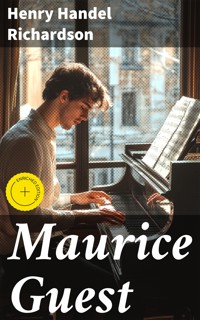
In "Maurice Guest," Henry Handel Richardson crafts a nuanced exploration of the complexities of aspiring artists and the emotional turbulence of unrequited love. Set in the backdrop of 19th-century Europe, this coming-of-age novel unfolds through the experiences of Maurice, a passionate music student caught in a web of ambition, desire, and heartbreak. Richardson's keen insight into the psychological dimensions of her characters, combined with her vivid and lyrical prose, encapsulates the essence of the fin-de-siècle literary movement, marked by a profound engagement with themes of identity and artistic struggle. Henry Handel Richardson, the pen name of Ethel Richardson, was an Australian author whose own musical education and experiences in Europe profoundly influenced her writing. Living through a transformative period in both the arts and society, Richardson draws upon her rich understanding of the artistic milieu, which informs Maurice's devotion to music and the struggles inherent in the pursuit of greatness. Her intimate grasp of human emotions resonates throughout the narrative, illustrating the interplay between personal ambition and societal expectations. "Maurice Guest" is essential reading for anyone interested in the intersection of art and personal identity, as well as the poignant exploration of love's complexities. Its resonant themes and richly drawn characters invite readers to reflect on their own passions and the sacrifices made in their pursuit. In this enriched edition, we have carefully created added value for your reading experience: - A succinct Introduction situates the work's timeless appeal and themes. - The Synopsis outlines the central plot, highlighting key developments without spoiling critical twists. - A detailed Historical Context immerses you in the era's events and influences that shaped the writing. - An Author Biography reveals milestones in the author's life, illuminating the personal insights behind the text. - A thorough Analysis dissects symbols, motifs, and character arcs to unearth underlying meanings. - Reflection questions prompt you to engage personally with the work's messages, connecting them to modern life. - Hand‐picked Memorable Quotes shine a spotlight on moments of literary brilliance. - Interactive footnotes clarify unusual references, historical allusions, and archaic phrases for an effortless, more informed read.
Das E-Book können Sie in Legimi-Apps oder einer beliebigen App lesen, die das folgende Format unterstützen:
Veröffentlichungsjahr: 2019
Ähnliche















Maurice Guest
Table of Contents
Introduction
An unguarded passion tests the boundary between artistic devotion and self-destruction. Henry Handel Richardson’s Maurice Guest examines how love, ambition, and the hunger for recognition can entangle and unsettle a young artist’s sense of self. Set amid the pressures and pleasures of a European musical city, the novel traces the perilous allure of idealization and the costs of confusing creative intensity with emotional absolutes. From the first pages, it establishes an atmosphere of expectation and vulnerability, where talent and desire ignite each other. The result is a searching, unsentimental exploration of feeling in a world that prizes discipline but thrives on ardor.
First published in 1908 and written under the pen name of Australian-born Ethel Florence Lindesay Richardson, Maurice Guest is a psychological novel grounded in the musical culture of Leipzig, Germany. Its milieu is the conservatory and its cosmopolitan student circles, an environment Richardson knew firsthand from her own musical training. The book belongs to the realist tradition, yet it anticipates later twentieth-century fiction in its intense interior scrutiny. Readers encounter a city of lessons, lodgings, cafés, and concert halls, rendered with precise observation and an ear attuned to the labor behind performance. Publication at the century’s turn situates it between classic realism and emerging modern sensibilities.
The premise unfolds with measured clarity: a young English pianist arrives in Leipzig to pursue serious study and to test his abilities among peers from across Europe. He is diligent, impressionable, and eager to belong. When he encounters a fellow student whose magnetism unsettles him, admiration gathers into compulsion. The novel follows the pressure this attraction exerts on his work, friendships, and daily routine, never rushing events or announcing conclusions. Instead, it builds a lived-in portrait of conservatory life—the practice rooms, boarding houses, examinations, and informal salons—through which the protagonist learns how easily artistic striving can be redirected by emotional need.
Richardson’s narrative voice balances outward detail with inward intensity. Scenes of lessons, rehearsals, and public performances are framed by meticulous attention to gesture, tone, and fatigue, while the protagonist’s thoughts are rendered with a sober, cumulative exactness. Music is everywhere, not only as subject matter but as atmosphere and metaphor: phrases swell, falter, and return, much like recurring moods. The style is forthright rather than florid, allowing feeling to emerge from the friction between expectation and reality. This restraint keeps the book clear of melodrama even as it dwells on heightening states of mind, making the emotional stakes feel earned rather than proclaimed.
At its core, the novel probes obsession, self-illusion, and the fragile architecture of identity. It asks how far devotion—to art or to another person—can stretch before it deforms the self that offers it. The competitive intensity of the student world exposes questions of talent, taste, and worth: Who judges excellence, and at what personal cost is excellence pursued? The expatriate setting underscores themes of belonging and estrangement, as national differences and social expectations brush against private aspiration. Richardson also observes how communities both sustain and surveil their members, creating a chorus of opinion that shapes, consoles, and sometimes pressures the solitary performer.
Readers today may find its concerns remarkably current. The book captures the precariousness of creative careers, the amplifying effects of tight-knit networks, and the psychological toll of measuring oneself against others in an exacting field. Its portrait of an international student culture—restless, ambitious, provisional—speaks to contemporary forms of mobility and uncertainty. The narrative’s careful mapping of infatuation will resonate with anyone who has watched desire reorganize habits and plans. Without offering easy lessons, it invites reflection on boundaries, resilience, and the difference between inspiration and fixation, reminding us that excellence requires both ardor and the steadiness to contain it.
To approach Maurice Guest is to enter a world where feeling is acute, effort is visible, and consequences gather by degrees. The novel offers the satisfactions of close realism and the intellectual challenge of a rigorous psychological study, all within a vividly rendered artistic city. It does not sensationalize its subject; it patiently reveals it, letting the reader inhabit the intervals between practice and performance, admiration and surrender. For those drawn to character-driven fiction, to music on the page, or to inquiries into the making and unmaking of the self, Richardson’s debut remains a bracing, resonant introduction to the costs and claims of passion.
Synopsis
Set in turn-of-the-century Leipzig, Maurice Guest follows a young English pianist who arrives in the famed conservatory city to pursue advanced musical training. The cosmopolitan milieu of teachers, students, boardinghouses, and concert halls frames his ambition to refine technique and win recognition. The narrative introduces the routines of lessons and practice, the social codes of the expatriate community, and the city’s seasons, which mark time as studies progress. From the outset, the novel balances the discipline of art with the daily pressures of living abroad, establishing a realistic backdrop for the emotional and professional tests that gradually define Maurice’s experience.
Within this environment Maurice meets Louise Dufrayer, an independent Australian singer whose beauty and force of personality quickly command his attention. She moves in a bohemian circle associated with the gifted violinist-composer Schilsky, a figure both admired and gossiped about for his talent and volatility. Their salons, rehearsals, and late-night discussions expose Maurice to a freer, riskier way of life than the conservatory’s regimen. The first encounters between Maurice and Louise are marked by curiosity and hesitation, their conversations threaded with musical references and hints of past entanglements. The city’s concert-going rhythm subtly binds their paths and sets expectations for future crossings.
Maurice’s attraction intensifies into infatuation, drawing him away from measured study into the unpredictable orbit of Louise’s social world. Friends and fellow students, recognizing the strain, warn him about divided priorities and the reputations surrounding Louise and Schilsky. Despite this, he pursues her attention through gestures, errands, and performances that he hopes will display his sensitivity. Lessons become irregular, finances tighten, and practice hours shrink under the pressure of anticipation and jealousy. The narrative traces this shift without judging motives, showing how a single relationship can reconfigure schedules, friendships, and prospects. Maurice’s inner uncertainty begins to register in small professional setbacks and missed opportunities.
A turning point arrives when Louise’s turbulent connection with Schilsky reaches a rupture, leaving her isolated and uncertain. Maurice, positioned as a patient confidant, steps closer, and intimacy grows from shared meals, errands, and practical support. They establish a fragile domestic routine that depends on his earnings and her intermittent engagements. The arrangement, though tender at moments, exposes their differing expectations and the limits of Maurice’s resources. Mentors caution him about the risks to his development; acquaintances quietly distance themselves. The novel presents this phase as both fulfillment and burden, neither condemning nor romanticizing the choice, but noting its concrete consequences for work, reputation, and health.
Around them, the student colony advances: examinations are sat, debuts are made, and rivalries harden into careers. Subplots trace the varying fates of singers, pianists, and violinists, including a pair of visiting Americans whose social aspirations intersect with the city’s musical calendar. Public performances, juries, and studio politics reveal the unglamorous mechanics of success, while cafés and boardinghouses record triumphs and failures. Maurice’s progress grows uneven as he juggles teaching, accompanying, and rehearsal commitments. The orchestration of many minor stories underscores the novel’s concern with the daily scaffolding of art, against which Maurice’s private choices appear at once ordinary and dangerously consuming.
Pressure returns when figures from Louise’s past reappear and old obligations stir, challenging the precarious balance they have assembled. The renewal of outside claims—professional, personal, and financial—heightens tension between autonomy and attachment. Maurice’s jealousy and vigilance increase as invitations, letters, and rumors circulate, and he becomes wary of chance encounters in concert foyers and streetcar stops. Friendships thin; opportunities are declined or missed; debts mount as winter closes in. The narrative emphasizes accumulation rather than spectacle: small compromises, delayed payments, and careful evasions. Louise’s capriciousness and Maurice’s need for reassurance feed a pattern of quarrel and reconciliation that erodes his confidence and focus.
Attempts at stabilization follow. Maurice canvasses for pupils, accompanies rehearsals, and considers composition to diversify income. A practical, loyal friend, Madeleine Wade, offers counsel and concrete help, modeling steadiness the others lack. Even so, misunderstandings multiply: notes go astray, promises are reinterpreted, and public scenes risk professional damage. Landlords, teachers, and colleagues become indirect participants, their patience tested by missed appointments and short tempers. The book records these negotiations with precision, showing how an artist’s life depends on punctuality and goodwill as much as talent. Maurice’s efforts to reassert discipline coexist uneasily with his dependence on Louise’s unpredictable affection and the shifting demands of their circle.
The plot tightens toward a critical juncture marked by a significant performance and an unexpected reunion. Chance sightings and whispered news crystallize suspicions, pushing Maurice to decisions that narrow his options. His sleepless nights, anxious walks, and halted rehearsals mirror a city that seems suddenly colder and less forgiving. The music that once offered order now underlines uncertainty, and the social fabric that sustained him grows thin. Without disclosing outcomes, the narrative prepares a conclusion shaped by accumulated choices, financial constraints, and emotional extremes. At the brink, the novel holds steady on external facts and internal states, allowing events to speak through measured, consequential action.
Maurice Guest ultimately presents a study of desire intersecting with vocation, set against a meticulously rendered European musical capital. Its central message concerns the costs of allowing passion to override judgment, and the difficulty of sustaining art within precarious social and economic conditions. The book’s realism extends to language, settings, and professional routines, emphasizing how environments shape feeling and fate. While the ending aligns with the somber trajectory established throughout, key specifics remain undisclosed here. The novel stands as an early modern portrait of psychological absorption and artistic ambition, offering readers a clear, sequential account of how personal choices and external pressures steadily converge.
Historical Context
Set chiefly in Leipzig in the late 1880s and 1890s, Maurice Guest inhabits the cosmopolitan milieu of the German Empire’s premier music city. Leipzig, in the Kingdom of Saxony, had become a magnet for international students after German unification (1871), famed for its Conservatorium (founded 1843) and the Gewandhaus Orchestra. Electric trams (introduced 1896), bustling trade fairs, and a dense network of cafés and boarding houses gave the city a modern, urban tempo. The era is Wilhelmine Germany (Kaiser Wilhelm II, 1888–1918), marked by outward self-confidence, strict social codes, and rapid industrial growth. Richardson’s own Leipzig study (1889–1892) informs the novel’s precise feel for classrooms, practice rooms, and the pressures of artistic ambition.
Leipzig’s musical institutions shaped daily life. Felix Mendelssohn founded the Conservatorium in 1843; Carl Reinecke directed it until 1895, embedding a rigorous, classical pedagogy that trained generations of European and foreign students. The Gewandhaus Orchestra, whose lineage dates to the 18th century, set performance standards; Arthur Nikisch assumed the conductorship in 1895, symbolizing modern orchestral brilliance. Publishers such as Breitkopf & Härtel and C. F. Peters, and the busy Petershof, anchored a global music trade centered in Leipzig. The novel mirrors this professionalized environment: juried examinations, masterclasses, and the competitive hierarchy of prodigies versus strivers channel the city’s institutional power, showing how reputation, patronage, and critique can determine an artist’s survival.
The German women’s movement forms a crucial social backdrop. The Allgemeiner Deutscher Frauenverein (ADF) was founded in Leipzig in 1865 by Louise Otto-Peters, advocating education and employment rights; the Bund Deutscher Frauenvereine followed in 1894 to coordinate reform. Despite activism, the 1900 Bürgerliches Gesetzbuch reinforced male marital authority, while most German universities fully admitted women only from 1908. Saxony gradually expanded women’s access to secondary instruction and auditing privileges in the 1890s. The novel’s passionate, ambitious women, whose mobility depends on teachers, guardians, or patrons, echo these constraints and aspirations. Their negotiation of career, marriage, and independence reflects the fin-de-siècle tension between a “New Woman” ethos and entrenched bourgeois expectations in Wilhelmine society.
Industrialization and the labor movement marked Leipzig’s streets and newspapers. After the Anti-Socialist Laws were lifted in 1890, the SPD rebounded, with August Bebel—long associated with Saxony—voicing workers’ demands in the Reichstag. The Leipzig-based Leipziger Volkszeitung, founded 1894, became a vital socialist daily, while May Day (first celebrated in Germany in 1890) regularized labor’s public presence. SPD votes surged across the 1890s; by 1912 it was the Reichstag’s largest party. The novel’s boarding houses, cheap cafés, and precarious lessons economy mirror a city stratified between salaried professionals and the urban poor. Artistic students brush against printers, clerks, and waiters—class frontiers that sharpen the novel’s conflict between aesthetic ideals and economic survival.
Wilhelmine nationalism and militarism formed the wider climate. Kaiser Wilhelm II dismissed Bismarck in 1890, embraced Weltpolitik, and backed Admiral von Tirpitz’s Navy Laws (1898, 1900), fueling a culture of discipline, display, and competition. The Pan-German League (founded 1891) promoted ethnic nationalism; student Korps with dueling rituals cultivated elite solidarity. Though far from barracks life, artists in Leipzig still lived under these hierarchies: uniforms filled streets, patriotic festivals animated public squares, and deference to rank structured social encounters. The novel registers this order indirectly in its status anxieties and the pressure to “belong”—foreign, impecunious musicians navigate a society that prizes conformity and pedigree even in supposedly free creative spaces.
Urban modernity transformed Leipzig’s rhythms. Population expanded from roughly 107,000 (1871) to over 450,000 (by 1910), supported by rail hubs, telegraph links, and the 1896 electrification of the tram network (Große Leipziger Straßenbahn). The city’s historic Messe reinvented itself as the Mustermesse (from 1895), drawing international merchants and seasonal crowds. Rents rose; lodging houses multiplied; cafés and music rooms became surrogate homes for students far from family. The novel’s nocturnal walks, overheard gossip, and fragile intimacies reflect this environment: anonymity enables new freedoms—romantic and artistic—yet also deepens isolation. The churn of arrivals and departures, auditions and failures, gives personal obsession a distinctly modern, metropolitan stage.
Fin-de-siècle culture wars included escalating antisemitism alongside liberal and socialist currents. Pastor Adolf Stoecker’s Christian Social movement (from 1878), the Conservative Party’s Tivoli Program (1892), and völkisch leagues normalized exclusionary rhetoric; the Pan-German League amplified it after 1891. Across Europe, the Dreyfus Affair (1894–1906) polarized opinion and circulated in German papers. Leipzig’s musical heritage—Mendelssohn’s Conservatorium, founded by a Jewish composer—stood as a counter-symbol to such bigotry, even as Wagnerian discourse fed stereotypes. The novel hints at the corrosive power of rumor, labeling, and the anxious policing of belonging in cafés and studios, reflecting how prejudice, though not always named, shadows reputations and opportunities in tight artistic circles.
As social and political critique, the book exposes how Wilhelmine structures—bourgeois morality, gender constraint under the 1900 civil code, and class stratification intensified by industrial capitalism—bear down on private lives. It presents conservatory training as a meritocracy shadowed by patronage and gatekeeping, where talent yields to rank and money. Foreign students’ vulnerability underscores national and cultural exclusions amid rising nationalism. Women’s ambitions confront legal and economic dependency. By tracing obsession to its social predicates—precarious income, crowded housing, competitive institutions—the novel indicts a society that commodifies art while denying care. Its portrait of Leipzig makes visible the costs of conformity and the psychic toll of a modernity that celebrates success but abandons the unsuccessful.
Maurice Guest
Part I
S'amor non e che dunque e quel ch'io sento? Ma s'egli e amor, per Dio, che cosa e quale? PETRARCH
I.
One noon in 189-, a young man stood in front of the new Gewandhaus[1] in Leipzig, and watched the neat, grass-laid square, until then white and silent in the sunshine, grow dark with many figures.
The public rehearsal of the weekly concert was just over, and, from the half light of the warm-coloured hall, which for more than two hours had held them secluded, some hundreds of people hastened, with renewed anticipation, towards sunlight and street sounds. There was a medley of tongues, for many nationalities were represented in the crowd that surged through the ground-floor and out of the glass doors, and much noisy ado, for the majority was made up of young people, at an age that enjoys the sound of its own voice. In black, diverging lines they poured through the heavy swinging doors, which flapped ceaselessly to and fro, never quite closing, always opening afresh, and on descending the shallow steps, they told off into groups, where all talked at once, with lively gesticulation. A few faces had the strained look that indicates the conscientious listener; but most of these young musicians were under the influence of a stimulant more potent than wine, which manifested itself in a nervous garrulity and a nervous mirth.
They hummed like bees before a hive. Maurice Guest, who had come out among the first, lingered to watch a scene that was new to him, of which he was as yet an onlooker only. Here and there came a member of the orchestra; with violin-case or black-swathed wind-instrument in hand, he deftly threaded his way through the throng, bestowing, as he went, a hasty nod of greeting upon a colleague, a sweep of the hat on an obsequious pupil. The crowd began to disperse and to overflow in the surrounding streets. Some of the stragglers loitered to swell the group that was forming round the back entrance to the building; here the lank-haired Belgian violinist would appear, the wonders of whose technique had sent thrills of enthusiasm through his hearers, and whose close proximity would presently affect them in precisely the same way. Others again made off, not for the town, with its prosaic suggestion of work and confinement, but for the freedom of the woods that lay beyond.
Maurice Guest followed them.
It was a blowy day in early spring. Round white masses of cloud moved lightly across a deep blue sky, and the trees, still thin and naked, bent their heads and shook their branches, as if to elude the gambols of a boisterous playfellow. The sun shone vividly, with restored power, and though the clouds sometimes passed over his very face, the shadows only lasted for a moment, and each returning radiance seemed brighter than the one before. In the pure breath of the wind, as it gustily swept the earth, was a promise of things vernal, of the tender beauties of a coming spring; but there was still a keen, delightful freshness in the air, a vague reminder of frosty starlights and serene white snow—the untrodden snow of deserted, moon-lit streets—that quickened the blood, and sent a craving for movement through the veins. The people who trod the broad, clean roads and the paths of the wood walked with a spring in their steps; voices were light and high, and each breath that was drawn increased the sense of buoyancy, of undiluted satisfaction. With these bursts of golden sunshine, so other than the pallid gleamings of the winter, came a fresh impulse to life; and the most insensible was dimly conscious how much had to be made up for, how much lived into such a day.
Maurice Guest walked among the mossgreen tree-trunks, each of which vied with the other in the brilliancy of its coating. He was under the sway of a twofold intoxication: great music and a day rich in promise. From the flood of melody that had broken over him, the frenzied storms of applause, he had come out, not into a lamplit darkness that would have crushed his elation back upon him and hemmed it in, but into the spacious lightness of a fair blue day, where all that he felt could expand, as a flower does in the sun.
His walk brought him to a broad stream, which flashed through the wood like a line of light. He paused on a suspension bridge, and leaning over the railing, gazed up the river into the distance, at the horizon and its trees, delicate and feathery in their nakedness against the sky. Swollen with recent rains and snows, the water came hurrying towards him—the storm-bed of the little river, which, meandering in from the country, through pleasant woods, in ever narrowing curves, ran through the town as a small stream, to be swelled again on the outskirts by the waters of two other rivers, which joined it at right angles. The bridge trembled at first, when other people crossed it, on their way to the woods that lay on the further side, but soon the last stragglers vanished, and he was alone.
As he looked about, eager to discover beauty in the strip of landscape that stretched before him—the line of water, its banks of leafless trees—he was instinctively filled with a desire for something grander, for a feature in the scene that would answer to his mood. There, where the water appeared to end in a clump of trees, there, should be mountains, a gently undulating line, blue with the unapproachable blue of distance, and high enough to form a background to the view; in summer, heavy with haze, melting into the sky; in winter, lined and edged with snow. From this, his thoughts sprang back to the music he had heard that morning. All the vague yet eager hopes that had run riot in his brain, for months past, seemed to have been summed up and made clear to him, in one supreme phrase of it, a great phrase in C major, in the concluding movement of Beethoven's Fifth Symphony. First sounded by the shrill sweet winds, it had suddenly been given out by the strings, in magnificent unison, and had mounted up and on, to the jubilant trilling of the little flutes. There was such a courageous sincerity in this theme, such undauntable resolve; it expressed more plainly than words what he intended his life of the next few years to be; for he was full to the brim of ambitious intentions, which he had never yet had a chance of putting into practice. He felt so ready for work, so fresh and unworn; the fervour of a deep enthusiasm was rampant in him. What a single-minded devotion to art, he promised himself his should be! No other fancy or interest should share his heart with it, he vowed that to himself this day, when he stood for the first time on historic ground, where the famous musicians of the past had found inspiration for their immortal works. And his thoughts spread their wings and circled above his head; he saw himself already of these masters' craft, their art his, he wrenching ever new secrets from them, penetrating the recesses of their genius, becoming one of themselves. In a vision as vivid as those that cross the brain in a sleepless night, he saw a dark, compact multitude wait, with breath suspended, to catch the notes that fell like raindrops from his fingers; saw himself the all-conspicuous figure, as, with masterful gestures, he compelled the soul that lay dormant in brass and strings, to give voice to, to interpret to the many, his subtlest emotions. And he was overcome by a tremulous compassion with himself at the idea of wielding such power over an unknown multitude, at the latent nobility of mind and aim this power implied.
Even when swinging back to the town, he had not shaken himself free of dreams. The quiet of a foreign midday lay upon the streets, and there were few discordant sounds, few passers-by, to break the chain of his thought. He had movement, silence, space. And as is usual with active-brained dreamers, he had little or no eye for the real life about him; he was not struck by the air of comfortable prosperity, of thriving content, which marked the great commercial centre, and he let pass, unnoticed, the unfamiliar details of a foreign street, the trifling yet significant incidents of foreign life. Such impressions as he received, bore the stamp of his own mood. He was sensible, for instance, in face of the picturesque houses that clustered together in the centre of the town, of the spiritual GEMUTLICHKEIT, the absence of any pomp or pride in their romantic past, which characterises the old buildings of a German town. These quaint and stately houses, wedged one into the other, with their many storeys, their steeply sloping roofs and eye-like roof-windows, were still in sympathetic touch with the trivial life of the day which swarmed in and about them. He wandered leisurely along the narrow streets that ran at all angles off the Market Place, one side of which was formed by the gabled RATHAUS[3], with its ground-floor row of busy little shops; and, in fancy, he peopled these streets with the renowned figures that had once walked them. He looked up at the dark old houses in which great musicians had lived, died and been born, and he saw faces that he recognised lean out of the projecting windows, to watch the life and bustle below, to catch the last sunbeam that filtered in; he saw them take their daily walk along these very streets, in the antiquated garments of their time. They passed him by, shadelike and misanthropic, and seemed to steal down the opposite side, to avoid his too pertinent gaze. Bluff, preoccupied, his keen eyes lowered, the burly Cantor passed, as he had once done day after day, with the disciplined regularity of high genius, of the honest citizen, to his appointed work in the shadows of the organ-loft; behind him, one who had pointed to the giant with a new burst of ardour, the genial little improviser, whose triumphs had been those of this town, whose fascinating gifts and still more fascinating personality, had made him the lion of his age. And it was only another step in this train of half-conscious thought, that, before a large lettered poster, which stood out black and white against the reds and yellows of the circular advertisement-column, and bore the word "Siegfried[2]," Maurice Guest should not merely be filled with the anticipation of a world of beauty still unexplored, but that the world should stand to him for a symbol, as it were, of the easeful and luxurious side of a life dedicated to art—of a world-wide fame; the society of princes, kings; the gloss of velvet; the dull glow of gold.—And again, tapering vistas opened up, through which he could peer into the future, happy in the knowledge, that he stood firm in a present which made all things possible to a holy zeal, to an unhesitating grasp.
But it was growing late, and he slowly retraced his steps. In the restaurant into which he turned for dinner, he was the only customer. The principal business of the day was at an end; two waiters sat dozing in corners, and a man behind the counter, who was washing metal-topped beer-glasses, had almost the whole pile polished bright before him. Maurice Guest sat down at a table by the window; and, when he had finished his dinner and lighted a cigarette, he watched the passers-by, who crossed the pane of glass like the figures in a moving photograph.
Suddenly the door opened with an energetic click, and a lady came in, enveloped in an old-fashioned, circular cloak, and carrying on one arm a pile of paper-covered music. This, she laid on the table next that at which the young man was sitting, then took off her hat. When she had also hung up the unbecoming cloak, he saw that she was young and slight. For the rest, she seemed to bring with her, into the warm, tranquil atmosphere of the place, heavy with midday musings, a breath of wind and outdoor freshness—a suggestion that was heightened by the quick decisiveness of her movements: the briskness with which she divested herself of her wrappings, the quick smooth of the hair on either side, the business-like way in which she drew up her chair to the table and unfolded her napkin.
She seemed to be no stranger there, for, on her entrance, the younger and more active waiter had at once sprung up with officious haste, and almost before she was ready, the little table was newly spread and set, and the dinner of the day before her. She spoke to the man in a friendly way as she took her seat, and he replied with a pleased and smiling respect.
Then she began to eat, deliberately, and with an overemphasised nicety. As she carried her soup-spoon to her lips, Maurice Guest felt that she was observing him; and throughout the meal, of which she ate but little, he was aware of a peculiarly straight and penetrating gaze. It ended by disconcerting him. Beckoning the waiter, he went through the business of paying his bill, and this done, was about to push back his chair and rise to his feet, when the man, in gathering up the money, addressed what seemed to be a question to him. Fearful lest he had made a mistake in the strange coinage, Maurice looked up apprehensively. The waiter repeated his words, but the slight nervousness that gained on the young man made him incapable of separating the syllables, which were indistinguishably blurred. He coloured, stuttered, and felt mortally uncomfortable, as, for the third time, the waiter repeated his remark, with the utmost slowness.
At this point, the girl at the adjacent table put down her knife and fork, and leaned slightly forward.
"Excuse me," she said, and smiled. "The waiter only said he thought you must be a stranger here: DER HERR IST GEWISS FREMD IN LEIPZIG?" Her rather prominent teeth were visible as she spoke.
Maurice, who understood instantly her pronunciation of the words, was not set any more at his ease by her explanation. "Thanks very much." he said, still redder than usual. "I ... er ... thought the fellow was saying something about the money."
"And the Saxon dialect is barbarous, isn't it?" she added kindly. "But perhaps you have not had much experience of it yet."
"No. I only arrived this morning."
At this, she opened her eyes wide. "Why, you are a courageous person!" she said and laughed, but did not explain what she meant, and he did not like to ask her.
A cup of coffee was set on the table before her; she held a lump of sugar in her spoon, and watched it grow brown and dissolve. "Are you going to make a long stay?" she asked, to help him over his embarrassment.
"Two years, I hope," said the young man.
"Music?" she queried further, and, as he replied affirmatively: "Then the Con. of course?"—an enigmatic question that needed to be explained. "You're piano, are you not?" she went on. "I thought so. It is hardly possible to mistake the hands"—here she just glanced at her own, which, large, white, and well formed, were lying on the table. "With strings, you know, the right hand is as a rule shockingly defective."
He found the high clearness of her voice very agreeable after the deep roundnesses of German, and could have gone on listening to it. But she was brushing the crumbs from her skirt, preparatory to rising.
"Are you an old resident here?" he queried in the hope of detaining her.
"Yes, quite. I'm at the end of my second year; and don't know whether to be glad or sorry," she answered. "Time goes like a flash.—Now, look here, as one who knows the ways of the place, would you let me give you a piece of advice? Yes?—It's this. You intend to enter the Conservatorium, you say. Well, be sure you get under a good man—that's half the battle. Try and play privately to either Schwarz or Bendel. If you go in for the public examination with all the rest, the people in the BUREAU[5] will put you to anyone they like, and that is disastrous. Choose your own master, and beard him in his den beforehand."
"Yes ... and you recommend? May I ask whom you are with?" he said eagerly.
"Schwarz is my master; and I couldn't wish for a better. But Bendel is good, too, in his way, and is much sought after by the Americans—you're not American, are you? No.—Well, the English colony runs the American close nowadays. We're a regular army. If you don't want to, you need hardly mix with foreigners as long as you're here. We have our clubs and balls and other social functions—and our geniuses—and our masters who speak English like natives ... But there!—you'll soon know all about it yourself."
She nodded pleasantly and rose.
"I must be off," she said. "To-day every minute is precious. That wretched PROBE[4] spoils the morning, and directly it is over, I have to rush to an organ-lesson—that's why I'm here. For I can't expect a PENSION to keep dinner hot for me till nearly three o'clock—can I? Morning rehearsals are a mistake. What?—you were there, too? Really?—after a night in the train? Well, you didn't get much, did you, for your energy? A dull aria, an overture that 'belongs in the theatre,' as they say here, an indifferently played symphony that one has heard at least a dozen times. And for us poor pianists, not a fresh dish this season. Nothing but yesterday's remains heated up again."
She laughed as she spoke, and Maurice Guest laughed, too, not being able at the moment to think of anything to say.
Getting the better of the waiter, who stood by, napkin on arm, smiling and officious, he helped her into the unbecoming cloak; then took up the parcel of music and opened the door. In his manner of doing this, there may have been a touch of over-readiness, for no sooner was she outside, than she quietly took the music from him, and, without even offering him her hand, said a friendly but curt good-bye: almost before he had time to return it, he saw her hurrying up the street, as though she had never vouchsafed him word or thought. The abruptness of the dismissal left him breathless; in his imagination, they had walked at least a strip of the street together. He stepped off the pavement into the road, that he might keep her longer in sight, and for some time he saw her head, in the close-fitting hat, bobbing along above the heads of other people.
On turning again, he found that the waiter was watching him from the window of the restaurant, and it seemed to the young man that the pale, servile face wore a malicious smile. With the feeling of disconcertion that springs from being caught in an impulsive action we have believed unobserved, Maurice spun round on his heel and took a few quick steps in the opposite direction. When once he was out of range of the window, however, he dropped his pace, and at the next corner stopped altogether. He would at least have liked to know her name. And what in all the world was he to do with himself now?
Clouds had gathered; the airy blue and whiteness of the morning had become a level sheet of grey, which wiped the colour out of everything; the wind, no longer tempered by the sun, was chilly, as it whirled down the narrow streets and freaked about the corners. There was little temptation now to linger on one's steps. But Maurice Guest was loath to return to the solitary room that stood to him for home, to shut himself up with himself, inside four walls: and turning up his coat collar, he began to walk slowly along the curved GRIMMAISCHESTRASSE. But the streets were by this time black with people, most of whom came hurrying towards him, brisk and bustling, and gay, in spite of the prevailing dullness, at the prospect of the warm, familiar evening. He was continually obliged to step off the pavement into the road, to allow a bunch of merry, chattering girls, their cheeks coloured by the wind beneath the dark fur of their hats, or a line of gaudy capped, thickset students, to pass him by, unbroken; and it seemed to him that he was more frequently off the pavement than on it. He began to feel disconsolate among these jovial people, who were hastening forward, with such spirit, to some end, and he had not gone far, before he turned down a side street to be out of their way. Vaguely damped by his environment, which, with the sun's retreat, had lost its charm, he gave himself up to his own thoughts, and was soon busily engaged in thinking over all that had been said by his quondam acquaintance of the dinner-table, in inventing neatly turned phrases and felicitous replies. He walked without aim, in a leisurely way down quiet streets, quickly across big thoroughfares, and paid no attention to where he was going. The falling darkness made the quaint streets look strangely alike; it gave them, too, an air of fantastic unreality: the dark old houses, marshalled in rows on either side, stood as if lost in contemplation, in the saddening dusk. The lighting of the street-lamps, which started one by one into existence, and the conflict with the fading daylight of the uneasily beating flame, that was swept from side to side in the wind like a woman's hair—these things made his surroundings seem still shadowier and less real.
He was roused from his reverie by finding himself on what was apparently the outskirts of the town. With much difficulty he made his way back, but he was still far from certain of his whereabouts, when an unexpected turn to the right brought him out on the spacious AUGUSTUSPLATZ, in front of the New Theatre. He had been in this square once already, but now its appearance was changed. The big buildings that flanked it were lit up; the file of droschkes waiting for fares, under the bare trees, formed a dotted line of lights. A double row of hanging lamps before the CAFE FRANCAIS made the corner of the GRIMMAISCHESTRASSE dazzling to the eyes; and now, too, the massive white theatre was awake as well. Lights shone from all its high windows, streamed out through the Corinthian columns and low-porched doorways. Its festive air was inviting, after his twilight wanderings, and he went across the square to it. Immediately before the theatre, early corners stood in knots and chatted; programme—and text-vendors cried and sold their wares; people came hurrying from all directions, as to a magnet; hastily they ascended the low steps and disappeared beneath the portico.
He watched until the last late-comer had vanished. Only he was left; he again was the outsider. And now, as he stood there in the deserted square, which, a moment before, had been so animated, he had a sudden sinking of the heart: he was seized by that acute sense of desolation that lies in wait for one, caught by nightfall, alone in a strange city. It stirs up a wild longing, not so much for any particular spot on earth, as for some familiar hand or voice, to take the edge off an intolerable loneliness.
He turned and walked rapidly back to the small hotel near the railway station, at which he was staying until he found lodgings. He was tired out, and for the first time became thoroughly conscious of this; but the depression that now closed in upon him, was not due to fatigue alone, and he knew it. In sane moments—such as the present—when neither excitement nor enthusiasm warped his judgment, he was under no illusion about himself; and as he strode through the darkness, he admitted that, all day long, he had been cheating himself in the usual way. He understood perfectly that it was by no means a matter of merely stretching out his hand, to pluck what he would, from this tree that waved before him; he reminded himself with some bitterness that he stood, an unheralded stranger, before a solidly compact body of things and people on which he had not yet made any impression. It was the old story: he played at expecting a ready capitulation of the whole—gods and men—and, at the same time, was only too well aware of the laborious process that was his sole means of entry and fellowship. Again—to instance another of his mental follies—the pains he had been at to take possession of the town, to make it respond to his forced interpretation of it! In reality, it had repelled him—yes, he was chilled to the heart by the aloofness of this foreign town, to which not a single tie yet bound him.
By the light of a fluttering candle, in the dingy hotel bedroom, he sat and wrote a letter, briefly announcing his safe arrival. About to close the envelope, he hesitated, and then, unfolding the sheet of paper again, added a few lines to what he had written. These cost him more trouble than all the rest.
ONCE MORE, HEARTY THANKS TO YOU BOTH, MY DEAR PARENTS, FOR LETTING ME HAVE MY OWN WAY. I HOPE YOU WILL NEVER HAVE REASON TO REGRET IT. ONE THING, AT LEAST, I CAN PROMISE YOU, AND THAT IS, THAT NOT A DAY OF MY TIME HERE SHALL BE WASTED OR MISSPENT. YOU HAVE NOT, I KNOW, THE SAME FAITH IN ME THAT I HAVE MYSELF, AND THIS HAS OFTEN BEEN A BITTER THOUGHT TO ME. BUT ONLY HAVE PATIENCE. SOMETHING STRONGER THAN MYSELF DROVE ME TO IT[1q], AND IF I AM TO SUCCEED ANYWHERE, IT WILL BE HERE. AND I MEAN TO SUCCEED, IF HUMAN WILL CAN DO IT.
He threw himself on the creaking wooden bed and tried to sleep. But his brain was active, and the street was noisy; people talked late in the adjoining room, and trod heavily in the one above. It was long after midnight before the house was still and he fell into an uneasy sleep.
Towards morning, he had a strange dream, from which he wakened in a cold sweat. Once more he was wandering through the streets, as he had done the previous day, apparently in search of something he could not find. But he did not know himself what he sought. All of a sudden, on turning a corner, he came upon a crowd of people gathered round some object in the road, and at once said to himself, this is it, here it is. He could not, however, see what it actually was, for the people, who were muttering to themselves in angry tones, strove to keep him back. At all costs, he felt, he must get nearer to the mysterious thing, and, in a spirit of bravado, he was pushing through the crowd to reach it, when a great clamour arose; every one sprang back, and fled wildly, shrieking: "Moloch[7], Moloch!" He did not know in the least what it meant, but the very strangeness of the word added to the horror, and he, too, fled with the rest; fled blindly, desperately, up streets and down, watched, it seemed to him, from every window by a cold, malignant eye, but never daring to turn his head, lest he should see the awful thing behind him; fled on and on, through streets that grew ever vaguer and more shadowy, till at last his feet would carry him no further: he sank down, with a loud cry, sank down, down, down, and wakened to find that he was sitting up in bed, clammy with fear, and that dawn was stealing in at the sides of the window.
II.
In Maurice Guest, it might be said that the smouldering unrest of two generations burst into flame. As a young man, his father, then a poor teacher in a small provincial town, had been a prey to certain dreams and wishes, which harmonised ill with the conditions of his life. When, for example, on a mild night, he watched the moon scudding a silvery, cloud-flaked sky; when white clouds sailed swiftly, and soft spring breezes were hastening past; when, in a word, all things seemed to be making for some place, unknown, afar-off, where he was not, then he, too, was seized with a desire to be moving, to strap on a knapsack and be gone, to wander through foreign countries, to see strange cities and hear strange tongues, was unconsciously filled with the desire to taste, lighthearted, irresponsible, the joys and experiences of the WANDERJAHRE[6], before settling down to face the matter-of-factnesss of life. And as the present continually pushed the realisation of his dreams into the future, he satisfied the immediate thirst of his soul by playing the flute, and by breathing into the thin, reedy tones he drew from it, all that he dreamed of, but would never know. For he presently came to a place in his life where two paths diverged, and he was forced to make a choice between them. It was characteristic of the man that he chose the way of least resistance, and having married, more or less improvidently, he turned his back on the visions that had haunted his youth: afterwards, the cares, great and small, that came in the train of the years, drove them ever further into the background. Want of sympathy in his home-life blunted the finer edges of his nature; of a gentle and yielding disposition, he took on the commonplace colour of his surroundings. After years of unhesitating toil, it is true, the most pressing material needs died down, but the dreams and ambitions had died, too, never to come again. And as it is in the nature of things that no one is less lenient towards romantic longings than he who has suffered disappointment in them, who has failed to transmute them into reality, so, in this case, the son's first tentative leanings to a wider life, met with a more deeply-rooted, though less decisive, opposition, on the part of the father than of the mother.
But Maurice Guest had a more tenacious hold on life.
The home in which he grew up, was one of those cheerless, middle-class homes, across which never passes a breath of the great gladness, the ideal beauty of life; where thought never swings itself above the material interests of the day gone, the day to come, and existence grows as timid and trivial as the petty griefs and pleasures that intersperse it. The days drip past, one by one, like water from a spout after a rain-shower; and the dull monotony of them benumbs all wholesome temerity at its core. Maurice Guest had known days of this kind. For before the irksomeness of the school-bench was well behind him, he had begun his training as a teacher, and as soon as he had learnt how to instil his own half-digested knowledge into the minds of others, he received a small post in the school at which his father taught. The latter had, for some time, secretly cherished a wish to send the boy to study at the neighbouring university, to make a scholar of his eldest son; but the longer he waited, the more unfavourable did circumstances seem, and the idea finally died before it was born.
Maurice Guest looked back on the four years he had just come through, with bitterness; and it was only later, when he was engrossed heart and soul in congenial work, that he began to recognise, and be vaguely grateful for, the spirit of order with which they had familiarised him. At first, he could not recall them without an aversion that was almost physical: this machine-like regularity, which, in its disregard of mood and feeling, had something of a divine callousness to human stirrings; the jarring contact with automaton-like people; his inadequacy and distaste for a task that grew day by day more painful. His own knowledge was so hesitating, so uncertain, too slight for self-confidence, just too much and too fresh to allow him to generalise with the unthinking assurance that was demanded of him. Yet had anyone, he asked himself, more obstacles to overcome than he, in his efforts to set himself free? This silent, undemonstrative father, who surrounded himself with an unscalable wall of indifference; this hard-faced, careworn mother, about whose mouth the years had traced deep lines, and for whom, in the course of a single-handed battle with life, the true reality had come to be success or failure in the struggle for bread. What was art to them but an empty name, a pastime for the drones and idlers of existence? How could he set up his ambitions before them, to be bowled over like so many ninepins? When, at length, after much heartburning and conscientious scrupling, he was mastered by a healthier spirit of self-assertion, which made him rebel against the uselessness of the conflict, and doggedly resolve to put an end to it, he was only enabled to stand firm by summoning to his aid all the strengthening egoism, which is latent in every more or less artistic nature. To the mother, in her honest narrowness, the son's choice of a calling which she held to be unfitting, was something of a tragedy. She allowed no item of her duty to escape her, and moved about the house as usual, sternly observant of her daily task, but her lips were compressed to a thin line, and her face reflected the anger that burnt in her heart, too deep for speech. In the months that followed, Maurice learnt that the censure hardest to meet is that which is never put into words, which refuses to argue or discuss: he chafed inwardly against the unspoken opposition that will not come out to be grappled with, and overthrown. And, as he was only too keenly aware, there was more to be faced than a mere determined aversion to the independence with which he had struck out: there was, in the first place, a pardonably human sense of aggrievedness that the eldest-born should cross their plans and wishes; that, after the year-long care and thought they had bestowed on him, he should demand fresh efforts from them; and, again, most harassing of all and most invulnerable, such an entire want of faith in the powers he was yearning to test—the prophet's lot in the mean blindness of the family—that, at times, it threatened to shake his hard-won faith in himself.—But before the winter drew to a close he was away.
Away!—to go out into the world and be a musician—that was his longing and his dream. And he never came to quite an honest understanding with himself on this point, for desire and dream were interwoven in his mind; he could not separate the one from the other. But when he weighed them, and allowed them to rise up and take shape before him, it was invariably in this order that they did so. In reality, although he himself was but vaguely conscious of the fact, it was to some extent as means to an end, that, when his eyes had been opened to its presence, he clutched—like a drowning man who seizes upon a spar—clutched and held fast to his talent. But the necessary insight into his powers had first to be gained, for it was not one of those talents which, from the beginning, strut their little world with the assurance of the peacock. He was, it is true, gifted with an instinctive feeling for the value and significance of tones—as a child he sang by ear in a small, sweet voice, which gained him the only notice he received at school, and he easily picked out his notes, and taught himself little pieces, on the old-fashioned, silk-faced piano, which had belonged to his mother as a girl, and at which, in the early days of her marriage, she had sung in a high, shrill voice, the sentimental songs of her youth. But here, for want of incentive, matters remained; Maurice was kept close at his school-books, and, boylike, he had no ambition to distinguish himself in a field so different from that in which his comrades won their spurs. It was only when, with the end of his schooldays in sight, he was putting away childish things, that he seriously turned his attention to the piano and his hands. They were those of the pianist, broad, strong and supple, and the new occupation soon engrossed him deeply; he gave up all his spare time to it, and, in a few months, attained so creditable a proficiency, that he went through a course of instruction with a local teacher of music, who, scenting talent, dismissed preliminaries with the assurance of his kind, and initiated his pupil into all that is false and meretricious in the literature of the piano—the cheaply pathetic, the tinsel of transcription, the titillating melancholy of Slavonic dance-music—to leave him, but for an increased agility of finger, not a whit further forward than he had found him. Then followed months when the phantom of discontent stalked large through Maurice's life, grew, indeed, day by day more tangible, more easily defined; for there came the long, restless summer evenings, when it seemed as if a tranquil darkness would never fall and bar off the distant, the unattainable; and as he followed some flat, white country road, that was lost to sight on the horizon as a tapering line, or looked out across a stretch of low, luxuriant meadows, the very placidity of which made heart and blood throb quicker, in a sense of opposition: then the desire to have finished with the life he knew, grew almost intolerable, and only a spark was needed to set his resolve ablaze.
It was one evening when the summer had already dragged itself to a close, that Maurice walked through a drizzling rain to the neighbouring cathedral town, to attend a performance of ELIJAH. It was the first important musical experience of his life, and, carried away by the volumes of sound, he repressed his agitation so ill, that it became apparent to his neighbour, a small, wizened, old man, who was leaning forward, his hands hanging between his knees and his eyes fixed on the floor, alternately shaking and nodding his head. In the interval between the parts, they exchanged a few words, halting, excited on Maurice's part, interrogative on his companion's; when the performance was over, they walked a part of the way together, and found so much to say, that often, after this, when his week's work was behind him, Maurice would cover the intervening miles for the pleasure of a few hours' conversation with this new friend. In a small, dark room, the air of which was saturated with tobacco-smoke, he learned, by degrees, the story of the old musician's life: how, some thirty years previously, he had drifted into the midst of this provincial population, where he found it easy to earn enough for his needs, and where his position was below that of a dancing-master; but how, long ago, in his youth—that youth of which he spoke with a far-away tone in his voice, and at which he seemed to be looking out as at a fading shore—it had been his intention to perfect himself as a pianist. Life had been against him; when, the resolve was strongest, poverty and ill-heath kept him down, and since then, with the years that passed, he had come to see that his place would only have been among the multitude of little talents, whose destiny it is to imitate and vulgarise the strivings of genius, to swell the over-huge mass of mediocrity. And so, he had chosen that his life should be a failure—a failure, that is, in the eyes of the world; for himself, he judged otherwise. The truth that could be extracted from words was such a fluctuating, relative truth. Failure! success!—what WAS success, but a clinging fast, unabashed by smile or neglect, to that better part in art, in one's self, that cannot be taken away?—never for a thought's space being untrue to the ideal each one of us bears in his breast; never yielding jot or tittle to the world's opinion. That was what it meant, and he who was proudly conscious of having succeeded thus, could well afford to regard the lives of others as half-finished and imperfect; he alone was at one with himself, his life alone was a harmonious whole.
To Maurice Guest, all this mattered little or not at all; it was merely the unavoidable introduction. The chief thing was that the old man had known the world which Maurice so desired to know; he had seen life, had lived much of his youth in foreign lands, and had the conversation been skilfully set agoing in this direction, he would lay a wrinkled hand on his listener's shoulder, and tell him of this shadowy past, with short hoarse chuckles of pleasure and reminiscence, which invariably ended in a cough. He painted it in vivid colours, and with the unconscious heightening of effect that comes natural to one who looks back upon a happy past, from which the countless pricks and stings that make up reality have faded, leaving in their place a sense of dreamy, unreal brightness, like that of sunset upon distant hills. He told him of Germany, and the gay, careless years he had spent there, working at his art, years of inspiriting, untrammelled progress; told him of famous musicians he had seen and known, of great theatre performances at which he had assisted, of stirring PREMIERES, long since forgotten, of burning youthful enthusiasms, of nights sleepless with holy excitement, and days of fruitful, meditative idleness. Under the spell of these reminiscences, he seemed to come into touch again with life, and his eyes lit with a spark of the old fire. At moments, he forgot his companion altogether, and gazed long and silently before him, nodding and smiling to himself at the memories he had stirred up in his brain, memories of things that had long ceased to be, of people who had long been quiet and unassertive beneath their handful of earth, but for whom alone, the brave, fair world had once seemed to exist. Then he would lose himself among strange names, in vague histories of those who had borne these names, and of what they had become in their subsequent journeyings towards the light, for which they had set out, side by side, with so much ardour (and oftenest what he had to tell was a modest mediocrity); but the greater number of them had lost sight one of the other; the most inseparable friends had, once parted, soon forgotten. And the bluish smoke sent upwards as he talked, in clouds and spirals that mounted rapidly and vanished, seemed to Maurice symbolic of the brief and shadowy lives that were unrolled before him. But, after all this, when the lights came, the piano was opened, and then, for an hour or two, the world was forgotten in a different way. It was here that the chief landmarks of music emerged from the mists in which, for Maurice, they had hitherto been enveloped; here he learned that Bach and Beethoven were giants, and made uncertain efforts at appreciation; learnt that Gluck was a great composer, Mozart a genius of many parts, Mendelssohn the direct successor in this line of kings. Sonatas, symphonies, operas, were hammered out with tremendous force and precision on the harsh, scrupulously tuned piano; and all were dominated alike by the hoarse voice of the old man, who never wavered, never faltered, but sang from beginning to end with all his might. Each one of the pleasant hours spent in this new world helped to deepen Maurice's resolution to free himself while there was yet time; each one gave more clearness and precision to his somewhat formless desires; for, in all that concerned his art, the nameless old musician hated his native land, with the hatred of the bigot for those who are hostile or indifferent to his faith.




