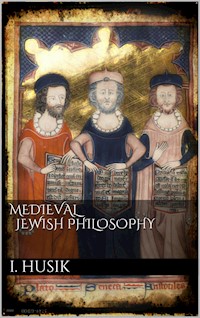
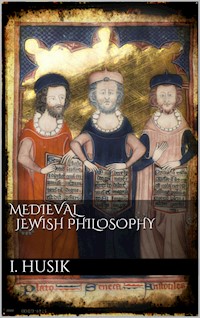
Isaac Husik
Mediaeval Jewish Philosophy
UUID: 7e9e2fc2-23dc-11e5-802c-119a1b5d0361
This ebook was created with BackTypo (http://backtypo.com)by Simplicissimus Book Farm
Table of contents
PREFACE
INTRODUCTION
CHAPTER I
CHAPTER II
CHAPTER III
CHAPTER IV
CHAPTER V
CHAPTER VI
CHAPTER VII
CHAPTER VIII
CHAPTER IX
CHAPTER X
CHAPTER XI
CHAPTER XII
CHAPTER XIII
CHAPTER XIV
CHAPTER XV
CHAPTER XVI
CHAPTER XVII
CHAPTER XVIII
CONCLUSION
NOTES
NOTES
NOTES
PREFACE
No
excuse is needed for presenting to the English reader a History of
Mediæval Jewish Philosophy. The English language, poor enough in
books on Jewish history and literature, can boast of scarcely
anything at all in the domain of Jewish Philosophy. The Jewish
Encyclopedia has no article on Jewish Philosophy, and neither has the
eleventh edition of the Encyclopedia Britannica. Hastings'
Encyclopedia of Religion and Ethics will have a brief article on the
subject from the conscientious and able pen of Dr. Henry Malter, but
of books there is none. But while this is due to several causes,
chief among them perhaps being that English speaking people in
general and Americans in particular are more interested in positive
facts than in tentative speculations, in concrete researches than in
abstract theorizing—there are ample signs that here too a change is
coming, and in many spheres we are called upon to examine our
foundations with a view to making our superstructure deep and secure
as well as broad and comprehensive. And this is nothing else than
philosophy. Philosophical studies are happily on the increase in this
country and more than one branch of literary endeavor is beginning to
feel its influence. And with the increase of books and researches in
the history of the Jews is coming an awakening to the fact that the
philosophical and rationalistic movement among the Jews in the middle
ages is well worth study, influential as it was in forming Judaism as
a religion and as a theological and ethical system.But
it is not merely the English language that is still wanting in a
general history of Mediæval Jewish Philosophy, the German, French
and Italian languages are no better off in this regard. For while it
is true that outside of the Hebrew and Arabic sources, German books
and monographs are the
sine qua non of the
student who wishes to investigate the philosophical movement in
mediæval Jewry, and the present writer owes very much to the
researches of such men as Joel, Guttmann, Kaufmann and others, it
nevertheless remains true that there is as yet no complete history of
the subject for the student or the general reader. The German writers
have done thorough and distinguished work in expounding individual
thinkers and problems, they have gathered a complete and detailed
bibliography of Jewish philosophical writings in print and in
manuscript, they have edited and translated and annotated the most
important philosophical texts. France has also had an important share
in these fundamental undertakings, but for some reason neither the
one nor the other has so far undertaken to present to the general
student and non-technical reader the results of their researches.What
was omitted by the German, French and English speaking writers was
accomplished by a scholar who wrote in Hebrew. Dr. S. Bernfeld has
written in Hebrew under the title "Daat Elohim" (The
Knowledge of God) a readable sketch of Jewish Religious philosophy
from Biblical times down to "Ahad Haam." A German scholar
(now in America), Dr. David Neumark of Cincinnati, has undertaken on
a very large scale a History of Jewish Philosophy in the Middle Ages,
of which only a beginning has been made in the two volumes so far
issued.The
present writer at the suggestion of the Publication Committee of the
Jewish Publication Society of America has undertaken to write a
history of mediæval Jewish rationalistic philosophy in one volume—a
history that will appeal alike to the scholar and the intelligent
non-technical reader. Treating only of the rationalistic school, I
did not include anything that has to do with mysticism or Kabbala. In
my attempt to please the scholar and the layman, I fear I shall have
succeeded in satisfying neither. The professional student will miss
learned notes and quotations of original passages in the language of
their authors. The general reader will often be wearied by the
scholastic tone of the problems as well as of the manner of the
discussion and argument. And yet I cannot but feel that it will do
both classes good—the one to get less, the other more than he
wants. The latter will find oases in the desert where he can refresh
himself and take a rest, and the former will find in the notes and
bibliography references to sources and technical articles where more
can be had after his own heart.There
is not much room for originality in a historical and expository work
of this kind, particularly as I believe in writing history
objectively. I have not attempted to read into the mediæval thinkers
modern ideas that were foreign to them. I endeavored to interpret
their ideas from their own point of view as determined by their
history and environment and the literary sources, religious and
philosophical, under the influence of which they came. I based my
book on a study of the original sources where they were available—and
this applies to all the authors treated with the exception of the two
Karaites, Joseph al Basir and Jeshua ben Judah, where I had to
content myself with secondary sources and a few fragments of the
original texts. For the rest I tried to tell my story as simply as I
knew how, and I hope the reader will accept the book in the spirit in
which it is offered—as an objective and not too critical exposition
of Jewish rationalistic thought in the middle ages.My
task would not be done were I not to express my obligations to the
Publication Committee of the Jewish Publication Society of America to
whose encouragement I owe the impulse but for which the book would
not have been written, and whose material assistance enabled the
publishers to bring out a book typographically so attractive.
INTRODUCTION
The
philosophical movement in mediæval Jewry was the result of the
desire and the necessity, felt by the leaders of Jewish thought, of
reconciling two apparently independent sources of truth. In the
middle ages, among Jews as well as among Christians and Mohammedans,
the two sources of knowledge or truth which were clearly present to
the minds of thinking people, each claiming recognition, were
religious opinions as embodied in revealed documents on the one hand,
and philosophical and scientific judgments and arguments, the results
of independent rational reflection, on the other. Revelation and
reason, religion and philosophy, faith and knowledge, authority and
independent reflection are the various expressions for the dualism in
mediæval thought, which the philosophers and theologians of the time
endeavored to reduce to a monism or a unity.Let
us examine more intimately the character and content of the two
elements in the intellectual horizon of mediæval Jewry. On the side
of revelation, religion, authority, we have the Bible, the Mishna,
the Talmud. The Bible was the written law, and represented literally
the word of God as revealed to lawgiver and prophet; the Talmud
(including the Mishna) was the oral law, embodying the unwritten
commentary on the words of the Law, equally authentic with the
latter, contemporaneous with it in revelation, though not committed
to writing until many ages subsequently and until then handed down by
word of mouth; hence depending upon tradition and faith in tradition
for its validity and acceptance. Authority therefore for the
Rabbanites was two-fold, the authority of the direct word of God
which was written down as soon as communicated, and about which there
could therefore be no manner of doubt; and the authority of the
indirect word of God as transmitted orally for many generations
before it was written down, requiring belief in tradition. By the
Karaites tradition was rejected, and there remained only belief in
the words of the Bible.On
the side of reason was urged first the claim of the testimony of the
senses, and second the validity of logical inference as determined by
demonstration and syllogistic proof. This does not mean that the
Jewish thinkers of the middle ages developed unaided from without a
system of thought and a
Weltanschauung,
based solely upon their own observation and ratiocination, and then
found that the view of the world thus acquired stood in opposition to
the religion of the Bible and the Talmud, the two thus requiring
adjustment and reconciliation. No! The so-called demands of the
reason were not of their own making, and on the other hand the
relation between philosophy and religion was not altogether one of
opposition. To discuss the latter point first, the teachings of the
Bible and the Talmud were not altogether clear on a great many
questions. Passages could be cited from the religious documents of
Judaism in reference to a given problem both
pro and
con. Thus in the
matter of freedom of the will one could argue on the one hand that
man must be free to determine his conduct since if he were not there
would have been no use in giving him commandments and prohibitions.
And one could quote besides in favor of freedom the direct statement
in Deuteronomy 30, 19, "I call heaven and earth to witness
against you this day, that I have set before thee life and death, the
blessing and the curse: therefore choose life, that thou mayest live,
thou and thy seed." But on the other hand it was just as
possible to find Biblical statements indicating clearly that God
preordains how a person shall behave in a given case. Thus Pharaoh's
heart was hardened that he should not let the children of Israel go
out of Egypt, as we read in Exodus 7, 3: "And I will harden
Pharaoh's heart, and multiply my signs and my wonders in the land of
Egypt. But Pharaoh will not hearken unto you, and I will lay my hand
upon Egypt, and bring forth my hosts, my people, the children of
Israel, out of the land of Egypt by great judgments." Similarly
in the case of Sihon king of Heshbon we read in Deuteronomy 2, 30:
"But Sihon king of Heshbon would not let us pass by him: for the
Lord thy God hardened his spirit, and made his heart obstinate, that
he might deliver him into thy hand, as at this day." And this is
true not merely of heathen kings, Ahab king of Israel was similarly
enticed by a divine instigation according to I Kings 22, 20: "And
the Lord said, Who shall entice Ahab, that he may go up and fall at
Ramoth-Gilead?"The
fact of the matter is the Bible is not a systematic book, and
principles and problems are not clearly and strictly formulated even
in the domain of ethics which is its strong point. It was not
therefore a question here of opposition between the Bible and
philosophy, or authority and reason. What was required was rather a
rational analysis of the problem on its own merits and then an
endeavor to show that the conflicting passages in the Scriptures are
capable of interpretation so as to harmonize with each other and with
the results of rational speculation. To be sure, it was felt that the
doctrine of freedom is fundamental to the spirit of Judaism, and the
philosophic analyses led to the same result though in differing form,
sometimes dangerously approaching a thorough determinism, as in
Hasdai Crescas.[1]If
such doubt was possible in an ethical problem where one would suppose
the Bible would be outspoken, the uncertainty was still greater in
purely metaphysical questions which as such were really foreign to
its purpose as a book of religion and ethics. While it was clear that
the Bible teaches the existence of God as the creator of the
universe, and of man as endowed with a soul, it is manifestly
difficult to extract from it a rigid and detailed theory as to the
nature of God, the manner in which the world was created, the nature
of the soul and its relation to man and to God. As long as the Jews
were self-centered and did not come in close contact with an alien
civilization of a philosophic mould, the need for a carefully thought
out and consistent theory on all the questions suggested was not
felt. And thus we have in the Talmudic literature quite a good deal
of speculation concerning God and man. But it can scarcely lay claim
to being rationalistic or philosophic, much less to being consistent.
Nay, we have in the Bible itself at least two books which attempt an
anti-dogmatic treatment of ethical problems. In Job is raised the
question whether a man's fortunes on earth bear any relation to his
conduct moral and spiritual. Ecclesiastes cannot make up his mind
whether life is worth living, and how to make the best of it once one
finds himself alive, whether by seeking wisdom or by pursuing
pleasure. But here too Job is a long poem, and the argument does not
progress very rapidly or very far. Ecclesiastes is rambling rather
than analytic, and on the whole mostly negative. The Talmudists were
visibly puzzled in their attitude to both books, wondered whether Job
really existed or was only a fancy, and seriously thought of
excluding Ecclesiastes from the canon. But these attempts at
questioning the meaning of life had no further results. They did not
lead, as in the case of the Greek Sophists, to a Socrates, a Plato or
an Aristotle. Philo in Alexandria and Maimonides in Fostat were the
products not of the Bible and the Talmud alone, but of a combination
of Hebraism and Hellenism, pure in the case of Philo, mixed with the
spirit of Islam in Maimonides.
Lesen Sie weiter in der vollständigen Ausgabe!
Lesen Sie weiter in der vollständigen Ausgabe!
Lesen Sie weiter in der vollständigen Ausgabe!
Lesen Sie weiter in der vollständigen Ausgabe!
Lesen Sie weiter in der vollständigen Ausgabe!
Lesen Sie weiter in der vollständigen Ausgabe!
Lesen Sie weiter in der vollständigen Ausgabe!
Lesen Sie weiter in der vollständigen Ausgabe!
Lesen Sie weiter in der vollständigen Ausgabe!
Lesen Sie weiter in der vollständigen Ausgabe!
Lesen Sie weiter in der vollständigen Ausgabe!
Lesen Sie weiter in der vollständigen Ausgabe!
Lesen Sie weiter in der vollständigen Ausgabe!
Lesen Sie weiter in der vollständigen Ausgabe!
Lesen Sie weiter in der vollständigen Ausgabe!
Lesen Sie weiter in der vollständigen Ausgabe!
Lesen Sie weiter in der vollständigen Ausgabe!
Lesen Sie weiter in der vollständigen Ausgabe!
Lesen Sie weiter in der vollständigen Ausgabe!
Lesen Sie weiter in der vollständigen Ausgabe!
Lesen Sie weiter in der vollständigen Ausgabe!
Lesen Sie weiter in der vollständigen Ausgabe!