


0,49 €
Niedrigster Preis in 30 Tagen: 3,49 €
Niedrigster Preis in 30 Tagen: 3,49 €
Mehr erfahren.
- Herausgeber: Booksell-Verlag
- Kategorie: Abenteuer, Thriller, Horror
- Sprache: Englisch
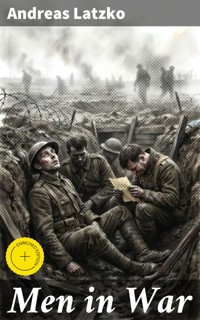
In "Men in War," Andreas Latzko presents a poignant exploration of the psychological and emotional landscapes of soldiers during World War I. Written in a modernist style, the narrative captures the stark realities of warfare, moving beyond mere battlefield heroics to investigate themes of fear, mortality, and the disillusionment of the human spirit. Latzko deftly employs vivid imagery and evocative language, immersing the reader in the harrowing experiences of men grappling with the chaos of combat. The work stands as a significant contribution to war literature, reflecting a post-Victorian shift where the valorization of heroism gives way to a more nuanced understanding of the impacts of war on the individual psyche. Andreas Latzko, an Austrian author and veteran of the war himself, draws upon his personal experiences to lend authenticity and urgency to his narrative. His background as a pacifist and a member of the anti-war movement profoundly informs the thematic core of "Men in War," allowing readers to engage with the moral complexities of conflict. Latzko'Äôs unique perspective provides a critical commentary on the societal glorification of military valor during a period marked by immense suffering. I highly recommend "Men in War" to readers seeking a deep and introspective look at the human costs of conflict. Latzko'Äôs masterful storytelling combines profound philosophical inquiry with raw emotional power, making it an essential read for anyone interested in the complexities of war, trauma, and humanity. This book invites reflection not only on the nature of warfare but also on the shared experiences of those who endure its brutality. In this enriched edition, we have carefully created added value for your reading experience: - A succinct Introduction situates the work's timeless appeal and themes. - The Synopsis outlines the central plot, highlighting key developments without spoiling critical twists. - A detailed Historical Context immerses you in the era's events and influences that shaped the writing. - A thorough Analysis dissects symbols, motifs, and character arcs to unearth underlying meanings. - Reflection questions prompt you to engage personally with the work's messages, connecting them to modern life. - Hand‐picked Memorable Quotes shine a spotlight on moments of literary brilliance. - Interactive footnotes clarify unusual references, historical allusions, and archaic phrases for an effortless, more informed read.
Das E-Book können Sie in Legimi-Apps oder einer beliebigen App lesen, die das folgende Format unterstützen:
Veröffentlichungsjahr: 2019
Ähnliche













Men in War
Table of Contents
Introduction
War tests not only bodies and nations but the fragile moral and emotional structures that allow people to call themselves human.
Men in War is a work by Andreas Latzko, written in the shadow of the First World War and recognized as an early twentieth-century antiwar book. Often approached as a sequence of war-centered episodes rather than a single conventional plot, it belongs to the tradition of literary testimony shaped by modern industrial conflict. Its world is the Eastern Front and the hinterlands that feed it, where military bureaucracy, medical wards, and transit spaces become stages for exhaustion and dread. The publication era matters because the book speaks from inside a conflict still unfolding in memory.
Instead of offering a grand strategic narrative, the book fixes attention on immediate, human-scale experience: men moving through stations, infirmaries, billets, and brief respites, only to be returned to machinery they cannot control. The premise is simple and relentless—war compresses life into waiting, fear, and routine—yet the effect is varied, because each scene refracts the same catastrophe through different temperaments and circumstances. Readers should expect a progression of encounters and impressions that accumulate into a sustained indictment, more emotional than explanatory and more intimate than panoramic.
Latzko’s voice is urgent and morally engaged, with a tone that oscillates between stark observation and fevered intensity. The style is marked by compression and sharp sensory emphasis; it is less concerned with battlefield spectacle than with the psychological afterimages of violence and the strained language of those trying to endure it. The reading experience can feel claustrophobic, even when the action moves through open landscapes, because the book dwells on how war colonizes thought. Its power lies in the way it renders fatigue, anxiety, and compassion as competing claims.
A central theme is the disintegration of individuality under systems designed to process people as units of labor and sacrifice. Men in War attends to how hierarchy, paperwork, and habitual obedience can become as destructive as shells, and how the rhetoric of duty struggles against private knowledge of suffering. It also explores comradeship, not as heroic camaraderie, but as a provisional shelter formed among the wounded and the frightened. The book’s attention to medical spaces underscores war’s continuity with illness: pervasive, contagious in its effects, and capable of redefining normal life.
Another lasting concern is the moral confusion produced when endurance is treated as virtue regardless of cost. The book interrogates what it means to be brave in circumstances where agency is minimal, and it suggests that survival can demand compromises that leave lasting scars. Without reducing soldiers to symbols, it shows how empathy persists in small gestures even when language fails and when institutions reward numbness. The result is an ethical portrait of war as a pressure chamber, revealing both cruelty and tenderness without turning either into consolation.
Men in War still matters because it insists that the real legacy of conflict is carried in damaged bodies, altered minds, and distorted public speech. Contemporary readers, living amid renewed debates about militarism, nationalism, and the management of violence at a distance, can recognize the patterns the book exposes: the normalization of suffering, the seductions of abstraction, and the bureaucratic smoothing-over of human loss. Its refusal to aestheticize destruction, paired with its insistence on looking steadily at consequences, makes it a valuable antidote to romantic narratives. It asks readers to measure policy and pride against the lived reality of those sent to endure them.
Synopsis
Men in War by Andreas Latzko is a short, modernist anti-war book first published during World War I. Rather than building a single continuous plot, it moves through a sequence of linked war scenes and portraits that accumulate into a broader narrative about soldiers’ lives at the front. The book’s opening establishes an atmosphere of exhaustion and disorientation, presenting combat not as heroic adventure but as a grinding condition that distorts time, memory, and moral bearings. From the outset, the emphasis is on what the war does to ordinary men as they try to endure it.
paragraphs with a value of a list of strings. It follows individuals whose identities are defined by rank and duty but whose inner lives keep breaking through official roles. Latzko’s method is to focus on immediate situations—moments of waiting, movement, medical triage, and sudden violence—so that the reader experiences war as a series of pressures rather than a coherent campaign. The narrative flow privileges sensory detail and shifting viewpoints, letting fear, physical pain, and strained camaraderie shape events. The central question becomes how any humane impulse can persist inside a system built on mechanized killing.
paragraphs with a value of a list of strings. As the episodes progress, the book repeatedly contrasts military discipline with the fragility of bodies and nerves. Officers and enlisted men alike are shown confronting not only external danger but also internal breakdown, with reactions ranging from grim stoicism to panic and despair. The recurring presence of wounded soldiers and medical spaces underscores that the front is as much a landscape of injury as of strategy. Latzko avoids explaining war through grand political argument; instead, he presents it as a lived reality in which ideals and slogans dissolve under hunger, fatigue, and relentless threat.
paragraphs with a value of a list of strings. Relationships among the men become a central field of conflict. Moments of solidarity appear, often born from shared vulnerability, yet they are continually tested by hierarchy, suspicion, and the brutal routines that force people to treat one another instrumentally. The book shows how language and ritual can both stabilize and falsify experience: orders, reports, and patriotic clichés compete with what the men actually see and feel. This tension drives many scenes, as characters struggle to reconcile their sense of self with the roles the army demands. The war’s impersonality repeatedly overwhelms private intention.
paragraphs with a value of a list of strings. Latzko’s narrative also emphasizes the randomness and asymmetry of suffering. Men are killed or maimed without clear purpose, and survival often depends on chance rather than merit. The book’s movement between different settings and groups reinforces a sense of a vast machinery in which individuals are interchangeable, even as each suffering body remains stubbornly particular. The episodes accumulate a moral indictment through depiction rather than verdict, making the reader confront the gap between the war’s purported aims and the daily reality of terror and waste. The resulting conflict is less between armies than between life instincts and the logic of war.
paragraphs with a value of a list of strings. Throughout, the prose favors intensity and compression, lingering on the psychological aftereffects of bombardment and the quiet, haunting intervals between catastrophes. The men’s thoughts turn toward home, faith, duty, and guilt, but these frameworks rarely provide stable consolation. Authority figures are not reduced to caricature, yet the institutional imperatives they represent appear incapable of accounting for individual suffering. The book’s structure—episodic, cumulative, and focused on experience—allows it to suggest a broad panorama of wartime existence without claiming to be an official record. It remains anchored in what can be witnessed, felt, and endured.
paragraphs with a value of a list of strings. Without relying on a single climactic revelation, Men in War builds toward a sustained understanding of how war corrodes perception, ethics, and community. Its power lies in the way it makes the front legible as a human environment shaped by fear, injury, and coerced participation, while keeping attention on the men’s attempts to retain dignity and compassion. Published in the midst of World War I, it stands as an early and influential expression of anti-war modernism, resonating beyond its immediate moment by insisting that the true measure of war is found in individual lives damaged or altered, not in abstract victories.
Historical Context
Andreas Latzko’s Men in War (originally published in German as Menschen im Krieg in 1917) emerged from the crisis of the First World War, fought from 1914 to 1918. The conflict mobilized mass conscript armies, relied on industrial firepower, and produced unprecedented casualties and displacement across Europe. The book belongs to a broad wartime literature shaped by trench warfare, artillery bombardment, military medicine, and the bureaucratic organization of violence by modern states. Its publication coincided with intense political polarization in the belligerent countries over war aims, censorship, and the legitimacy of continued fighting.
Latzko was born in 1876 in what was then Austria-Hungary, a multiethnic empire governed from Vienna and Budapest. Before the war he lived as a writer and critic, and he served in the Austro-Hungarian Army after 1914. He experienced the war at the front and later suffered a breakdown, after which he spent time in Switzerland, a neutral state that became a hub for exiles, pacifists, and émigré publishing. These biographical facts matter because Men in War is grounded in the perspective of a participant-observer of the Central Powers’ military world and its human costs.
The Austro-Hungarian war effort unfolded under severe strategic and internal pressures. In 1914 the empire fought Serbia and Russia; by 1915 Italy joined the Entente and opened the Isonzo Front along the Alps. Austro-Hungarian forces also fought on the Eastern Front in Galicia and later in Romania after 1916. Shortages, inflation, and ethnic tensions grew at home as the war continued. The narrative environment of Men in War reflects this imperial military setting: a multinational army, complex front systems, and a society increasingly strained by prolonged total war and the demands of mobilization.
By 1915–1917, European warfare was dominated by trench systems, repeated offensives, and the heavy use of artillery, machine guns, and barbed wire. Poison gas was introduced on a large scale in 1915, adding new forms of injury and psychological terror. Combatants faced shell shock, exhaustion, and the constant presence of mass death, while battlefield medical services struggled with evacuation, triage, and infection. These conditions are verifiable features of the war and form the experiential background for Latzko’s work, which emphasizes the bodily and mental breakdown of soldiers and the grim routines imposed by industrialized combat.
The home fronts of the belligerents were regulated by wartime administrations that managed food supplies, transport, labor, and information. Censorship shaped newspapers, letters, and publishing, and official propaganda promoted sacrifice, discipline, and loyalty to the state. The Central Powers, including Austria-Hungary and Germany, tightened internal controls as shortages worsened. The separation between front and home was bridged by railways and postal systems, yet also widened by the gulf between lived experience and official rhetoric. Men in War was written within this atmosphere of restricted expression and contested narratives, where dissenting depictions of war could be politically sensitive.
Intellectual and political opposition to the war intensified as casualties mounted. Socialist and pacifist currents existed across Europe; in 1915 the Zimmerwald Conference in Switzerland gathered antiwar socialists, and later meetings continued this dissident internationalism. In 1917, revolutionary upheavals in Russia contributed to the collapse of the Eastern Front and reshaped European politics. Within Austria-Hungary, strikes and unrest increased as economic conditions deteriorated. These broader movements provide context for Latzko’s antiwar stance, even when the book focuses primarily on soldiers and officers rather than formal party politics or detailed diplomatic developments.
Switzerland’s neutrality and publishing networks made it an important location for wartime writing that could not easily appear under stricter censorship. Many authors, activists, and refugees circulated through Swiss cities, and books and pamphlets produced there could reach German-speaking readers abroad. Men in War’s 1917 appearance in this environment contributed to its international visibility and controversy. In several places the work encountered censorship or hostile reception because it challenged heroic narratives and emphasized suffering. These facts illuminate why the book is associated with wartime dissent and with a transnational public sphere shaped by exile, neutral presses, and contested moral authority.
As a product of 1917, Men in War reflects an era when faith in quick victory had largely collapsed and societies were confronting the cumulative effects of prolonged combat. The work draws on recognizable features of the First World War—front-line attrition, medical trauma, institutional discipline, and the distance between command structures and individual pain—to critique the machinery of modern war. Without relying on detailed plot outcomes, its historical significance lies in documenting how imperial militaries and industrial methods shaped human experience. In doing so, it aligns with contemporary antiwar literature that questioned nationalism, obedience, and the moral costs of total mobilization.




