


0,49 €
Niedrigster Preis in 30 Tagen: 1,99 €
Niedrigster Preis in 30 Tagen: 1,99 €
Mehr erfahren.
- Herausgeber: Booksell-Verlag
- Kategorie: Poesie und Drama
- Sprache: Englisch
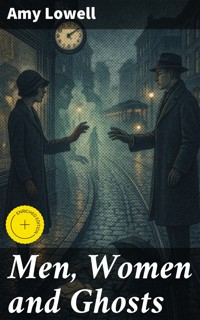
In her groundbreaking collection "Men, Women and Ghosts," Amy Lowell explores the intricacies of human relationships and the ephemeral nature of existence through a modernist lens. Combining vivid imagery with free verse, Lowell's poetry delves into themes of love, identity, and the spectral presence of memory. Each poem serves as a window into the varied emotional landscapes of both men and women, revealing the ghosts of past experiences that haunt the present. Her innovative use of form and language challenges traditional poetic structures, situating her work within the broader context of early 20th-century American literature, where experimentation and personal expression were paramount. Amy Lowell, an influential figure in the Imagist movement, was known for her passionate beliefs in artistic independence and clarity of expression. Her diverse influences, which spanned from classical literature to contemporary arts, informed her work and nurtured her dedication to exploring the complexities of human emotion. Overcoming societal norms of her time, Lowell's voice emerged as a powerful force, championing the rights of women both in literature and life, which undoubtedly shaped her thematic choices in this collection. I highly recommend "Men, Women and Ghosts" to those seeking a profound exploration of the human experience through the lens of modernist poetry. Lowell's ability to capture the essence of her subjects with unflinching honesty offers readers an enriching journey into the heart of emotional truths'—perfect for both poetry aficionados and new readers alike. In this enriched edition, we have carefully created added value for your reading experience: - A succinct Introduction situates the work's timeless appeal and themes. - The Synopsis outlines the central plot, highlighting key developments without spoiling critical twists. - A detailed Historical Context immerses you in the era's events and influences that shaped the writing. - A thorough Analysis dissects symbols, motifs, and character arcs to unearth underlying meanings. - Reflection questions prompt you to engage personally with the work's messages, connecting them to modern life. - Hand‐picked Memorable Quotes shine a spotlight on moments of literary brilliance. - Interactive footnotes clarify unusual references, historical allusions, and archaic phrases for an effortless, more informed read.
Das E-Book können Sie in Legimi-Apps oder einer beliebigen App lesen, die das folgende Format unterstützen:
Veröffentlichungsjahr: 2019
Ähnliche

















Men, Women and Ghosts
Table of Contents
Introduction
Men, Women and Ghosts traces how desire, memory, and history press upon ordinary life until the seen and the unseen mingle, asking what remains of us in the wake of encounter, change, and time’s persistent undertow.
Amy Lowell’s Men, Women and Ghosts is a collection of poems first published in 1916, a moment when modernist experimentation was reshaping Anglophone literature amid the upheavals of the First World War. Written by a leading American poet associated with Imagism, the book belongs to the broader modernist genre of early twentieth-century poetry that favored precision of image, fresh rhythms, and concentrated emotion. Its settings shift fluidly—from city streets and domestic interiors to imagined historical and psychological spaces—so that place functions less as backdrop than as a pressure that shapes voice, mood, and the visual architecture of each poem.
Readers encounter a variegated experience: intimate lyrics, narrative sketches, and dramatic monologues that move between tenderness and ferocity. The style alternates between supple free verse and more patterned measures, attentive to cadence and the tactile weight of words. Lowell’s voice is sensuous yet exacting, favoring concrete images over abstraction while sustaining a reflective, often meditative tone. Rather than offer a single storyline, the collection invites the reader to traverse a gallery of moments where a gesture, an object, or a flash of color anchors feeling. The mood is by turns luminous, restless, and quietly appraising of the world’s textures.
The title indicates the book’s abiding concerns: relations between men and women, and the ghostly residua that experience leaves behind. The poems probe how longing shapes perception, how power and vulnerability circulate through intimacy, and how memory refuses to remain buried. Ghosts, in this sense, are not confined to the supernatural; they are the afterimages of passion, the echoes of history, and the habits that outlive their occasions. Lowell’s attention to embodiment and self-scrutiny underscores questions of agency and constraint, while her modern urban and domestic motifs situate private feeling within broader currents of social expectation and change.
Formally, the collection exemplifies modernist poise: images are presented with crisp edges, sensory details accumulate with deliberate pacing, and line breaks choreograph breath and emphasis. Lowell draws on free verse to mimic the contours of thought, but she also employs patterned sound and occasional rhyme to tighten focus and amplify resonance. Objects—textiles, light, metal, foliage—become catalytic, translating emotion into shape and surface. Refrains and subtle repetitions generate momentum without surrendering nuance. The result is a poetry that feels both immediate and crafted, balancing spontaneity with design so that the reader’s attention is guided but never coerced.
Published during the war years, the book reflects an era alert to rupture, acceleration, and the fragility of inherited forms. Lowell’s association with Imagism situates her within a transatlantic conversation about clarity, concision, and musical freedom in verse. That context matters: the poems’ precision reads as a response to cultural noise, while their openness to multiple speakers and scenes mirrors a world newly conscious of competing perspectives. Without relying on programmatic statements, the collection embodies the period’s search for new idioms capable of honoring individual experience while acknowledging the pressure of public events and the uneasy persistence of the past.
For contemporary readers, Men, Women and Ghosts offers an invitation to attend closely—to how language can hold feeling without flattening it, and to how the past threads itself through present sensation. Its questions remain timely: how do we inhabit desire responsibly, what do we owe our memories, and how do we live among remnants that will not fade? By marrying precise imagery to supple cadence, Lowell crafts a durable exploration of intimacy and perception. The collection rewards rereading, not with puzzles for their own sake, but with accumulating clarity, granting the experience of recognition that is neither sentimental nor austere but exact.
Synopsis (Selection)
Published in 1916, Men, Women and Ghosts is Amy Lowell’s third major collection, bringing together imagist clarity, musical free verse, and experimental polyphonic prose. The book surveys the textures of modern life—urban streets, cultivated gardens, parlors, battlefront reports, and remembered rooms—while organizing its poems around the title’s triad of human presence and lingering aftermaths. Across these pieces, concrete images carry feeling: colors, fabrics, weather, light, and sound register private desire, social custom, and historical shock. The sequence proceeds from intimate observation to public disturbance and then to spectral reverberation, maintaining a lucid, descriptive tone that favors precision over commentary or explicit argument.
The opening poems establish the voice through concentrated moments of looking and listening. City thoroughfares at night, windowed interiors, and sudden separations are rendered as arrangements of light, shadow, and motion. Short, sharply drawn lyrics chart fluctuating distances between people: letters written and withheld, footsteps retreating, a door shutting on lingering scent. These pages foreground tactility and cadence, letting objects suggest emotional temperature without overt declaration. As the speaker moves between streets and rooms, an attention to surfaces—stone, glass, fabric—becomes a way to register inward change. The book’s early movement thus posits perception itself as a narrative, a progression of scenes that accumulate meaning.
A central early sequence turns to daylight and civic bustle. In successive panels, a spring morning unfolds through markets, benches, shopfronts, and tramcars, each vignette quick with color and small transactions. Written in Lowell’s polyphonic prose, the piece braids sensory notations, shifting tempos, and recurring motifs to create momentum without conventional plot. The effect is mosaic: brief fragments align into a day’s arc, from chilly start to warmer noon, from solitude to passing sociability. The sequence demonstrates the collection’s method of building larger coherence out of discrete particulars, while anchoring the reader in a recognizably modern city whose liveliness is measured through attention.
From outdoor brightness the book returns to formal gardens and domestic ornament, where portraits of women consider the interplay between appearance and feeling. The long poem Patterns sets a figure in a meticulously designed landscape, her brocaded dress and the clipped paths echoing each other in motif and restraint. As she measures out her walk, desire presses against etiquette, and news from beyond the garden reshapes the pattern’s meaning. The poem marks a turn from private arrangement to public contingency, not by argument but by juxtaposing texture and event. Its controlled repetitions emphasize how social design both composes and confines individual impulse.
Subsequent pieces broaden the lens to the disruptions of war. The Bombardment, one of the collection’s most formally dynamic works, assembles multiple voices and street-level details to render a city under fire. Fragments of speech, sounds, and sights interrupt one another, creating an aural map of shock without narrating outcomes. Elsewhere, shorter poems record absences and anticipations—telegrams, uniforms, trains pulling away—showing how public crises infiltrate private routines. The collection maintains its emphasis on exact observation, allowing the pressure of events to be sensed through altered rhythms and images rather than through direct exposition, and situating individual perception within a wider historical disturbance.
Alongside these public scenes, the book offers portraits of men in motion and at work: artisans bent over tasks, travelers charting routes, soldiers drilled into patterns of step and stance. Their energies are often described through tools, materials, and measured beats, giving masculinity a vocabulary of cadence and craft. These depictions counterbalance earlier interiors by emphasizing outward action and habitual gesture. Yet the poems refrain from judgment, presenting the rhythms of vocation and duty as ways of being in time. The juxtaposition of genders becomes structural rather than polemical, adding another dimension to the collection’s study of how lives take shape.
The titular ghosts emerge less as apparitions than as persistences: memories that animate objects, histories that inhabit rooms, and artworks that speak across eras. In New England houses and European galleries alike, the past is sensed as an atmospheric pressure—scents that return, clocks that seem to listen, stairways that creak into meaning. Occasional spectral visitations underscore how absence can be a kind of presence, but the emphasis remains on ordinary settings haunted by what they have witnessed. These poems extend the book’s method of precise noticing to temporal layers, making time itself another texture to be felt and described.
As the sequence arcs toward its close, the poems quiet into evening tones—winter streets, dim shorelines, interiors after conversation. Motifs recur transformed: a dress becomes a memory, a streetlamp a star, a footstep an echo. The diction grows sparer, the measures steadier, as if attending to residue rather than event. Without imposing a thesis or final resolution, the collection circles back to the opening’s rooms and avenues, now charged by war’s interruptions and by the accrued presences of memory. The concluding pieces suggest continuity instead of closure, registering how perception adapts and how forms hold after what animated them has passed.
Taken together, Men, Women and Ghosts proposes that attention—precise, patient, sensuous—can disclose both the shape of experience and the pressures that deform it. The arrangement tracks a movement from singular moments to shared upheavals to lingering aftereffects, while maintaining a consistent commitment to exact image and musical line. Rather than argue, the book demonstrates: that pattern and desire coexist, that public events enter private rooms, and that the past inhabits the present. Its core message is not prescriptive but descriptive, inviting readers to recognize modern life’s textures and continuities in the carefully observed details through which the collection proceeds.
Historical Context
Published in Boston and New York by Houghton Mifflin in 1916, Men, Women and Ghosts emerges from the United States during the late Progressive Era, with the poet writing from a New England vantage, especially Boston and its environs. The poems’ settings range widely: intimate Boston interiors and streets, imagined European gardens and salons, and contemporary wartime scenes in Flanders and France. The temporal frame spans the immediate years of the First World War (1914–1916) while also invoking earlier centuries through historical tableaux and artifacts. This geographic and temporal breadth allows the book to juxtapose American urban modernity with the convulsions of European conflict and with ancestral European cultures that haunt the present.
The First World War is the collection’s dominant historical horizon. Hostilities began in July–August 1914 after the assassination of Archduke Franz Ferdinand (28 June 1914) and the subsequent cascade of mobilizations and declarations of war among the Central and Allied Powers. The Western Front, stretching from the North Sea through Flanders and northern France, produced industrial-scale casualties at battles such as Ypres (1914–1915) and the Somme (1916). The United States, led by President Woodrow Wilson, remained officially neutral through 1916. The book registers this global crisis: poems invoke Flanders’ killing fields and the psychic shock of modern artillery, filtering distant events through American consciousness and personal bereavement to portray the war’s intrusion into private life.
Civilian bombardment and the destruction of cultural heritage—especially in France and Belgium—form a specific wartime backdrop. German artillery set fire to Reims Cathedral on 19 September 1914, with several hundred shells igniting the roof and damaging sculptures and stained glass; images of the wounded cathedral circulated worldwide. Naval and coastal attacks struck civilians in Britain on 16 December 1914, when German battlecruisers shelled Scarborough, Hartlepool, and Whitby, killing 137 people and injuring hundreds. The first Zeppelin raid on London on 31 May 1915 killed 7 and injured dozens. The book’s evocation of shattering blasts, fractured urban soundscapes, and endangered art mirrors these events, rendering the home front’s terror and the symbolic assault on European civilization.
American neutrality and the Preparedness Movement shaped U.S. public life in 1914–1916. Wilson’s proclamation of neutrality (19 August 1914) conflicted with mounting outrage after the RMS Lusitania was torpedoed on 7 May 1915, killing 1,198 passengers, including 128 Americans. Business ties and humanitarian relief deepened engagement with Allied suffering, while large Preparedness parades—such as New York City’s on 27 May 1916 with over 100,000 participants—argued for military strengthening. Congress passed the National Defense Act on 3 June 1916, expanding the Army and National Guard. The collection’s anxious, anticipatory atmosphere and its gravitation to European scenes reflect an America poised between isolation and intervention, attentive to casualty lists and cultural losses abroad.
Women’s legal and social status in the 1910s provides a second major framework. Massachusetts held a women’s suffrage referendum on 2 November 1915, which failed, reflecting persistent resistance even in reform-minded New England; national enfranchisement would not arrive until the Nineteenth Amendment (1920). Activists such as Carrie Chapman Catt reorganized NAWSA in 1915, while Alice Paul and allies formed the National Woman’s Party in 1916. Dress and conduct codes, reinforced by corsetry and elaborate social rituals, constrained women across classes. The book’s portrayals of tightly patterned garments, regimented gardens, and delayed or thwarted unions dramatize these constraints. Domestic love lyrics addressed to women also register the period’s silence around same-sex intimacy and the pressures of moral surveillance, especially in Boston.
Urbanization and new technologies supply the collection’s American social texture. Boston’s population grew from 670,585 (1910) to 748,060 (1920), part of a national shift culminating in the 1920 census, when the U.S. became majority urban. Electric lighting, telephones, and subways were transforming city tempo; Boston opened the first U.S. subway in 1897. Motor taxicabs, introduced in New York in 1907 and spreading quickly, symbolized speed and anonymity by the mid-1910s. The collection’s depictions of nighttime streets, swift conveyances, and disorienting distances—most famously in a poem that centers a taxi ride—encode the exhilaration and estrangement of modern metropolitan life, staging how technology both connects and isolates individuals within dense social networks.
European cultural artifacts, especially from German-speaking regions, recur as historical emblems. Saxon porcelain, pioneered at Meissen in 1710 under Augustus the Strong and chemist J. F. Böttger, later refined by modeller J. J. Kändler, epitomized eighteenth-century courtly delicacy. Saxony’s political fortunes, buffeted by the Seven Years’ War (1756–1763), haunt such objects with a record of upheaval. During 1914–1916, German identity in the Anglophone world became fraught, even as collectors and museums in Boston and New York prized these artifacts. By invoking figurines and Rococo interiors while war ravages Belgium and France—where over a million Belgians fled as refugees in 1914—the book contrasts fragile European elegance with the continent’s shattering, echoing transatlantic relief efforts led by Herbert Hoover’s Commission for Relief in Belgium.
As social and political critique, the book indicts militarism’s assault on civilians and culture, exposing how total war penetrates bedrooms, streets, and memory. It scrutinizes classed and gendered codes that script behavior—clothing, etiquette, property, and lineage—and shows how such patterns suppress desire, agency, and grief. The wartime American stance of watchful neutrality is portrayed as morally precarious, a posture that risks aestheticizing catastrophe while others bleed. Urban scenes register the modern city’s inequities: mobility and light for some, isolation and precarious labor for others. By entwining private losses with public events, the work reveals the era’s fundamental tensions—empire and democracy, liberty and surveillance, intimacy and social constraint.




