


1,99 €
Mehr erfahren.
- Herausgeber: Booksell-Verlag
- Kategorie: Poesie und Drama
- Sprache: Englisch
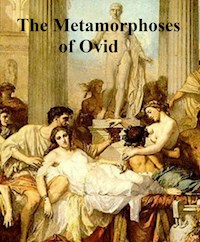
In Ovid's "Metamorphoses," we encounter a masterful tapestry of mythological tales intricately woven into a single narrative that explores transformation in its myriad forms. Comprising fifteen books, this epic poem transcends mere storytelling, employing a rich blend of elegiac couplets and vivid imagery to illustrate the fluidity of identity and the omnipresence of change. Each transformation'Äîfrom the tragic metamorphosis of Daphne into laurel and Narcissus'Äô self-obsession to the fantastical tales of gods and mortals'Äîserves to interrogate themes of love, power, and the eternal human experience within the broader context of Roman literature and myth. Ovid's innovative structure single-handedly influenced subsequent literary traditions, merging classic mythology with a distinctly personal voice that resonates through the ages. Publius Ovidius Naso, known simply as Ovid, was a poet whose life and works mirrored the tumultuous transition of Rome from a Republic to an Empire. Born in 43 BCE, his education in rhetoric and poetry allowed him to capture the cultural zeitgeist and examine the human condition through an artistic lens. His exile to Tomis on the Black Sea in 8 CE, often attributed to political missteps or perhaps his controversial themes, intensified his exploration of transformation'Äîas he himself was transformed from a celebrated poet to an isolated figure. "Metamorphoses" invites readers to delve deep into the transformative power of narrative itself. Its captivating blend of allegory, myth, and human emotion not only entertains but also provokes critical reflection on our own identities. Scholars and enthusiasts of literature alike will find Ovid'Äôs work essential, as it transcends time and continues to inspire modern interpretations and adaptations across various art forms. In this enriched edition, we have carefully created added value for your reading experience: - A succinct Introduction situates the work's timeless appeal and themes. - The Synopsis outlines the central plot, highlighting key developments without spoiling critical twists. - A detailed Historical Context immerses you in the era's events and influences that shaped the writing. - An Author Biography reveals milestones in the author's life, illuminating the personal insights behind the text. - A thorough Analysis dissects symbols, motifs, and character arcs to unearth underlying meanings. - Reflection questions prompt you to engage personally with the work's messages, connecting them to modern life. - Hand‐picked Memorable Quotes shine a spotlight on moments of literary brilliance. - Interactive footnotes clarify unusual references, historical allusions, and archaic phrases for an effortless, more informed read.
Das E-Book können Sie in Legimi-Apps oder einer beliebigen App lesen, die das folgende Format unterstützen:
Veröffentlichungsjahr: 2023
Ähnliche



Metamorphoses
Table of Contents
Introduction
A world where gods, mortals, animals, and landscapes can shift their shapes at any moment is also a world where desire, power, and suffering leave visible marks on bodies and on history.
Ovid’s Metamorphoses has endured as a classic because it offers a sweeping imaginative architecture for understanding change—personal, political, natural, and artistic—while telling stories that remain intensely human. Its ingenuity lies not only in the inventiveness of its tales but in the way it continually reflects on how stories are made, retold, and transformed. The poem became a reservoir of myth for later cultures, providing a shared vocabulary of figures and episodes that writers and artists could adapt to new contexts. Its influence is visible across centuries of European literature and visual art.
The author, Publius Ovidius Naso (Ovid), was a Roman poet active during the Augustan age. Metamorphoses is a Latin narrative poem, composed in the early years of the first century CE, that gathers and reshapes a vast array of Greco-Roman myths into a single flowing sequence. It is not a handbook of religion, nor a sober chronicle, but a work of poetic art that uses myth to explore the instability of form and fortune. Ovid’s signature is his wit, narrative speed, and psychological sharpness, even when the material is ancient and supernatural.
The central premise is simple and expansive: the poem traces a chain of transformations, moving from the origins of the world to later mythic times, with one change leading into the next. Gods intervene, passions flare, rivalries erupt, and boundaries between species and states of being repeatedly blur. Metamorphosis in Ovid is not merely a trick of plot; it is the principle that organizes the whole book. The poem invites readers to consider how identity can be altered by violence, love, punishment, or rescue, and how nature itself can become a record of what has happened.
Part of the poem’s classic status comes from its form. Written in dactylic hexameter, it adopts the meter of epic while refusing to be a single heroic saga. Instead it offers a mosaic of interlinked narratives, shifting in scale from the cosmic to the intimate. Ovid connects episodes through thematic echoes and narrative handoffs, creating momentum without relying on one protagonist. The effect is a literary river: stories flow into one another, sometimes with surprising turns, yet with a persistent sense that the world’s continuity is built out of change rather than stability.
Metamorphoses also endures because it confronts the ambivalence of the divine and the vulnerability of the human. The gods can be creators, protectors, and sources of beauty, but they can also be capricious, jealous, or punitive. Mortals, meanwhile, may show courage, devotion, ingenuity, or cruelty, often caught in conflicts beyond their control. Without revealing outcomes, it is enough to say that transformation can be blessing or catastrophe, sometimes both at once. This moral complexity—refusing neat consolations—keeps the poem from becoming merely decorative mythography.
The poem’s thematic range is broad: love and pursuit, pride and retribution, artistic ambition, family bonds, and the costs of power. Ovid repeatedly explores how speech and silence, persuasion and coercion, shape what happens to bodies and reputations. He also probes the fragility of boundaries—between human and animal, living and nonliving, civilized and wild—and in doing so makes transformation feel less like fantasy than like an extreme version of experiences readers recognize: the way grief can remake a life, or fame can harden a person into an image.
Its influence on later writers is one of the clearest reasons it holds classic status. In the Middle Ages, the Renaissance, and beyond, Metamorphoses served as a major conduit through which classical myth was read, reimagined, and repurposed. Many later poets and dramatists drew on its episodes and its narrative strategies, and countless painters and sculptors found in it scenes that invited visual translation. The work’s very structure—an anthology threaded into a continuous poem—encouraged selective adaptation, making it unusually fertile for retelling in new genres and new languages.
Yet the poem is not just a storehouse of plots; it is also a meditation on art. Ovid is keenly aware that storytelling itself is a form of transformation, turning events into patterns and bodies into symbols. Characters become famous through narration; places become meaningful through the tales attached to them. The poem’s movement across time and space suggests that cultural memory is made by repetition with variation. In that sense, Metamorphoses models what later literature often does: it inherits earlier materials and changes them, making novelty out of tradition.
Reading Metamorphoses today also means attending to its Roman context. Ovid writes from within an imperial culture that valued order and continuity, yet his poem revels in instability and reversal. Without needing to map each episode onto contemporary events, a reader can still sense the tension between authority and freedom, between official narratives and the unruly energies of myth. Ovid’s artistry lies in his ability to keep the poem open-ended in feeling, even as it marches through a vast timeline. The result is a work that can be read for pleasure, pattern, or critique.
Because the poem is expansive, it welcomes different kinds of readers. One can follow it as a succession of gripping tales, or pause to notice recurring motifs: the ethics of looking, the unpredictability of desire, the way nature can become a witness. The transitions between stories are part of its charm, teaching readers to accept surprise as a principle. At the same time, the poem rewards rereading, since earlier episodes often cast shadows forward and later episodes reshape how earlier ones are understood. Its coherence lies less in plot than in its persistent preoccupation with change.
Metamorphoses remains compelling because its central concerns have not faded. Modern life is saturated with transformations—technological, social, ecological, and personal—and Ovid’s poem offers a language for thinking about what it means to become someone else, or to watch the world you knew alter around you. Its myths can be approached as stories, as symbols, or as reflections on power and vulnerability, without requiring belief in the gods it portrays. That flexibility, paired with Ovid’s narrative brilliance, explains why the poem still invites readers to return, and why it continues to generate new interpretations and new art.
Synopsis
Ovid’s Metamorphoses is a Latin narrative poem, composed in fifteen books and structured as a continuous sequence of myths connected by the theme of change. It opens with the poet’s aim to recount transformations from the world’s beginnings to his own era, framing mythic episodes as parts of a single, flowing history. The poem’s organizing question is how divine power, desire, rivalry, and chance reshape bodies, identities, and societies. Rather than a single protagonist, it offers a shifting cast whose stories overlap through genealogies, shared locations, and thematic echoes, creating an expansive mythic panorama.
paragraphs within that opening move quickly from cosmogony to early humanity, presenting creation, ordering of elements, and the emergence of gods and mortals. The narrative explores how stability is repeatedly challenged by violence, hubris, and moral breakdown, and how the gods respond through interventions that can seem protective, punitive, or arbitrary. Early episodes introduce a pattern that will recur: mortals test boundaries, deities enforce them, and transformation becomes a visible record of conflict. Alongside grand beginnings, Ovid balances intimate personal dramas, setting a tone in which cosmic scope and individual suffering coexist.
The poem then turns to a series of divine pursuits and rivalries that foreground desire as a destabilizing force. Gods and mortals collide in stories where attraction, fear, and power imbalance drive sudden reversals of fortune. Transformations frequently become a way to escape violation, to memorialize grief, or to mark punishment, raising questions about agency and justice in a world governed by capricious higher powers. Ovid’s narrative method links episodes through brief transitions and shared motifs, so that one metamorphosis leads naturally to the next, emphasizing continuity amid constant change.
As the sequence develops, Metamorphoses broadens from individual encounters to family and civic consequences. Tales of kinship and lineage show how transformations reverberate across generations, shaping reputations and destinies. The poem juxtaposes artistry and violence, devotion and betrayal, often staging disputes between gods and mortals over honor, skill, or piety. Stories can pivot from domestic spaces to public arenas, revealing how personal actions become communal legends. Throughout, transformation functions as both plot engine and interpretive lens, suggesting that identity is mutable and memory can be embedded in the natural world.
Midway through the work, Ovid increasingly centers on heroes and heroic enterprises, integrating well-known mythic cycles while preserving his emphasis on change. Quests, contests, and confrontations with monsters or formidable adversaries appear alongside episodes of love and loss. The heroic material is not presented as a straightforward celebration; it is repeatedly complicated by divine interference and the costs borne by companions, families, and bystanders. Metamorphosis remains the poem’s connective tissue, turning climactic moments into lasting signs and folding heroic deeds into the larger pattern of the world’s instability.
The narrative continues to interweave metamorphosis with reflections on storytelling and representation. Several episodes foreground singers, artisans, or narrators whose performances introduce embedded tales, creating layers of perspective. These internal narrations often revisit similar themes—desire, punishment, rivalry, and mourning—while shifting tone from tragic to playful or ironic. Ovid uses this structure to keep the poem in motion, connecting disparate myths through rhetorical bridges and thematic mirrors. The reader is invited to compare versions, motives, and outcomes without being offered a single moral framework.
As the poem proceeds, myths associated with specific places and origins become prominent, linking transformations to the founding of customs, landmarks, and communities. Ovid treats the natural and cultural landscape as a repository of earlier lives, where rivers, trees, stones, and stars can preserve traces of human and divine histories. This approach gives the work an almost encyclopedic reach, while maintaining narrative momentum through constant variety. The tension between local, intimate stories and broader historical movement persists, suggesting that collective memory is built from innumerable personal upheavals.
In the later books, Metamorphoses draws closer to the legendary past that precedes recorded history, incorporating traditions that lead toward the rise of Rome. The poem’s attention shifts toward political and civic horizons, while still returning to the familiar dynamics of passion, rivalry, and divine decree. Transformation remains central as a way to mark transitions between eras and to connect mythic time with the author’s present. Ovid’s technique keeps the narrative open-ended and associative, using genealogy and succession to create a sense of forward movement without a single linear plot.
Across its full span, Metamorphoses presents change as the governing principle of nature and of human experience, where permanence is rare and even the gods’ actions can be unpredictable. The poem’s enduring significance lies in how it binds a vast body of Greco-Roman myth into a continuous story-world, highlighting the fragility of identity and the power of narrative to preserve what is lost. Without reducing its episodes to simple lessons, it repeatedly asks how suffering, desire, and ambition shape lives, and how art turns transformation into lasting cultural memory.
Historical Context
Metamorphoses was composed in Rome in the late reign of Augustus (27 BCE–14 CE), when the city had become the administrative center of a vast Mediterranean empire. The dominant institutions shaping public life were the imperial household, the Senate (still prestigious but politically constrained), and traditional religious colleges that managed state cult. Latin literature flourished under elite patronage and within a competitive urban book culture. Ovid wrote for readers formed by rhetorical education and familiar with Greek myth. His poem’s sweep from cosmic beginnings to Roman times is framed by this Augustan world, where history, religion, and political authority were closely linked.
Publius Ovidius Naso (Ovid) was born in 43 BCE at Sulmo in central Italy, entered Rome as a young man, and trained in rhetoric, the standard route for an ambitious equestrian. He belonged to the generation that came of age after the civil wars, when Octavian’s victory reshaped Roman politics. Ovid pursued literary fame rather than a traditional public career, publishing love elegies and other works that made him a prominent figure in Rome’s literary circles. Metamorphoses, written in dactylic hexameter, draws on Greek and Roman myth but is deeply colored by the author’s urban, elite perspective and his familiarity with Augustan cultural politics.
The most direct political backdrop is the series of Roman civil wars (approximately 49–31 BCE) and their aftermath, which left Romans wary of instability and receptive to promises of order. Augustus presented his regime as a restoration of peace and traditional values, while in practice concentrating power in one ruler. Metamorphoses does not narrate contemporary battles, but its recurring themes of violent change, the fragility of human fortune, and the transformation of communities echo a society that had recently watched institutions and allegiances shift rapidly. The poem’s interest in beginnings, endings, and repeated re-foundings resonates with an age that reimagined Rome’s history to justify a new political settlement.
Augustus invested heavily in public building and urban renewal, reshaping daily life in Rome and projecting an image of permanence. Major projects included the Forum of Augustus and the Temple of Mars Ultor (dedicated 2 BCE), along with repairs to temples and infrastructure. Such monumentalization encouraged citizens to interpret the city as a moral and historical text. Ovid’s poem repeatedly links myth to places and cults known in Italy, reflecting an environment where landscape and architecture were used to anchor collective memory. The poem’s interest in origins—of rituals, names, and monuments—fits an era that sought to stabilize meaning through stone, ceremony, and controlled narratives about the past.
Religion in the Augustan period combined traditional civic cult with renewed emphasis on ancestral rites. Augustus held key priestly roles (including pontifex maximus from 12 BCE) and promoted practices that presented Rome as favored by the gods. Metamorphoses is filled with divine interventions, punishments, and foundations of cult; it also shows gods acting with caprice, desire, and rivalry. That portrayal reflects long-standing mythic tradition, yet it can sit uneasily beside an official program that highlighted piety and moral clarity. By foregrounding the unpredictable and often harsh behavior of deities, Ovid’s poem implicitly complicates attempts to present religion as a straightforward instrument of civic renewal and political legitimacy.
Literary culture under Augustus was shaped by patronage networks and by the prestige of earlier poets, especially Virgil and Horace. The Aeneid (published posthumously around 19 BCE) offered a national epic that connected Rome’s destiny to divine plan and Augustan leadership. Metamorphoses engages the epic tradition but also diverges from it: rather than a single hero and teleological mission, it presents a chain of stories linked by transformation. This formal choice matters historically because it contrasts with contemporary efforts to streamline Roman history toward a culminating moment of Augustan order. Ovid participates in high cultural forms while resisting a single authoritative narrative.
Ovid’s career unfolded alongside Augustus’ moral legislation, notably laws on marriage and adultery (including legislation in 18 BCE and 9 CE) intended to encourage legitimate births among the elite and regulate sexual behavior. These measures became part of a broader program that publicly associated private conduct with public stability. Ovid’s earlier works, especially the Ars Amatoria, were later implicated in his downfall, but even Metamorphoses bears the imprint of an environment intensely concerned with sexuality, marriage, and social boundaries. The poem’s frequent depictions of pursuit, coercion, and shifting identities do not simply mirror policy debates, but they do speak to the era’s anxieties about desire and control.
The poem’s composition was also shaped by the expanding reach of Roman power and the cultural consequences of empire. By the late first century BCE, Rome had incorporated Greece, Asia Minor, Syria, Egypt, and much of the western Mediterranean into a connected imperial system. This brought wealth to Italy and created a cosmopolitan elite comfortable with Greek language and art. Metamorphoses draws extensively on Greek myth and Hellenistic storytelling techniques, reflecting Rome’s longstanding appropriation and adaptation of Greek culture. At the same time, the poem’s movement toward Italy and Rome reflects the imperial habit of collecting diverse traditions into a single overarching framework.
Economic and social inequality in Rome provided another context. The capital attracted migrants, freedpersons, and provincial visitors, while elite households depended on enslaved labor in domestic service and on large estates. Public entertainment, patron-client ties, and the distribution of grain were central to urban life. Metamorphoses is not a social-realist portrait of Rome, but its stories repeatedly explore power asymmetries—between gods and mortals, rulers and subjects, men and women—within a culture accustomed to hierarchy. The stark consequences that follow from unequal power in the myths can be read alongside the lived experience of Roman stratification, even when the settings are fantastical or archaic.
Education and communication practices also influenced how Ovid wrote and how audiences read. Elite boys trained in rhetoric through exercises that emphasized persuasive speech, mythic exempla, and imaginative reworking of inherited material. This rhetorical schooling encouraged variation, ingenuity, and argument from multiple perspectives. Metamorphoses displays those skills through rapid shifts in voice, embedded narratives, and inventive reframing of familiar myths. The work’s intertextual play assumes readers who recognized standard versions and appreciated deviation. Historically, this reflects a late Republican and early imperial literary environment in which authors competed within a shared classical canon while demonstrating mastery through transformation—an aesthetic parallel to the poem’s thematic focus.
Rome’s calendar of festivals and public spectacles, including theatrical performances and games, was another shaping force. Mythological narratives were common in stage traditions and visual art, and audiences encountered gods and heroes through performance as well as reading. Ovid’s vivid set pieces, dramatic monologues, and sharp reversals reflect a sensibility attuned to spectacle and to the performative dimensions of storytelling. Although Metamorphoses is a written epic, its style often feels close to scenes that could be imagined on a stage or in a painted panel. This connection matters historically because Augustus also regulated and sponsored public culture, using festivals and games to promote communal identity.
The Augustan age was a period of administrative consolidation, with provinces governed by imperial appointees and with military power concentrated under the princeps. Although Rome still used republican language, decision-making increasingly depended on imperial favor. Metamorphoses repeatedly depicts assemblies of gods, verdicts, and punishments that are issued from above, often without appeal. These divine bureaucracies are mythic, but they echo the experience of living under a system where authority was becoming more centralized. The poem does not offer a direct political allegory, yet its fascination with the mechanisms of judgment and the vulnerability of individuals to higher powers is historically resonant.
Ovid’s own relationship to imperial authority became explicit with his exile. In 8 CE Augustus banished him to Tomis (modern Constanța on the Black Sea), where Ovid spent the rest of his life, dying around 17 or 18 CE. Ovid attributed the exile to “carmen et error” (“a poem and a mistake”), with the poem generally understood to be the Ars Amatoria, though the “error” remains unclear in surviving evidence. This event is directly connected to Metamorphoses because Ovid states in his later poetry that the epic was unfinished when he was sent away. The exile underlines the real limits of artistic freedom in Augustan Rome.
Metamorphoses also reflects Rome’s evolving relationship to time and history. Augustus encouraged accounts that linked Rome’s rise to divine favor and to a providential trajectory, a tendency visible in public monuments and in state-sponsored cultural messaging. Ovid’s poem organizes mythic time in a continuous sequence, yet it emphasizes recurrence and instability as much as progress. Transformations disrupt identities and blur boundaries between past and present, human and nonhuman. This structure can be read as a counterpoint to official narratives that sought a clear culmination in the Augustan settlement. Historically, the poem participates in contemporary debates—implicit rather than programmatic—about what it meant to claim a coherent national story.
Cultural production in this period was materially supported by technologies of writing and circulation. Papyrus rolls, ink, and a professional book trade made texts available to an expanding literate elite in Rome and Italy. Recitations in salons and public venues helped launch new works, and literary reputations were built through performance and copying. Metamorphoses, with its episodic design, suited both extended reading and selective excerpting, which may have aided its spread. These conditions matter for historical context because they show how Ovid could address a broad, interconnected audience within the empire, and how literary fashion and competition shaped the poem’s polished, self-conscious artistry.
The poem’s sustained attention to sexual violence and coercion has a historical dimension beyond mythic inheritance. Roman society was patriarchal, and legal and social norms granted substantial authority to male heads of household, while enslaved people lacked legal autonomy. Myths of gods pursuing mortals were traditional, but Ovid’s narrations often linger on the victim’s fear, the imbalance of power, and the irreversible consequences. Without reducing the poem to a single message, this emphasis reflects the realities of domination familiar to Roman audiences and the moral contradictions within a culture that praised virtue while normalizing harsh hierarchies. In an age of moral legislation, such stories could sharpen awareness of the gap between ideals and lived power.
Metamorphoses’ frequent interest in boundaries—between human and animal, culture and nature, city and wilderness—also connects to Roman expansion and colonization. Roman rule brought roads, veteran settlements, and administrative divisions that reorganized landscapes and peoples, while also provoking resistance and cultural negotiation in many regions. Ovid’s stories of new forms emerging from violence, displacement, or divine decree resonate with imperial experiences of reclassification and control. At the same time, the poem’s variety preserves the strangeness of local myths and cult origins, suggesting how Rome’s imperial culture simultaneously absorbed and transformed the traditions it encountered. This mirrors the broader historical process of Romanization alongside persistent diversity within the empire’s reach and memory systems in Italy and beyond, among elites too, while some retained local identities within a framework of Roman citizenship expansion that would continue later under the emperors, but was already significant through grants and municipal integration in Italy after earlier wars and reforms before Augustus, affecting how readers thought about belonging and change in Ovid’s day. The poem’s fluid identities can be situated within these shifting definitions of community and status, even if it does not narrate those policies directly, and it aligns with a world accustomed to re-labeling peoples and places under Roman rule, through maps, census practices, and legal categories established by magistrates and imperial administrators that touched everyday life in subtle ways and provided a background for thinking about transformation as a constant condition rather than an exception in the imperial Mediterranean world at the turn of the era.
Author Biography
Introduction
Publius Ovidius Naso, known in English as Ovid, was a Roman poet whose work became central to the literary culture of the early Roman Empire. Born in 43 BCE at Sulmo (modern Sulmona) in central Italy, he wrote in Latin and achieved early prominence in Rome for poetry marked by wit, technical mastery, and a vivid interest in desire, transformation, and myth. His most influential writings include the Metamorphoses, a sweeping mythological epic, and the Ars Amatoria, a didactic poem on love. Late in life he was exiled by the emperor Augustus, a disruption that shaped his final books and later reputation.
Education and Literary Influences
Ovid was born into an equestrian (knightly) family and, like many young men of his rank, was prepared for public life. Ancient biographical traditions report that he was educated in rhetoric at Rome, studying under well-known teachers of the period, and that he briefly held minor public posts before turning away from an official career. His poetry reflects familiarity with rhetorical techniques prized in elite education, including argument, rapid shifts of tone, and polished verbal display. In literary terms, Ovid inherited the achievements of earlier Latin poets, particularly the elegiac tradition cultivated in Rome, and he engaged closely with the conventions and expectations of Augustan literature.
Literary Career
Ovid first made his name in Latin love elegy, a genre that combined personal voice with sophisticated literary artifice. His Amores, a collection of short elegiac poems, helped establish him as a leading poet in Rome by showcasing a playful, self-aware stance and a refined command of meter and narrative persona. Around the same period he composed the Heroides, a series of verse letters written in the voices of mythological heroines addressing absent lovers; these poems display his ability to dramatize character and to reinterpret well-known stories through intimate monologue. Together these early works positioned him within the circle of prominent Augustan poets while also marking him as unusually inventive in tone and perspective.
He expanded his reach with the Ars Amatoria, a didactic poem that treats romantic pursuit with ironic elegance and practical detail. Often paired with it are works associated with the same thematic terrain, including the Remedia Amoris, which offers counsel on escaping love, and the Medicamina Faciei Femineae, a brief didactic poem on women’s cosmetics that survives only in part. These texts reveal a poet adept at blending instruction with humor, urban observation, and metapoetic commentary. They also contributed to later controversies about the social implications of his writing, especially under the moralizing public program of Augustus, even though the poems operate within recognizable literary conventions.
Ovid’s greatest single achievement is commonly regarded as the Metamorphoses, a long narrative poem in hexameters that strings together myths of transformation from the creation of the world to the deification of Julius Caesar. Rather than a single linear plot, the work advances through a sequence of interlaced tales, linked by thematic echoes and by Ovid’s distinctive narrative transitions. Its style combines swift storytelling, psychological vividness, and frequent shifts between pathos, comedy, and irony. In the ancient world and beyond, the poem became a major conduit through which Greco-Roman mythology was read, remembered, and reimagined.
In addition to the Metamorphoses, Ovid undertook the Fasti, an elegiac poem organized around the Roman calendar, its festivals, and associated myths and antiquarian lore. Only part of the project survives, corresponding to the first six months of the year, and the incomplete state of the poem is often connected with the disruption of his exile. The Fasti demonstrates a different aspect of Ovid’s artistry: his ability to combine learned research into Roman religion and customs with narrative charm, etiological storytelling, and reflections on contemporary Rome. Its mix of scholarship and poetic invention made it an important, if complex, witness to Roman cultural memory under Augustus.
Beliefs and Advocacy
Ovid is not known as a political activist in the modern sense, and much of what can be said about his convictions must be inferred carefully from texts designed for literary effect. What is clearly documented is his public stance as a poet who prized artful play, erotic themes, and imaginative freedom within established genres. His love elegies and didactic works on romance often treat desire as a powerful social force and explore the strategies, misunderstandings, and performances that surround it in urban life. These poems intersected uneasily with Augustan moral legislation and propaganda that promoted traditional family values; Ovid’s work, even when ironic, could be read as complicating official ideals.
The most consequential public fact about Ovid’s life is his exile, announced by Augustus in 8 CE. Ovid himself attributes the punishment to a combination of a poem and an error, but he does not clearly identify the personal mistake; modern accounts therefore must stop short of certainty about the cause. The exile carried him far from Rome to Tomis on the Black Sea, on the edge of imperial territory. His later poetry repeatedly returns to themes of injustice, vulnerability, and the dependence of artists on imperial favor, offering an unusually sustained record of how cultural power and political authority could shape a writer’s fate in the early Empire.
Final Years & Legacy
In exile Ovid continued to write extensively, producing the Tristia and the Epistulae ex Ponto, collections of elegiac poems that combine personal lament with literary self-fashioning and appeals for clemency. These works portray the hardships of distance from Rome, the anxiety of declining reputation, and the effort to maintain connections through correspondence and poetry. They also preserve valuable reflections on his earlier career and on the role of patronage and imperial decision in literary life. Another exile-era poem, the Ibis, offers a highly learned invective modeled on Hellenistic precedent, demonstrating that even under constraint Ovid sustained his wide reading and technical versatility.
Ovid died in exile, traditionally dated to around 17 or 18 CE, without returning to Rome. The later history of his writings, however, ensured that exile did not erase his literary standing. The Metamorphoses became one of the most widely read classical works in Europe, profoundly shaping medieval and Renaissance approaches to myth, allegory, and narrative art. His stories supplied material for countless poets, painters, and dramatists, and his influence can be traced across Latin literature and later vernacular traditions. Modern scholarship continues to study his innovations in narrative structure, voice, and intertextual play, as well as the historical tensions between artistic expression and imperial authority.
Metamorphoses
INTRODUCTION.
P. Ovidius Naso—commonly known as Ovid—was born at Sulmo, about, ninety miles from Rome, in the year 43 B.C. His father belonged to an old equestrian family, and at an early age brought his son to Rome, where he was educated under the most distinguished masters. Very little is known of the poetís life, except that which is gathered from his own writings. After finishing his education at home he visited Athens, in company with the poet Macer, for the purpose of completing his studies, and before returning visited the magnificent cities of Asia Minor and spent nearly a year in Sicily.
Although as a young man Ovid showed a natural taste and inclination for poetical composition, he was by no means encouraged to indulge in this pursuit. His father thought that the profession of law was much more apt to lead to distinction and political eminence than the vocation of a poet. He therefore dissuaded his son from writing poetry and urged him to devote himself to the legal profession. Compliance with his father’s wishes led him to spend much time in the forum, and for a while poetry was abandoned. Upon attaining his majority, he held several minor offices of state; but neither his health nor his inclinations would permit him to perform the duties of public life. Poetry was his love, and in spite of the strong objections of his father, he resolved to abandon the law courts and devote himself to a more congenial occupation. He sought the society of the most distinguished poets of the day, and his admiration for them amounted almost to reverence. He numbered among his intimate friends the poets Macer, Propertius, Ponticus and Bassus, while Æmilius Macer, Virgil’s contemporary, used to read his compositions to him, and even the fastidious Horace, it is said, occasionally delighted the young man’s ear with the charm of his verse.
Ovid was married three times. His first wife he married when little more than a boy, and the union does not seem to have been a happy one, though it was probably due to no fault of the wife. His second wife seems also to have been of blameless character, but his love for her was of short duration. His third wife was a lady of the great Fabian house and a friend of the Empress Livia. She appears to have been a woman in every way worthy of the great and lasting love which the poet lavished upon her to the day of his death.
Up to the age of fifty Ovid had lived a life of prosperity and happiness. Though not a wealthy man, his means were such as to permit him to indulge in the luxuries of refined life, and his attainments as a poet had surrounded him with a circle of most desirable friends and admirers. He had even obtained the favor and patronage of the royal family. About the year 8 A.D. he, however, incurred the great displeasure of Augustus, and was ordered by him to withdraw from Rome and dwell in the colony of Tomi[1], on the shore of the Euxine sea[2]. Leaving behind him a wife to whom he was devotedly attached he obeyed the edict of his emperor and entered upon an exile from which he was destined never to return. He died in banishment at Tomi in the year 18 A.D.
The exact reason for Ovid’s banishment has never been clear, though there have been many conjectures as to the cause. About two years previous to his exile Ovid had published a composition which had greatly displeased Augustus, on account of its immoral tendency. Almost coincident with this publication was the discovery of the scandal relating to Julia, daughter of the emperor. It is probable that the proximity of these two events tended to intensify the imperial displeasure, and when some time later there was made public the intrigue of the emperor’s granddaughter, the indignation of Augustus gave itself vent in the banishment of Ovid.
The writings of Ovid consist of the Amores in three books; the Heroic Epistles, twenty-one in number; the Ars Amatoria[3]; the Remedia Amoris; the Metamorphoses, in fifteen books; the Fasti, in six books; the Tristia, in five books; the Epistles, in four books, and a few minor poems. In the following pages will be found a translation of the Metamorphoses.
The Metamorphoses of Ovid are a compendium of the Mythological narratives of ancient Greece and Rome, so ingeniously framed, as to embrace a large amount of information upon almost every subject connected with the learning, traditions, manners, and customs of antiquity, and have afforded a fertile field of investigation to the learned of the civilized world. To present to the public a faithful translation of a work, universally esteemed, not only for its varied information, but as being the masterpiece of one of the greatest Poets of ancient Rome, is the object of the present volume.
To render the work, which, from its nature and design, must, of necessity, be replete with matter of obscure meaning, more inviting to the scholar, and more intelligible to those who are unversed in Classical literature, the translation is accompanied with Notes and Explanations, which, it is believed, will be found to throw considerable light upon the origin and meaning of some of the traditions of heathen Mythology.
In the translation, the text of the Delphin edition has been generally adopted; and no deviation has been made from it, except in a few instances, where the reason for such a step is stated in the notes; at the same time, the texts of Burmann and Gierig have throughout been carefully consulted. The several editions vary materially in respect to punctuation; the Translator has consequently used his own discretion in adopting that which seemed to him the most fully to convey in each passage the intended meaning of the writer.
The Metamorphoses of Ovid have been frequently translated into the English language. On referring to Mr. Bohn’s excellent Catalogue of the Greek and Latin Classics and their Translations, we find that the whole of the work has been twice translated into English Prose, while five translations in Verse are there enumerated. A prose version of the Metamorphoses was published by Joseph Davidson, about the middle of the last century, which professes to be “as near the original as the different idioms of the Latin and English will allow;” and to be “printed for the use of schools, as well as of private gentlemen.” A few moments’ perusal of this work will satisfy the reader that it has not the slightest pretension to be considered a literal translation, while, by its departure from the strict letter of the author, it has gained nothing in elegance of diction. It is accompanied by “critical, historical, geographical, and classical notes in English, from the best Commentators, both ancient and modern, beside a great number of notes, entirely new;” but notwithstanding this announcement, these annotations will be found to be but few in number, and, with some exceptions in the early part of the volume, to throw very little light on the obscurities of the text. A fifth edition of this translation was published so recently as 1822, but without any improvement, beyond the furbishing up of the old-fashioned language of the original preface. A far more literal translation of the Metamorphoses is that by John Clarke, which was first published about the year 1735, and had attained to a seventh edition in 1779. Although this version may be pronounced very nearly to fulfil the promise set forth in its title page, of being “as literal as possible,” still, from the singular inelegance of its style, and the fact of its being couched in the conversational language of the early part of the last century, and being unaccompanied by any attempt at explanation, it may safely be pronounced to be ill adapted to the requirements of the present age. Indeed, it would not, perhaps, be too much to assert, that, although the translator may, in his own words, “have done an acceptable service to such gentlemen as are desirous of regaining or improving the skill they acquired at school,” he has, in many instances, burlesqued rather than translated his author. Some of the curiosities of his version will be found set forth in the notes; but, for the purpose of the more readily justifying this assertion, a few of them are adduced: the word “nitidus” is always rendered “neat,” whether applied to a fish, a cow, a chariot, a laurel, the steps of a temple, or the art of wrestling. He renders “horridus,” “in a rude pickle;” “virgo” is generally translated “the young lady;” “vir” is “a gentleman;” “senex” and “senior” are indifferently “the old blade,” “the old fellow,” or “the old gentleman;” while “summa arx” is “the very tip-top.” “Misera” is “poor soul;” “exsilio” means “to bounce forth;” “pellex” is “a miss;” “lumina” are “the peepers;” “turbatum fugere” is “to scower off in a mighty bustle;” “confundor” is “to be jumbled;” and “squalidus” is “in a sorry pickle.” “Importuna” is “a plaguy baggage;” “adulterium” is rendered “her pranks;” “ambages” becomes either “a long rabble of words,” “a long-winded detail,” or “a tale of a tub;” “miserabile carmen” is “a dismal ditty;” “increpare hos” is “to rattle these blades;” “penetralia” means “the parlour;” while “accingere,” more literally than elegantly, is translated “buckle to.” “Situs” is “nasty stuff;” “oscula jungere” is “to tip him a kiss;” “pingue ingenium” is a circumlocution for “a blockhead;” “anilia instrumenta” are “his old woman’s accoutrements;” and “repetito munere Bacchi” is conveyed to the sense of the reader as, “they return again to their bottle, and take the other glass.” These are but a specimen of the blemishes which disfigure the most literal of the English translations of the Metamorphoses.
In the year 1656, a little volume was published, by J[ohn] B[ulloker,] entitled “Ovid’s Metamorphosis, translated grammatically, and, according to the propriety of our English tongue, so far as grammar and the verse will bear, written chiefly for the use of schools, to be used according to the directions in the preface to the painfull schoolmaster, and more fully in the book called, ‘Ludus Literarius, or the Grammar school, chap. 8.’” Notwithstanding a title so pretentious, it contains a translation of no more than the first 567 lines of the first Book, executed in a fanciful and pedantic manner; and its rarity is now the only merit of the volume. A literal interlinear translation of the first Book “on the plan recommended by Mr. Locke,” was published in 1839, which had been already preceded by “a selection from the Metamorphoses of Ovid, adapted to the Hamiltonian system, by a literal and interlineal translation,” published by James Hamilton, the author of the Hamiltonian system. This work contains selections only from the first six books, and consequently embraces but a very small portion of the entire work.
For the better elucidation of the different fabulous narratives and allusions, explanations have been added, which are principally derived from the writings of Herodotus, Apollodorus, Pausanias, Dio Cassius, Dionysius of Halicarnassus, Strabo, Hyginus, Nonnus, and others of the historians, philosophers, and mythologists of antiquity. A great number of these illustrations are collected in the elaborate edition of Ovid, published by the Abbé Banier, one of the most learned scholars of the last century; who has, therein, and in his “Explanations of the Fables of Antiquity,” with indefatigable labour and research, culled from the works of ancient authors, all such information as he considered likely to throw any light upon the Mythology and history of Greece and Rome.
This course has been adopted, because it was considered that a statement of the opinions of contemporary authors would be the most likely to enable the reader to form his own ideas upon the various subjects presented to his notice. Indeed, except in two or three instances, space has been found too limited to allow of more than an occasional reference to the opinions of modern scholars. Such being the object of the explanations, the reader will not be surprised at the absence of critical and lengthened discussions on many of those moot points of Mythology and early history which have occupied, with no very positive result, the attention of Niebuhr, Lobeck, Müller, Buttmann, and many other scholars of profound learning.
A SYNOPTICAL VIEW OF THE PRINCIPAL TRANSFORMATIONS MENTIONED IN THE METAMORPHOSES.
BOOK I.
Chaos is divided by the Deity into four Elements: to these their respective inhabitants are assigned, and man is created from earth and water. The four Ages follow, and in the last of these the Giants aspire to the sovereignty of the heavens; being slain by Jupiter, a new race of men springs up from their blood. These becoming noted for their impiety, Jupiter not only transforms Lycaon into a wolf, but destroys the whole race of men and animals by a Deluge, with the exception of Deucalion and Pyrrha, who, when the waters have abated, renew the human race, by throwing stones behind them. Other animated beings are produced by heat and moisture: and, among them, the serpent Python. Phœbus slays him, and institutes the Pythian games as a memorial of the event, in which the conquerors are crowned with beech; for as yet the laurel does not exist, into which Daphne is changed soon after, while flying from Phœbus. On this taking place, the other rivers repair to her father Peneus, either to congratulate or to console him; but Inachus is not there, as he is grieving for his daughter Io, whom Jupiter, having first ravished her, has changed into a cow. She is entrusted by Juno to the care of Argus; Mercury having first related to him the transformation of the Nymph Syrinx into reeds, slays him, on which his eyes are placed by Juno in the tail of the peacock. Io, having recovered human shape, becomes the mother of Epaphus.
BOOK II.
Epaphus, having accused Phaëton of falsely asserting that Phœbus is his father, Phaëton requests Phœbus, as a proof of his affection towards his child, to allow him the guidance of the chariot of the Sun for one day. This being granted, the whole earth is set on fire by him, and the Æthiopians are turned black by the heat. Jupiter strikes Phaëton with a thunderbolt, and while his sisters and his kinsman Cyenus are lamenting him, the former are changed into trees, and Cyenus into a swan. On visiting the earth, that he may repair the damage caused by the conflagration, Jupiter sees Calisto, and, assuming the form of Diana, he debauches her. Juno, being enraged, changes Calisto into a bear; and her own son Arcas being about to pierce her with an arrow, Jupiter places them both among the Constellations. Juno having complained of this to Oceanus, is borne back to the heavens by her peacocks, who have so lately changed their colour; a thing which has also happened to the raven, which has been lately changed from white to black, he having refused to listen to the warnings of the crow (who relates the story of its own transformation, and of that of Nyctimene into an owl), and having persisted in informing Phœbus of the intrigues of Coronis. Her son Æsculapius being cut out of the womb of Coronis and carried to the cave of Chiron the Centaur, Ocyrrhoë, the daughter of Chiron, is changed into a mare, while she is prophesying. Her father in vain invokes the assistance of Apollo, for he, in the guise of a shepherd, is tending his oxen in the country of Elis. He neglecting his herd, Mercury takes the opportunity of stealing it; after which he changes Battus into a touchstone, for betraying him. Flying thence, Mercury beholds Herse, the daughter of Cecrops, and debauches her. Her sister Aglauros, being envious of her, is changed into a rock. Mercury returns to heaven, on which Jupiter orders him to drive the herds of Agenor towards the shore; and then, assuming the form of a bull, he carries Europa over the sea to the isle of Crete.
BOOK III.
Agenor commands his son Cadmus to seek his sister Europa. While he is doing this, he slays a dragon in Bœotia; and having sowed its teeth in the earth, men are produced, with whose assistance he builds the walls of Thebes. His first cause of grief is the fate of his grandson Actæon, who, being changed into a stag, is torn to pieces by his own hounds. This, however, gives pleasure to Juno, who hates not only Semele, the daughter of Cadmus, and the favourite of Jupiter, but all the house of Agenor as well. Assuming the form of Beroë, she contrives the destruction of Semele by the lightnings of Jupiter; while Bacchus, being saved alive from his mother’s womb, is brought up on the earth. Jupiter has a discussion with Juno on the relative pleasures of the sexes, and they agree to refer the question to Tiresias, who has been of both sexes. He gives his decision in favour of Jupiter, on which Juno deprives him of sight; and, by way of recompense, Jupiter bestows on him the gift of prophesy. His first prediction is fulfilled in the case of Narcissus, who, despising the advances of all females (in whose number is Echo, who has been transformed into a sound), at last pines away with love for himself, and is changed into a flower which bears his name. Pentheus, however, derides the prophet; who predicts his fate, and his predictions are soon verified; for, on the celebration of the orgies, Bacchus having assumed a disguise, is brought before him; and having related to Pentheus the story of the transformation of the Etrurian sailors into dolphins, he is thrown into prison. On this, Pentheus is torn in pieces by the Bacchanals, and great respect is afterwards paid to the rites of Bacchus.
BOOK IV.
Still Alcithoë and her sisters, neglecting the rites, attend to their spinning, during the festivities, and pass the time in telling stories; and, among others, that of Pyramus and Thisbe, by whose blood the mulberry is turned from white to black, and that of the discovery of the intrigues of Mars and Venus, on the information of the Sun. They also tell how the Sun assumed the form of Eurynome, that he might enjoy her daughter Leucothoë; how Clytie, becoming jealous of her sister, was transformed into a sun-flower; and how Salmacis and Hermaphroditus had become united into one body. After this, through the agency of Bacchus, the sisters are transformed into bats, and their webs are changed into vines. Ino rejoicing at this, Juno, in her hatred and indignation, sends one of the Furies to her, who causes her to be struck with insanity, on which she leaps into the sea, with her son Melicerta in her arms; but by the intercession of Venus, they become sea Deities, and their Sidonian attendants, who are bewailing them as dead, are changed into rocks. Cadmus, afflicted at this fresh calamity, retires from Thebes, and flies to Illyria, together with his wife, where they are both transformed into serpents. Of those who despise Bacchus, Acrisius alone remains, the grandfather of Perseus, who, having cut off the head of the Gorgon Medusa, serpents are produced by her blood. Perseus turns Atlas into a mountain, and having liberated Andromeda, he changes sea-weed into coral, and afterwards marries her.
BOOK V.
A tumult arising during the celebration of the nuptials, Phineus claims Andromeda, who has been betrothed to him; and together with Prœtus, he and Polydectes are turned into stone. Pallas, who has aided Perseus, now leaves him, and goes to Helicon, to see the fountain of Hippocrene. The Muses tell her the story of Pyreneus and the Pierides, who were transformed into magpies after they had repeated various songs on the subjects of the transformation of the Deities into various forms of animals; the rape of Proserpine, the wanderings of Ceres, the change of Cyane into a fountain, of a boy into a lizard, of Ascalaphus into an owl, of the Sirens into birds in part, of Arethusa into a spring, of Lyncus into a lynx, and of the invention of agriculture by Triptolemus.
BOOK VI.
Influenced by the example of the Muses, Pallas determines on the destruction of Arachne. She enters with her into a contest for the superiority in the art of weaving. Each represents various transformations on her web, and then Arachne is changed into a spider. Niobe, however, is not deterred thereby from preferring her own lot to that of Latona; on account of which, all her children are slain by Apollo and Diana, and she is changed into a rock. On learning this, while one person relates the transformation by Latona of the Lycian rustics into frogs, another calls to mind how Marsyas was flayed by Apollo. Niobe is lamented by Pelops, whose shoulder is of ivory. To console the Thebans in their afflictions, ambassadors come from the adjacent cities. The Athenians alone are absent, as they are attacked by hordes of barbarians, who are routed by Tereus, who marries Progne, the daughter of Pandion. Tereus coming a second time to Athens, takes back with him to his kingdom Philomela, his wife’s sister; and having committed violence on her, with other enormities, he is transformed into a hoopoe, while Philomela is changed into a nightingale, and Progne becomes a swallow. Pandion, hearing of these wondrous events dies of grief. Erectheus succeeds him, whose daughter, Orithyia, is ravished by Boreas, and by him is the mother of Calais and Zethes, who are of the number of the Argonauts on the following occasion.
BOOK VII.
Jason, by the aid of Medea, having conquered the bulls that breathe forth flames, having sowed the teeth of a serpent, from which armed men are produced, and having lulled the dragon to sleep, recovers the Golden Fleece. Medea, accompanying Jason to Greece, restores Æson to youth by the aid of drugs; and promising the same to Pelias, having first, as a specimen, changed a ram into a lamb, by stratagem she kills him. Passing through many places made remarkable by various transformations, and having slain her children, she marries Ægeus, when Theseus returns home, and narrowly escapes being poisoned by her magic potions. Minos interrupts the joy of Ægeus on the return of his son, and wages war against him; having collected troops from all parts, even from Paros, where Arne has been changed into a jackdaw. Minos endeavours to gain the alliance of Æacus, who, however, refuses it, and sends the Myrmidons, (who have been changed into ants from men after a severe pestilence), under the command of Cephalus to assist Ægeus. Cephalus relates to Phocus, the son of Æacus, how, being carried off by Aurora and assuming another shape, he had induced his wife Procris to prove faithless; and how he had received from her a dog and a javelin, the former of which, together with a fox, was changed into stone; while the latter, by inadvertence, caused the death of his wife.
BOOK VIII.
In the mean time Minos besieges Megara. Scylla, becoming enamoured of him, betrays her country, the safety of which depends upon the purple lock of her father Nisu. Being afterwards rejected by Minos, she clings to his ship, and is changed into a bird, while her father becomes a sea eagle. Minos returns to Crete, and having erected the Labyrinth with the assistance of Dædalus, he there encloses the Minotaur, the disgrace of his family, and feeds it with his Athenian captives. Theseus being one of these, slays the monster: and having escaped from the Labyrinth by the aid of Ariadne, he takes her with him, but deserts her in the isle of Dia, where Bacchus meets with her, and places her crown among the Constellations. Dædalus being unable to escape from the island of Crete, invents wings and flies away; while Icarus, accompanying his father, is drowned. The partridge beholds the father celebrating his funeral rites, and testifies his joy: Perdix, or Talus, who had been envied by Minos for his ingenuity, and had been thrown by him from the temple of Minerva, having been transformed into that bird. Theseus, having now become celebrated, is invited to the chase of the Calydonian boar, which Atalanta is the first to wound. Meleager slays the monster; and his death is accelerated by his mother Althæa, who places in the fire the fatal billet. Returning from the expedition, Theseus comes to Acheloüs, and sees the islands called the Echinades, into which the Naiads have been transformed. Pirithoüs denies the possibility of this; but Lelex quotes, as an example, the case of Baucis and Philemon, who were changed into trees, while their house became a temple, and the neighbouring country a pool of water. Acheloüs then tells the story of the transformations of Proteus and of Metra, xii and how Metra supported her father Erisicthon, while afflicted with violent hunger.
BOOK IX.
Acheloüs then relates his own transformations, when he was contending with Hercules for the hand of Deïanira. Hercules wins her, and Nessus attempts to carry her off: on which Hercules pierces him with one of his arrows that has been dipped in the blood of the Hydra. In revenge, Nessus, as he is dying, gives to Deïanira his garment stained with his blood. She, distrusting her husband’s affection, sends him the garment; he puts it on, and his vitals are consumed by the venom. As he is dying, he hurls his attendant Lychas into the sea, where he becomes a rock. Hercules is conveyed to heaven, and is enrolled in the number of the Deities. Alcmena, his mother, goes to her daughter-in-law Iole, and tells her how Galanthis was changed into a weasel; while she, in her turn, tells the story of the transformation of her sister Dryope into the lotus. In the meantime Iolaüs comes, whose youth has been restored by Hebe. Jupiter shows, by the example of his sons Æacus and Minos, that all are not so blessed. Miletus, flying from Minos, arrives in Asia, and becomes the father of Byblis and Caunus. Byblis falls in love with her brother, and is transformed into a fountain. This would have appeared more surprising to all, if Iphis had not a short time before, on the day of her nuptials, been changed into a man.
BOOK X.
Hymenæus attends these nuptials, and then goes to those of Orpheus; but with a bad omen, as Eurydice dies soon after, and cannot be brought to life. In his sorrow, Orpheus repairs to the solitudes of the mountains, where the trees flock around him at the sound of his lyre; and, among others, the pine, into which Atys has been changed; and the cypress, produced from the transformation of Cyparissus. Orpheus sings of the rape of Ganymede; of the change of Hyacinthus, who was beloved and slain by Apollo, into a flower; of the transformation of the Cerastæ into bulls; of the Propœtides, who were changed into stones; and of the statue of Pygmalion, which was changed into a living woman, who became the mother of Paphos. He then sings, how Myrrha, for her incestuous intercourse with her father, was changed into the myrrh tree; and how Adonis (to whom Venus relates the transformation of Hippomenes and Atalanta into lions) was transformed into an anemone.
BOOK XI.
Orpheus is torn to pieces by the Thracian women; on which, a serpent, which attacks his face, is changed into stone. The xiii women are transformed into trees by Bacchus, who deserts Thrace, and betakes himself to Phrygia; where Midas, for his care of Silenus, receives the power of making gold. He loathes this gift; and bathing in the river Pactolus, its sands become golden. For his stupidity, his ears are changed by Apollo into those of an ass. After this, that God goes to Troy, and aids Laomedon in building its walls. Hercules rescues his daughter Hesione, when fastened to a rock, and his companion Telamon receives her as his wife; while his brother Peleus marries the sea Goddess, Thetis. Going to visit Ceyx, he learns how Dædalion has been changed into a hawk, and sees a wolf changed into a rock. Ceyx goes to consult the oracle of Claros, and perishes by shipwreck. On this, Morpheus appears to Halcyone, in the form of her husband, and she is changed into a kingfisher; into which bird Ceyx is also transformed. Persons who observe them, as they fly, call to mind how Æsacus, the son of Priam, was changed into a sea bird, called the didapper.
BOOK XII.
Priam performs the obsequies for Æsacus, believing him to be dead. The children of Priam attend, with the exception of Paris, who, having gone to Greece, carries off Helen, the wife of Menelaüs. The Greeks pursue Paris, but are detained at Aulis, where they see a serpent changed into stone, and prepare to sacrifice Iphigenia to Diana; but a hind is substituted for her. The Trojans hearing of the approach of the Greeks, in arms await their arrival. At the first onset, Cygnus, dashed by Achilles against a stone, is changed by Neptune into the swan, a bird of the same name, he having been vulnerable by no weapon. At the banquet of the chiefs, Nestor calls to mind Cæneus, who was also invulnerable; and who having been changed from a woman into a man, on being buried under a heap of trees, was transformed into a bird. This Cæneus was one of the Lapithæ, at the battle of whom with the Centaurs, Nestor was present. Nestor also tells how his brother, Periclymenus, was changed into an eagle. Meanwhile, Neptune laments the death of Cygnus, and entreats Apollo to direct the arrow of Paris against the heel of Achilles, which is done, and that hero is slain.
BOOK XIII.
Ajax Telamon and Ulysses contend for the arms of Achilles. Ihe former slays himself, on which a hyacinth springs up from his blood. Troy being taken, Hecuba is carried to Thrace, where she tears out the eyes of Polymnestor, and is afterwards changed into a bitch. While the Gods deplore her misfortunes, Aurora is occupied with grief for the death of her xiv




