


1,99 €
Mehr erfahren.
- Herausgeber: Quickie Classics
- Kategorie: Krimi
- Sprache: Englisch
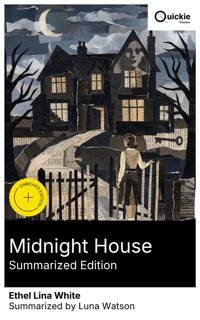
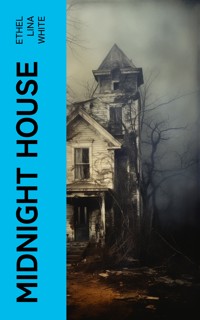
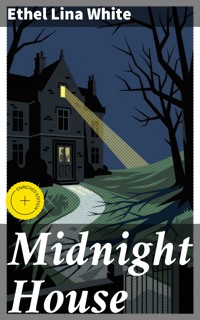
Midnight House unfolds in the shadowed corridors of a brooding country estate, where a newcomer's arrival unsettles a web of secrets, inheritances, and unspoken fears. White makes the building itself a participant in the drama—its stairwells and silences orchestrating menace. Composed amid Britain's interwar domestic Gothic, the novel fuses Golden Age clueing with psychological suspense, privileging atmosphere and shifting suspicion over mere puzzle mechanics. Ethel Lina White, Welsh-born mistress of female-in-peril suspense, left the civil service to write full time; the bureaucratic vantage sharpened her ear for social nuance and quiet coercions. Best known for The Wheel Spins (filmed by Hitchcock as The Lady Vanishes) and Some Must Watch (The Spiral Staircase), she drew on interwar anxieties about mobility, privacy, and the vulnerability of women within ostensibly safe households. Readers who prize Daphne du Maurier's atmospherics or Margery Allingham's social acuity will find Midnight House both humane and mordant. The clues are fair, the ironies exact, and the denouement chilling yet earned. For students of Golden Age evolution and for anyone who suspects houses remember what people try to forget, this remains an essential, unsettling pleasure. Quickie Classics summarizes timeless works with precision, preserving the author's voice and keeping the prose clear, fast, and readable—distilled, never diluted. Enriched Edition extras: Introduction · Synopsis · Historical Context · Brief Analysis · 4 Reflection Q&As · Editorial Footnotes.
Das E-Book können Sie in Legimi-Apps oder einer beliebigen App lesen, die das folgende Format unterstützen:
Veröffentlichungsjahr: 2026
Ähnliche










Midnight House (Summarized Edition)
Table of Contents
Introduction
Midnight House turns the comforting idea of home into a stage where certainty fractures into watchfulness and doubt. Ethel Lina White builds her suspense on everyday gestures and rooms that feel familiar until they suddenly don’t, converting the ordinary into a pressure chamber of unease. Rather than relying on spectacle, the novel lets apprehension accumulate through glances, silences, and the quiet logic of a mind trying to stay one step ahead of danger. That slow-tightening grip is the book’s signature effect: the reader senses that safety is a performance, that trust is provisional, and that the next closed door might not keep anything out.
Ethel Lina White is a British author of psychological suspense and crime fiction from the early-to-mid twentieth century, a period often associated with the classic era of British mysteries. Midnight House belongs to that tradition while favoring mood and psychology over elaborate puzzle mechanics. First issued during that era, it reflects the period’s appetite for taut, character-driven danger and the unsettling currents of social change surrounding it. The novel’s world is recognizably that of its time—hierarchies intact, manners observed—yet alert to the cracks that let fear seep in, aligning it with the atmospheric strain of suspense that White consistently refined.
Without disclosing its turns, the premise unfolds with deliberate concentration around a focal place whose very name promises secrecy and darkness, drawing a small circle of people into proximity and scrutiny. The narrative attention follows a perspective attuned to risk: small irregularities bristle into warnings, confidences can’t quite be trusted, and the familiar timetable of days and nights becomes a metronome of dread. Readers encounter a pattern of reveals that feel both inevitable and destabilizing, designed to make every explanation provisional until the next page. The result is a controlled, mounting anxiety that privileges perception, inference, and the peril of being almost—but not entirely—certain.
White’s voice is precise, observant, and slyly ironic, with descriptive economy that sharpens rather than softens the edges of fear. Dialogue carries social nuance while testing loyalties, and the narration parcels detail with measured restraint, ensuring revelations land with quiet authority. The tone is cool enough to sustain rational analysis, yet warm enough to keep us tethered to human stakes. Pacing alternates between quickened beats and stillness, a structure that lets suspicion accumulate before it spills over. Readers should expect graceful misdirection, cleanly drawn scenes, and an insistence that what seems incidental will later matter, though rarely in the way it first appears.
Key themes assemble around vulnerability and control: how space can be weaponized; how politeness masks aggression; how seeing and being seen confer power. Midnight House probes the performance of respectability, testing whether rules protect or endanger those who obey them. It scrutinizes the fragile contract between private life and public judgment, and the moral costs of passivity versus intervention. Time and thresholds—doors, corridors, the hour suggested by the title—become emblems for decisions postponed too long. The novel repeatedly asks where safety truly resides: in compliance, in vigilance, or in the hard clarity that arrives when fear strips away pretense.
Within the larger landscape of British crime writing, White’s work bridges the elegantly engineered mystery and the later, psychologically concentrated thriller. Midnight House exemplifies that bridge by privileging motive, perception, and the slow exposure of fault lines over puzzle bravura. The book’s craft lies in its architecture of suspicion—how rooms, routines, and relationships become circuits for fear—and in its insistence that danger is most persuasive when it looks plausible. That balance of design and feeling has allowed White’s stories to endure, not as period curiosities, but as living demonstrations of how anxiety can be made legible on the page.
For contemporary readers, Midnight House matters because it dramatizes conditions that persist: the negotiation of safety in familiar places, the credibility of witnesses who sense risk before others do, and the power dynamics that turn courtesy into coercion. Its restraint feels modern, favoring psychological precision over sensationalism, and its questions about trust and responsibility resonate in an age saturated with surveillance and doubt. The novel invites a reflective reading—attentive to pattern, alert to understatement—while delivering the elemental satisfactions of suspense. In showing how terror thrives in what we overlook, it earns its place among durable, unsettling entertainments.
Synopsis
Midnight House, a suspense novel by British writer Ethel Lina White, opens with a young woman arriving at an isolated mansion whose very name suggests darkness and enclosure. Seeking security in uncertain times, she accepts a position that ties her to the house’s uneasy rhythms and to a set of strangers bound by obligation, money, and old habit. From the first, the building itself feels like a character: echoing corridors, unused rooms, and a sense of events continuing behind closed doors. The narrative introduces a central question that will govern her stay: is the menace she senses superstition, nervous imagination, or a human design?
The household surrounding Midnight House is a compound of relations, dependents, and servants whose loyalties do not neatly align. An older figure presides, but authority is dispersed through petty fiefdoms, creating frictions that the newcomer must navigate with tact. Townspeople regard the place with wary fascination, repeating stories of accidents and unhappy histories without agreeing on causes. Inside, daily routines feel choreographed to avoid fresh disputes, yet small slights and secret alliances keep tensions high. The heroine’s practical instincts help her map this social maze, even as she learns that certain doors stay locked, certain topics are discouraged, and certain hours seem particularly fraught.
Disturbances begin discreetly: a misplaced key, a shadow seen twice, a warning that plausibly could be a joke. They accumulate into a pattern of nighttime incidents—sounds without sources, lights extinguished at inconvenient moments, footprints that lead nowhere—that test both nerves and reason. The newcomer resists the house’s folklore, preferring to look for human hands behind the spectacles. Yet every rational step points her toward a thicket of competing motives. Some residents fear change, others covet influence, and a few behave as if concealing earlier missteps. The idea that fear itself can be deployed as an instrument becomes increasingly persuasive.
She begins to sort friends from mere acquaintances, weighing confidences offered by a smooth-talking visitor against quiet assistance from a more reticent ally within the staff. Polite society rules limit what can be asked directly, forcing her to gather fragments—unguarded remarks, suspicious timetables, small inconsistencies—into a rough hypothesis. She is never sure whether she is the target, a pawn, or a witness who knows too much. As episodes of staged terror heighten, she tests the house’s geography and routines, learning where a person might hide and how easily a corridor can be darkened. Rationality is her compass, but fear stalks close behind.
Investigation becomes unavoidable after a near catastrophe suggests planning rather than chance. Following the paper trail of letters and accounts, she outlines competing stories: money could shift hands, reputations could be preserved or destroyed, and the past might be rewritten if one voice were silenced. Alibis begin to fray when checked against the practical realities of the house. A remark once shrugged off as trivial now seems calculated; a chronic ailment looks suspiciously convenient. The newcomer learns to read pauses as well as statements, sensing that the truth is a lattice of self-interest in which kindness and cruelty can masquerade as each other.
The narrative angles toward a culminating night when the house’s name acquires literal force. At an appointed hour, constraints that kept secrets contained give way to direct action, and the heroine’s earlier deductions are tested in real time. The solution, when it comes, grows from character and circumstance rather than contrivance: a pattern of conduct reveals its inevitable endpoint. Without detailing identities, the aftermath reinterprets prior frights as deliberate signals or strategic misdirection, and restores ordinary meanings to the house’s echoing spaces. What remains is the recognition that fear, once organized, can be as effective as any weapon—and as traceable.
Beyond its immediate suspense, Midnight House exemplifies the early twentieth-century domestic thriller’s fascination with closed communities and the ethics of observation. White uses a single location to probe class boundaries, the power of gossip, and the vulnerability of women negotiating employment, dependence, and desire for autonomy. The book’s restraint, preference for suggestion over spectacle, and clear, sequential logic give it lasting appeal. It asks who benefits when dread circulates unchecked, and how far civility can mask danger. Even after the final reveal, its most resonant image is the house itself—an architecture of secrets that mirrors the social arrangements sustaining them.
Historical Context
Ethel Lina White, a prominent British crime novelist of the 1930s–1940s, issued Midnight House during the Second World War. Known for The Wheel Spins (filmed by Alfred Hitchcock as The Lady Vanishes in 1938) and Some Must Watch (filmed as The Spiral Staircase in 1946), White specialized in suspense centered on women navigating perilous social spaces. Midnight House belongs to that tradition, drawing on contemporary British life rather than distant historical milieus. Readers approached it in an era of nightly blackouts, ration books, and disrupted routines, circumstances that heightened the appeal of claustrophobic mysteries and attuned audiences to stories of isolation, vigilance, and fragile security.
Although Britain’s class system was shifting by the 1940s, the large house and its dependencies remained visible institutions, especially outside major cities. Country estates, boarding houses, and respectable suburban villas formed familiar settings for crime fiction, with hierarchies of owners, companions, and servants still shaping daily life. Domestic service had declined since the 1920s but persisted as a major female employer. Secretaries, governesses, paid companions, and caretakers commonly straddled the boundary between family and staff, giving writers like White a ready-made stage for tension about trust, privacy, and status. Midnight House taps this environment, where etiquette and dependency coexist with concealed grievances.
Britain’s wartime home front supplies the broader atmosphere. From September 1939, blackout regulations extinguished street lighting and veiled windows, creating darkened roads and houses that altered perceptions of safety. Petrol rationing limited private motoring, while railways bore heavy traffic under air-raid risk. Civil defence institutions—the Air Raid Precautions service, wardens, and later the Home Guard—organized nightly vigilance. After the Blitz (1940–41), raids continued, and 1942 saw the Baedeker attacks on historic towns. Such conditions disrupted travel, communications, and routine policing, intensifying anxieties about strangers, trespass, and movements after dark—ingredients that suspense fiction, including White’s, could refract into personal jeopardy and misread intentions.
In the 1940s, criminal investigation in England and Wales remained locally grounded. County and borough forces handled most cases, calling on Scotland Yard’s Criminal Investigation Department for specialist assistance when needed. Forensic science—fingerprinting, ballistics, blood-grouping—was established but unevenly available outside major centers, keeping witness testimony, timetables, and alibis central to detection. Coroners’ inquests examined sudden deaths in public hearings, attracting press interest within wartime reporting limits. Defence Regulations empowered authorities to restrict information and movement, shaping what could be printed or pursued. Such legal and institutional frameworks underpin the plausibility of Midnight House, where procedure, jurisdiction, and publicity influence characters’ choices and risks.
White wrote at a moment when gender roles were both traditional and in flux. After longstanding debates over “surplus women” following the First World War, the Second World War opened new paths in uniformed services and wartime industries, while preserving older roles in service, clerical work, and caregiving. Women often traveled alone for employment or billeting, negotiated unfamiliar lodgings, and navigated male-dominated institutions. Contemporary crime narratives, including White’s, explored fears about surveillance, harassment, and credibility, alongside assertions of competence and autonomy. Midnight House channels these tensions: threats to safety are filtered through women’s perspectives, testing social support systems and the reliability of authority figures.
Midnight House emerged from the British crime tradition’s transition from puzzle-dominated “Golden Age” tales toward darker psychological suspense. Between the late 1920s and early 1940s, writers including Agatha Christie, Dorothy L. Sayers, Margery Allingham, and Anthony Berkeley shaped expectations about fair-play clues and closed settings. White contributed a complementary focus on dread, tempo, and the ordinary turning menacing. Her international reputation was reinforced by cinema: Hitchcock’s The Lady Vanishes (1938) made her a marquee name, and The Spiral Staircase (1946) cemented her association with peril-in-the-home suspense. Readers thus approached Midnight House primed for intimate menace rather than elaborate ratiocination.
The novel’s ambience reflects contemporary technology and built environments. Telephones were common but far from universal, with rural exchanges, shared party lines, and limited night staffing affecting urgent calls. The BBC provided news and civil-defence information, yet blackout regulations kept exterior spaces dim, making flashlights, candles, and matches indispensable. Many British houses, especially older villas and country residences, featured attics, basements, and service corridors that complicated surveillance and offered concealment—features frequently exploited by 1940s thrillers. Railways and country buses knit together towns and villages on wartime schedules, while petrol shortages curtailed spontaneous drives. These constraints sharpen narrative dependence on timing, proximity, and chance encounters.
Within this matrix of war-shadowed domesticity, changing labor patterns, and procedural realities, Midnight House operates as both entertainment and commentary. Its stresses on vigilance, rumor, and the permeability of respectable spaces mirror a society living under alert conditions, where small lapses could carry disproportionate consequences. By centering women’s perceptions, it interrogates authority’s responsiveness and the ambiguities of protection, exposing how class expectations and institutional routines can overlook private peril. The result is a wartime suspense novel that neither propagandizes nor retreats into pure escapism: it registers contemporary uncertainties and translates them into intimate gothic unease, demanding attention to ordinary habits of trust.




