


0,49 €
Mehr erfahren.
- Herausgeber: Booksell-Verlag
- Kategorie: Poesie und Drama
- Sprache: Englisch
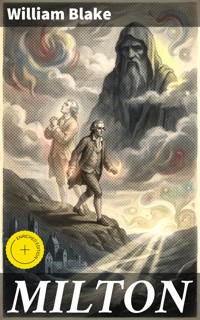
In "Milton," William Blake presents an ambitious poetic exploration that traverses the realms of creativity, spirituality, and human potential. Combining elements of Romanticism and mystical symbolism, the work is structured as an epic, drawing upon the figure of John Milton as both hero and adversary. Blake's intricate use of vivid imagery and metaphor engages with themes such as the nature of freedom, the conflict between good and evil, and the transcendence of the human spirit. This work, part of Blake's larger prophetic catalog, appears as a critique of organized religion and an invitation to personal spiritual awakening through the lens of the imaginative mind. William Blake, born in 1757, was a pioneering artist and poet, whose works often delve into the psychological and philosophical struggles between the material and the spiritual worlds. His own mystical experiences and a lifelong fascination with the metaphysical informed his poetry, leading him to questions about creation and individualism. Blake'Äôs unique worldview and his critical stance toward conventional religion significantly influence "Milton," underlying the narrative of inspiration and rebellion. Readers seeking a transformative poetic experience will find "Milton" a compelling exploration of humanity's divine potential. Blake's profound insights on creativity and the imagination offer resonant lessons for contemporary times, making this work essential for scholars, poets, and anyone captivated by the intersection of art and spirituality. In this enriched edition, we have carefully created added value for your reading experience: - A succinct Introduction situates the work's timeless appeal and themes. - The Synopsis outlines the central plot, highlighting key developments without spoiling critical twists. - A detailed Historical Context immerses you in the era's events and influences that shaped the writing. - An Author Biography reveals milestones in the author's life, illuminating the personal insights behind the text. - A thorough Analysis dissects symbols, motifs, and character arcs to unearth underlying meanings. - Reflection questions prompt you to engage personally with the work's messages, connecting them to modern life. - Hand‐picked Memorable Quotes shine a spotlight on moments of literary brilliance. - Interactive footnotes clarify unusual references, historical allusions, and archaic phrases for an effortless, more informed read.
Das E-Book können Sie in Legimi-Apps oder einer beliebigen App lesen, die das folgende Format unterstützen:
Veröffentlichungsjahr: 2023
Ähnliche


MILTON
Table of Contents
Introduction
A visionary poet summons the dead into the living present to wrestle art itself away from complacency and toward moral awakening.
William Blake’s MILTON (often titled Milton: a Poem) stands among the defining achievements of British Romantic literature because it fuses lyric intensity, prophetic scope, and daring formal invention into a single work. It is “classic” not by the standards of popularity in its own day—Blake wrote largely outside the commercial mainstream—but by the way it continues to shape conversations about imagination, conscience, and the responsibilities of the artist. Its hybrid mode, at once poem, spiritual drama, and illuminated book, expanded what readers and later writers understood poetry could attempt: not merely to describe the world, but to remake perception.
Blake (1757–1827) composed MILTON during the early nineteenth century, working on it across several years and issuing it in his characteristic method of illuminated printing. This technique, which combined text and image on the same etched plates, makes MILTON inseparable from its visual designs. The poem belongs to Blake’s later “prophetic” books, a group of works in which he created a private mythological vocabulary to address public questions—religion, politics, and the inner life—through symbolic narrative rather than conventional realism. Because the illuminated books were produced in small numbers, MILTON’s influence grew gradually, deepening as later generations gained access to the text and images.
At its center, MILTON is a poem about the meeting of minds across time: the historical poet John Milton becomes a dramatic presence within Blake’s visionary framework. Blake does not treat Milton merely as a literary predecessor to praise or critique at a distance; he turns him into an active figure whose arrival sets the poem’s action in motion. The premise is overtly spiritual and imaginative rather than biographical, and it asks readers to consider how a great writer’s legacy continues to act in the world. Without revealing the poem’s later turns, it is enough to say that Blake stages a quest for renewal that involves both artistic creation and moral self-examination.
The form of MILTON contributes directly to its status. Blake writes in long, propulsive lines that carry the weight of epic, sermon, and visionary proclamation, yet he constantly interrupts any expectation of neat narrative closure. The poem moves through shifting scenes and symbolic spaces, demanding that the reader interpret patterns of recurrence and transformation rather than follow a straightforward plot. This formal freedom is not ornamental; it embodies Blake’s belief that imagination is a mode of truth. The poem’s refusal to be easily summarized has helped it endure, inviting successive readers to return, reconsider, and argue—an enduring mark of a classic work.
MILTON also has classic standing because it crystallizes themes that remain central to Blake’s reputation: the struggle against mental and spiritual constraint, the critique of rigid moralism, and the insistence that perception shapes reality. Blake’s poetry repeatedly contests the forces that narrow human capacity—whether those forces appear as social institutions, inherited habits of mind, or self-imposed fear. In MILTON these concerns are intensified through the figure of a major English poet entering Blake’s imaginative universe, turning questions of influence into questions of responsibility. The poem asks what it means to inherit a tradition and whether one can be faithful to it without being confined by it.
The book’s literary impact extends beyond its immediate circle because it models a way of writing that is at once intensely personal and cosmically ambitious. Later readers have recognized in Blake’s prophetic works a precursor to modern experiments in myth-making and symbolic narrative. MILTON, with its dense allusiveness and its insistence that poetry can be a vehicle for ethical and spiritual change, has appealed to writers and artists interested in the intersections of vision, politics, and form. Its influence is not a matter of single borrowed motifs so much as a permission structure: it legitimizes the idea that a poem may invent its own world and still speak urgently to the real one.
Understanding MILTON benefits from a basic awareness of Blake’s dual vocation as poet and visual artist. The illuminated plates present text within an environment of figures, borders, and scenes that do not function as mere decoration. Image and word work together to create an interpretive field in which meaning is distributed across what is said and what is shown. Because copies of illuminated books can differ in coloring and finishing, MILTON also has a material history that complicates any single “definitive” presentation. This unique mode of publication contributes to the poem’s aura and its scholarly fascination, while also emphasizing Blake’s conviction that art should address the whole human faculty of imagination.
The poem’s engagement with Milton is equally significant as literary criticism in imaginative form. Blake admired Milton’s stature in English letters while resisting aspects of the tradition Milton represented, and MILTON dramatizes that tension as a spiritual and artistic problem rather than an academic dispute. In doing so, Blake invites readers to reconsider what it means to read predecessors: not passively, but as an encounter that can change both reader and text. This approach has proved influential for later writers and critics who view literary history as a living struggle over values, freedom, and the shaping power of language.
MILTON belongs to a historical moment marked by political upheaval and intense debate over religion and authority, and Blake’s prophetic mode addresses these pressures indirectly through symbol and vision. Rather than offering topical reportage, Blake translates large public anxieties into inner drama, where the stakes are nothing less than the liberation of human perception. That translation is one reason the poem remains durable: it speaks beyond the immediate controversies of its day without abandoning their urgency. The poem’s central premise—an encounter that aims at transformation—keeps the focus on process, on what must change in thought and imagination for a different world to become possible.
Readers new to MILTON may find its mythic names, abrupt transitions, and visionary assertions challenging, but those very features are central to its power. The poem is constructed to be experienced as an act of imaginative participation, where comprehension unfolds through rereading and attention to recurring symbols. Approached patiently, it reveals a coherent set of concerns about how individuals and societies become trapped in limiting stories and how art can contest those traps. Blake’s language often strives for the intensity of revelation, and the poem’s form asks the reader to meet that intensity with active interpretation rather than passive consumption.
MILTON’s enduring themes—creative freedom, moral responsibility, and the struggle against internalized constraint—help explain its ongoing influence. The work continues to attract scholars of Romanticism, students of visionary literature, and artists drawn to the union of text and image. It also continues to matter to writers wrestling with how tradition can both nourish and imprison. By turning literary inheritance into a dramatic premise, Blake offers a framework for thinking about influence not as a chain but as a field of choices: what to accept, what to transform, and what to resist in the name of a larger human possibility anchored in imagination and ethical seriousness, not mere taste or fashion alone worldwide today still widely read despite complexity and rarity of early copies in archives and museums, fueling study and creative responses across media forms in many countries for generations to come still now and future readers alike endlessly returning and reflecting further onward with each era’s concerns and languages evolving as new editions appear for study and art practice alike evermore without end in sight surely, sustained by its density and unique art form presentation qualities that remain unmatched by many peers in the canon at all times for the most devoted readers and artists around the world now and again repeatedly always revisiting it with fresh eyes and minds and hearts each time accordingly in new contexts and interpretations across time and place, offering enduring challenge and reward consistently for serious engagement and contemplation of humanity’s freedom and vision and moral imagination within life itself as art and spirit intertwined forevermore in Blake’s visionary project as a whole within his canon and beyond for readers and creators alike each new generation seeking meaning and liberation through creative encounter with this classic work of English literature and art of the Romantic period of early nineteenth century Britain and its visionary imagination and spiritual struggle over perception and freedom that continues to resonate today in our world of rapid change and contested narratives, where art still fights for the soul of society and the individual mind alike as ever and always in the ongoing human story that seeks emancipation through imagination and love rather than domination and fear.
Synopsis
Milton: a Poem is William Blake’s prophetic work, first issued in two books and printed in illuminated form across the early nineteenth century. The poem is framed as a visionary narrative rather than a conventional biography, and it treats the poet John Milton as a spiritual figure whose choices matter for England’s imaginative life. Blake situates the action within a symbolic geography that shifts between cosmic spaces and recognizable places, especially London and its environs. From the outset, the work announces a concern with how creative energy becomes trapped by moral systems, and how liberation might begin through an inward, imaginative act.
paragraphs through which Milton and other figures move. In this opening movement, Blake introduces the idea that the imagination is not merely personal but a living power that shapes communities and history. The poem positions poetic vocation as inseparable from ethical and political responsibility, and it establishes a tension between visionary freedom and forms of mental constraint. Milton’s entrance is presented as a deliberate undertaking that requires renunciation of complacent spiritual states. The narrative proceeds by symbolic episodes rather than linear realism, and it continuously shifts scale from individual psychology to national destiny.
paragraphs through which Milton and other figures move. In this opening movement, Blake introduces the idea that the imagination is not merely personal but a living power that shapes communities and history. The poem positions poetic vocation as inseparable from ethical and political responsibility, and it establishes a tension between visionary freedom and forms of mental constraint. Milton’s entrance is presented as a deliberate undertaking that requires renunciation of complacent spiritual states. The narrative proceeds by symbolic episodes rather than linear realism, and it continuously shifts scale from individual psychology to national destiny.
paragraphs through which Milton and other figures move. In this opening movement, Blake introduces the idea that the imagination is not merely personal but a living power that shapes communities and history. The poem positions poetic vocation as inseparable from ethical and political responsibility, and it establishes a tension between visionary freedom and forms of mental constraint. Milton’s entrance is presented as a deliberate undertaking that requires renunciation of complacent spiritual states. The narrative proceeds by symbolic episodes rather than linear realism, and it continuously shifts scale from individual psychology to national destiny.
paragraphs through which Milton and other figures move. In this opening movement, Blake introduces the idea that the imagination is not merely personal but a living power that shapes communities and history. The poem positions poetic vocation as inseparable from ethical and political responsibility, and it establishes a tension between visionary freedom and forms of mental constraint. Milton’s entrance is presented as a deliberate undertaking that requires renunciation of complacent spiritual states. The narrative proceeds by symbolic episodes rather than linear realism, and it continuously shifts scale from individual psychology to national destiny.
paragraphs through which Milton and other figures move. In this opening movement, Blake introduces the idea that the imagination is not merely personal but a living power that shapes communities and history. The poem positions poetic vocation as inseparable from ethical and political responsibility, and it establishes a tension between visionary freedom and forms of mental constraint. Milton’s entrance is presented as a deliberate undertaking that requires renunciation of complacent spiritual states. The narrative proceeds by symbolic episodes rather than linear realism, and it continuously shifts scale from individual psychology to national destiny.
paragraphs through which Milton and other figures move. In this opening movement, Blake introduces the idea that the imagination is not merely personal but a living power that shapes communities and history. The poem positions poetic vocation as inseparable from ethical and political responsibility, and it establishes a tension between visionary freedom and forms of mental constraint. Milton’s entrance is presented as a deliberate undertaking that requires renunciation of complacent spiritual states. The narrative proceeds by symbolic episodes rather than linear realism, and it continuously shifts scale from individual psychology to national destiny.
paragraphs through which Milton and other figures move. In this opening movement, Blake introduces the idea that the imagination is not merely personal but a living power that shapes communities and history. The poem positions poetic vocation as inseparable from ethical and political responsibility, and it establishes a tension between visionary freedom and forms of mental constraint. Milton’s entrance is presented as a deliberate undertaking that requires renunciation of complacent spiritual states. The narrative proceeds by symbolic episodes rather than linear realism, and it continuously shifts scale from individual psychology to national destiny.
paragraphs through which Milton and other figures move. In this opening movement, Blake introduces the idea that the imagination is not merely personal but a living power that shapes communities and history. The poem positions poetic vocation as inseparable from ethical and political responsibility, and it establishes a tension between visionary freedom and forms of mental constraint. Milton’s entrance is presented as a deliberate undertaking that requires renunciation of complacent spiritual states. The narrative proceeds by symbolic episodes rather than linear realism, and it continuously shifts scale from individual psychology to national destiny.




