


Erhalten Sie Zugang zu diesem und mehr als 300000 Büchern ab EUR 5,99 monatlich.
- Herausgeber: Musaicum Books
- Kategorie: Poesie und Drama
- Sprache: Englisch
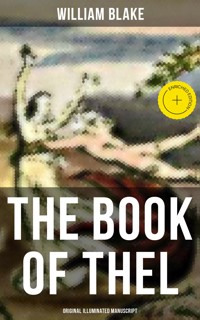
William Blake's 'The Book of Thel' is a fascinating exploration of innocence, experience, and the nature of existence. This original illuminated manuscript showcases Blake's unique blend of poetry and visual art, creating a truly immersive literary experience. Set in a rich symbolic landscape, 'The Book of Thel' delves into themes of life, death, and the eternal struggle between the material and spiritual worlds. The lyrical prose and intricate illustrations make this work a masterpiece of Romantic literature, showcasing Blake's visionary genius and philosophical depth. The intricate detail and symbolism within the manuscript invite readers to ponder the profound questions of existence and the human condition. William Blake's 'The Book of Thel' is a must-read for anyone interested in the intersection of art and literature, as well as the deeper mysteries of life and consciousness. In this enriched edition, we have carefully created added value for your reading experience: - A succinct Introduction situates the work's timeless appeal and themes. - The Synopsis outlines the central plot, highlighting key developments without spoiling critical twists. - A detailed Historical Context immerses you in the era's events and influences that shaped the writing. - An Author Biography reveals milestones in the author's life, illuminating the personal insights behind the text. - A thorough Analysis dissects symbols, motifs, and character arcs to unearth underlying meanings. - Reflection questions prompt you to engage personally with the work's messages, connecting them to modern life. - Hand‐picked Memorable Quotes shine a spotlight on moments of literary brilliance. - Interactive footnotes clarify unusual references, historical allusions, and archaic phrases for an effortless, more informed read.
Sie lesen das E-Book in den Legimi-Apps auf:
Seitenzahl: 58
Veröffentlichungsjahr: 2017
Das E-Book (TTS) können Sie hören im Abo „Legimi Premium” in Legimi-Apps auf:
Ähnliche

THE BOOK OF THEL
(Original Illuminated Manuscript)
Published by
Books
Table of Contents
Introduction
At the threshold between innocence and embodiment, a young voice pauses, listening for the purpose of life in the soft murmur of clouds, flowers, and earth, uncertain whether to enter the world of change. This tension between hesitation and calling is the animating energy of William Blake’s The Book of Thel, a work that distills the anxieties of growth into a brief, radiant vision. Its scene is pastoral and dreamlike, yet its questions—about meaning, duty, and mortality—are unflinchingly human. The poem’s music, images, and meditative poise invite readers to dwell in a liminal place where attention becomes a form of courage.
William Blake, the poet, engraver, and printer born in London in 1757, composed and engraved The Book of Thel in 1789. Like his other illuminated books, it was realized through his own relief-etching process and printed in a small number of hand-finished copies. The work appears as an integration of verse and image, designed, lettered, and illustrated by the author himself. The present volume emphasizes that original conception by presenting the poem as an “Original Illuminated Manuscript,” foregrounding the crafted unity Blake intended. To encounter Thel is thus to enter an artwork whose language, lettering, and imagery are inseparable parts of a single act.
The poem’s premise is simple and arresting. In the dream-bright Vales of Har, a maiden named Thel contemplates the brevity of life and the mystery of purpose. She listens to the counsel of emblematic voices of nature—the Lily of the Valley, a fleeting Cloud, a tiny Worm, and the humble Clod of Clay—each offering a measure of consolation and insight. Their answers turn on service, renewal, and the circulation of life’s gifts. Thel hears, questions, and wonders. Without disclosing the poem’s later turns, it is enough to say that its movement is inward and reflective, guided by dialogue and vision.
Blake’s themes here are enduring: the relation of innocence to experience, the cost of selfhood, and the fear that beauty must perish when it enters time. The speakers embody distinct understandings of transience and care—the flower nourishes, the cloud descends in rain, the clay bears the impress of life—each suggesting a way to inhabit change without despair. Thel’s hesitation is not merely a private tremor; it is the universal pause before commitment, a meditation on how to accept finite form while honoring spiritual aspiration. The poem’s brevity conceals a subtle architecture of thought, balanced between reassurance and unease.
As an illuminated manuscript, The Book of Thel asks to be seen as carefully as it is read. The lines flow through Blake’s calligraphic hand, bordered by vegetal motifs and figures that echo the poem’s speakers. The visual field does not illustrate in a literal sense so much as amplify the poem’s metaphors—clouds, tendrils, and gentle contours make the page itself part of the pastoral scene. Because Blake printed and often hand-colored each copy, no two impressions are identical. The designation “Original Illuminated Manuscript” signals a return to that material particularity, where color, line, and word jointly carry meaning.
In Blake’s oeuvre, Thel stands among his early illuminated works, close in time to Songs of Innocence and preceding the darker counterpoint that would emerge in Songs of Experience. Its setting, the Vales of Har, introduces a pastoral locale that belongs to Blake’s growing visionary geography. Compact yet resonant, the poem demonstrates how Blake could compress metaphysical questioning into a lyric format without invoking the full breadth of his later mythic system. For many readers, it offers a welcoming portal: the themes are profound, the symbols are clear enough to grasp, and the pages display the signature fusion of art and poetry.
The book’s classic status rests first on this perfected fusion. Blake reinvented what a poem could be by making the page a stage where voice and image converse. Thel exemplifies how a short lyric can open onto questions often reserved for epic or philosophy, without losing tenderness or grace. In doing so, it helped shape the Romantic conviction that imagination reorders experience and that vision may be embodied in crafted form. The work continues to be studied not only for its textual art but also for its place in the history of the artist’s book, anticipating later experiments in multimodal literature.
Thel has also proved influential through the readers and artists it inspired. Nineteenth-century champions, including figures connected with Alexander Gilchrist’s Life of William Blake, helped renew attention to Blake’s illuminated books. Dante Gabriel Rossetti admired Blake’s union of art and verse, and W. B. Yeats, who co-edited a landmark Blake edition in the 1890s, drew enduring energy from Blake’s symbolic imagination. While their projects differ, the example of Thel—concise, visionary, materially crafted—encouraged poets and artists to enact a marriage of image and idea and to treat lyric poetry as a vessel for metaphysical exploration.
The poem’s enduring themes speak vividly to contemporary concerns. Thel listens, above all, to nonhuman voices, and discovers that meaning might be shared rather than possessed. In an age attentive to ecological interdependence, this intuition feels newly pertinent. The poem articulates the anxiety of crossing thresholds—into adulthood, responsibility, or vulnerability—while asking how care can be practiced in a transient world. Its pastoral idiom does not evade difficulty; instead, it proposes patience, attention, and service as possible bearings within change. That ethical poise grants the work a durable moral and emotional resonance.
Reading The Book of Thel benefits from a slow, contemplative approach. Let the sequence of speakers unfold without hurry; notice how each voice frames its form of giving and how the imagery on the plate subtly underscores that stance. The poem’s diction is accessible, yet its metaphors are layered, inviting rereading. The visual margins—blossoms, tendrils, and drifting forms—do not merely decorate; they extend the poem’s argument about nurture and permeability. Because the work is concise, even small details matter: a posture, a curve of script, a drift of cloud. Thel rewards such care with steadily deepening clarity.
Publication history matters for understanding the experience offered here. Because Blake printed, etched, and colored his own plates, each surviving copy preserves decisions of touch and tone that shape interpretation. Modern facsimiles often pair plates with diplomatic transcriptions, but the images carry argument as surely as the lines. An edition that foregrounds the Original Illuminated Manuscript makes the reader a viewer, restoring a sense of the work as object. This is not antiquarianism; it is fidelity to Blake’s intention that thought should be sensed through color, contour, and the living particularity of a handmade page.




