


1,99 €
Niedrigster Preis in 30 Tagen: 0,00 €
Niedrigster Preis in 30 Tagen: 0,00 €
Mehr erfahren.
- Herausgeber: Musaicum Books
- Kategorie: Geisteswissenschaft
- Sprache: Englisch
John Ruskin's 'Modern Painters' is a comprehensive exploration of art and its role in society during the 19th century. Written in a highly descriptive and philosophical style, the book delves into the significance of landscape painting and the principles of artistry. Ruskin's detailed analysis of works by artists such as J.M.W. Turner provides valuable insight into the Romantic movement and the changing perceptions of beauty in art. Drawing upon his background in art criticism and his deep admiration for the natural world, Ruskin offers a rich tapestry of ideas that continue to resonate with readers today. His eloquent prose and keen observations make 'Modern Painters' a timeless classic in the realm of art history and criticism. John Ruskin's passion for art and nature shines through in 'Modern Painters', making it a must-read for anyone interested in the intersection of aesthetics and philosophy in the 19th century. In this enriched edition, we have carefully created added value for your reading experience: - A succinct Introduction situates the work's timeless appeal and themes. - The Synopsis outlines the central plot, highlighting key developments without spoiling critical twists. - A detailed Historical Context immerses you in the era's events and influences that shaped the writing. - An Author Biography reveals milestones in the author's life, illuminating the personal insights behind the text. - A thorough Analysis dissects symbols, motifs, and character arcs to unearth underlying meanings. - Reflection questions prompt you to engage personally with the work's messages, connecting them to modern life. - Hand‐picked Memorable Quotes shine a spotlight on moments of literary brilliance. - Interactive footnotes clarify unusual references, historical allusions, and archaic phrases for an effortless, more informed read.
Das E-Book können Sie in Legimi-Apps oder einer beliebigen App lesen, die das folgende Format unterstützen:
Veröffentlichungsjahr: 2022
Ähnliche









![Stones of Venice [introductions] - John Ruskin - E-Book](https://legimifiles.blob.core.windows.net/images/bbc8b2fc235b859daa0429d722b5ed07/w200_u90.jpg)

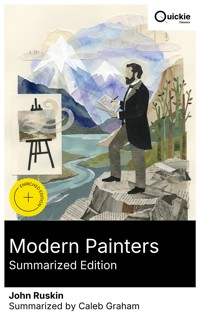
Modern Painters
Published by
Books
Table of Contents
Introduction
Modern Painters opens by challenging received taste, insisting that the measure of art lies in how honestly it teaches us to see. Written by John Ruskin during the high Victorian era, this ambitious work sets modern landscape painting against the prestige of the past and asks readers to test reputation by looking, not by convention. Its first volume appeared in 1843 and eventually grew into five volumes issued through 1860, building an argument that united aesthetic judgment with attentive observation of nature. The result is both a guide to pictures and a study of the habits of attention on which good seeing—and thus good criticism—depends.
Its classic status rests first on the audacity of its claim: that contemporary painters of landscape deserved higher honor than many canonized predecessors. Ruskin did not merely rank artists; he redefined criteria, moving from rote comparison to standards grounded in fidelity to the natural world and moral seriousness. In doing so, he advanced the scope of English art criticism, fusing philosophical reflection with impassioned prose. Generations have read the book not only to learn how to look at painting but to encounter a distinctive voice that made criticism a literary art. Its sentences, charged with vivid description, continue to shape the language of looking.
The work’s publication history underscores its cultural moment. The first volume appeared anonymously, attributed to “A Graduate of Oxford,” a signature that allowed a young critic to confront fashionable opinion without the ballast of celebrity. Over the next seventeen years, the project expanded into a five-volume enterprise, written and revised amid intense public debate about art, taste, and the authority of tradition. Its Victorian context—of scientific discovery, religious questioning, and industrial change—inflects the pages, yet the argument remains centered on perceiving the world as it is, before it is obscured by habits, formulas, and inherited praise.
At its core, the book advances a clear premise: modern landscape painting, exemplified above all by J. M. W. Turner, reveals truths about light, atmosphere, and form that older conventions misrepresented or ignored. Ruskin asks readers to examine clouds, rocks, foliage, and the effects of weather with the same seriousness they grant to narrative subjects. The point is not novelty for its own sake, but a disciplined fidelity to seen reality. He contends that such fidelity, achieved by modern masters, demonstrates both technical genius and an ethical commitment to truthfulness that should weigh more heavily than inherited prestige.
From that premise flows a rich theory of artistic value. Ruskin insists that the artist’s duty begins in patient, accurate observation and extends to the imagination that orders perception without falsifying it. He treats art as a mode of knowledge—of nature, of the human spirit, and of the conditions that make perception reliable. The discussion moves from details of brushwork to large questions about the purposes of art. Throughout, the argument ties beauty to sincerity, suggesting that style detached from honest seeing becomes mannerism, while style rooted in close attention becomes a form of moral clarity.
One reason Modern Painters endures is the variety of methods it brings to bear. Ruskin compares specific works, but he also ranges into geology, meteorology, and botany to anchor aesthetic claims in observed phenomena. Descriptions of mountain structure, cloud forms, and the movement of water are not digressions; they are the evidentiary basis for judgments about pictorial truth. This interdisciplinary reach mirrors Victorian intellectual life while anticipating modern art history’s dialogue with the sciences. The book’s authority thus rests on more than taste—it rests on a demonstrated capacity to test paintings against the world they depict.
The work’s influence on artists was immediate and practical. Ruskin’s insistence on exacting study of nature bolstered the aims of the Pre-Raphaelite Brotherhood, whose members pursued precise detail, clear color, and uncompromising observation. His public defense of their principles helped secure space for experiments that resisted academic convention. Though Modern Painters is a work of criticism, it functions for many painters as a manual of looking: it instructs them to seek form and meaning in the specific, not in generalized formula. In this way the book bridged theory and practice, turning aesthetic doctrine into studio discipline.
Writers and critics, too, found in Ruskin a touchstone to accept, refine, or resist. Later Victorian aesthetes debated his insistence on the ethical dimensions of art, taking up positions in conversation with his claims. The elegance and urgency of his prose set a standard for criticism as literature, influencing how subsequent generations wrote about painting, architecture, and nature. Beyond Britain, admirers studied and translated his works, carrying his arguments into broader discussions of culture. Even disagreement with Ruskin proved fruitful: by defining issues so sharply, he gave later thinkers a durable framework for response.
Modern Painters is also a triumph of style. Ruskin’s pages move from minute description to panoramic synthesis with a cadence that feels both patient and impassioned. He writes scenes the way a painter composes them—foreground detail illuminated against a vast atmospheric background—so that arguments are felt as well as understood. This rhetorical power matters because the book is, at heart, a training in attention. The prose models the very habits it prescribes, inviting readers to linger over a blade of grass, a shifting cloud, or a glazed surface until the world discloses patterns otherwise missed.
Its historical reception reflects this dual achievement of theory and style. The early volumes helped reshape public sentiment toward Turner, whose late works had faced misunderstanding. Ruskin’s advocacy, grounded in close analysis, equipped audiences to see what once appeared obscure. Over time the work came to be recognized as a landmark of Victorian letters and a catalyst for new standards in art criticism. While fashions changed and controversies cooled, the book’s central insight—that careful looking can refine judgment and renew value—remained persuasive, sustaining its place in classrooms, galleries, and the wider culture.
Readers approaching the book today will find an argument that unfolds across varied terrains: passages of analysis sit beside travel observation, meditations on weather, and reflections on artistic labor. The volumes invite unhurried reading. Rather than a single thesis shouted from a pulpit, the work offers a sustained apprenticeship in seeing, calibrated by examples and tests. It asks for intellectual openness and a willingness to compare what is on the canvas with what lies beyond the frame. In return, it offers a more capacious sense of what art can reveal about the world and about ourselves.
Modern Painters remains contemporary because its lessons address perennial habits of mind. In an age crowded by images, its call to disciplined attention and honest standards feels newly urgent. Its alliance of aesthetics with knowledge, and of perception with responsibility, speaks to debates about expertise, environmental awareness, and cultural authority. By tying artistic value to the living textures of nature and to the integrity of the observer, Ruskin bequeaths a method as well as a message. That method—patient, exacting, humane—is the source of the book’s lasting appeal and the reason it continues to matter now.
Synopsis
Modern Painters, published in five volumes between 1843 and 1860, is John Ruskin’s expansive reassessment of landscape art and its critical standards. Conceived initially to defend contemporary painters—above all J. M. W. Turner—against entrenched preference for Old Masters, it develops into a comprehensive inquiry into how art should represent nature. Ruskin combines aesthetic theory, technical analysis, and moral reflection, arguing that the highest art arises from faithful, reverent observation of the natural world. Across the series, he compares paintings to phenomena that can be examined outdoors, urging critics and viewers to ground judgment in demonstrable fact rather than inherited convention or formula.
The work opens with a forceful case for modern landscape’s superiority in truthfulness. Ruskin contends that many canonical models rely on mannered routines that suppress the complexity of real skies, waters, and terrains. He advances criteria for evaluating paintings by testing them against observable effects—light modulations, cloud structure, reflections, and atmospheric perspective. Turner is upheld as exemplary for capturing transient conditions that earlier schools neglected or simplified. The argument does not reject tradition wholesale, but it demands that authority be earned by comparison with nature, not granted by reputation. This empirical emphasis sets the tone for the inquiries that follow.
Having established the priority of observation, Ruskin refines what “truth” in painting entails. He distinguishes different kinds of fidelity—accuracy of tone and color, coherence of spatial relations, and credibility of natural form—showing how each supports convincing representation. Close looking becomes a discipline that corrects studio habits and stock effects. Technical discussions of rock formation, reflections, and cloud gradations are used to demonstrate how painters can translate complex facts without pedantry. Throughout, Ruskin links fact to feeling: he maintains that imagination achieves its power only when it rests on accurate seeing, so that invention amplifies nature rather than substituting for it.
The next major movement turns from defense and description to theory. Ruskin proposes a structured account of beauty that separates stable, archetypal qualities from the animated signs of life and growth. This theory connects aesthetics to human faculties of perception, insisting that viewers must learn to see before they can judge. He explores how light, color, and form cooperate to evoke delight, while cautioning that taste needs training to discriminate the essential from the decorative. Imagination is cast as selective fidelity: it emphasizes what matters in nature without falsifying it. The result is a framework that reconciles rigor with feeling.
Ruskin then examines expression and emotion, carefully regulating their place within truthful art. He introduces the term pathetic fallacy to describe the tendency, under strong emotion, to project human feeling onto inanimate nature. Rather than dismissing such language altogether, he analyzes when it becomes misleading for painters and poets, and when it may serve heightened perception. The discussion clarifies limits: expression must not override the observed character of things. By distinguishing disciplined from distorting response, Ruskin preserves room for passion in art while maintaining the work’s responsibility to the world it depicts.
A substantial portion of the series studies nature’s elements in detail. Ruskin investigates mountains, clouds, water, and vegetation, drawing on contemporary scientific knowledge to explain their forms and behavior. He argues that painters should understand underlying structures—stratification, atmospheric layers, wave motion—if they are to render them convincingly. These inquiries return repeatedly to Turner, whose depictions of weather, light, and distance are analyzed as instances of informed vision. Against picturesque conventions and idealized templates, Ruskin favors attentive transcription of specific effects, on the grounds that particularity is the pathway to breadth, grandeur, and lasting expressiveness.
Alongside analyses of nature, Ruskin addresses the cultivation of artistic skill and perception. He advocates rigorous drawing from life, careful study of color and light, and the exercise of memory as a bridge between observation and invention. Virtues such as patience, humility, and sincerity are treated as practical conditions for good art, not merely private morals. His advice extends to viewers, who must learn to recognize both the evidences of study and the economies of suggestion by which painters convey complexity. In this way, the series seeks to reform taste as much as it evaluates individual works.
As the project matures, Ruskin synthesizes technical, theoretical, and ethical strands into a unified vision of landscape art. He reaffirms that the most compelling paintings arise from a truthful and reverent engagement with nature, interpreted by an imagination disciplined by fact. The later pages revisit earlier claims with expanded evidence, clarifying how art’s aims involve both knowledge and feeling. Landscape becomes a site where observation, beauty, and moral insight converge. Without abandoning his initial defense of modern practitioners, Ruskin broadens the stakes, proposing standards by which art can be measured across schools and periods.
Modern Painters achieved enduring significance by reshaping Victorian art discourse and influencing subsequent practice. It helped consolidate Turner’s reputation, encouraged a generation of artists to study nature directly, and furnished critics with a richer vocabulary—most notably the analysis of the pathetic fallacy. Beyond its historical moment, the work models a method that unites empirical scrutiny, aesthetic reasoning, and ethical concern. Its central message is that art attains greatness when it renders the world with accuracy, imagination, and integrity, inviting viewers to see more fully and to value the attentive regard that such seeing requires.
Historical Context
Modern Painters emerged in Victorian Britain between 1843 and 1860, a period framed by Queen Victoria’s reign, Parliamentary governance, and an expanding British Empire. London’s Royal Academy of Arts set artistic standards, while the Anglican Church and the ancient universities shaped moral and intellectual life. The work addressed a growing, educated, middle-class readership able to purchase substantial books and visit exhibitions. Within this institutional landscape, Ruskin aimed to reset standards for artistic judgment. He wrote first as “A Graduate of Oxford,” later openly, situating his argument within a culture that prized classical models yet was grappling with the meanings of modernity, nationhood, and cultural authority.
The Industrial Revolution underwrote the era’s prosperity and anxieties. Factories, railways, and steamships reordered space and time, concentrating populations in rapidly growing towns. New wealth fueled consumer markets but also environmental degradation, harsh labor conditions, and stark contrasts between urban squalor and rural retreat. Debates about mechanization’s moral consequences intensified as technology transformed daily life. Ruskin’s exhortation to “truth to nature” functioned as a counterweight to mechanized seeing and manufacture, urging careful, reverent attention to the natural world. His aesthetic claims thus intersected with broader social questions: could a society organized around speed, profit, and mass production still cultivate truthful perception and humane feeling?
Artistic institutions were pivotal to these debates. The Royal Academy, heir to Joshua Reynolds’s Discourses, ranked history painting above landscape and promoted “generalization” from ideal forms. Yet eighteenth- and early nineteenth-century Britain had already elevated landscape through figures like Gainsborough, Constable, and Turner, as well as thriving watercolor societies. By the 1840s the Academy still guarded standards, but critics disagreed on how painters should represent nature. Ruskin challenged inherited hierarchies and the reliance on old-master conventions, arguing that fidelity to observed nature—correct form, light, and color—offered a more ethical and intellectually rigorous path than repeating codified, idealized formulas.
On the immediate level, Modern Painters was a defense of J. M. W. Turner, then criticized for audacity of color and atmospheric “indistinctness.” Turner’s late style provoked skeptical reviews that accused him of excess or incoherence. Ruskin’s first volume (1843) answered such attacks by comparing Turner’s knowledge of natural effects with admired precedents like Claude Lorrain, arguing that the modern’s scientific precision and inner truth surpassed academic classicism. This polemical defense grew into a comprehensive theory of art, rooted in observation and conscience. Ruskin’s case also reflected the collecting culture around him: his father, a prosperous wine merchant, had assembled Turner watercolors, sharpening the son’s eye and commitment.
The book also belongs to Romantic reappraisals of landscape and the sublime. British readers shaped by Wordsworth and Coleridge valued mountains, clouds, and solitary reflection, while “picturesque” tourism encouraged framing roughness and ruin as pleasing variety. Writers such as William Gilpin and Uvedale Price shaped those tastes. Ruskin retained Romantic feeling, but he critiqued the picturesque when it drifted into formula or sentimentalism. He asked painters and viewers to confront the precise structure of rocks, skies, and plants without prettifying them. The sublime, for him, depended not on sensational effect but on truthful encounter with creation’s order, beauty, and moral implications.
Scientific inquiry enlarged that encounter. Charles Lyell’s Principles of Geology (1830s) advanced uniformitarian explanations and deep time, reshaping public understanding of the earth. Glacial studies in the 1840s and popular meteorological classifications since Luke Howard’s early nineteenth-century work trained Britons to see clouds and climate with new specificity. Ruskin absorbed this ethos of observation. Modern Painters treats mountain anatomy, atmospheric perspective, and reflected light with quasi-scientific attention, while resisting reduction of nature to mechanism. The book participates in a culture where natural theology and empirical science overlapped, proposing that disciplined looking could honor both physical fact and moral meaning.
Religion provided the era’s most searching vocabulary of conscience. Ruskin’s Evangelical upbringing emphasized Scripture, self-scrutiny, and moral seriousness, while the Oxford Movement (from 1833) contested Anglican identity, reviving ritual and patristic authority. Public debate about doctrine, authority, and the nature of truth permeated educated discourse. In that climate, Ruskin’s aesthetic terms—truthfulness, sincerity, humility—carry clear ethical overtones. He judged art as a revelation of character: accuracy without reverence was insufficient, but pious generalities without accuracy were dishonest. This moralized criticism reflected a society negotiating how faith could persist within modern science, commerce, and secular institutions.
Economic change reshaped patronage and taste. Expanding trade and finance created a broad middle-class market for prints, watercolors, and exhibition tickets, while dealers and auction houses professionalized the art economy. Repeal of the Corn Laws in 1846 symbolized free-trade ascendancy, increasing imports and consumer choice. Within this marketplace, James Ruskin’s collection of Turners exemplified how private wealth stewarded new art, influencing public opinion through loans and conversational networks. Modern Painters thus arose in a culture where taste was no longer the monopoly of aristocratic connoisseurs; it addressed readers whose purchasing power, travel, and education could alter the direction of national art.
Print culture made such intervention effective. Periodicals like The Athenaeum and The Art-Journal shaped reputations, and serialized literature trained readers to follow long arguments across years. Advances in papermaking and printing lowered costs and widened distribution. Ruskin’s decision to issue Modern Painters as a multi-volume treatise gave him space to develop method, from optics to morality. Publishing the early volumes anonymously as “A Graduate of Oxford” lent institutional gravitas while shielding a young author from backlash. Reviews, subsequent editions, and public controversy kept the book in view, folding aesthetic debate into the regular rhythms of Victorian reading and conversation.
Travel and tourism supplied material and audiences. Railways and steam navigation shortened journeys to the Lake District, the Alps, and Italy. English guidebooks, notably John Murray’s handbooks, instructed travelers in what to see, and sketching became a respectable pastime. Ruskin’s repeated tours of Switzerland and northern Italy provided firsthand study of rock strata, glaciers, and light, shaping extended chapters on mountains and atmospheric effects. As more Britons encountered the same scenery, his arguments offered a way to judge both scenery and its representations, teaching readers to prefer patient attention and drawing from life over quick, picturesque impressions collected on hurried itineraries.
Britain’s imperial reach also structured collecting, pedagogy, and design. Government initiatives such as the School of Design (founded 1837) sought to improve manufactured goods by training taste. After mid-century, new museums gathered global examples to educate public and industry. The Museum of Manufactures was established in 1852, later expanding at South Kensington. These institutions framed debates over ornament, craft, and historical styles. Ruskin engaged the same questions from a different angle: he argued for craftsmanship grounded in moral purpose and close study of nature, criticizing purely utilitarian approaches that divorced beauty from labor, memory, and the truthful record of materials.
The Great Exhibition of 1851 crystallized tensions between art and industry. Joseph Paxton’s iron-and-glass structure symbolized technical prowess and imperial trade, attracting millions of visitors. Admirers hailed the triumph of machines and materials; skeptics worried about standardization and the loss of individuality. Ruskin’s broader writings of the period, including The Seven Lamps of Architecture (1849), articulated misgivings about mechanical ornament and the spiritual cost of industrial uniformity. Within Modern Painters, especially the later volumes of the 1850s, his analysis of natural law, beauty, and national character offered an implicit counter-narrative to purely utilitarian celebration, urging cultivation of conscience as the measure of progress.
The Pre-Raphaelite Brotherhood, founded in 1848 by young painters including Millais, Rossetti, and Holman Hunt, tested these principles on canvas. They declared allegiance to nature, intense color, and detailed study from life, while turning to pre-Raphael sources for honesty and freshness. Public controversy followed their early exhibitions. In 1851 Ruskin published letters in The Times defending them on grounds that echoed Modern Painters: truth to nature and moral seriousness. The alliance reinforced his program: rigorous observation was not only scientifically exacting but ethically commendable. The Pre-Raphaelites, in turn, supplied vivid examples that brought his critical vocabulary before a wide audience.
Across the Channel, realism gathered force. The Barbizon painters pursued direct study of landscape and light; Gustave Courbet’s declarations of realism in the 1850s rejected ideal subject matter and academic finish. Photography’s rise intensified debates about truth and selection. Ruskin agreed that art must start from accurate seeing, yet he rejected mere transcription when it lacked moral imagination and hierarchy of attention. He placed English art within European currents while asserting that fidelity joined to conscience could yield a distinct national strength. His polemics against certain old-master conventions and against vacant virtuosity aligned with, yet also qualified, continental realism.
Politics and reform shadowed cultural life. Chartist agitation for universal male suffrage crested in the 1838–1848 period, and the revolutions of 1848 rattled Europe. In Britain, legislation on public health and sanitation advanced in the 1840s and 1850s, responding to urban crisis. Ruskin’s criticism increasingly linked artistic health to social conditions, arguing that a nation’s art reflects its labor, justice, and moral priorities. While Modern Painters is not a political treatise, it contains seeds of arguments he later developed in social writings such as Unto This Last (1860), tracing connections from truthful vision to equitable economic life and the dignity of work.
Technologies of seeing altered artistic practice. New pigments and improved manufacture expanded palettes, while contemporary color theory—famously discussed by Michel Eugène Chevreul in 1839—sharpened debates about contrast and harmony. The invention of photography in 1839 and its rapid refinement offered unprecedented means to record detail, raising questions about the value of hand drawing. Ruskin insisted that drawing trains judgment, selection, and love of form—capacities no instrument could replace—while acknowledging the need for disciplined accuracy in rendering light, air, and texture. His discussions of color and atmosphere aligned practical instruction with broader questions about knowledge and the senses.
All these forces shaped everyday experience: urban fog and factory smoke, crowded exhibitions and railway excursions, sermons and scientific lectures, illustrated magazines and public museums. Modern Painters speaks from within that dense fabric, teaching readers how to look, and why looking matters for character as well as for culture. It treats rocks, clouds, and leaves as tests of honesty and attention in an age tempted by haste and display. By defending modern art against ill-informed reverence for the past, it also defends a modern conscience, judging Victorian progress by the clarity of its vision and the integrity of its craft.
Author Biography
John Ruskin (1819–1900) was a preeminent Victorian writer, art critic, and social thinker whose work reshaped British and European cultural life. Ranging across art history, architecture, political economy, and natural description, he argued that aesthetics and ethics are inseparable. His advocacy for J. M. W. Turner, the Gothic revival, and the Pre-Raphaelite painters helped define nineteenth-century taste. Ruskin wrote in a highly distinctive prose that combined close observation with moral urgency, and he used books, lectures, and philanthropy to reach broad audiences. Across six decades, his interventions influenced artists, educators, reformers, and readers well beyond the confines of academic criticism.
Ruskin’s education joined formal study with extensive European travel that exposed him to Alpine geology and Old Master painting. At Christ Church, Oxford, he read widely in classics and natural science and won the Newdigate Prize for poetry in 1839. He took lessons in drawing and watercolor with leading practitioners, sharpening an observational method that would underpin his criticism. Romantic literature and landscape, especially the poetry of Wordsworth, shaped his sensibility, as did close study of Turner’s art. Early essays on geology and architecture signaled the interdisciplinary approach that would distinguish his later books and lectures on art and society.
Ruskin first gained fame with Modern Painters, begun in 1843 and completed in multiple volumes over nearly two decades. Written initially in defense of Turner, it developed the principle of fidelity to nature, urging meticulous study of light, atmosphere, and form. Architecture soon commanded his attention. The Seven Lamps of Architecture set out ethical principles for building, and The Stones of Venice offered a sweeping analysis of Venetian Gothic, arguing for the social value of craftsmanship and honest construction. Ruskin also became a principal defender of the Pre-Raphaelite Brotherhood, whose attention to detail and sincerity he championed in public debates.
From the late 1850s Ruskin extended his criticism to social and economic life. Sesame and Lilies addressed education and reading; The Crown of Wild Olive gathered lectures on work and war; Ethics of the Dust explored pedagogy through dialogues. Unto This Last and later Munera Pulveris and Time and Tide challenged laissez-faire economics, insisting that wealth be measured by human well-being rather than profit. Seeking practical outlets, he launched the Guild of St George to encourage small-scale agriculture, craft, and cultural access, and he founded a museum for working people, pairing fine art with natural specimens to cultivate judgment and taste.
Appointed the first Slade Professor of Fine Art at Oxford in 1869, Ruskin created the Ruskin School of Drawing and developed influential teaching in draftsmanship, observation, and architectural study. His lectures and travel guides of the 1870s, including The Eagle’s Nest, Ariadne Florentina, Mornings in Florence, and The Bible of Amiens, blended art history with moral reflection and field instruction. His polemical force also led to controversy. A caustic review of James McNeill Whistler’s Nocturne prompted a libel suit in 1878, resulting in nominal damages for the painter and sustained public debate over the purpose and limits of artistic criticism.
Ruskin’s program of moral economy and civic education found sustained expression in Fors Clavigera, a series of letters to working people issued from 1871 to the 1880s. He also addressed environmental change in The Storm-Cloud of the Nineteenth Century, linking industrial pollution to cultural malaise. From the late 1870s he experienced recurring mental illness, retreated for long periods from public life, and concentrated on reflection and editing. His memoir Praeterita, published in installments in the 1880s, offered a selective account of his childhood, travels, and intellectual formation, emphasizing the landscapes, artworks, and books that had shaped his way of seeing.
Ruskin died in 1900 after years of seclusion, leaving a vast body of prose that remains central to art history, architectural theory, and cultural criticism. His ideas nourished the Arts and Crafts movement and helped establish principles of heritage conservation and anti-restoration. He catalogued and promoted the Turner Bequest, reshaped museum pedagogy, and modeled a criticism grounded in patient looking. His social writings influenced reformers and thinkers worldwide; Leo Tolstoy praised him, Marcel Proust translated him, and Mohandas Gandhi credited Unto This Last with redirecting his thought. Ruskin’s insistence that art, labor, and nature are morally interconnected continues to resonate.
Modern Painters
Volume 1
Table of Contents
PREFACE TO THE SECOND EDITION.
It is allowed by the most able writers on naval and military tactics, that although the attack by successive divisions absolutely requires in the attacking party such an inherent superiority in quality of force, and such consciousness of that superiority, as may enable his front columns, or his leading ships, to support themselves for a considerable period against overwhelming numbers; it yet insures, if maintained with constancy, the most total ruin of the opposing force. Convinced of the truth, and therefore assured of the ultimate prevalence and victory of the principles which I have advocated, and equally confident that the strength of the cause must give weight to the strokes of even the weakest of its defenders, I permitted myself to yield to a somewhat hasty and hot-headed desire of being, at whatever risk, in the thick of the fire, and began the contest with a part, and that the weakest and least considerable part, of the forces at my disposal. And I now find the volume thus boldly laid before the public in a position much resembling that of the Royal Sovereign at Trafalgar[2], receiving, unsupported, the broadsides of half the enemy's fleet, while unforeseen circumstances have hitherto prevented, and must yet for a time prevent, my heavier ships of the line from taking any part in the action. I watched the first moments of the struggle with some anxiety for the solitary vessel—an anxiety which I have now ceased to feel—for the flag of truth waves brightly through the smoke of the battle, and my antagonists, wholly intent on the destruction of the leading ship, have lost their position, and exposed themselves in defenceless disorder to the attack of the following columns.
If, however, I have had no reason to regret my hasty advance, as far as regards the ultimate issue of the struggle, I have yet found it to occasion much misconception of the character, and some diminution of the influence, of the present essay. For though the work has been received as only in sanguine moments I had ventured to hope, though I have had the pleasure of knowing that in many instances its principles have carried with them a strength of conviction amounting to a demonstration of their truth, and that, even where it has had no other influence, it has excited interest, suggested inquiry, and prompted to a just and frank comparison of Art with Nature; yet this effect would have been greater still, had not the work been supposed, as it seems to have been by many readers, a completed treatise, containing a systematized statement of the whole of my views on the subject of modern art. Considered as such, it surprises me that the book should have received the slightest attention. For what respect could be due to a writer who pretended to criticise and classify the works of the great painters of landscape, without developing, or even alluding to, one single principle of the beautiful or sublime? So far from being a completed essay, it is little more than the introduction to the mass of evidence and illustration which I have yet to bring forward; it treats of nothing but the initiatory steps of art, states nothing but the elementary rules of criticism, touches only on merits attainable by accuracy of eye and fidelity of hand, and leaves for future consideration every one of the eclectic qualities of pictures, all of good that is prompted by feeling, and of great that is guided by judgment; and its function and scope should the less have been mistaken, because I have not only most carefully arranged the subject in its commencement, but have given frequent references throughout to the essays by which it is intended to be succeeded, in which I shall endeavor to point out the signification and the value of those phenomena of external nature which I have been hitherto compelled to describe without reference either to their inherent beauty, or to the lessons which may be derived from them.
Yet, to prevent such misconception in future, I may perhaps be excused for occupying the reader's time with a fuller statement of the feelings with which the work was undertaken, of its general plan, and of the conclusions and positions which I hope to be able finally to deduce and maintain.
Nothing, perhaps, bears on the face of it more appearance of folly, ignorance, and impertinence, than any attempt to diminish the honor of those to whom the assent of many generations has assigned a throne; for the truly great of later times have, almost without exception, fostered in others the veneration of departed power which they felt themselves, satisfied in all humility to take their seat at the feet of those whose honor is brightened by the hoariness of time, and to wait for the period when the lustre of many departed days may accumulate on their own heads, in the radiance which culminates as it recedes. The envious and incompetent have usually been the leaders of attack, content if, like the foulness of the earth, they may attract to themselves notice by their noisomeness, or, like its insects, exalt themselves by virulence into visibility. While, however, the envy of the vicious, and the insolence of the ignorant, are occasionally shown in their nakedness by futile efforts to degrade the dead, it is worthy of consideration whether they may not more frequently escape detection in successful efforts to degrade the living—whether the very same malice may not be gratified, the very same incompetence demonstrated in the unjust lowering of present greatness, and the unjust exaltation of a perished power, as, if exerted and manifested in a less safe direction, would have classed the critic with Nero and Caligula, with Zoilus and Perrault[3]. Be it remembered, that the spirit of detraction is detected only when unsuccessful, and receives least punishment where it effects the greatest injury; and it cannot but be felt that there is as much danger that the rising of new stars should be concealed by the mists which are unseen, as that those throned in heaven should be darkened by the clouds which are visible.
There is, I fear, so much malice in the hearts of most men, that they are chiefly jealous of that praise which can give the greatest pleasure, and are then most liberal of eulogium when it can no longer be enjoyed. They grudge not the whiteness of the sepulchre, because by no honor they can bestow upon it can the senseless corpse be rendered an object of envy; but they are niggardly of the reputation which contributes to happiness, or advances to fortune. They are glad to obtain credit for generosity and humility by exalting those who are beyond the reach of praise, and thus to escape the more painful necessity of doing homage to a living rival. They are rejoiced to set up a standard of imaginary excellence, which may enable them, by insisting on the inferiority of a contemporary work to the things that have been, to withdraw the attention from its superiority to the things that are. The same undercurrent of jealousy operates in our reception of animadversion. Men have commonly more pleasure in the criticism which hurts than in that which is innocuous, and are more tolerant of the severity which breaks hearts and ruins fortunes, than of that which falls impotently on the grave.
And thus well says the good and deep-minded Richard Hooker[4]: "To the best and wisest, while they live, the world is continually a froward opposite; and a curious observer of their defects and imperfections, their virtues afterwards it as much admireth. And for this cause, many times that which deserveth admiration would hardly be able to find favor, if they which propose it were not content to profess themselves therein scholars and followers of the ancient. For the world will not endure to hear that we are wiser than any have been which went before."—Book v. ch. vii. 3. He therefore who would maintain the cause of contemporary excellence against that of elder time, must have almost every class of men arrayed against him. The generous, because they would not find matter of accusation against established dignities; the envious, because they like not the sound of a living man's praise; the wise, because they prefer the opinion of centuries to that of days; and the foolish, because they are incapable of forming an opinion of their own. Obloquy so universal is not lightly to be risked, and the few who make an effort to stem the torrent, as it is made commonly in favor of their own works, deserve the contempt which is their only reward. Nor is this to be regretted, in its influence on the progress and preservation of things technical and communicable. Respect for the ancients is the salvation of art, though it sometimes blinds us to its ends. It increases the power of the painter, though it diminishes his liberty; and if it be sometimes an incumbrance to the essays of invention, it is oftener a protection from the consequences of audacity. The whole system and discipline of art, the collected results of the experience of ages, might, but for the fixed authority of antiquity, be swept away by the rage of fashion, or lost in the glare of novelty; and the knowledge which it had taken centuries to accumulate, the principles which mighty minds had arrived at only in dying, might be overthrown by the frenzy of a faction, and abandoned in the insolence of an hour.
Neither, in its general application, is the persuasion of the Page xvii superiority of former works less just than useful. The greater number of them are, and must be, immeasurably nobler than any of the results of present effort, because that which is best of the productions of four thousand years must necessarily be in its accumulation, beyond all rivalry from the works of any given generation; but it should always be remembered that it is improbable that many, and impossible that all, of such works, though the greatest yet produced, should approach abstract perfection; that there is certainly something left for us to carry farther, or complete; that any given generation has just the same chance of producing some individual mind of first-rate calibre, as any of its predecessors; and that if such a mind should arise, the chances are, that with the assistance of experience and example, it would, in its particular and chosen path, do greater things than had been before done.
We must therefore be cautious not to lose sight of the real use of what has been left us by antiquity, nor to take that for a model of perfection which is, in many cases, only a guide to it. The picture which is looked to for an interpretation of nature is invaluable, but the picture which is taken as a substitute for nature, had better be burned; and the young artist, while he should shrink with horror from the iconoclast who would tear from him every landmark and light which has been bequeathed him by the ancients, and leave him in a liberated childhood, may be equally certain of being betrayed by those who would give him the power and the knowledge of past time, and then fetter his strength from all advance, and bend his eyes backward on a beaten path—who would thrust canvas between him and the sky, and tradition between him and God.
And such conventional teaching is the more to be dreaded, because all that is highest in art, all that is creative and imaginative, is formed and created by every great master for himself, and cannot be repeated or imitated by others. We judge of the excellence of a rising writer, not so much by the resemblance of his works to what has been done before, as by their difference from it; and while we advise him, in his first trials of strength, to set certain models before him with respect to inferior points—one for versification, another for arrangement, another for treatment—we yet admit not his greatness until he has broken away from all his models, and struck forth versification, arrangement, and treatment of his own.
Three points, therefore, I would especially insist upon as necessary to be kept in mind in all criticism of modern art. First, that there are few, very few of even the best productions of antiquity, which are not visibly and palpably imperfect in some kind or way, and conceivably improvable by farther study; that every nation, perhaps every generation, has in all probability some peculiar gift, some particular character of mind, enabling it to do something different from, or something in some sort better than what has been before done; and that therefore, unless art be a trick, or a manufacture, of which the secrets are lost, the greatest minds of existing nations, if exerted with the same industry, passion, and honest aim as those of past time, have a chance in their particular walk of doing something as great, or, taking the advantage of former example into account, even greater and better. It is difficult to conceive by what laws of logic some of the reviewers of the following Essay have construed its first sentence into a denial of this principle—a denial such as their own conventional and shallow criticism of modern works invariably implies. I have said that "nothing has been for centuries consecrated by public admiration without possessing in a high degree some species of sterling excellence." Does it thence follow that it possesses in the highest degree every species of sterling excellence? "Yet thus," says the sapient reviewer, "he admits the fact against which he mainly argues—namely, the superiority of these time-honored productions." As if the possession of an abstract excellence of some kind necessarily implied the possession of an incomparable excellence of every kind! There are few works of man so perfect as to admit of no conception of their being excelled,A—there are thousands which have been for centuries, and will be for centuries more, consecrated by public admiration, which are yet imperfect in many respects, and have been excelled, and may be excelled again. Do my opponents mean to assert that nothing good can ever be bettered, and that what is best of past time is necessarily best of all time? Perugino, I suppose, possessed some species of sterling excellence, but Perugino was excelled by Raffaelle; and so Claude possesses some species of sterling excellence, but it follows not that he may not be excelled by Turner.
The second point on which I would insist is that if a mind were to arise of such power as to be capable of equalling or excelling some of the greatest works of past ages, the productions of such a mind would, in all probability, be totally different in manner and matter from all former productions; for the more powerful the intellect, the less will its works resemble those of other men, whether predecessors or contemporaries. Instead of reasoning, therefore, as we commonly do, in matters of art, that because such and such a work does not resemble that which has hitherto been a canon, therefore it must be inferior and wrong in principle; let us rather admit that there is in its very dissimilarity an increased chance of its being itself a new, and perhaps, a higher canon. If any production of modern art can be shown to have the authority of nature on its side, and to be based on eternal truths, it is all so much more in its favor, so much farther proof of its power, that it is totally different from all that have been before seen.B
The third point on which I would insist, is that if such a mind were to arise, it would necessarily divide the world of criticism into two factions; the one, necessarily the largest and loudest, composed of men incapable of judging except by precedent, ignorant of general truth, and acquainted only with such particular truths as may have been illustrated or pointed out to them by former works, which class would of course be violent in vituperation, and increase in animosity as the master departed farther from their particular and preconceived canons of right—thus wounding their vanity by impugning their judgment; the other, necessarily narrow of number, composed of men of general knowledge and unbiassed habits of thought, who would recognize in the work of the daring innovator a record and illustration of facts before unseized, who would justly and candidly estimate the value of the truths so rendered, and would increase in fervor of admiration as the master strode farther and deeper, and more daringly into dominions before unsearched or unknown; yet diminishing in multitude as they increased in enthusiasm: for by how much their leader became more impatient in his step—more impetuous in his success—more exalted in his research, by so much must the number capable of following him become narrower, until at last, supposing him never to pause in his advance, he might be left in the very culminating moment of his consummate achievement, with but a faithful few by his side, his former disciples fallen away, his former enemies doubled in numbers and virulence, and the evidence of his supremacy only to be wrought out by the devotion of men's lives to the earnest study of the new truths he had discovered and recorded.
Such a mind has arisen in our days. It has gone on from strength to strength, laying open fields of conquest peculiar to itself. It has occasioned such schism in the schools of criticism as was beforehand to be expected, and it is now at the zenith of its power, and, consequently, in the last phase of declining popularity.
This I know, and can prove. No man, says Southey, was ever yet convinced of any momentous truth without feeling in himself the power, as well as the desire of communicating it. In asserting and demonstrating the supremacy of this great master, I shall both do immediate service to the cause of right art, and shall be able to illustrate many principles of landscape painting which are of general application, and have hitherto been unacknowledged.
For anything like immediate effect on the public mind, I do not hope. "We mistake men's diseases," says Richard Baxter, "when we think there needeth nothing to cure them of their errors but the evidence of truth. Alas! there are many distempers of mind to be removed before they receive that evidence." Nevertheless, when it is fully laid before them, my duty will be done. Conviction will follow in due time. I do not consider myself as in any way addressing, or having to do with, the ordinary critics of the press. Their writings are not the guide, but the expression, of public opinion. A writer for a newspaper naturally and necessarily endeavors to meet, as nearly as he can, the feelings of the majority of his readers; his bread depends on his doing so. Precluded by the nature of his occupations from gaining any knowledge of art, he is sure that he can gain credit for it by expressing the opinions of his readers. He mocks the picture which the public pass, and bespatters with praise the canvas which a crowd concealed from him.
Writers like the present critic of Blackwood's MagazineC deserve more respect—the respect due to honest, hopeless, helpless imbecility. There is something exalted in the innocence of their feeblemindedness: one cannot suspect them of partiality, for it implies feeling; nor of prejudice, for it implies some previous acquaintance with their subject. I do not know that even in this age of charlatanry, I could point to a more barefaced instance of imposture on the simplicity of the public, than the insertion of these pieces of criticism in a respectable periodical. We are not insulted with opinions on music from persons ignorant of its notes; nor with treatises on philology by persons unacquainted with the alphabet; but here is page after page of criticism, which one may read from end to end, looking for something which the writer knows, and finding nothing. Not his own language, for he has to look in his dictionary, by his own confession, for a wordD occurring in one of the most important chapters of his Bible; not the commonest traditions of the schools, for he does not know why Poussin was called Page xxii "learned;"E not the most simple canons of art, for he prefers Lee to Gainsborough;F not the most ordinary facts of nature, for we find him puzzled by the epithet "silver," as applied to Page xxiii the orange blossom—evidently never having seen anything silvery about an orange in his life, except a spoon. Nay, he leaves us not to conjecture his calibre from internal evidence; he candidly tells us (Oct. 1842) that he has been studying trees only for the last week, and bases his critical remarks chiefly on his practical experience of birch. More disinterested than our friend Sancho, he would disenchant the public from the magic of Turner by virtue of his own flagellation; Xanthias-like, he would rob his master of immortality by his own powers of endurance. What is Christopher North[5] about? Does he receive his critiques from Eaton or Harrow—based on the experience of a week's birds'-nesting and its consequences? How low must art and its interests sink, when the public mind is inadequate to the detection of this effrontery of incapacity! In all kindness to Maga, we warn her, that, though the nature of this work precludes us from devoting space to the exposure, there may come a time when the public shall be themselves able to distinguish ribaldry from reasoning, and may require some better and higher qualifications in their critics of art, than the experience of a school-boy, and the capacities of a buffoon.
It is not, however, merely to vindicate the reputation of those whom writers like these defame, which would but be to anticipate by a few years the natural and inevitable reaction of the public mind, that I am devoting years of labor to the development of the principles on which the great productions of recent art are based. I have a higher end in view—one which may, I think, justify me, not only in the sacrifice of my own time, but in calling on my readers to follow me through an investigation far more laborious than could be adequately rewarded by mere insight into the merits of a particular master, or the spirit of a particular age.
It is a question which, in spite of the claims of Painting to be Page xxiv called the Sister of Poetry, appears to me to admit of considerable doubt, whether art has ever, except in its earliest and rudest stages, possessed anything like efficient moral influence on mankind. Better the state of Rome when "magnorum artificum frangebat pocula miles, ut phaleris gauderet equus," than when her walls flashed with the marble and the gold, "nec cessabat luxuria id agere, ut quam plurimum incendiis perdat." Better the state of religion in Italy, before Giotto had broken on one barbarism of the Byzantine schools, than when the painter of the Last Judgment, and the sculptor of the Perseus, sat revelling side by side. It appears to me that a rude symbol is oftener more efficient than a refined one in touching the heart, and that as pictures rise in rank as works of art, they are regarded with less devotion and more curiosity.
But, however this may be, and whatever influence we may be disposed to admit in the great works of sacred art, no doubt can, I think, be reasonably entertained as to the utter inutility of all that has been hitherto accomplished by the painters of landscape. No moral end has been answered, no permanent good effected, by any of their works. They may have amused the intellect, or exercised the ingenuity, but they never have spoken to the heart. Landscape art has never taught us one deep or holy lesson; it has not recorded that which is fleeting, nor penetrated that which was hidden, nor interpreted that which was obscure; it has never made us feel the wonder, nor the power, nor the glory, of the universe; it has not prompted to devotion, nor touched with awe; its power to move and exalt the heart has been fatally abused, and perished in the abusing. That which ought to have been a witness to the omnipotence of God, has become an exhibition of the dexterity of man, and that which should have lifted our thoughts to the throne of the Deity, has encumbered them with the inventions of his creatures.
If we stand for a little time before any of the more celebrated works of landscape, listening to the comments of the passers-by, we shall hear numberless expressions relating to the skill of the artist, but very few relating to the perfection of nature. Hundreds will be voluble in admiration, for one who will be silent in delight. Multitudes will laud the composition, and depart with the praise of Claude on their lips—not one will feel as if it were no composition, and depart with the praise of God in his heart.
These are the signs of a debased, mistaken, and false school of painting. The skill of the artist, and the perfection of his art, are never proved until both are forgotten. The artist has done nothing till he has concealed himself—the art is imperfect which is visible—the feelings are but feebly touched, if they permit us to reason on the methods of their excitement. In the reading of a great poem, in the hearing of a noble oration, it is the subject of the writer, and not his skill—his passion, not his power, on which our minds are fixed. We see as he sees, but we see not him[1q]. We become part of him, feel with him, judge, behold with him; but we think of him as little as of ourselves. Do we think of Æschylus while we wait on the silence of Cassandra,G or of Shakspeare, while we listen to the wailing of Lear? Not so. The power of the masters is shown by their self-annihilation. It is commensurate with the degree in which they themselves appear not in their work. The harp of the minstrel is untruly touched, if his own glory is all that it records. Every great writer may be at once known by his guiding the mind far from himself, to the beauty which is not of his creation, and the knowledge which is past his finding out.
And must it ever be otherwise with painting, for otherwise it has ever been. Her subjects have been regarded as mere themes on which the artist's power is to be displayed; and that power, be it of imitation, composition, idealization, or of whatever other kind, is the chief object of the spectator's observation. It is man and his fancies, man and his trickeries, man and his inventions—poor, paltry, weak, self-sighted man—which the connoisseur forever seeks and worships. Among potsherds and dunghills, among drunken boors and withered beldames, through every scene of debauchery and degradation, we follow Page xxvi the erring artist, not to receive one wholesome lesson, not to be touched with pity, nor moved with indignation, but to watch the dexterity of the pencil, and gloat over the glittering of the hue.
I speak not only of the works of the Flemish School—I wage no war with their admirers; they may be left in peace to count the spiculæ of haystacks and the hairs of donkeys—it is also of works of real mind that I speak—works in which there are evidences of genius and workings of power—works which have been held up as containing all of the beautiful that art can reach or man conceive. And I assert with sorrow, that all hitherto done in landscape, by those commonly conceived its masters, has never prompted one holy thought in the minds of nations. It has begun and ended in exhibiting the dexterities of individuals, and conventionalities of systems. Filling the world with the honor of Claude and Salvator, it has never once tended to the honor of God.
Does the reader start in reading these last words, as if they were those of wild enthusiasm—as if I were lowering the dignity of religion by supposing that its cause could be advanced by such means? His surprise proves my position. It does sound like wild, like absurd enthusiasm, to expect any definite moral agency in the painters of landscape; but ought it so to sound? Are the gorgeousness of the visible hue, the glory of the realized form, instruments in the artist's hand so ineffective, that they can answer no nobler purpose than the amusement of curiosity, or the engagement of idleness? Must it not be owing to gross neglect or misapplication of the means at his command, that while words and tones (means of representing nature surely less powerful than lines and colors) can kindle and purify the very inmost souls of men, the painter can only hope to entertain by his efforts at expression, and must remain forever brooding over his incommunicable thoughts?
The cause of the evil lies, I believe, deep-seated in the system of ancient landscape art; it consists, in a word, in the painter's taking upon him to modify God's works at his pleasure, casting the shadow of himself on all he sees, constituting himself arbiter where it is honor to be a disciple, and exhibiting his ingenuity by the attainment of combinations whose highest praise is that they are impossible. We shall not pass through a single gallery of old art, without hearing this topic of praise Page xxvii confidently advanced. The sense of artificialness, the absence of all appearance of reality, the clumsiness of combination by which the meddling of man is made evident, and the feebleness of his hand branded on the inorganization of his monstrous creature, is advanced as a proof of inventive power, as an evidence of abstracted conception;—nay, the violation of specific form, the utter abandonment of all organic and individual character of object, (numberless examples of which from the works of the old masters are given in the following pages,) is constantly held up by the unthinking critic as the foundation of the grand or historical style, and the first step to the attainment of a pure ideal. Now, there is but one grand style, in the treatment of all subjects whatsoever, and that style is based on the perfect




