


11,49 €
Mehr erfahren.
- Herausgeber: Atlantic Books
- Kategorie: Religion und Spiritualität
- Sprache: Englisch
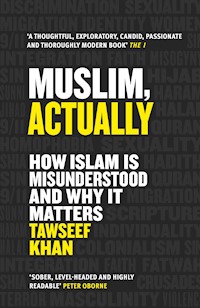
AS RECOMMENDED ON THE TROJAN HORSE AFFAIR PODCAST Why are Muslim men portrayed as inherently violent? Does the veil violate women's rights? Is Islam stopping Muslims from integrating? Across western societies, Muslims are perhaps more misunderstood than any other minority. How did we get here? In this landmark book, Tawseef Khan draws on history, memoir and original research to show what it is really like to live as a Muslim in the West. With unflinching honesty, he dismantles stereotypes from inside and outside the faith, and explores why many are so often wrong about even the most basic facts. Bold and provocative, Muslim, Actually is both a wake-up call for non-believers and a passionate new framework for Muslims to navigate a world that is often set against them Muslim, Actually was previously published in 2021 in hardback under the title The Muslim Problem.
Das E-Book können Sie in Legimi-Apps oder einer beliebigen App lesen, die das folgende Format unterstützen:
Veröffentlichungsjahr: 2021
Ähnliche















Tawseef Khan is a qualified solicitor specialising in immigration and asylum law, and a human rights activist with over ten years’ experience working on refugee and Muslim issues. In 2016 he obtained a doctoral degree from the University of Liverpool, where his thesis explored the fairness of the British asylum system. He was a recipient of a 2017 Northern Writers Award. He is a Muslim and lives in Manchester.
Published in hardback and trade paperback as The Muslim Problem inGreat Britain in 2021 by Atlantic Books, an imprint of Atlantic Books Ltd.
Th is paperback edition published in 2022.
Copyright © Tawseef Khan, 2021
The moral right of Tawseef Khan to be identified as the author of this work has been asserted by him in accordance with the Copyright, Designs and Patents Act of 1988.
All rights reserved. No part of this publication may be reproduced, stored in a retrieval system, or transmitted in any form or by any means, electronic, mechanical, photocopying, recording, or otherwise, without the prior permission of both the copyright owner and the above publisher of this book.
Every effort has been made to trace or contact all copyright holders. The publishers will be pleased to make good any omissions or rectify any mistakes brought to their attention at the earliest opportunity.
10 9 8 7 6 5 4 3 2 1
A CIP catalogue record for this book is available from the British Library.
Paperback ISBN: 978 1 78649 953 0
E-book ISBN: 978 1 78649 954 7
Printed in Great Britain
Atlantic Books
An imprint of Atlantic Books Ltd
Ormond House
26–27 Boswell Street
London
WC1N 3JZ
www.atlantic-books.co.uk
For my brother HaseebAnd everybody out there like him
Contents
Preface to the Paperback Edition
Introduction
1. ‘Muslims Don’t Integrate’
2. ‘Islam Is Violent’
3. ‘Muslim Men Are Threatening’
4. ‘Islam Hates Women’
5. ‘Islam Is Homophobic’
Conclusion: The Muslim Problem
Notes
Acknowledgements
Index
Preface to the Paperback Edition
Like many others I closely followed the news in August 2021 when the United States and its allies withdrew forces from Afghanistan and evacuated citizens from Kabul. Reading reports of human rights abuses inflicted by the Taliban in rural areas while I watched thousands of Afghans rush to Kabul airport, desperate to flee, was an incredibly bleak experience. I had grown up with the shadow of 9/11, the invasion of Afghanistan and the War on Terror always looming over me – it was why I decided to write this book. Seeing the vulnerability and pointless suffering of the Afghan people escalated once more, I felt like a young teenager again, when videos of the Taliban blowing up the Buddhas of Bamiyan, or the Americans bombing the mountains of Tora Bora left me hurt, confused and depressed.
The media began to examine the legacy of America’s war in Afghanistan. On the twentieth anniversary of the Twin Towers attacks, this examination took on the legacy of 9/11. Many journalists concentrated on the psychological toll inflicted by the attacks on the American people, the lives lost on the day or in combat subsequently, and how the American view of interventionist wars had slowly changed. Few considered the legacy of 9/11 from a Muslim perspective.
This is a legacy of extraordinary rendition, kidnapping, indefinite detention, torture, targeted killings and drone attacks abroad; watchlists, surveillance, anti-terror laws and ‘countering violent extremism’ programmes, and racial and religious profiling at home. A legacy of families with deceased, injured or disappeared parents, siblings and children; of societies destroyed and traumatised by war and conflict; of communities stigmatised by the endless cycle of Islamophobia. A legacy in which the language and logic of the War on Terror has been reproduced far outside the West – in Burma, India, China and Sri Lanka, its leaders opportunistically casting Muslims as terrorists and national security threats and perpetual outsiders. A legacy in which Islam is always presented as a metaphor for misogyny and oppression, as we saw when restrictive abortion laws were introduced in Texas and critics invoked images of women in burqas and references to Shariah, ISIS and the Taliban.
It’s a legacy in which nothing has been learnt, but what remains clearer than ever is how deliberate this ignorance is. Without such flattened, distorted representations of Muslims, the West cannot maintain the War on Terror nor the asymmetric relationships it has upheld with the Muslim communities living within its borders. It explains why, twenty years after it first used orientalist clichés to justify war in Afghanistan, the media and political establishment redeployed them to justify withdrawal. US President Biden argued that forging a functioning nation was impossible, that many had tried and failed over the centuries. He was unwilling for American forces to fight and die in a war that Afghans wouldn’t fight for themselves. The media similarly blamed the Afghan people for the failure of the American mission and the Taliban’s resurgence. Afghanistan was the ‘graveyard of empires’, whose citizens were war-hardened and corrupt; where, due to tribal and ethnic divisions and harsh geographic terrain, democracy couldn’t take root. Journalists overstated the Islamic credentials of the Taliban, ignoring how the previous government of Afghanistan had also claimed to be led and inspired by Islam. They selectively wrung their hands over the safety of Afghan women and LGBT people, weaponising their identities while ignoring how Western occupation had failed to ensure their basic needs were met. They emphasised, through a reemphasis on the ‘bad’ brown man, that Afghan men were not deserving of safety or our compassion.
According to the Costs of War project at the Watson Institute of International and Public Affairs, the American mission in Afghanistan killed around 50,000 civilians and 70,000 military and police. Over the last two decades, it has expanded to involve counterterror operations in over 85 countries. It has caused the deaths of more than 929,000 people globally and created over 38 million refugees and displaced people. Countries like Afghanistan and Iraq (where 200,000 civilians are also estimated to have been killed during the war there) have seen so much needless destruction, so much suffering, loss and trauma. People have had their lives completely devastated. For Muslim communities living in the West, the terrain in which we forge our identities has irrevocably changed. We have had to quickly become literate in the hostility we find ourselves facing on a daily basis. We have had to find ways to adapt and succeed whilst processing that stigma. And yet, the Islamophobia train shows no sign of stopping. Despite the two decades that have passed since the beginning of the War on Terror – two decades for our leaders and commentators to improve their understanding of Islam and Muslims – we continue to be portrayed and understood in almost exactly the same way: as savages, misogynists, homophobes and outsiders. As the American scholar Sylvia Chan-Malik commented on Twitter when the Taliban returned to power in Afghanistan: ‘20 years later, everything has changed, yet nothing at all’.
Everything has changed, yet nothing at all. Since the last twenty years have not been enough to drive systemic change on Islamophobia I understand that the publication of this book and the year that has followed – especially a year like this – isn’t either. The Coronavirus pandemic has laid bare the vulnerability of Muslim communities in Britain. According to the Office for National Statistics, between January 2020 and February 2021, Muslims had the highest death rate by faith group, with 966.9 deaths per 100,000 men and 519.1 deaths per 100,000 women. That’s almost two and a half times the death rate of Christian men and twice the rate of Christian women. The government cited the existence of ‘pre-existing health conditions’ within communities of colour to explain away these disparities, but they were, in fact, driven by prevailing socio-economic inequalities related to housing, location and employment. We may have been living through extraordinary, anxiety-filled times, but those inequalities didn’t go away.
Nor did the pervasive atmosphere of Islamophobia in Britain. In fact, Islamophobia is as tedious, repetitive and exhausting as ever. Whether our newspapers are raging about so-called ‘no-go zones’ in the richest, whitest areas of Manchester (Didsbury) or commentators are interrogating Muslim representatives about female imams in a religion that has no formal clergy (Emma Barnett on BBC Radio 4 Woman’s Hour), we Muslims face the same old stereotypes and the same manufactured controversies. We see our leaders cashing in on Islamophobia to win voters with, for example, Keir Starmer, the leader of the Labour party, remaining silent as 1 in 4 Muslim members and supporters report direct experiences of Islamophobia within the party, or the British government rejecting the working definition of Islamophobia developed by the All-Party Parliamentary Group on British Muslims, but failing to produce its own definition more than two years on. In other parts of the West, France in particular, the discriminatory policies and laws being introduced against Muslims are incredibly frightening, serving to make the West a more difficult place for us to live and thrive. Though I fear these developments leave us more vulnerable and more politically homeless, despised by those in power and those close to us, I seek comfort and confidence in the knowledge that it’s not about us, not really. Muslims are mere instruments in broader discourses – scapegoats in various Western battles around values and national identity. Indeed, if Islam is ‘in crisis’, as the French President Emmanuel Macron believes, it isn’t alone.
What I choose to focus on where I can are the pockets of hope. At the 2020 Olympic Games, the rower Mohamed Karim Sbihi became the first Muslim to carry the flag for Great Britain at the opening ceremony. The Dutch-Ethiopian athlete Sifan Hassan became the first to medal in the 1,500 metres, 5,000 metres and 10,000 metres events at the same Games. Elsewhere, We Are Lady Parts, the Channel 4 comedy series about an all-female Muslim punk band, has been ground-breaking in its representation of Muslim women. Each of the five central characters are complex and different, neither victims nor terrorists. The actor Riz Ahmed recently founded the Pillars Artist Fellowship, which seeks to empower emerging Muslim directors and screenwriters towards success. While these developments aren’t going to single-handedly reverse systemic Islamophobia, I hope they reflect our decision to take control and flip the narrative we hear about ourselves. I hope they also reflect an increasing desire to see and tell a different story about Muslim communities. And rather than constituting superficial, tokenistic gestures or singular achievements with no ripple effect, I hope they can be stitched together to create a movement; small, meaningful steps towards sustainable change.
I want this book to be a part of that movement. By complicating the Western narrative about Islam and about Muslim communities, I want to help create a critical mass that can capture the public’s attention, challenge dominant perceptions, and demand a fairer relationship between Islam and the West. Going by my conversations this year, I am optimistic. I’ve received messages from readers eager to understand Islam better and grateful for the arguments I have presented, who wanted to respond meaningfully to the Islamophobia encountered in their day-to-day lives but didn’t know how. I’ve also received messages from Muslim readers excited by the way I examine religious texts or deconstruct contemporary Islamophobia, empowered by my statements encouraging other Muslims to develop individual relationships with faith, or simply happy to be seen and represented by another member of their tribe. I continue to believe in the power of conversations: in sharing experiences to educate and inspire others, in meeting one another’s pain and understanding it, in forging solidarity across communities. Those are the building blocks of real change.
Tawseef Khan, November 2021
Introduction
I was fourteen years old when, during one lunch break in high school, I burst into a classroom and announced that I’d become a pagan. My friends were sat on desks, huddled against a radiator for warmth in a room that we claimed as ours during break times; a room in the Science building that was musty with the smell of animals because it was home to two rabbits and two hamsters, a tank of terrapins and an albino rat. They shrugged in response and continued chatting. My confession came as no great surprise. We already had a pagan in the group, and a white witch too.
This was my first act of rebellion against Islam; against the dogmatic, observance-oriented Islam in which I was raised. My critique of Islam actually began much earlier, as an eight-yearold, when my mother first told me off for breaking my prayers to answer the phone. Precocious perhaps, maybe also unbelievable that I was criticizing religion at such a young age, but my mother had been teaching me about Islam since I was able to speak, and I was incredibly sensitive about being told what to do. When she chastised me in front of my cousin, I was so humiliated I began to privately question the very ritual I was participating in.
As I got older, the limits imposed on my relationship with Islam became clearer. I wasn’t supposed to question doctrine; God had supposedly determined every aspect of our religious practice. To critique Islam, therefore, was to be a bad Muslim who was destined for hell. When I was old enough to pray independently, my mother began pushing me to perform my five compulsory daily prayers. She warned me about God’s punishment if I didn’t comply. Sometimes I would pretend to fall asleep to avoid them, but she would yank off the bedcovers and send me to wash. And in the bathroom, as I sulkily cleaned my hands, my ears, my nose, my face, my arms, my neck and then my feet, I would ask myself why God wanted this. What was the point in prayer if my heart wasn’t in it? Prayer was more than a series of movements showing off my religious devotion. If God refused the prayer I had broken off in order to answer the phone, then surely God would also refuse these unhappily performed prayers I was offering as a teenager?
So my frustration had been bubbling away for several years when I adopted paganism. I knew that many Muslims would have found my behaviour disrespectful, insubordinate, insulting to Allah even, but I didn’t care. I needed to register my complaint with Allah. I was angry with God and felt that I had every right to be. I had been deeply unhappy for such a long time. It was not the general melancholy and malaise that teenagers experience during puberty. It was rooted in my discontent with how Islam was being framed, as something based around observance, permissibility and submission.
Today I can understand my parents’ decisions a little better – they were trying to shape my identity in a non-Muslim landscape as best they could. They were trying to instil me with self-worth. They wanted to save me from feeling dislocated as a British-Pakistani Muslim – from being caught between two worlds – especially as they navigated their own feelings of disorientation living in a country where they hadn’t been born. But that ended up happening anyway. Using Islam in such a way led to a crisis of faith. There was nobody to talk it over with. Protesting to God seemed like the only thing I could do.
Every protest has its critics. Maybe you would have criticized mine. Aft er all, I had no idea what paganism actually involved. Was it enough that I felt a greater ‘connection’ to nature than to my community? Probably not. And to all intents and purposes, I continued to live a tangibly Muslim life. It didn’t occur to me to change that. Besides, I hadn’t given up believing in God altogether. I fasted (because I enjoyed it), prayed (when I couldn’t get out of it) and travelled to Saudi Arabia for umrah. At the ages of fifteen and twenty-two, I performed this pilgrimage with my family. Both times, I sat inside the sacred mosque in the city of Mecca and spoke to Allah in the same way: ‘I am stuck. I am angry with you. You know this. You know why.’ I prayed for a solution. But as much as I sought distance from my religious identity, to get some perspective on its place in my life, the world would not allow it.
The attacks of 9/11 occurred a short time aft er I first registered my protest with Allah. The effect was that my personal spiritual crisis began to unfurl in the shadow of a much larger political and religious one. Before I had even developed a sense of who I was as a Muslim, I was on the back foot. I felt like I was carrying a narrative – what would become perhaps the defining narrative of our time – of a war brought to the West by terrorists inspired and guided by ‘radical Islam’. In the years to come, I would be weighed down by this burden. It coloured my internal struggle and I could not escape it. I remember the jokes made by high-school acquaintances, where the punchline centred on me being a terrorist. How my friends laughed without hesitation, and I felt such impotence at having no comeback.
I went shopping with my mother in Manchester city centre the day aft er the London bombings of July 2005. As we walked along the high street I felt tension rising in my body. There was the distinct feeling of self-consciousness, of being monitored, of deliberation over every step in case we stoked someone’s anger. The latent threat of reprisals seemed to be everywhere. Mum’s hijab clearly identified her as a Muslim, and for those looking to blame the bombings on Islam, she’d be fair game. We expected it. We had already heard about the anti-Muslim attacks on the news.
Then there was a visit to Latvia in February 2007. Aft er dinner, I walked back to my hostel in Riga with some friends. A man approached me with an invitation to attend a club he was promoting. When I declined, I watched his expression turn ugly and aggressive. ‘You big Osama,’ he said, as he gestured towards my facial hair. ‘You very, very big Osama.’
In those years, Muslims were barely represented in public life and, when we were, media coverage was bleak and unwavering. ‘We tend to write about Muslims mainly when they cause trouble,’ the journalist Brian Whitaker once admitted.1 Newspapers that had mostly ignored Muslims before 9/11 (resulting in scant knowledge about Islam amongst journalists, and even less amongst the public) were suddenly obsessed, writing almost 600 per cent more articles about us than in the years before – and that was just 2001–2002.2 In those pieces, representation was constructed almost entirely in the context of terrorism. We went from being more or less invisible to every aspect of our existence being connected to and framed by violence and hatred. Media outlets assembled panel discussions to understand the ‘trouble’ with Islam. In 2005, Jyllands-Posten, a Danish newspaper, published caricatures of Prophet Muhammad (peace be upon him) that seemed to be a deliberate provocation to Muslims.3 It was not just that the Prophet had been illustrated that was the problem, but that many of these representations reinforced stereotypes about Muslims in general: he was depicted with devil horns, holding a sabre and preparing for battle, and with a bomb inside his turban (which was inscribed with the shahadah – the Islamic declaration of faith). Muslims, who already existed on the margins of society, were being vilified and even further excluded. A Daily Mail article by Richard Littlejohn seemed to summarize feelings about Islam at the time, ‘If they hate us so much, why don’t they leave?’4
This portrayal of Muslims as illiberal and violent was regurgitated across the media. It infected everything. Even well-meaning representations upheld racist tropes; the media assumed that all Muslims were bad unless and until we could perform our ‘goodness’ and, when we did, these examples were celebrated as proof that some Muslims could theoretically assimilate into Western society. Young Muslims, like me at that time, saw Islam being portrayed as regressive, barbaric, bloodthirsty and incompatible with Western modernity. We tried to counteract these stereotypes and hoped that we could find a way out of this narrative. But inevitably we internalized their alienating rhetoric – how could we have avoided it? – causing us to feel split within ourselves and fight a battle with our identities.
I am a product of the construct that is the ‘War on Terror’. I am one of its children. There are so many of us. I consumed its negative messaging and found myself recoiling from my religious identity. Every time a Muslim was responsible for a terror attack somewhere around the world, I lashed out at my faith and myself. My critiques of Islam became harsher. I resented my heritage and my community. I became uncomfortable openly identifying as Muslim, with Islamic practice that I had decided was shallow and performative. To greet another Muslim and give them my salaam – the most basic expression of human kinship – was something that I struggled with deeply. I had no coherent sense of self. I became extremely depressed.
And yet, despite all the years that have passed since my adolescence, I’m dismayed to see that the situation hasn’t improved. If anything, it has grown worse. Young Muslims are developing their identities in a climate of unparalleled hatred, fear and stigmatization. The Right is in ascendance across the Western world, and Muslims continue to be ‘othered’ in new and surprising ways. This rhetoric of ‘war’, of the West fighting the Muslim world, and the very notion of the Muslim world as a foreign, external entity, is an ingrained and historic one. But it is more pervasive and harmful than ever before, in part because of the massive influence the media has in shaping our lives and identities, particularly the lives of young people. Human beings look to the environment around us to understand ourselves and give meaning to our existence. If the messaging coming from the media about you is negative, or one in which you don’t exist at all, it causes untold damage to your self-esteem and how you move through the world.
Jawaab is a British charity that focuses on young Muslims. In 2018, they found that 61 per cent of young Muslims surveyed had either personally experienced Islamophobia or knew somebody who had; 60 per cent felt the pressure to suppress their Muslim identities, especially when travelling or operating in work environments; and 43 per cent felt conflicted in their identities, citing extremism, disenfranchisement and evolving relationships with Islam as the main reasons for this.5 The report detailed experiences of struggling to resist negative stereotypes associated with Islam. As one young Muslim woman said: ‘I’ve felt excluded. When you’re young all you’re trying to do is belong, be accepted… It’s difficult being not white. Then you’re not white, and you’re a Muslim and female.’
I worry about how my brother is being shaped by the continuing War on Terror. When I began writing this book, he was twenty years old (I am ten years older than him) and in the middle of studying for a degree in Biology. Early on, I asked him about being a Muslim in Britain. He replied with his knowledge that no matter how busy public transport was, how crowded a university lecture happened to get, the space next to him on the bus or in the lecture hall always remained empty. He insisted that he ‘didn’t care’ about being singled out, but I know first-hand that creating an identity in opposition to ever-present stigma isn’t easy, that this identity always lacks something; it is never fully whole. My brother’s knowledge of Islamophobia is still in its infancy. It will grow, and his twenties will be a critical time for him and the making of his identity. If there is a way to make that journey better – smoother – for him, I want to find it.
Across the West, the overdue conversation about race is commanding more attention than it has for years. That conversation has been forged by many different segments of our societies: the emergence of activist movements like Black Lives Matter; musicians, actors and athletes like Beyoncé, Jesse Williams and Colin Kaepernick using their celebrity to bring attention to racial injustice; social media platforms providing the space for individuals from all walks of life to learn, engage and organize; and conditions like the coronavirus pandemic in which racial inequalities become extremely difficult to ignore. Books have been integral to this conversation – through those such as The Good Immigrant, Brit(ish), Natives and Why I’m No Longer Talking to White People About Race, British writers of colour are claiming and creating spaces where they can voice their experiences of discrimination and othering, educate and push for systemic change. But as much as I’m inspired by these conversations, the prospect of giving voice to another overdue conversation – about the West and its relationship with Muslims – is daunting. Where do I begin?
I know when the need for that conversation first dawned on me. I was born and raised in the city of Manchester. I am a proud Mancunian. The terrorist attacks that have occurred near constantly around the world over the last twenty years both horrify and depress me, even as they oft en barely cause a ripple in our news cycle. But as a Mancunian, I can’t deny that it was the bombing of the Manchester Arena in May 2017 that had the most profound and long-lasting effect on me.
I remember lounging on the sofa as the news came in. My parents were watching a Pakistani news channel, so we heard it in Urdu first, then quickly flipped channels to watch the BBC. My body grew numb as I watched the details emerge, as I picked out various parts of my city from the coverage. I would never have imagined that Manchester could be targeted in this way.
Late into the night, my Muslim friends and I texted each other in disbelief. Our initial feelings were of heartbreak. An attack on our city felt like an attack on us. But where there was vulnerability and anger, there was also relief that we and our loved ones were safe. On any other night, I could have been there. Some of my happiest memories of Manchester involve dressing up and attending pop concerts at the Arena. So, when we texted each other that night, we also mourned the way that things sacred to us all – life and freedom, music and the innocence of youth – had been violated. Then, as the news sank in, we began to fear how this event would change things for us. What would it mean for Muslims living in Manchester, in the UK? Would we be at the forefront of the backlash?
This fear did not subside in the weeks aft er the attack. I watched Mancunians unite and felt heartened by the refusal to be divided, but the attack was a jolt. It was impossible to forget it and move on. Around Manchester, raids were being conducted on houses and arrests made. The bomber’s links to Libya and Didsbury Mosque in South Manchester – a mosque I have visited – were under investigation. Intelligence officials continued to insist that a second attack was imminent. There was every reason to feel tense. But there was another dimension to my fear, to the fear felt by other Muslims. Amongst the calls for defiance and unity, the voices of anger and dissent felt like they were directed at me. Islamophobic hate crimes surged again.6 Some critics demanded that Muslims condemn the attack; always there is this transferral of anger, a pressure that we bow down and atone for crimes committed by people with whom we share nothing but our faith (if we share that at all). The singer Morrissey, for example, lambasted Sadiq Khan, the Mayor of London, for his failure to condemn Islamic State, which had assumed responsibility for the bombing.7 Other commentators restated Islam’s incompatibility with the West. In this vein, the newspaper columnist Katie Hopkins chillingly tweeted the need for a ‘final solution’.8 Taken with the Westminster attack that had occurred two months before Manchester, and the London Bridge attack that took place a fortnight aft er, the summer of 2017 was a frightening one for us all, but especially terrifying if you were a British Muslim.
A few days aft er the attacks, I wrote to a number of literary agents and sent them a proposal for this book. I had been working on the idea for some time. I wanted to write something that addressed how badly Muslims were perceived in Britain and also supported young Muslims who were struggling with their identities as I once had. These motivations crystallized in the aft ermath of the Manchester terror attack. I felt a sudden urgency to communicate with the world, to speak about how Muslims were developing their identities in societies where their faith is considered poisonous. I wanted to speak about how gruelling it was to accept these successive hits to our collective self-esteem.
I was too young to fully comprehend the significance of 9/11 or even the 7/7 attacks (especially what impact they would eventually have on my life as a Muslim), but this time – with Manchester – I did. I had lived through years of Islamophobia. I was familiar with the harm it caused and could articulate that experience. For me, the Manchester attack drew a line in the sand; we could go no further down this destructive path without having a real conversation about anti-Muslim bigotry and hatred.
At the same time, the line in the sand represented to me how critical it had become to address the oppressive beliefs and practices that hold sway amongst a minority of Muslims, including those that justify violence, oppression or the marginalization of vulnerable groups (women and sexual minorities, for example). These practices are not part of the Islam I follow and recognize. Islam has ethics at its core. Like all mainstream religions, it is concerned with how we treat one another on this planet. As Prophet Muhammad once said: ‘None among you is a believer until he wishes for his brothers and sisters what he wishes for himself.’ So this was not simply about the beliefs that might have inspired the attack on Manchester Arena; it was about the beliefs I had been battling my entire life.
Contrary to the strategies adopted by the government, I believe that these narratives are best neutralized by Muslims themselves. I know that countless Muslims are quietly getting on with this work, but equally, many within our communities have underestimated the scale of the task before us. Their neglect has allowed our religious beliefs to be hijacked, for unjust practices to take hold; if they didn’t actively encourage them, many in our communities at least watched them unfold. This narrowing of religious expression resulted in many of my early religious experiences being shaped not by autonomy, empowerment and self-direction, but by duty, authority and inflexibility. And although I am an adult now, this stagnation still registers. It still prevents us from neutralizing extremist or otherwise oppressive beliefs effectively. It still prevents some young Muslims from developing an empowered relationship with Islam.
By writing this book, I want to take the opportunity to dispel long-standing myths about Muslims that have been allowed to circulate and evolve in our societies unchecked. We are perhaps the most misunderstood – and misrepresented – minority group living in the West today. Myths exist within Muslim communities too – oft en along similar lines; Islam tends to be completely misunderstood by many of its own followers. By challenging the preconceptions of Muslims and non-Muslims alike, I hope to share a true picture of what it’s like (and what it can look like, should you want it to) to be a Muslim living in the West today.
The fear, prejudice and hatred that are directed towards Muslim communities are more commonly described today as ‘Islamophobia’. The All-Party Parliamentary Group on Muslims has defined Islamophobia as ‘a type of racism that targets expressions of Muslimness or perceived Muslimness’.9
There’s a great deal of resistance to this term being used. Some figures argue that criticizing Islam and Muslims isn’t a form of racism; that describing it as such is an attempt to silence such criticisms.10 Other objections hone in on the fact that Muslims aren’t a singular race and, therefore, can’t be subject to racism on grounds of their religion. Some agitators position themselves as independent and unbiased, so that their criticisms of Islam are treated as facts that they’ve arrived at fairly and logically.11 But we should reflect on the reasons why a person might object to the term being used. For example, describing something as Islamophobic helps us to bring attention to bigotry. Denying the term altogether allows those propagating myths about Islam and Muslims to do so without being held accountable.
Moreover, using the term Islamophobia is appropriate in a discussion about how Muslims are treated because it’s the right term. We use Islamophobia not because Muslims are perceived as being ethnically homogenous, but in reference to the way that Muslims are racialized.12
Let me explain what I mean by this. Race is a social construct. As a concept it was invented during the European Enlightenment to advance the superiority of one group of people over others, namely the superiority of white people over everybody else. Islamophobia, then, is a type of racism. As part of it, Muslims are constructed as a singular, homogenous group and broad arguments are used to dehumanize and assert Western moral and intellectual superiority over us. Like all forms of racism, Islamophobia is rooted in power, in particular the power held by the powerful to define the way Muslims are perceived and treated. As Muslims don’t hold an equivalent amount of power and influence within British society (nor do they in other Western societies), we don’t have the ability to effectively challenge the way we are portrayed. That’s why it’s important for us to describe anti-Muslim prejudice as Islamophobia: it isn’t just bigotry, it’s racism. It has that added edge. And since our constructions of race are malleable, shift ing as dominant powers need, it’s no defence to maintain that Muslims are not a race. For all intents and purposes, we exist as one in the minds of those who hate us.
Moreover, Islamophobia is racism because it has structural, institutional limbs. Anti-Muslim prejudice exists in all areas of public life, at every level of society, and it limits the opportunities we have access to. Examples of Islamophobia can be found within the media and the criminal justice system, in the areas of education and housing. Muslims have to engage with the reality that anti-Muslim attitudes determine their life experiences, whether in the job market, at a restaurant or even in an act as banal as obtaining car insurance.13 In his report about the police investigation into Stephen Lawrence’s murder, Lord Macpherson defined institutional racism as:
the collective failure of an organization to provide an appropriate and professional service to people because of their colour, culture, or ethnic origin. It can be seen or detected in processes, attitudes and behaviour which amount to discrimination through unwitting prejudice, ignorance, thoughtlessness and racist stereotyping which disadvantage minority ethnic people.14
When I say that Islamophobia is structural or institutional, I am describing how the British government has implicitly and explicitly endorsed anti-Muslim sentiment to further its own goals. There is no clearer example than Prevent, the British government’s counter-radicalization programme. As part of Prevent, police officers are tasked with building relations with organizations across the UK, that are then encouraged, even forced – as teachers, doctors and other public sector workers are forced – to refer ‘suspicious behaviour’ to a local Prevent body.15 This initiative has been criticized for many reasons, including its incursions on the right to free speech and its policing of ‘acceptable’ Muslim behaviour. (There’s a cruel, hypocritical irony to the way that critics of Islam rely on free speech rights to say what they want about Muslims even as the government takes steps to curb our own rights to the same.) Prevent has criminalized countless innocent Muslims, including many young children. Teachers at one school in Luton referred a fourteen-year-old student to the Prevent authorities. His crime? He had attended school wearing a pro-Palestine badge and later tried to fundraise for Palestinian children living under Israeli bombardment.16 Pointing out the institutional nature of Islamophobia shows not only how anti-Muslim sentiment has infiltrated all aspects and levels of British society, but also the fact that this infiltration is nearly always state-sponsored.
The state’s exploitation of Islamophobia is strategic. It has been used to maintain what Reni Eddo-Lodge describes as ‘systemic power’.17 Time and time again, politicians pit Muslim communities against the rest of British society to advance their aims. Consider the 2016 election campaign for the Mayor of London. Leaflets from the Conservative candidate, Zac Goldsmith, targeted Hindu voters and claimed that Goldsmith would stand up for them, whilst Sadiq Khan, the candidate for Labour, would tax their jewellery.18 His campaign sought to portray Khan as a terrorist sympathizer, disseminating materials that called him ‘radical and divisive’. Then prime minister David Cameron pushed this line of attack at Prime Minister’s Questions, accusing Khan of ‘sharing a platform with extremists’, including an alleged supporter of Islamic State.19 (Cameron was later forced to apologize to the imam concerned, who was not a supporter of Islamic State at all.) Goldsmith authored an article for the Mail on Sunday – accompanied by a picture from the 7/7 attacks – in which he claimed that Khan ‘repeatedly legitimised those with extremist views’.20
In August 2018, Boris Johnson used his column in the Telegraph to compare niqab-wearing Muslim women to letterboxes and bank robbers.21 Pressed to apologize, he refused. Following an investigation, the Conservative Party cleared Johnson of Islamophobia, finding him to be ‘respectful and tolerant’.22 It speaks volumes about attitudes in the Conservative Party that none of their most senior politicians stepped in to criticize his comments or the outcome of the inquiry. This mealy-mouthed response, Johnson’s naked (and obviously successful) calculation that such remarks would help with his goal of occupying No. 10 Downing Street, and the media’s commentary have demonstrated how Islamophobia operates in our societies. Writing for the Guardian, Polly Toynbee accepted that Johnson’s words were a clarion call to racists.23 And yet, she went on to regurgitate familiar tropes about Muslim women lacking agency and being dehumanized by the veil.
This is what everyday Islamophobia looks like. Way back in 2011, Baroness Sayeeda Warsi warned that Islamophobia ‘has passed the dinner-table test’ – but it has more than passed the test. It has facilitated access to some of the highest tables in the land.24There is political capital in Islamophobia; it’s clearer than ever that the state and media work in tandem to extract it.
What also remains clear is that contemporary Islamophobia appears in markedly different forms to ‘traditional’ racism. We mistakenly restrict our understanding of racism to ugly, abusive language and behaviour. But this, paradoxically, enables racism because actual racism can be far more subtle and sophisticated. Using hints and suggestions rather than insults, it allows racist messaging to pass as harmless, as long as it doesn’t contain language that is explicitly offensive.
Zac Goldsmith’s campaign demonstrated the slippery insidiousness of contemporary Islamophobia. The Tories didn’t explicitly call Sadiq Khan a terrorist. They simply linked his Muslim identity to the ongoing discourse around Islamic extremism. By describing him as ‘radical and divisive’, and by claiming that he shared platforms with extremists, the entire campaign was designed to discredit his candidacy. They used his religion to do that. With cleverly coded messages, the campaign preyed on people’s fears without abusing Khan outright and, in doing so, managed to escape accountability.
But basing a campaign on Islamophobia was a colossal miscalculation, especially in a city as cosmopolitan as London. In the days aft er Goldsmith’s article was published, his vote share plunged to 32 per cent in the polls.25 It recovered to 35 per cent by the time of the first-round vote, but this still represented a 9 per cent drop in the Tory share on the previous election. By contrast, Khan became the most senior directly elected official in the UK, and the first Muslim mayor of a Western capital. When Khan finally called out the tone of the campaign, Goldsmith denied referencing his religious or ethnic identity and accused Khan of ‘calling Islamophobia to prevent legitimate questions being asked’.26 It’s worth noting that Goldsmith has never suffered for his actions; despite losing his seat in the 2019 general election, he was awarded a life peerage and sits in the Conservative cabinet as Minister for the Environment. If anything, his racism has been and continues to be rewarded.
Our media disseminates Islamophobia with the same toxic mix of doublespeak, fearmongering and falsehood. When the child-grooming scandals blew up in Rochdale, Newcastle and Rotherham, conversations around toxic patriarchy and misogyny were employed to stigmatize Muslim communities.27 Despite successive outcries about the treatment of vulnerable young women by the media, the victims were used as fodder to make more insidious arguments about the nature of all Muslim men. The Times newspaper also broke the hysteria-laden story of a white Christian child ‘forced into Muslim foster care’ by Tower Hamlets council.28 The foster carers were described in terms that were a dog whistle to those who dislike Muslims; they ‘didn’t speak English’ – one of them wore a niqab. The story alleged that they had removed a cross from the child’s neck and left her ‘sobbing’. The implication was that the Muslim foreignness of the carers meant they were unfit to take responsibility for this girl. In fact, Andrew Norfolk, the investigative reporter who first broke this story, is responsible for most of the Islamophobic stories published by The Times in recent years – almost all of which have been proven to be unfounded.29 The effect of these stories is to amplify the anti-Muslim climate.
In just eighteen months, Miqdaad Versi from the Muslim Council of Britain won more than forty corrections from the British print media over misleading stories about Islam and Muslims.30 The corrections have challenged reports, for example, that one in five British Muslims sympathize with jihadis, that Muslims are ‘silent on terror’, and that there was an ‘Islamic plot’ to take over a school in Birmingham, and a separate plot in Oldham. These kinds of falsified stories are directly responsible for the growth in the number of British people who see Islam as a threat to Western democracy (more than half, according to a poll conducted by YouGov).31 And they’re responsible for 31 per cent of schoolchildren believing that Muslims have taken over England.32 Even Gary Jones, the new Editor-in-Chief of the Daily Express, has come to acknowledge the ‘Islamophobic sentiment’ within the British media.33
I call this barrage of negativity a destructive influence on British society because it hurts so many of us. The constant vilification and humiliation of Muslims, and the experiences of structural discrimination and state-sponsored stigma only force Muslim communities into a corner, where we are constantly defending ourselves from attack. Withstanding Islamophobia takes energy from Muslim communities – energy that could be better directed inwards. But this, as Toni Morrison argues, is its very purpose: ‘The function, the very serious function of racism is distraction. It keeps you from doing your work. It keeps you explaining, over and over again, your reason for being.’34 The endless barrage of negativity stifles the ability of Muslim communities to improve themselves, critique themselves and develop healthy self-esteems. It’s also destructive because it erodes trust and relations between communities. It damages the way that non-Muslims perceive their Muslim neighbours, leading many to absorb unquestioningly the rhetoric that Muslims cannot live peacefully in the West. How can we live in a society where we have an irrational dislike and distrust of our neighbours?
And I call it destructive because Islamophobia puts lives at risk. The same month as the attack around London Bridge in 2017 (in which eight people were killed and forty-eight injured by three assailants), there was an incident outside Finsbury Park mosque. A white van ploughed into worshippers emerging from the mosque aft er tarawih prayers – the nightly prayers conducted in the evenings during Ramadan. Witnesses quote the driver as saying, ‘I want to kill all Muslims’ and ‘this is for London Bridge’ – referencing that earlier attack. Darren Osborne, the perpetrator, was sentenced to life for murder and attempted murder, with the judge identifying that his targeting of people wearing traditional Islamic dress reflected his ‘ideology of hate towards Muslims’.35 The trial revealed that Osborne had been radicalized in a matter of weeks, consuming anti-Muslim material over the Internet from Stephen Yaxley-Lennon (more commonly known by his alias, ‘Tommy Robinson’), the former leader of the English Defence League (EDL), and from Britain First.
But anti-Muslim hatred is also born out of a specific historical context. What I mean by this is that the West, particularly Western Europe, has a long tradition of feeling threatened by Islam, responding by debasing Islam and racializing Muslims as ‘other’. Drawing the link between this old bigotry and the anti-Muslim sentiment that exists today is vital. It helps us to appreciate the irrationality that is at the core of all anti-Muslim sentiment. Because the criticisms of Islam that circulate in our societies today aren’t reasoned arguments, but myths that have been around for centuries, myths drawn from very limited interaction with actual Muslims. The belief that Muslims are violent and barbaric is, in fact, an archaic stereotype that was formulated at a time when the West had little to no experience of Islam and Muslims and even less knowledge. When reviving these arguments, Islamophobes might try to give them a sheen of reasonableness and respectability – using secular, dispassionate language, applying them to a contemporary context – but we should see through them. Throughout history, the West has used these exact stereotypes to humiliate and pigeonhole Muslims and they have the same effect today. All this supposed logic and neutrality is but mere posturing; it’s to mask the cultural entitlement and hegemony that the West adopted towards Islam many centuries ago and has refused to abandon ever since.
To understand the roots of Islamophobia we must first understand Christianity. When Muslims emerged from the Arabian Peninsula in the Middle Ages, the Christians of medieval Europe were wrestling over power and doctrine. Christianity had five seats of power (Rome, Constantinople, Alexandria, Antioch and Jerusalem) competing for influence, and it was dealing with a series of splits and schisms. For example, the East–West Schism in 1054 resulted in the separation of the Catholic and Eastern Orthodox churches. At this time, Christian Europe paid little attention to the Muslims. Islam, it assumed, was another of its deviant sects. Muslims, aft er all, also believe in one God and the Abrahamic prophets.36
But as the Muslim empires rapidly spread, Christianity couldn’t afford to ignore Islam any longer. Muslims had conquered large swathes of traditionally Christian land: in Spain, North Africa and the Levant, for example, including the power bases of Alexandria, Antioch and Jerusalem. More troubling was the fact that Christians were willingly converting to Islam in substantial numbers, and this posed a huge threat to Christianity’s integrity. The fear of losing followers, of being wiped out, disturbed Christian leaders and they fumbled for an explanation for this loss of face. Some leaders looked to scripture for an answer; they found it in references to the Apocalypse. Muslims were no longer viewed as belonging to the collective pantheon of wayward Christian sects. Instead, they came to be seen as the fulfilment of Biblical ‘barbarians’ and ‘tyrants’, sent by God to challenge the faithful. Once destroyed, Christianity (in its rightful form of Catholicism) would finally reign supreme.
In the absence of actual knowledge and understanding, the Christian leaders of medieval Europe concocted outrageous descriptions to explain to their followers why this particular schism, this inferior ‘heresy’ of Islam, was spreading across the world in place of the ‘true’ Christian faith. Of course, the problem was that Islam challenged not just Christianity’s destiny (an un -assailable trajectory towards becoming the universal religion), but also the various churches’ doctrines, such as the divinity of Jesus. Thus, Islam was a monster set to destroy Christianity and its followers were heretics and pagans. They reserved the worst insults for Prophet Muhammad; discrediting the Prophet delegitimized Islam itself. He was portrayed as lustful and violent, a fraud who had taken Christian theology and distorted it for his own gain. The Spanish theologians Eulogius and Paulus Alvarus associated the Prophet with the Antichrist, the former claiming that he was ‘seduced by demonic illusions, devoted to sacrilegious sorcery’.37
Then, in November 1095, Pope Urban II delivered a sermon in which he declared Christianity in serious trouble.38 The Holy Land was under Muslim control. ‘[A] people… alien to God’ had tortured Christians and desecrated the Holy City, Jerusalem. They were violent, barbaric; they raped women. He called upon Europe to rise up as the ‘soldiers of Christ’ and take it back. The First Crusade took the Muslim regions by surprise; in recapturing the Holy Land, the Christian army massacred 30,000 Muslims and Jews in Jerusalem. Its legacy (as documented in medieval chronicles of the Crusades) was the establishment of Muslims as a ‘vile and abominable race’, ‘fit only for extermination’.39
For several centuries the Crusades dragged on and, when the appetite for war petered out, a more nuanced set of personal and political relationships resumed between Muslims and Christians. But in 1492, the Spanish monarchy recaptured Spain from the Muslim Umayyads and this relationship shift ed again. The monarchy expelled Muslims and Jews from the territory and those remaining were forcibly converted to Christianity. But the Spanish continued to persecute the converts, then expelled them from their territory in 1609. It’s perhaps worth remembering that Europe can only be said to have a Christian identity – as critics hostile to Islam tend to argue – because Jews and Muslims were driven out.




