


139,99 €
Mehr erfahren.
- Herausgeber: John Wiley & Sons
- Kategorie: Wissenschaft und neue Technologien
- Sprache: Englisch
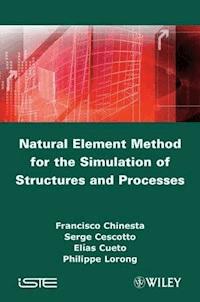
Computational mechanics is the discipline concerned with the use of computational methods to study phenomena governed by the principles of mechanics. Before the emergence of computational science (also called scientific computing) as a "third way" besides theoretical and experimental sciences, computational mechanics was widely considered to be a sub-discipline of applied mechanics. It is now considered to be a sub-discipline within computational science. This book presents a recent state of the art on the foundations and applications of the meshless natural element method in computational mechanics, including structural mechanics and material forming processes involving solids and Newtonian and non-Newtonian fluids.
Sie lesen das E-Book in den Legimi-Apps auf:
Seitenzahl: 266
Veröffentlichungsjahr: 2013
Ähnliche
















Table of Contents
“Fondation Cetim” 2008 AwardForeword
Acknowledgements
Chapter 1: Introduction
1.1. SPH method
1.2. RKPM method
1.3. MLS based approximations
1.4. Final note
Chapter 2: Basics of the Natural Element Method
2.1. Introduction
2.2. Natural neighbor Galerkin methods
2.3. Exact imposition of the essential boundary conditions
2.4. Mixed approximations of natural neighbor type
2.5. High order natural neighbor interpolants
Chapter 3: Numerical Aspects
3.1. Searching for natural neighbors
3.2. Calculation of NEM shape functions of the Sibson type
3.3. Numerical integration
3.4. NEM on an octree structure
Chapter 4: Applications in the Mechanics of Structures and Processes
4.1. Two- and three-dimensional elasticity
4.2. Indicators and estimators of error: adaptivity
4.3. Metal extrusion
4.4. Friction stir welding
4.5. Models and numerical treatment of the phase transition: foundry and treatment of surfaces
4.6. Adiabatic shearing, cutting, and high speed blanking
Chapter 5: A Mixed Approach to the Natural Elements
5.1. Introduction
5.2. The Fraeijs de Veubeke variational principle for linear elastic problems
5.3. Field decomposition
5.4. Discretization
5.5. Discretized equations
5.6. Matrix solution for linear elastic problems
5.7. Numerical integration
5.8. Linear elastic patch tests
5.9. Application 1: pure bending of a linear elastic beam
5.10. Application 2: square domain with circular hole
5.11. Mixed approach to nonlinear problems
5.12. Step-by-step solution of the discretized nonlinear equations
5.13. Example of an elastoplastic material
5.14. Application: pure bending of an elastoplastic beam
5.15. Conclusion
Chapter 6: Flow Models
6.1. Natural element method in fluid mechanics: updated Lagrangian approach
6.2. Free and moving surfaces
6.3. Short-fiber suspensions flow
6.4. Breaking dam problem
6.5. Multi-scale approaches
Chapter 7: Conclusion
Bibliography
Index
First published 2011 in Great Britain and the United States by ISTE Ltd and John Wiley & Sons, Inc. Adapted and updated from La méthode des éléments naturels en calcul des structures et simulation des procédés published 2009 in France by Hermes Science/Lavoisier © LAVOISIER 2009
Apart from any fair dealing for the purposes of research or private study, or criticism or review, as permitted under the Copyright, Designs and Patents Act 1988, this publication may only be reproduced, stored or transmitted, in any form or by any means, with the prior permission in writing of the publishers, or in the case of reprographic reproduction in accordance with the terms and licenses issued by the CLA. Enquiries concerning reproduction outside these terms should be sent to the publishers at the undermentioned address:
ISTE Ltd27-37 St George’s RoadLondon SW19 4EUUKJohn Wiley & Sons, Inc.111 River StreetHoboken, NJ 07030USAwww.iste.co.ukwww.wiley.com© ISTE Ltd 2011The rights of Francisco Chinesta to be identified as the author of this work have been asserted by him in accordance with the Copyright, Designs and Patents Act 1988.
Library of Congress Cataloging-in-Publication Data
Chinesta, Francisco.
Natural element method for the simulation of structures and processes / Francisco Chinesta.
p. cm.
Summary: “This book presents a recent state of the art on the foundations and applications of the meshless natural element method in computational mechanics, including structural mechanics and material forming processes involving solids and Newtonian and non-Newtonian fluids”-- Provided by publisher.
Includes bibliographical references and index.
ISBN 978-1-84821-220-6 (hardback)
1. Materials--Mechanical properties--Mathematical models. 2. Numerical analysis. 3. Numbers, Natural. I. Title.
TA404.8.C486 2011
624.1'7015118--dc22
2010048621
British Library Cataloguing-in-Publication Data
A CIP record for this book is available from the British Library
ISBN 978-1-84821-220-6
“Fondation Cetim” 2008 AwardForeword
Cetim, an 850-member strong organization, is recognized nationally and internationally due to its applicable research and contribution to the innovation of the mechanical engineering industry. In this world of globalization, with exchanges and the increasing exacerbated competition, it became apparent to us to prepare the long-term future by expanding basic research through the creation of Cetim. This was done to encourage university laboratories to develop scientific works in response to the challenges of the competitive mechanical engineering industry.
Since its foundation in 2003, Cetim has given financial support to around 10 large scientific projects, associating approximately 40 laboratories.
But once these scientific advances have been obtained, the most important thing is to make them known to the community, especially to engineers and industrial mechanics. This is why Cetim also promotes the publication of results in a monographic form, leaving a great scope for potential applications of this new knowledge, by allotting each year one or more awards to the authors of particularly remarkable monographs.
The Cetim award was thus allotted in 2008 to the research team that carried out this work and devoted itself to establishing the foundations of an original and promising method, the natural element method, in the field of the numerical simulation of structures and material forming processes.
Numerical simulation is indeed advancing with great steps and is of great importance to the mechanical engineering industry. Simulation certainly makes it possible to guarantee the speed and reliability of conception, to open the field of innovation, and especially to reduce the time and cost of conception. A survey led by the research company Aberdeen Group carried out in 2006 on mechanical manufacturers revealed that the large manufacturers who intensely used the numerical simulation of structures and processes made less than half physical prototypes than the average manufacturer, and put their products on the market 58% early, with the design cost being 50% lower.
The natural element method should make a significant contribution in response to the vast competitiveness of mechanical companies.
Michel Laroche
Chairman of Cetim
Acknowledgements
The authors would like to extend their thanks to everyone who contributed to the results shown or described in this book, especially: I. Alfaro, D. Gonzalez and M. Doblare from the University of Saragosse; J. Yvonnet from the University of Marne-la-Vallée; L.A. Illoul from Arts et Métiers ParisTech; as well as M. LI Xiang, doctorate at the University of Liège (Belgium) and the University of Technology of Dalian (People’s Republic of China).
Chapter 1
Introduction
“Meshless” methods are alternative techniques to the finite element method in solving partial differential equations. While the finite element method derives an approximation based on the elements, using shape functions, the meshless methods allow us to derive an approximation at any point; thanks to the information provided by the surrounding nodes. In these approaches the concept of element is thus not used any more. Connectivity between the nodes is not defined any more by the mesh but only by the concepts of “vicinity” or “field of influence.” These methods were developed with the aim of avoiding the numerical problems involved in mesh construction. These problems have been discussed in many studies; it is, forexample, a question of simulation of manufacturing processes such as extrusion, injection, or setting forms by removal of matter where it is necessary to face extremely large distortions of the mesh. In other processes such as foundry, drilling, or laser welding, precisely knowing the position of the interface between the solid phase and the liquid phase is essential. In the simulation of processes such as cutting by adiabatic shearing which involves a localized deformation, possibly accompanied by the propagation of a fissure, it is necessary to carry out the simulation without the mesh being conceived influencing the direction of propagation of the shear band or the fissure. The appearance of a localized deformation requires a finer representation of the solution in certain areas of the domains, and it is thus necessary to be able to refine the mesh easily without the geometrical constraints known within the framework of finite elements (mainly in 3D) and the problems related to precise projection of the fields between the two meshes. The objective of the meshless methods is to eliminate the structure of the mesh and to build the approximation starting only from the nodes. Although structures with a geometrical character are necessary (to build node connectivity for the integration of the weak form associated with the equation to be solved and so on), these do not interfere, in general, with the quality of the solution and thus can be built independently. Even after being proposed at the end of 1970s, the “meshless” methods had to wait approximately 15 years before having a real development and an interest within the scientific community.
Lesen Sie weiter in der vollständigen Ausgabe!
Lesen Sie weiter in der vollständigen Ausgabe!
Lesen Sie weiter in der vollständigen Ausgabe!
Lesen Sie weiter in der vollständigen Ausgabe!
Lesen Sie weiter in der vollständigen Ausgabe!
Lesen Sie weiter in der vollständigen Ausgabe!
Lesen Sie weiter in der vollständigen Ausgabe!
Lesen Sie weiter in der vollständigen Ausgabe!




