


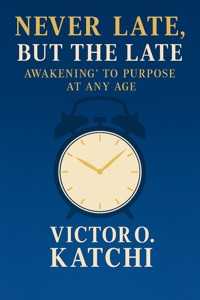
2,99 €
Mehr erfahren.
- Herausgeber: Victor Onyebuchi Katchi
- Kategorie: Religion und Spiritualität
- Sprache: Englisch
Have you ever felt that your time has passed? That you are too late to begin again, too far behind to catch up, too old to make a difference?
In Never Late, But the Late: Awakening to Purpose at Any Age, Victor Onyebuchi Katchi dismantles the myth of “too late” and unveils a timeless truth: your morning begins the moment you awaken to God’s purpose.
This powerful book weaves together scripture, personal reflection, and modern testimonies to show that fruitfulness is not bound to youth or clocks. From Abraham and Sarah’s laughter in old age, to Caleb’s mountain at eighty-five, to Colonel Sanders and Grandma Moses beginning world-changing work late in life, you’ll discover that the evening glow can be the season of greatest impact.
Inside you will learn how to:
Silence regret and the inner critic.
Redeem the time and embrace God’s kairos timing.
Build sustaining rhythms of prayer, rest, and renewal.
Multiply your influence through mentorship and legacy.
Live fearlessly and fruitfully at every stage of life.
Each chapter ends with Morning Activation Points — practical steps that transform inspiration into daily action.
Whether you are in your 20s and feeling “behind,” in your 40s and wrestling with regret, or in your 70s and wondering if your fruitfulness is over, this book is your awakening call.
It is not too late. Your time is now.
Das E-Book können Sie in Legimi-Apps oder einer beliebigen App lesen, die das folgende Format unterstützen:
Veröffentlichungsjahr: 2025
Ähnliche




Never Late, But The Late: Awakening to Purpose at any Age
By Victor O. Katchi
Copyright Page
Never Late, But the Late: Awakening to Purpose at Any Age Copyright © 2025 by Victor Onyebuchi Katchi
All rights reserved. No portion of this book may be reproduced, stored in a retrieval system, or transmitted in any form or by any means — electronic, mechanical, photocopy, recording, or otherwise — without the prior written permission of the publisher, except in the case of brief quotations used in reviews or articles.
Scripture quotations are taken from the Holy Bible, New King James Version (NKJV), unless otherwise indicated. Used by permission. All rights reserved.
Published by [Publisher Name] Printed in [Country]
ISBN: [To be assigned]
Dedication
To all the “late bloomers” of this world — those who thought their time had passed, those who almost gave up, those who doubted the worth of their evening years.
This book is for you. May you discover that your morning begins the moment you awaken to purpose, and may your evening glow shine brighter than the noon.
Epigraph
“They will still bear fruit in old age; they will stay fresh and green, proclaiming, ‘The Lord is upright; He is my Rock.’” — Psalm 92:14–15
Acknowledgments
Every book is a journey, and no journey is walked alone.
I thank God Almighty, the Author of Time, who planted this message in my spirit and sustained me through its writing. Without His grace, there would be no pages, no words, no awakening.
To my family, who encouraged me when doubt whispered, who believed in me when the critic spoke loudest — your love is my anchor.
To friends, mentors, and readers who carried the “No Late” philosophy in their own lives and inspired me with their testimonies — this book carries your fingerprints.
And finally, to every reader who turns these pages: thank you for opening your heart to this message. My prayer is that you will not only be awakened yourself but that you will awaken others.
Table of Contents
Prologue
Introduction
Chapter1: The Whisper Under the Tree
Chapter 2: Better Late or No Late?
Chapter 3: The God of Perfect Timings: Kairos vs. Chronos — Are They the Same?
Chapter 4: The Myth of Missing Out
Chapter 5: The Power of Awakening
Chapter 6: Sarah’s Laughter: Faith Beyond Age
Chapter 7: Palm Tree Principle
Chapter 8: Restoration Beyond Ruin
Chapter 9: Eleventh-Hour Laborers
Chapter 10: The Late Bloomers’ Club
Chapter 11: From Regret to Reawakening
Chapter 12: Late Discoveries in Arts, Science & Leadership
Chapter 13: Evening Glow
Chapter 14: No Retirement, Only Transition
Chapter 15: The Late Achievers’ Statistics
Chapter 16: Disarming the Inner Critic
Chapter 17: Cultivating a Whenever Mindset
Chapter 18: Redeeming the Time
Chapter 19: Taking the First Step
Chapter 20: Building Your Support System
Chapter 21: Overcoming the Fear of Judgment
Chapter 22: The Rhythm of Renewal
Chapter 23: Fruitfulness Beyond Seasons
Chapter 24: Evening Life Legacy
Chapter 25: A Final Word of Grace
Chapter 26: The Call to Awaken Others
Chapter 27: Final Charge: No Late Than The Late
Epilogue – The Benediction of the Evening Glow
Reader’s Declaration
Prologue – When Morning Comes in the Evening
It was under the quiet shade of a tree, in the solitude of reflection, that the phrase came to me like a whisper from eternity:
“There is no late, but the late. When you wake up, it is your morning.”
At first, I brushed it aside as a passing thought. But the more I pondered, the more it echoed. It would not leave me. The Spirit of God pressed it deeper, and I began to see it woven across scripture, across history, across my own life.
We live in a world obsessed with clocks and calendars. It tells us there is a “right age” to succeed, a “proper season” to bloom, and that if you miss it, you are finished. Society celebrates youthful prodigies and dismisses those who come later as irrelevant. But the God of time does not bow to human clocks. He works in kairos, not chronos. He is not bound by our schedules, nor limited by our delays.
Abraham laughed at the promise of a child in his old age. Sarah laughed too — yet her laughter turned into Isaac’s cry. Caleb claimed his mountain at eighty-five. Anna and Simeon held the Messiah in their wrinkled arms, proof that waiting is never wasted. Each story whispers the same truth: it is never late, but the late.
The Myth of “Too Late”
Perhaps you have heard the voice: “You are too old. You missed your chance. Others have gone ahead. Why try now?” It is the cruel whisper of the inner critic, reinforced by a culture addicted to youth.
But what if the greatest chapters of your life are still unwritten? What if the evening glow carries a brilliance the noonday sun cannot match? What if your testimony, forged in fire and time, is the very story that will awaken a generation?
The myth of “too late” must be dismantled, for it has kept too many dreams buried, too many books unwritten, too many callings silenced.
The Seed of This Book
This book was born out of that whisper beneath the tree — and the conviction that lives must be awakened. It is not merely information but an invitation: an invitation to rise again, to dream again, to believe again.
It is a testimony that your morning begins not when the world says so, but when you awaken to God’s purpose. Whether you are twenty or seventy, whether you feel behind or wasted, whether regret haunts you or fear binds you — this is your call to rise.
Every chapter will point you to stories of late bloomers, biblical and modern, who proved that age is no barrier. It will equip you with practices to silence the inner critic, redeem your time, and build legacy. It will remind you that life’s evening is not decline but harvest — not fading, but flourishing.
My Heart for You, Reader
As you turn these pages, know this: I am not offering theories from a distance. I am offering scars, laughter, tears, and revelations that I have lived. This book is my testimony and my charge.
I want you to feel as though you are sitting under that same tree with me — as if we are two friends, speaking honestly about fears and faith, about regrets and renewals, about what it means to live awake.
And if you take nothing else from this book, take this: when you wake up, it is your morning.
A Call to Awakening
This is more than a personal journey. It is a movement — a No Late Generation. Men and women who refuse to surrender to clocks, who choose to bloom in evening glow, who live as if every day is ripe with purpose.
You are part of that generation. This book is your torch. Take it. Run with it. Pass it on.
Reflection Before We Begin
Pause for a moment before you enter Chapter One. Ask yourself:
- Where have I believed the lie of “too late”?
- What dreams have I buried under regret or delay?
- What would it mean for me to awaken today?
Write them down. Carry them with you. Because as you journey through these pages, you will see that God is not finished with you.
Your morning is now. Your fruit is still ahead. Your legacy is still unfolding.
A Prayer for Beginning
Father, Lord of Time and Eternity, I surrender my clocks, my regrets, and my fears into Your hands. Awaken me afresh today. Let me see that it is never late but the late. Teach me to walk in purpose in every season of my life. Use this journey to renew my mind, restore my courage, And release me into the fruitfulness You have prepared. In Jesus’ name, Amen.
Introduction
The afternoon sun slanted through the branches, sketching restless patterns of gold and shadow across the ground. I sat beneath the tree, not because I was weary but because I needed stillness. The breeze carried the faint smell of dust and leaves, that quiet perfume of the earth after a morning rain. It was a place of silence, a pocket of the world where the noises of men seemed far away, and only the whispers of eternity could find their way through.
I had come to meditate, but I did not expect revelation. Then, in that silence, a thought slipped into my heart. It did not thunder, yet it was louder than thunder. It did not shout, yet it arrested every fiber of my being:
“There is no Late than the Late. When you wake up, it is your morning.”
I froze. The words hung in the air like an unseen banner. I repeated them quietly, tasting their weight: No Late than the Late. When you wake up, it is your morning. They were not just words — they were truth, distilled and burning, unraveling years of assumptions about time, age, delay, and regret.
I thought of the many who carry heavy sighs of wasted years, of lost opportunities, of beginnings that never found their dawn. I thought of those who whisper to themselves: It is too late for me now. My morning is past. My chances are gone. And suddenly, in the shade of that tree, I knew this whisper was a lie the enemy has rehearsed into countless lives.
For in that moment, scripture after scripture began to crowd into my spirit like old friends arriving at once: Abraham and Sarah laughing at the impossibility of childbirth at their age. Caleb, at eighty-five, demanding a mountain for his inheritance. Moses, hidden away in obscurity for forty years until the burning bush rekindled his purpose. Elizabeth, thought barren and forgotten, holding the child who would prepare the way of the Lord. And the Psalmist’s song, declaring that the righteous shall still bear fruit in old age, flourishing and green even when others expect decline.
That day, under that tree, one truth became an unshakable foundation in my heart: morning does not come with the clock, but with awakening.
This book is the unfolding of that truth. It is the story of divine timings, of lives that proved “too late” is a lie, of the evening season that can still glow with the brilliance of dawn. It is written to silence the voice that tells you your time is past. It is written to prove that in God’s calendar, there is no such thing as “retirement,” only renewal — no closure but death itself.
And so I invite you: walk with me through these pages. We will look into scripture, into history, into modern lives, and into our own hearts. Together we will discover that there is, indeed, No Late than the Late — and that when you wake up, it is your morning.
Chapter One – The Whisper Under the Tree
The afternoon sun slanted through the branches, sketching restless patterns of gold and shadow across the earth. I sat beneath the old tree, not because my body demanded rest, but because my spirit longed for silence. The breeze carried the perfume of damp soil and fallen leaves, that earthy fragrance that arrives after a rain. The world seemed hushed; even the rustle of sparrows in the distance felt far away. It was one of those moments when time itself slows, when eternity seems close enough to touch.
I had come to meditate, but what came was revelation. Not in thunder. Not in fire. Not in a voice that shook the earth. It came like a whisper, soft yet undeniable. It settled in my heart and would not let go:
“There is no Late than the Late. When you wake up, it is your morning.”
At first, I repeated it quietly, almost testing the weight of the words. Then I froze. They were alive. I knew immediately that this was no ordinary thought. It was truth, distilled and burning, carrying within it a key to lives locked in regret, despair, and wasted years.
I thought of the many who live under the tyranny of clocks and calendars. How often do we say, “I am too old to begin again. My time has passed. My morning is gone.” I thought of friends who sighed away their dreams, convinced that delay had killed destiny. Yet here, in the shade of that tree, a divine contradiction rose up against the lie: there is no lateness except the lateness of death. Until then, when you awaken, it is your morning.
The Tyranny of the Clock
From childhood, we are taught to measure life by hours and years. We are told when we are “on time” — finishing school by twenty, starting careers by thirty, raising families by forty, building houses by fifty, and retiring by sixty-five. Society applauds those who keep to this schedule and quietly pities those who fall behind. It is a cruel system, because it leaves no room for God’s interruptions, detours, and resurrections.
Heaven, however, does not bow to man’s clock. Heaven moves by purpose, not by deadlines. God does not pace the floor, wringing His hands because you missed a year or lost a decade. To Him, one day is as a thousand years, and a thousand years as one day. He is never in a hurry, yet He is never late.
The whisper under the tree was telling me that sleep is the true enemy, not time. A man may live seventy years asleep to his purpose and then awaken at seventy-one — and that year will become his morning.
Sarah’s Laughter
Consider Sarah. Ninety years old. Her body long past childbearing. When she heard the angels announce that she would conceive, she laughed. It was not the laughter of joy, but of disbelief. “After I am worn out, and my lord is old, shall I have pleasure?” (Genesis 18:12).
To Sarah, the morning of possibility had gone forever. Yet the Lord answered her laughter with His own question: “Is anything too hard for the Lord?” That was her awakening. Her morning did not come at sixteen, or at thirty, or even at fifty. Her morning came at ninety, because that was when she woke up to God’s timing.
When Isaac was born, she named him “Laughter.” The laughter of doubt had been transformed into the laughter of joy. Sarah’s story declares across the centuries: you are not late until you are late in the grave. Until then, God can still awaken your morning.
Caleb’s Mountain
Then there is Caleb. At eighty-five, most men are thinking of peace and quiet, of smaller burdens, of fading gently into the background. But not Caleb. His heart was as young as his faith. He stood before Joshua and said, “Give me this mountain.”
For forty-five years, he had carried the promise spoken by Moses. Others might have forgotten; Caleb had not. While the wilderness buried a generation, Caleb’s spirit stayed awake. And when the time came, his morning dawned — not at forty, but at eighty-five. His mountain waited, and he was ready to climb it.
The morning of your life is not measured by sunrise, but by awakening.
Moses at the Bush
And what shall we say of Moses? For forty years, he lived as a prince. Then for another forty, he wandered as a shepherd. By the time God called to him from the burning bush, Moses was eighty. To the Egyptians, he was forgotten. To his own people, he was a stranger. To himself, he was finished.
But God saw a deliverer. In the desert of obscurity, Moses woke up to his true calling. His morning came late, but it came — and it changed the destiny of a nation.
Awakening, Not Age
Sarah, Caleb, Moses — their lives prove one thing: lateness is an illusion. You are not late until you are dead. Until then, the alarm of heaven can still sound, and your morning can still break forth.
This is why the whisper under the tree pierced me so deeply. It was God’s way of announcing that no man has the right to surrender to despair because of time. What matters is not your age, but your awakening.
Modern Echoes
We see it even in our own time. Colonel Harland Sanders started KFC at sixty-five. Nelson Mandela became president at seventy-six. Grandma Moses began painting at seventy-eight. Each of them, in their own way, proved that morning comes when you wake up, not when the world says it should.
Reflection
The greatest tragedy is not that some dreams are delayed, but that some lives never awaken. There are those who live eighty years asleep, never answering the call within them. And there are those who wake up late, only to discover that late is still early when God breathes upon it.
That day under the tree, I realized: time is not my tyrant. Sleep is. Awakening is the miracle.
Morning Activation Points
1.Write down one dream you thought was dead because of delay. Beside it, write today’s date — the day of its awakening.
2. Ask yourself: Have I been bound by society’s clock, or freed by God’s calendar?
3. Declare aloud: “My morning begins the moment I wake up. Today, I awaken.”
Chapter Two – Better Late or No Late?
The phrase rolls off the tongue like a piece of common wisdom: “Better late than never.” It sounds safe, even comforting. We use it to excuse delays, to soften regret, to justify postponements. If someone arrives two hours behind schedule, we laugh it off: better late than never. If a project lingers unfinished, we console ourselves with the same refrain.
But beneath its friendly surface lies a subtle trap. For while it appears to honor persistence, it quietly normalizes procrastination. It whispers, “Delay is acceptable, as long as you eventually get there.” It teaches us to make peace with postponement instead of seizing the urgency of now.
Yet the whisper under the tree that day shattered this old wisdom. Heaven’s truth is sharper: Never Late, But the Late. With God, your morning is not measured by the world’s deadlines. But neither is it licensed for endless delay. Every moment you are awake is a morning to act, not an excuse to drift.
The Trap of “Better Late”
Think of how often the phrase has stolen opportunities. A young man feels the stirrings of a calling, but shrugs it off with, “I’ll pursue it later.” A woman senses the nudge to begin her studies again, but delays with, “I’ll do it someday.” Each time they console themselves: better late than never.
But in truth, each postponement is not neutral. Time does not wait. The habit of delay weakens resolve. The dream grows faint. And sometimes the “late” never arrives at all.
What if Sarah had dismissed the promise with, “better late than never”? What if Caleb had said, “perhaps someday” instead of “give me this mountain”? What if Moses, standing before the bush, had answered, “I’ll go tomorrow”?
Procrastination is not harmless. It is theft. And its thief disguises itself as wisdom.
The “No Late” Mindset
In contrast, the No Late mindset is a call to awakening. It declares: Now is the time to rise. Now is the time to answer. Now is the time to live. Not because tomorrow will not come, but because tomorrow is not promised.
Paul the Apostle said it best: “Now is the accepted time; behold, now is the day of salvation” (2 Corinthians 6:2). Not next week. Not when conditions are perfect. Now.
Living with a No Late mindset does not mean rushing recklessly. It means aligning each day with purpose. It means refusing to excuse delay with the soft pillow of “better late than never.” It means seizing the present as sacred.
Living in Alignment
Every life has rhythms — mornings and evenings, seasons of growth and seasons of rest. But alignment means that whatever the season, you are awake to God’s invitation in it.
When you rise each morning with this awareness, you no longer measure yourself by what has been lost. You measure yourself by what can begin today.
That is why the whisper under the tree spoke of awakening. For the true tragedy is not lateness, but sleep. A man asleep at twenty is no different from a man asleep at seventy. And a man awake at seventy is more alive than one who slumbers at thirty.
Better late than never? No. Better awake now than asleep forever.
Modern Echoes
Consider the man who waits until his health collapses to change his lifestyle. Or the woman who waits until the children are grown before pursuing the call God placed in her heart. They console themselves: “better late than never.” But too often, the delay erodes both strength and courage.
On the other hand, think of those who awaken in unlikely seasons. Ray Kroc, at fifty-two, transformed a small burger stand into McDonald’s. Laura Ingalls Wilder, at sixty-five, published Little House in the Big Woods, the first of her beloved series. Each story proves that it is not lateness that matters — it is awakening.
Reflection
The danger of “better late than never” is that it teaches us to accept delay as destiny. The invitation of Never Late, But the Late is that it calls us to awaken now. For when you wake up, it is your morning.
Morning Activation Points
Identify one area where you’ve been hiding behind the phrase “better late than never.” Write it down.
Replace that thought with the declaration: “Better now than later. My morning begins today.”
Take one small action today — a call, a prayer, a step — to align with that awakening.
Chapter Three – The God of Perfect Timings: Kairos vs. Chronos — Are They the Same?
Time. It is the silent ruler of human life. We rise with its alarms, labor under its deadlines, celebrate its birthdays, and fear its wrinkles. We measure our worth by its passing, as if the ticking of the clock were the voice of destiny itself. This is chronos — man’s time. The relentless counting of days, hours, and years.
But above chronos there is another order of time: kairos. This is heaven’s clock, the divine appointment, the sacred moment when purpose and promise intersect. Unlike chronos, kairos cannot be hurried by anxiety or delayed by doubt. It is the time when God says, “Now.”
And the whisper under the tree was pointing me toward this truth: Kairos and chronos are not the same. One enslaves; the other liberates. One measures; the other fulfills. One belongs to man; the other belongs to God.
Chronos: The Tyranny of the Clock
Chronos is the Greek word from which we derive “chronology.” It is linear, measurable, predictable. It tells us when the sun will rise and when the day will end. It calculates age, sets schedules, and draws retirement charts.
It is not evil in itself. Chronos orders human society. Without it, there would be chaos in commerce, travel, learning, and governance. But chronos becomes a tyrant when we let it dictate the value of our lives.
Chronos whispers: “You are too young.” Then later it mocks: “You are too old.” It counts down your years like sand in an hourglass, reminding you of what you have not done, what you should have achieved, and what you can never recover. Many surrender their dreams at its command, believing the lie that purpose has an expiration date.
Kairos: The God of Perfect Timings
Kairos, however, is different. It is not measured in minutes, but in meaning. It is not about when in man’s calendar, but what in God’s purpose.
Paul describes kairos when he writes, “But when the fullness of the time was come, God sent forth His Son, made of a woman, made under the law” (Galatians 4:4). Jesus was not born a year too early or a decade too late. He arrived in the fullness of kairos.
Kairos is the moment when divine preparation meets human readiness. It is when barren wombs are opened, when exiled shepherds are called, when captives are set free. It cannot be rushed, but neither can it be denied.
Abraham and Sarah: The Appointed Time
Take Abraham and Sarah. By chronos, they were finished. Abraham was a hundred, Sarah ninety. Their neighbors had long given up whispering about their childlessness; it was simply too late. Yet in Genesis 18, the Lord declares, “At the appointed time I will return to you, and Sarah shall have a son.”
Notice that word: appointed time. That is kairos. Man’s chronology said impossible; God’s kairos said inevitable. And when Isaac was born, laughter filled their tent. What chronos mocked, kairos fulfilled.
Elizabeth and Zechariah: Too Late, Yet Right on Time
Generations later, another barren couple stood in the temple courts. Zechariah and Elizabeth were “well advanced in years,” their hope of children buried by the passing of decades. Yet Gabriel announced that Elizabeth would bear John, the forerunner of Christ.
Luke 1:36 records the angel’s words: “This is the sixth month with her who was called barren. For with God nothing will be impossible.”
Chronos had written them off. Kairos wrote them in. The timing was not accidental — John’s birth was synchronized with the coming of Christ.
Jesus and the Hour That Had Not Yet Come
Even our Lord walked in kairos. At the wedding in Cana, when urged to act, He replied, “My hour has not yet come” (John 2:4). Again and again in the Gospels, He moves according to divine timing, not human pressure. And when the hour did come, He set His face toward Jerusalem.
Chronos tried to seize Him prematurely, but He slipped away. Kairos held Him until the appointed Passover, when the Lamb of God would be offered once for all.
Man’s Delay vs. God’s Fulfillment
When we confuse chronos with kairos, despair sets in. We assume that because man’s calendar says we are behind, God must also have abandoned us. But the two are not the same.
Chronos says: “You are late.” Kairos says: “You are right on time.”
Chronos says: “You missed it.” Kairos says: “It was never yours until now.”
Chronos says: “Your season is past.” Kairos says: “Your season is beginning.”
Modern Echoes of Kairos
History is filled with men and women who awakened not in youth, but in the evening of life — yet fulfilled destinies no younger soul could have carried.
- Colonel Sanders launched KFC at sixty-five.
- Grandma Moses began painting in her late seventies.
- Nelson Mandela walked out of prison at seventy-two and became president at seventy-six.
Chronos mocked them as too old. Kairos anointed them as just right.
Learning to Discern Kairos
How, then, can we live attuned to kairos? The key is awakening. To walk with God each day is to invite His timing into your steps. Proverbs says, “In all your ways acknowledge Him, and He shall direct your paths” (Proverbs 3:6).
When you surrender to His Spirit, delays no longer crush you, and haste no longer drives you. You move not by the tyranny of deadlines, but by the rhythm of destiny. You begin to see that every setback is preparation, every waiting room a classroom, every pause a hidden mercy.
Kairos teaches you to wait without despair, and to act without delay.
Reflection
Kairos and chronos are not the same. Chronos measures years; kairos redeems them. Chronos tells you when to retire; kairos tells you when to begin again. Chronos says you are too old; kairos whispers, “When you wake up, it is your morning.”
Morning Activation Points
Reflect: Have I been measuring my life by chronos or aligning it with kairos?
Identify one area where chronos has discouraged you (age, years lost, deadlines missed). Write a prayer of surrender, asking God to reveal His kairos in that area.
Declare aloud: “I am not late. I am in God’s appointed time. My morning begins when I awaken to His purpose.”
Chapter Four – The Myth of Missing Out
The world has a cruel chorus it loves to sing: “You missed your chance.” It echoes in classrooms, boardrooms, marriages, and even in churches. We hear it when others move ahead while we remain behind. We feel it when opportunities slip through our hands. And soon, the refrain becomes internal: “It’s over. Someone else took what should have been mine. My season is gone.”
This is the myth of missing out. It is the lie that destiny is a race with limited seats, that purpose is a game of musical chairs where only the quick survive. It whispers that God’s blessings are scarce, His callings fragile, His mercy short-lived.
But the truth is brighter. In God’s kingdom, you cannot miss what was appointed for you. You can delay, you can resist, you can even wander — but if you awaken, your morning still comes.
FOMO: The Fear of Missing Out
Today’s culture has baptized this lie with a new name: FOMO — Fear of Missing Out. Social media fuels it relentlessly. We scroll through pictures of others celebrating milestones, traveling the world, or enjoying success, and we sigh: “That could have been me. I missed my moment.”
But FOMO is not new. It is simply the modern mask of an ancient deception. Esau felt it when he sold his birthright for a meal. Saul felt it when David’s songs outshone his. The prodigal’s elder brother felt it when his father celebrated the younger’s return. Each believed: “I have missed out. My chance is gone.”
Yet in every case, the real loss was not destiny itself, but the blindness caused by envy, comparison, and unbelief.
The Parable of the Vineyard Workers
Jesus confronted this myth head-on in the parable of the vineyard workers (Matthew 20:1–16). Some were hired at dawn, others at midday, and some at the eleventh hour. When evening came, the master paid them all the same wage.
The early workers grumbled. “It’s unfair,” they said. “We bore the burden of the day, yet those who came last received equal pay.”
But the master replied, “Am I not allowed to do what I choose with what belongs to me? Or do you begrudge my generosity?”
The point is clear: in God’s economy, the reward is not about when you began, but about who you belong to. The eleventh-hour worker did not miss out. His awakening at the last moment was still morning in the eyes of God.
Restoration, Not Replacement
The myth of missing out also thrives on comparison. We assume that because someone else has achieved what we desired, our own story is now redundant.
But God does not recycle destinies. What He gives to one does not cancel another. Peter and John both followed Christ, yet their paths diverged. David and Jonathan both loved God, yet their purposes were distinct. No one can live your calling for you, and you cannot live theirs.
Joel 2:25 thunders against the myth: “I will restore to you the years that the swarming locust has eaten.” Restoration means nothing is truly lost in the hands of God. Time wasted in sleep can still be redeemed in awakening.
Modern Echoes
Think of those who thought they had “missed out” yet found themselves in a new morning:
- Vera Wang entered the fashion world at forty, after failing as a skater. Today her name defines elegance.
- Ray Kroc joined McDonald’s at fifty-two, proving it was not too late to build an empire.
- Grandma Moses began painting after seventy, and her works now hang in museums.
Each could have surrendered to the myth: “I am late. I missed my chance.” Instead, they awakened — and morning broke.
Reflection
The myth of missing out dies in the presence of truth. You have not missed your destiny. You have not been replaced. You have not been disqualified by age, delay, or comparison. If you are alive, your morning can still dawn.
The only true missing out is refusing to awaken at all.
Morning Activation Points
Identify one area where you believe, “I have missed my chance.” Surrender it to God in prayer.
Read Joel 2:25 aloud and declare: “My years are not wasted. God restores them.”
Each time envy whispers, replace it with gratitude for your unique path.
Chapter Five – The Power of Awakening: When You Wake Up, It Is Your Morning
There is a moment each morning when the world shifts. The eyes open, light filters in, sounds sharpen, and the body stirs. Before that moment, it does not matter if the sun has been shining for hours — to the sleeper, it is still night. But when the sleeper awakens, it is morning.
So it is in the spirit. Morning is not dictated by the clock but by awakening. A man may lie in the bed of slumber until noon, yet for him, the day begins only when he wakes. In the same way, you may live decades asleep to your purpose, but the instant you awaken, your morning breaks.
This is the essence of the whisper under the tree: When you wake up, it is your morning.
Sleep vs. Awakening
Sleep, in the language of scripture, is often more than physical rest. It is spiritual lethargy, moral complacency, the dullness of a heart that refuses to perceive. Paul pleads in Romans 13:11, “The hour has come for you to wake from sleep. For salvation is nearer to us now than when we first believed.”
Sleep is not measured in years, but in awareness. You can be twenty and already asleep, drifting through life with no urgency. And you can be seventy, fully awake, alive to every whisper of God’s Spirit.
The danger is not age, but slumber. The gift is not youth, but awakening.
Jacob at Bethel: Awakening to God’s Presence
Jacob fled into the wilderness, burdened with guilt and fear. One night he laid his head upon a stone and slept. In his sleep he dreamed of a ladder reaching to heaven, angels ascending and descending, and the Lord Himself standing above it.
When Jacob awoke, he declared, “Surely the Lord is in this place, and I did not know it” (Genesis 28:16). His morning began not when the sun rose, but when his eyes were opened to the presence of God.
That is the power of awakening — to see what was always there, to recognize purpose where once there was only despair.
Samuel in the Temple: Awakening to God’s Voice
Young Samuel lay in the temple when the Lord called his name. At first he thought it was Eli. Three times the call came, and three times he mistook it. Finally, Eli instructed him to say, “Speak, Lord, for Your servant hears.”
That night, Samuel awakened to the voice of destiny. He was still a boy, but his morning had begun. His ears were opened, and he became a prophet who carried God’s word to a nation.
Awakening is not about how long you have lived, but how open you are to hear when God calls.
The Prodigal Son: Awakening to Himself
Perhaps the most poignant picture is in Luke 15. The prodigal son squandered his inheritance, wasted his strength, and fell into ruin. But verse 17 records the turning point: “But when he came to himself, he said, ‘How many of my father’s hired servants have bread enough and to spare, and I perish with hunger!’”
That moment — when he came to himself — was his awakening. His morning began not in the pigsty but in his realization. From there he rose and returned to his father.
So it is with us. Morning begins not with changed circumstances but with awakened hearts.
Sleep in Modern Life
Today, many walk through life half-asleep. They drift in jobs they hate, relationships that drain them, habits that chain them. They know they are made for more, yet they silence the inner cry with distractions. Social media becomes the lullaby, entertainment the blanket, procrastination the pillow.
But the tragedy is not that they are too late — it is that they refuse to awaken. Years pass, and still they sleep.
Yet the good news remains: the moment they wake, it is morning.
Awakening Brings Urgency
Awakening does not simply open your eyes; it ignites urgency. When a sleeper wakes to discover the house on fire, he does not roll over — he rises with haste. When a runner hears the gun at the starting line, he does not yawn — he launches forward.
Awakening fills the heart with holy immediacy. You realize that every day is precious, every opportunity sacred, every breath a gift. You stop postponing purpose. You stop saying “someday.” You begin to live as though time were seed to be sown, not sand to be wasted.
Modern Witnesses of Awakening
- John Newton, the slave trader, awakened to grace in midlife and became the voice behind Amazing Grace.
- C.S. Lewis, an atheist professor, awakened to faith in his thirties and became one of the most influential Christian authors of all time.
- Harriet Doerr published her first novel at seventy-three, winning the National Book Award.
For each, morning began when they woke, not when the world expected.
Reflection
Awakening is the great equalizer. It erases the regrets of wasted years and redeems the lateness of delayed beginnings. You are not late if you awaken now. The only lateness is the refusal to wake at all.
Morning Activation Points
Ask yourself: Where am I still asleep — in faith, in calling, in vision?
Take one action today that says, “I am awake.” It may be a prayer, a phone call, a first step toward a dream.
Declare aloud: “Today I awaken. Today is my morning. My eyes are open, my heart is alive, my steps are aligne
Chapter Six – Biblical Witnesses of Late Fruitfulness
There is a rhythm woven into Scripture that defies human reason. Again and again, God calls forth fruit not in the spring of life, but in its autumn. He summons strength from bodies that should be weary, vision from eyes dim with age, and promises from wombs long considered barren. Why? Because fruitfulness in late years silences the lie that purpose expires with time.
In the gallery of God’s witnesses, we find portraits of men and women who bloomed long after the world declared their season closed. Their stories are the bedrock of our conviction: you are not late until you are late in the grave. Until then, fruit is still possible, promise still alive, purpose still breathing.
Moses at Eighty: Called from the Flames
For forty years, Moses had been a prince in Egypt. For another forty, he had been a shepherd in Midian. By the time we meet him at the burning bush (Exodus 3), he was eighty years old — an age when most men count their days in memories, not in missions.
Yet God chose that moment, not his prime, to awaken him. A bush burned without being consumed, and from it came the voice that shook history: “Come, I will send you to Pharaoh that you may bring my people, the children of Israel, out of Egypt.”
Moses resisted. He counted his disqualifications: too old, too slow of speech, too far removed. But heaven counted his readiness. What seemed the dusk of life became the dawn of deliverance. Moses’ greatest work — the plagues, the Red Sea crossing, the Ten Commandments — all unfolded after eighty.
Man’s chronos said, “Retire.” God’s kairos said, “Arise.”
Caleb at Eighty-Five: “Give Me This Mountain”
Caleb had been a young man when he spied out Canaan. He had walked the promised land, tasted its grapes, and believed God could give it. But unbelief in others delayed the promise for forty years. Caleb wandered with a generation that perished in the wilderness, yet his spirit never withered.
When Israel finally entered Canaan, Caleb was eighty-five. By then, most would be content with a tent and peace. But not Caleb. Standing before Joshua, he declared: “I am still as strong today as I was in the day that Moses sent me… So now give me this mountain” (Joshua 14:11–12).
His morning had not been wasted in the wilderness; it had been preserved for that moment. At an age when others surrendered, Caleb claimed inheritance. His fruitfulness was not in youth, but in perseverance.
Sarah at Ninety: Laughter Turned to Life
Sarah had long borne the shame of barrenness. By ninety, she no longer entertained the possibility of bearing children. When the angels announced she would conceive, she laughed — not in joy, but in disbelief. “After I am worn out, and my lord is old, shall I have pleasure?” (Genesis 18:12).
But God’s response was firm: “Is anything too hard for the Lord? At the appointed time I will return to you… and Sarah shall have a son.”
And so Isaac was born, and Sarah’s laughter was redeemed. What was once mockery of impossibility became the music of fulfillment. She named her son “Laughter,” a living reminder that morning can break even after decades of night.
Sarah’s story proves that delay is not denial. Fruit can spring forth in the most unlikely soil, at the most improbable time.
Elizabeth and Zechariah: The Forerunner’s Parents
Luke’s Gospel introduces us to a priestly couple described as righteous, yet barren. By the time the angel appeared, Elizabeth and Zechariah were “advanced in years” (Luke 1:7). They had likely stopped praying for a child.
Yet Gabriel announced that their son would be John, the forerunner of Christ. The timing was not accidental. John’s birth had to align with the coming of Jesus. Elizabeth’s lateness in man’s eyes was right on schedule in God’s plan.
When John was born, neighbors rejoiced, saying, “The Lord has shown great mercy to her.” Mercy, not misfortune, had written her story. Her womb had waited, not wasted.
The Pattern of Evening Fruitfulness
From Moses to Caleb, Sarah to Elizabeth, the pattern is clear: God delights in evening fruit. He chooses the aged, the weary, the forgotten, to prove that His power is not bound by time.
Psalm 92:14 declares it plainly: “They still bear fruit in old age; they are ever full of sap and green.” The righteous are not seasonal trees; they are evergreens of destiny.
Fruit in later years carries a special fragrance. It testifies not just to human strength, but to divine sustenance. It silences despair and declares: “It is never late, except the late.”
Modern Witnesses of Late Fruitfulness
Scripture’s pattern echoes in modern times:
- Laura Ingalls Wilder published her first book at sixty-five, birthing the Little House series.
- Nelson Mandela walked out of prison at seventy-two, to lead South Africa into freedom.
- Grandma Moses, who began painting in her late seventies, left a legacy that outlived her by decades.
Their stories join the biblical chorus: age is not the enemy; slumber is. Awakening, whenever it comes, ushers in morning.
Reflection
These witnesses remind us that there is no expiry date on God’s promises. If He has spoken, He will perform it — even if the fulfillment blooms in the twilight of life.
The evening life can be the most radiant, because it carries the weight of wisdom, the testimony of endurance, and the fragrance of grace. You may not have the strength of youth, but you have the substance of years — and in God’s hands, that is enough to shake nations.
Morning Activation Points
Reflect on Moses, Caleb, Sarah, and Elizabeth. Which of their stories mirrors your own delays?
Write this declaration in your journal: “I will bear fruit in my evening life. My age is not my limitation, but my testimony.”
Pray Psalm 92:14 aloud and claim it: “I will still bear fruit in old age; I will be fresh and flourishing.”
Chapter Seven – The Palm Tree Principle
“They shall still bear fruit in old age; they shall be fresh and flourishing.” — Psalm 92:14
Scripture often hides its greatest truths in images drawn from creation. Mountains, rivers, sheep, lions, eagles — each reveals something of God’s ways. And in Psalm 92, the righteous are compared to a tree: “The righteous shall flourish like a palm tree, he shall grow like a cedar in Lebanon.”
Why the palm tree? Why not the oak, mighty and broad? Why not the olive, useful and enduring? Because the palm tree carries within it a unique lesson: it flourishes in its latter years.
The psalmist declares that the righteous are not designed for decline, but for continued fruitfulness. Even in old age, they remain “fresh and flourishing.” This is what I call the Palm Tree Principle.
The Nature of the Palm
The palm tree is unlike many others. Where other trees become brittle with age, the palm becomes stronger. Where others hollow out, the palm’s core remains supple. Its leaves are evergreen, refusing to wither even in drought. And most astonishingly, the palm’s fruitfulness increases with the years.
Some species of palm bear their best clusters not in youth, but in maturity. The older they grow, the sweeter their fruit. This is not poetic exaggeration — it is agricultural fact.
No wonder the psalmist chose the palm as a picture of the righteous. In God’s economy, age does not mean decay. It means depth. The evening life is not barren, but blooming.
Flourishing Beyond the Sunset
The Palm Tree Principle confronts one of the greatest lies of our age: that life peaks in youth and fades thereafter. Modern culture idolizes the young, markets to the strong, and sidelines the old. But scripture paints another vision: even in old age, the righteous flourish.
This flourishing is not merely physical strength, though God can renew that too. It is the flourishing of wisdom, of perspective, of influence, of spiritual authority. A palm tree planted by the Lord may not run as swiftly as before, but it casts longer shade. Its roots hold deeper in the soil. Its fruit nourishes generations.
Moses and Caleb Revisited
Moses’ face shone with glory in his eighties. Caleb conquered mountains at eighty-five. These were not exceptions but embodiments of Psalm 92:14. They bore fruit in old age because they were rooted not in human chronos, but in God’s kairos.
They were palm trees in deserts, flourishing when others withered. Their strength was not in muscle but in mission, not in years but in yield.
The Power of Evergreen Living
The palm tree never sheds all its leaves at once. It is evergreen, retaining freshness year-round. So it is with the righteous. They are not bound to cycles of relevance and irrelevance. Their lives remain a testimony of consistency.
Freshness is not about novelty, but vitality. To be fresh in old age is to remain alive in spirit, curious in mind, tender in heart, and steadfast in faith. Flourishing does not mean escaping challenges; it means overcoming them with resilience that only years can teach.
Modern Echoes of the Palm Tree
- Billy Graham preached into his nineties, his voice weaker but his impact stronger than ever.
- Nelson Mandela spent his later years reconciling a nation, proving that evening influence can heal what morning strife has broken.
- Mother Teresa, frail in body but fierce in love, poured herself out until the very end, flourishing in compassion.
These were palm trees of their generation — still bearing fruit, still fresh, still flourishing.
How to Live the Palm Tree Principle
Stay Planted — A palm flourishes only because its roots remain deep in the right soil. Psalm 92:13 says, “Those who are planted in the house of the Lord shall flourish in the courts of our God.” Stay rooted in His presence.
Stay Fresh — Renewal comes not from years, but from daily communion with God. The inward man is renewed day by day (2 Corinthians 4:16).
Stay Fruitful — Refuse to retire from purpose. You may shift seasons, but never surrender fruitfulness. Influence has no retirement age in the kingdom.
Reflection
The Palm Tree Principle is God’s promise that your evening can be greener than your morning. Your twilight can be brighter than your dawn. In Him, you do not wither — you flourish. You do not expire — you expand.
Your fruit is needed, your wisdom is necessary, your voice is vital. Do not believe the lie that you are finished. If you are planted in the Lord, you are a palm tree — ever fresh, ever flourishing.
Morning Activation Points
Meditate on Psalm 92:14. Speak it aloud as a declaration: “I will still bear fruit in old age; I will be fresh and flourishing.”
Identify one area of your life where you feel “finished.” Ask God to make it fresh again.
Share your wisdom or skill with someone younger this week. Let your fruit nourish another generation.
Chapter Eight – Restoration Beyond Ruin
“I will multiply upon you man and beast; and they shall increase and bear young. I will make you inhabited as in former times, and will do better for you than at your beginnings. Then you shall know that I am the Lord.” — Ezekiel 36:11
Ruins and the Whisper of Hope
There are moments when life feels like a city after siege. Walls broken. Houses silent. Fields barren. Dreams scattered like ashes in the wind. Ezekiel spoke to such a people — Israel, carried away in exile, their land desolate, their hope dissolved.
Yet into that wasteland, the Lord declared restoration: “I will do better for you than at your beginnings.” What a God! He does not merely replace what was lost; He multiplies. He does not merely repair; He renews. His promise is not survival but flourishing.
Restoration beyond ruin is the anthem of Ezekiel 36. It is also the testimony of every soul who has felt barren, forgotten, or wasted by time — yet awakened to the God of renewal.
From Barrenness to Blessing
Barrenness in Scripture is never the final word. Sarah’s womb, Hannah’s tears, Elizabeth’s silence — each was interrupted by God’s promise of fruit. Barrenness is man’s verdict, but blessing is God’s decree.
In Ezekiel 36, the barren land was promised fruitfulness once more. “The desolate land shall be tilled, instead of lying desolate… And they will say, ‘This land that was desolate has become like the garden of Eden’” (verses 34–35).
That is the divine exchange: waste for wonder, emptiness for Eden.
And so it is with lives. No matter how many years feel barren, the God of Ezekiel still speaks: “I will make you prosper more than before.”
The Rebuilding of Lives
Restoration is not only about land; it is about lives.
- Job sat among ashes, stripped of wealth, family, and health. Yet the Lord gave him twice as much as he had before (Job 42:10). His latter end was greater than his beginning.
- Naomi returned to Bethlehem bitter, empty, and grieving. Yet through Ruth, God restored her joy and gave her a grandson who carried the lineage of Christ (Ruth 4:14–17).
- Israel’s dry bones in Ezekiel 37 rose to become an army, proving that even graves can be cradles in God’s hands.
The same God still rebuilds shattered lives. Wasted years are not wasted when He restores.
Hope for the Desolate
Desolation breeds despair. It whispers: “It is too late. Too much is gone. Nothing can be rebuilt.” But the testimony of scripture is that no ruin is beyond redemption.
- Abraham thought his body was “as good as dead,” yet became father of nations.
- Peter wept bitterly after denying Christ, yet was restored to lead the church at Pentecost.
- Paul, once a persecutor, became the apostle to the Gentiles.
The ruins of their past became the foundation for their calling. God’s grace did not erase their failures; it transformed them.
Modern Echoes of Restoration
History and testimony abound with lives restored beyond ruin:
- Joni Eareckson Tada — paralyzed at seventeen, yet her ministry has touched millions worldwide.
- John Newton — once a slave trader, awakened to grace and gave the world Amazing Grace.
- Nelson Mandela — after 27 years in prison, emerged to reconcile and rebuild a nation.
Each story declares that ruin is not the end. In God’s hands, it is the raw material for restoration.
The Redemptive Pattern
God does not merely restore to the level of the past; He exceeds it. “I will do better for you than at your beginnings” (Ezekiel 36:11). This is His redemptive signature:
- The prodigal son did not return as a servant, but was restored as a son with robe and ring.
- Israel did not return from exile to survive, but to rebuild a temple more glorious.
- Christ Himself rose from the grave, not as the crucified carpenter, but as the resurrected Lord of glory.
Restoration beyond ruin is not a consolation prize. It is God’s demonstration that He wastes nothing, redeems everything, and renews abundantly.
Reflection
You may look at your life and see ruins — wasted years, broken promises, desolate places. But God looks and sees a garden waiting to bloom. He speaks not survival but restoration, not repair but renewal.
Your barrenness can become blessing. Your ruin can become testimony. Your desolation can become delight. For in Christ, the end is never the end — it is the beginning of better.
Morning Activation Points
Identify one “ruin” in your life — an area that feels barren or wasted. Write God’s promise of Ezekiel 36:11 over it.
Declare aloud: “My latter end will be greater than my beginning. God restores my years.”
Take a small step toward rebuilding — reconnect with a lost vision, forgive a past failure, or plant a new seed of faith.
Chapter Nine – Eleventh-Hour Laborers (Matthew 20:1–16)
The sun was climbing high over the Judean hills when the master of the vineyard first went out. He found men in the marketplace waiting for work. At dawn, he hired them. Later, at the third hour, he returned and found others. At the sixth hour, more still. At the ninth, he gathered another group. Finally, at the eleventh hour — with evening nearly upon them — he saw men still standing idle.
“Why have you been standing here all day doing nothing?” he asked.
“Because no one has hired us,” they replied.
“Then you also go into the vineyard,” he said. And they went.
When evening came, the steward lined up the laborers for their wages, beginning with the last hired. To their shock, the eleventh-hour workers received a full day’s pay. So did the ninth-hour, the sixth-hour, the third-hour, and even the first-hour laborers. The early workers grumbled, offended at the master’s generosity. But the master answered, “Am I not allowed to do what I choose with what belongs to me? Or do you begrudge my generosity? So the last will be first, and the first last.”
The Parable of Grace
This is not a story about wages, but about grace. Jesus told it to reveal the nature of His Father: His kingdom is not bound by human concepts of fairness. In our world, pay is proportional to hours worked. But in God’s vineyard, the reward is not about length of service, but the generosity of the Master.
We may stagger into His call late — the eleventh hour of life, of history, of opportunity. Yet to Him, it is still morning, because we have awakened.
The parable silences the myth of being “too late.” No one who responds to God’s invitation is ever late in His vineyard.
No One Is Too Late
The workers of the eleventh hour had been idle all day, not because they despised labor, but because no one hired them. They were overlooked, unwanted, left behind. Yet at the last moment, the master sought them out.
This is the gospel: the Master still seeks. He still calls. He still invites those whom society has passed by, those who feel disqualified, those who believe their morning has gone forever.
No one is too late in God’s kingdom. The thief on the cross proved it. With his last breath, he whispered, “Lord, remember me.” And Jesus replied, “Today you will be with Me in paradise.”
Eleventh-hour grace is still grace.
The Value of a Willing Heart
What, then, matters in God’s eyes? Not how long we have labored, but whether we are willing when called. The master did not scold the eleventh-hour workers for their delay. He did not pay them less because of their lateness. He honored their willingness in the moment of invitation.
So it is with us. God does not measure destiny by decades served, but by the heart’s response. A single day of obedience can outweigh a lifetime of slumber. A single “yes” to His call can rewrite wasted years.
It is not the quantity of time but the quality of surrender that matters.
Modern Echoes of the Eleventh Hour
- John Newton, hardened by sin for much of his life, found grace in his later years and gave the world Amazing Grace.
- Nicky Cruz, once a violent gang leader, awakened to Christ in an evangelistic meeting, and has since led thousands to faith.
- Countless men and women have answered God’s call late in life, proving that the eleventh hour is still an hour of destiny.
History remembers not when they started, but that they answered.
The Offense of Grace
The first-hour workers grumbled. To them, it seemed unfair that latecomers received the same reward. But grace will always offend the self-righteous. Grace is not earned; it is given. And the generosity of God is not diminished by how long we have walked with Him.
This parable rebukes comparison. It reminds us that God’s kingdom is not a competition. The vineyard is large enough for all, and the reward is life eternal, not wages per hour.
Reflection
The parable of the eleventh-hour laborers is a song of hope. It declares that your lateness does not disqualify you. If you awaken now, your morning has begun. The Master still calls, still welcomes, still rewards.
You are not too late. You are right on time in His vineyard.
Morning Activation Points
Read Matthew 20:1–16 slowly. Identify with the workers hired last and hear the Master’s voice calling you even now.
Write this declaration: “I am not too late. The Master has called me. My morning begins today.”
Take a practical step of obedience — volunteer, begin, call, forgive — as your response to His invitation.
Chapter Ten – The Late Bloomers’ Club: Entrepreneurs
The world loves to celebrate prodigies — the young star who makes headlines at twenty, the billionaire at thirty, the genius who retires before forty. But Scripture and history whisper a different anthem: destiny is not bound to youth. Morning belongs not to the young alone, but to the awakened — at any age.
There exists a remarkable fellowship of men and women who defied the tyranny of the clock and rose to greatness in the evening of their lives. Call it the Late Bloomers’ Club — a testimony that fruitfulness has no expiry date, and innovation has no age limit.
Colonel Sanders: The Fried Chicken Visionary at 65




