


Erhalten Sie Zugang zu diesem und mehr als 300000 Büchern ab EUR 5,99 monatlich.
- Herausgeber: Books on Demand
- Kategorie: Religion und Spiritualität
- Sprache: Englisch
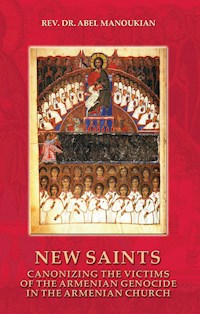
The present volume introduces the development of Canonization in the Armenian Church Tradition and professes strongly to canonize the Armenian Martyrs on the eve of the 100th Anniversary of 1915 Genocide Commemoration. How will this joint canonization be conveyed with regards to the massive number of genocide victims? Will it be done through individualization or by the following decree: "All those who died for their Christian faith." It is important for the Armenian Church to take the latter approach, for it is only God who knows, as He is the one who sanctifies either a person or a collective, for their sacrifice and testimony of faith. Of course, it would have been better if our Church had, many years ago, taken the necessary steps of enlightening our people as to why we needed to sanctify our martyrs, why their canonization is valuable to us now and to future generations as well. Let this booklet be a small offering in fulfilling what this prospect essentially lacks.
Sie lesen das E-Book in den Legimi-Apps auf:
Seitenzahl: 77
Veröffentlichungsjahr: 2015
Das E-Book (TTS) können Sie hören im Abo „Legimi Premium” in Legimi-Apps auf:
Ähnliche
















This book is dedicated to the memory of
the 1,500,000 victims of the Armenian Genocide
on the eve of the 100th Anniversary Commemoration
This publication is sponsored by
Dr. Mihran and Mrs. Armik Yeromian.
Many thanks for their kind and generous donation.
TABLE OF CONTENTS
Author’s Note
Preface
Individual and Collective Sainthood in the Church The Countless Armenian Martyrs of the Armenian Genocide
Foreword
Introduction
The Perfect Occasion of the 100
th
Anniversary of the Armenian Genocide for the Canonization of Martyrs
Who Should Canonize the Armenian Genocide Martyrs?
Komitas Vardapet, a Symbolic Figure of the Armenian Intellectuals Martyrs of the Genocide
Saints in the Church Tradition
Saints in the Armenian Church Tradition
The Last Saints
600 Years without Saints
The Spiritual and Moral Imperative of the New Times
Do We Need New Saints?
Demand for Canonization of the Genocide Martyrs and His Holiness Vasken I
Canonization of the Genocide Martyrs as Timeless Spiritual and Moral Imperative for Armenians
The Creation of a Canonization Committee
Collective Canonization of Martyrs in the Armenian Tradition
Canonization in the Armenian Church Tradition
The Debate
Calendar and Ritual Issues
In Sacred Relationship with the Genocide Martyrs
Index
AUTHOR'S NOTE
This book should have been published a year ago, as it was a project we had planned. But due to certain circumstances and unforeseen delays, its publication now coincides with the revision of the decision regarding sanctification.
Deliberations, which are recapped in this booklet, date back to 2005, when the question of canonizing the victims of the Armenian Genocide was being discussed within national and clerical circles. At the time, a publication entitled "Did the Armenian Church stop having Saints?" was printed in Eastern and Western Armenian, as well as in French.
We are extremely overjoyed that the Catholicos of each Armenian See has in their decree reflected on the joint decision of sanctification on the occasion of the 100th anniversary of the Armenian Genocide and an official canonization ceremony will take place for our countless Armenian martyrs on April 23, 2015.
How will this joint canonization be conveyed with regards to the massive number of genocide victims? Will it be done through individualization or by the following decree: "All those who died for their Christian faith." It is important for the Armenian Church to take the latter approach, for it is only God who knows, as He is the one who sanctifies either a person or a collective, for their sacrifice and testimony of faith.
Of course, it would have been better if our Church had, many years ago, taken the necessary steps of enlightening our people as to why we needed to sanctify our martyrs, why their canonization is valuable to us now and to future generations as well.
Let this booklet be a small offering in fulfilling what this prospect essentially lacks.
Let the great testimony of faith from our countless Armenian martyrs be a luminous example to us so along with the Apostle Paul, we may say: "I have fought the good fight, I have finished the race, I have kept the faith. Now there is in store for me the crown of righteousness, which the Lord, the righteous Judge, will award to me on that day — and not only to me, but also to all who have longed for his appearing." (2 Timothy 4:7-8)
Let us remain in the communion of our martyred saints; let us be worthy of their ray of light, of that life that overcomes death.
Acknowledgements
I express my profound gratitude to all those friends and colleagues who helped me complete this project. In particular, I would like to thank: Nathalie Yeguenian, Dania Ohanian, Dr. Iso Baumer, Dr. Hratch Tchilingirian, Jirair Tutunjian, Papken Topjian, Thomas Flügge, Heinrich and Gerold Evanzin, and my dear friend and brother in Christ for their great assistance with the English translation, and for their part in the proof-reading of this edition.
I owe as well my heartfelt thanks to Dr. Mihran and Mrs. Armik Yeromian for their kind and generous donation which made possible the publication of this volume.
I should also like to extend my sincere thanks to my publisher Mr. Yeprem Tokjian for the meticulous care that he provided at each phase of the production of this publication.
Fr. Abel Manoukian
PREFACE
On the 75th anniversary of the Armenian Genocide, in a joint Communiqué issued on April 29, 1989 for the occasion, Their Holiness Vasken I Catholicos of All Armenians and Karekin II Catholicos of Cilicia "propose[d] that the preparatory activities continue for the canonization of [the Genocide] victims." Indeed, the idea of religious commemoration of the Genocide victims goes back to the early years of the First Republic of Armenia (1918-1920), when the Armenian Government at the time formally applied to Catholicos Gevorg V to include the martyrs in the liturgical calendar of the Armenian Church. The current publication brings together Fr. Abel Manoukian's study, discernment and writings over the last two decades on this subject as both an adviser on the subject to His Holiness Catholicos Vasken I, and a pastor of the Armenian Church.
In November 2014, the Synod of Bishops and the two Catholicoi of the Armenian Church announced that the martyrs of the Genocide would formally be declared saints on 23 April 2015. This has been the desired outcome the author of this publication had hoped for. The original Armenian transcript of this work was published before the decision of the Church hierarchy and, today, many of the questions raised in this publication have since been answered. Even so, this written account is being published for the valuable background it provides on the discussion of canonization of the Armenian Genocide victims.
Canonization is the final stage of declaration of sainthood, whereby a person or a group of persons are considered to share the holiness of God, and their lives bear witness to the authenticity and truth of the Christian gospel. Saints are believed to have joined God in an endless sharing of a divine life beyond all corruption. As such, with their exemplary lives, the saints are an integral part of Christianity since ancient times and have held a significant place in the doctrinal, liturgical and pietistic traditions of the "One, Universal, Apostolic, Holy Church".
In the last two decades, the discussions of the canonization of the Armenian Genocide victims were confined to various committees and a narrow circle of clergymen. The deep theological meaning of sainthood and its relevance to faith and piety have hardly been explained to the ordinary Armenian faithful. The saints are canonized primarily for the faithful. Declaring the Genocide martyrs as saints is not rewarding them the "medal of honour," but to provide role models to emulate and to continue the evangelistic and spiritual mission of the Armenian Church in Armenia and the Diaspora.
Are the victims of the Genocide being canonized by the Church hierarchy for its "symbolic value" on the 100th anniversary of the Genocide or will the declaration of these new saints provide a unique opportunity to renew and revitalize the Armenian Apostolic Church in the 21st century? This remains to be seen.
Dr. Hratch Tchilingirian
INDIVIDUAL AND COLLECTIVE SAINTHOOD IN THE CHURCH THE COUNTLESS ARMENIAN MARTYRS OF THE ARMENIAN GENOCIDE
The events that took place in the Ottoman Empire towards the end of the 19th Century and particularly during WWI with regards to the Armenian population (as well as Greek and Syriac) are a problem that has yet to be resolved. These "events," which are constantly denied by Turks, the heirs of the Ottoman Empire, are simply omitted from their documents and textbooks or simply evoked by means of placatory circumlocutions. However, most historians across the world and more than 20 states correctly define these events with the term "genocide," a massacre perpetrated by an institution with the goal of exterminating a people, a nation.
These events are primarily a political issue: the Ottoman Empire was for a long time on the verge of collapse (becoming known as the sick man of Europe) and there was big push towards ethnic cleansing in this multi-ethnic state for a new state, which was supposed to emerge after the war. However, it was mainly (or rather exclusively) the Christians who were targeted, and between them, especially the Armenians, which in turn allows us to highlight the religious aspect of the tragedy. Approximately two-thirds of the Armenian population was exterminated and while Christians made up about 20% of the Ottoman Empire's population. In the current Turkish state, they are now less than 1% of the population and live under considerable restrictions, like in many Muslim states. The religion of Islam has only granted Christians an inferior status, that of dhimmitude, a sort of right to official protection, which varies in history from a certain freedom to painful restrictions.




