


Erhalten Sie Zugang zu diesem und mehr als 300000 Büchern ab EUR 5,99 monatlich.
- Herausgeber: Parthian Books
- Kategorie: Poesie und Drama
- Serie: New Welsh Review
- Sprache: Englisch
Bringing together the best of Wales' review-essays, including a comparison of new editions of nature classics, 'Back to the Land' by Pippa Marland. The books under review, Thomas Firbank's I Bought a Mountain and Margiad Evans' Autobiography take contrasting blustering and humble approaches to stepping over the sub/urban doorstep into nature. A showcase of new nonfiction, previewing forthcoming titles from some of Wales' key English-language publishers, exploring books on anti-Welsh media vitriol covering the early Manic Street Preachers, and historical flooding and the riches of an Eton-owned Benedictine fishery on the Gwent Levels. In original fiction: a wonderful story about a teenage boy on the cusp of bodily and emotional change, 'Trout', by Satterday Shaw, and a second, finely crafted story about the effect of geographical dislocation on teenage identity emergence, 'Another Place' by Philippa Holloway, set on Crosby beach. Plus Editorial by Gwen Davies and a new opinion feature, Last Page, by Richard Lewis Davies, in which the writers note that magazines in Wales are undergoing a transition, during which readers and subscribers will need to step up to the plate if a commitment to expressing – without interference - our particular place and time, is to be maintained. EDITORIAL Half-in, half-out Gwen Davies NONFICTION Bears at the Fridge: From Goldcliff to Whitson Preview extract from This Stolen Land by Marsha O'Mahony The Kinnock Factor: The Manics and Anti-Welshness Edited abridged preview from International Velvet by Neil Collins FICTION Another Place Story by Philippa Holloway Trout Story by Satterday Shaw ESSAYS Dark Formula Timothy Laurence Marsh on why reckless travel writing matters Books for Alien Girls JL George's personal and practical reflections on the role neurodivergence can and should play when writing fiction REVIEW-ESSAYS Back to the Land Pippa Marland on two nature memoir classics, one of hubristic bluster, the other humbly receptive 'Queer Old Codgers' Claire Pickard on the portrayal of highly nuanced gay identities and history in recent nonfiction titles and a major short story anthology THE LAST PAGE Back to the Future Richard Lewis Davies on how a culture with ambition needs critics and readers
Sie lesen das E-Book in den Legimi-Apps auf:
Seitenzahl: 114
Veröffentlichungsjahr: 2024
Das E-Book (TTS) können Sie hören im Abo „Legimi Premium” in Legimi-Apps auf:
Ähnliche

















NEW WELSH REVIEW
Gwen Davies
1
CONTENTS #135 SUMMER 2024
THRESHOLD
New Welsh Review The Old Surgery Cardigan SA43 1ED
www.newwelshreview.com
New Welsh Review was established in 1988 by Academi and the Association for Welsh Writing in English.
Editor: Gwen [email protected]
Management Board: David Lloyd-Owen and Niall Griffiths
Patrons: Richard S Powell and Bob Borzello
Design: Ingleby Davies Design and Syncopated Pandemonium
Proofreading/editorial support: Steven Lovatt
Cover image: ‘Mirage’, 2002 (81x82cm), William McClure Brown, courtesy of estate of William
McClure Brown; image on contents page: ‘Mari Lwyd’, William McClure Brown, courtesy of artist’s estate; image on this page: William McClure Brown, courtesy of artist’s estate.
The contents: © The New Welsh Review Ltd and the authors
Print ISBN: 978–1–913830–26–7 eBook ISBN: 978–1–913830–27–4 ISSN: 09542116
Views expressed in NWR are the authors’ own and do not necessarily reflect the opinions of either editor or board.
All rights reserved. No part of this publication may be reproduced, stored in a retrieval system or transmitted in any form or by any means, electronic, recorded or otherwise, without the permission of the publisher, the New Welsh Review Ltd.
New Welsh Review is hosted by Aberystwyth University’s Department of English & Creative Writing.
Mae croeso ichi ohebu â’r golygydd yn Gymraeg.
EDITORIAL
HALF-IN, HALF-OUT
EDITORIAL BY GWEN DAVIES
Am I coming or am I going? What aboutNew Welsh Review? Good questions, in this period of flux, with answers becoming increasingly clear. The term ‘liminal’ is jargon, but it does describe that overlapping of worlds, a transitional place marvellously described by Matthew Francis’ recent book, Unreal City: Depersonalisation and Creative Writing (Routledge, 2022) as one great for writing, sometimes challenging when taken to extremes.
If thresholds are good for writing, so my present half-in, half-out state as ongoing (outgoing at some point?) editor of New Welsh Reader may be good for editorship, too. It is certainly true for this edition, curated in unusual circumstances but sound of heart, nevertheless.
Here we bring together the best of NWR’s online essays and review-essays within a showcase of new work previewing forthcoming titles from some of this country’s key English-language publishers, plus continuing to offer regular creative opportuniites as before (see advert on inside front cover). Plus a wonderful bonus original story about a teenage boy on the cusp of bodily and emotional change, ‘Trout’, by Satterday Shaw, and a new review-essay on contrasting blustering and humble approaches to stepping over the sub/urban doorstep into nature: ‘Back to the Land’ by Pippa Marland.
In Philippa Holloway’s masterly story ‘Another Place’, its teenage protagonists vie for power, meaning and freedom on Crosby Beach, at times sunk half-in, half-out of the waves like the sculptures whose title the writer borrows. From a story set in a north-eastern intertidal borderland (Merseyside) we move to an essay exploring a south-eastern political borderzone and its identity 4hangups: Gwent, home of Blackwood and the Manic Street Preachers. In Neil Collins’ survey of the Nineties Cool Cymru music scene, International Velvet (Calon, July), he reflects on the poison of Kinnock-era media anti-Welshness fuelling the angst and anger of the Manics: read more in our preview extract. And, shimmying further east and down a bit, along our side of the marshy Severn estuary, Marsha O’Mahony’s This Stolen Land (Seren, July) is a love letter to the Gwent Levels and its people. The chapter we choose to excerpt is called ‘Bears at the Fridge: Goldcliff to Whitson’ in honour of sun bears escaping their estuarine zoo in search of a picnic, stepping first over a domestic threshold to nick supplies from the Keeper’s fridge. We also hear of past Leveller picnickers near Nash lighthouse, now facing water: ‘We’d have our picnics out there. Just grass, it was, but it’s been washed away over the years.’
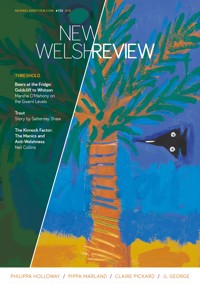
And so from dream-scenes of seashores and teddy bears’ picnics to our featured artwork by William McClure Brown (1953–2008, see cover, imprint and contents pages, and inside back cover). These were chosen to celebrate Peter Wakelin’s forthcoming book on the artist, Pursued by a Bear (Parthian, September). Brown was a man visually obsessed by bears, who conjured his own zoological escapades set in vivid dreamscapes, as well as recalling socially sanctioned Welsh shapeshifting (see ‘Mari Lwyd’, contents page). When briefing for this edition’s cover (‘Mirage’, credit details on copyright page) and beginning to have my own ursine hallucinations, I saw as Brown’s iconic lean bear’s face (set sideways) what Peter Wakelin informed me the next day may more properly be seen as a fighter jet, a different obsession of the artist following a visit to north Africa in the 1980s. Take a look at the Abergavenny Art Shop’s 2018 exhibition gallery (artshopandgallery.co.uk/exhibitions/william-brown-bogeyman-the-man-of-myth/) to see what I mean, or better still buy Pursued by a Bear and magic up your own dreams.
Life changes. Land shifts, dreams propel us to another space. That threshold before or after a journey or when addled by screentime, when one is half-asleep or half-awake, is a promising place to be, one where jet planes become shy bears peeping from a palm tree. The temptation is strong to Exit, pursued by a bear. Shall I do it?
No: we’re not quite ready to exit yet.
NONFICTION
BEARS AT THE FRIDGE: GOLDCLIFF TO WHITSON
PREVIEW EXTRACT FROM THIS STOLEN LAND BY MARSHA O’MAHONY
The cider press was kept busy at the coastal community of Goldcliff [on the Gwent Levels] as one resident, Margaret Gutteridge, recalled. I met Margaret at a bingo session I dropped into at Whitson’s old school, now a community space, one Thursday morning. I had come off the path for a wander, and when I heard laughter coming from the hall I popped my head around the corner. I’ve not been lonely on this walk, but admit I need the company of others at times. I was encouraged by the lovely ladies to tuck into the refreshments. I squeezed onto the bench next to Margaret, a neat lady with short grey hair and a soft Welsh accent like so many down here. She’s quietly spoken and I mistook it for shyness. Once I got to know her, I realised there was nothing shy about this lady. She was gutsy and got things done. I warmed to her immediately. She remembered Melvin Jones, the cider press man: ‘We used to have three orchards, but they’ve cut all the trees down now. We had apples, pears, damsons, plums, Cox’s orange pippins, russets, and Victoria plums, loads of cooking apples and the red apples. Mr Jones’ cider press came from Nash, pulled by a horse. They used to turn a wheel and crush the apples and then put the pulp in the press. The pressing would take a whole day and [the press] would be there perhaps for a few days. When the cider was ready, they had casks and they were kept in the dairy. Great big casks they were.’
Margaret developed a taste for it. ‘I used to love it when it was first made 6because it was really sweet. My grand-dad caught me drinking it once. I used to go to the dairy when I came home from school and dip a mug in. But in the end they put a lock on the door to stop me gaining entrance.’
The Levels, said Margaret, were once full of fruit trees: ‘There were orchards all over then.’ In an interview recorded in the 1990s, Angela Horup noted the decline in orchards too. Her grandparents ran a farm in Nash: ‘As a child growing up in the ’50s and ’60s, I have vivid recollections of the orchards that were in abundance in my area of The Levels. If I close my eyes now and recollect, I can see an orchard neatly laid out [in] rows, where in autumn the trees were weighed down with fruit.’
Many hours listening to her grandparents’ stories have left a clear image: ‘This farm had been in my family for generations, so I had vivid pictures of my long-gone ancestors working hard to plant these very trees. It must be remembered that orchards in bygone days were extremely important; life was far removed from what it is today.’
People depended on fruit for desserts, preserves and a healthy diet. ‘The apples [were] sold in shops because people relied on home-grown produce rather than imports. Fruit that was carefully picked and placed in the correct storage facility lasted well into the New Year,’ she said.
You can walk from Redwick to Goldcliff along the foreshore. But if you take the lanes higher up, past Green Moor and Bowleaze Common, the road drops down to the village, passing Whitson Court. It’s a fine-looking building, with nothing to indicate its former life. As the Christmas holidays approached in December 1975, an estate car left Whitson Court heading for Caerleon. The occupants included the driver and her unlikely passenger: a donkey. The animal had been booked to appear at a nativity event for a local school. Normal means of haulage had failed, but the driver saw no reason to cancel the booking. Instead, she used her car and got the donkey in the back without too much of a struggle. It appeared to be quite happy, enjoying the passing scenes, with its nose pressed against the screen.
Midway to Caerleon, however, Margaret’s car was stopped by a 7policeman on a motorbike. He was naturally curious about the occupant. After a quick check and probably some bewilderment, the donkey and his keeper were sent on their way to Caerleon, with a blue-light police escort. Welcome to Whitson Zoo.
Built in 1795, Whitson Court was one of the finest manor houses on The Levels. It was designed by John Nash, the man also responsible for Brighton Pavilion and Clarence House. It’s had an intriguing history and a variety of residents. In 1901, French nuns fleeing religious persecution sought refuge there. Later, in 1923, it was a school for trainee missionaries, young men bound for Africa. And during the Second World War, it was a haven for Jewish refugees escaping Nazi persecution. It was later turned back into a private home, having undergone extensive restoration. But between the 1960s and 1980s, its most unlikely incarnation was that of a zoo.
Whitson Zoo was opened in the 1960s by Mrs Olive Maybury, an ardent animal lover who provided a home to all sorts of waifs and strays including bears, foxes, donkeys, raccoons, peacocks, terrapins, llamas, red deer, monkeys and lions. The zoo became a popular visitor attraction, but it was Kath Johnson’s nearby farm that appealed more to one of its residents.
‘Mrs Maybury was lovely,’ said Kath, who still lives in her childhood home at Goldcliff. Imagine your favorite aunt, and you have Kath. She’s lovely, warm, and chatty. ‘I was a chopsy little girl,’ she said. The local policeman used to accompany her as she cycled to Goldcliff school. ‘He knew all the news because I would be telling him what I’d heard from all around.
‘We lived a few fields away from the zoo. Mrs Maybury had a deer there and she had to keep it tethered because every time she let it go it ended up here. No sooner had we got it back to her than it was back again. It must have liked us. But it wouldn’t stay with her, and she got fed up coming to get it.’ By mutual agreement, the deer quit Mrs Maybury’s zoo. ‘In the end she said, “I’m going to give you the deer,” and it never left us after that. Perfectly happy it was with the cows.’
The Johnson farm supported the zoo in other ways: ‘If you had an animal die, you would take it over to her and she’d give it to the lions. But 8all she had to keep these lions in, was something like an old-fashioned chain harrow, the sort they would pull behind the tractor to level the ground off. We [would] hear the lion roar here if the wind was in our direction. You just got used to [the roaring]. It never escaped, as far as I know.’




