


0,99 €
Mehr erfahren.
- Herausgeber: Balungi Francis
- Kategorie: Religion und Spiritualität
- Sprache: Englisch
Inside you will read about:
The English Civil War, Newton and the Apple, Newton's Work in Mathematics and Optics, Middle Years in Scientific Experiments,Principia, Newton and Alchemy, Later Life and Death And much more. Follow along as you travel from a rugged stone farmhouse to Trinity College, Cambridge to the halls of London exhibitions where Newton found himself the celebrity of the age. Looking back on Aristotle, and inspired by all that Galileo had brought the world, Newton made his life work much of what is heralded as the modern age. He saw what no one else did, and his vision saw into the universe.
See how he did it, and why.
Das E-Book können Sie in Legimi-Apps oder einer beliebigen App lesen, die das folgende Format unterstützen:
Veröffentlichungsjahr: 2021
Ähnliche













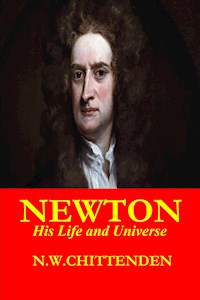
NEWTON: HIS LIFE AND UNIVERSE
BY
N. W. CHITTENDEN
Table of Contents
Title Page
LIFE OF SIR ISAAC NEWTON
LIFE OF SIR ISAAC NEWTON
From the thick darkness of the middle ages man's struggling spirit emerged as in new birth; breaking out of the iron control of that period; growing strong and confident in the tug and din of succeeding conflict and revolution, it bounded forwards and upwards with resistless vigour to the investigation of physical and moral truth; ascending height after height; sweeping afar over the earth, penetrating afar up into the heavens; increasing in endeavour, enlarging in endowment; every where boldly, earnestly out-stretching, till, in the Author of the Principia, one arose, who, grasping the master-key of the universe and treading its celestial paths, opened up to the human intellect the stupendous realities of the material world, and, in the unrolling of its harmonies, gave to the human heart a new song to the goodness, wisdom, and majesty of the all-creating, all-sustaining, all-perfect God.
Sir Isaac Newton, in whom the rising intellect seemed to attain, as it were, to its culminating point, was born on the 25th of December, O. S. 1642—Christmas day—at Woolsthorpe, in the parish of Colsterworth, in Lincolnshire. His father, John Newton, died at the age of thirty-six, and only a few months after his marriage to Harriet Ayscough, daughter of James Ayscough, of Rutlandshire. Mrs. Newton, probably wrought upon by the early loss of her husband, gave premature birth to her only and posthumous child, of which, too, from its extreme diminutiveness, she appeared likely to be soon bereft. Happily, it was otherwise decreed! The tiny infant, on whose little lips the breath of life so doubtingly hovered, lived;—lived to a vigorous maturity, to a hale old age;—lived to become the boast of his country, the wonder of his time, and the "ornament of his species."
Beyond the grandfather, Robert Newton, the descent of Sir Isaac cannot with certainty be traced. Two traditions were held in the family: one, that they were of Scotch extraction; the other, that they came originally from Newton, in Lancashire, dwelling, for a time, however, at Westby, county of Lincoln, before the removal to and purchase of Woolsthorpe—about a hundred years before this memorable birth.
The widow Newton was left with the simple means of a comfortable subsistence. The Woolsthorpe estate together with small one which she possessed at Sewstern, in Leicestershire, yielded her an income of some eighty pounds; and upon this limited sum, she had to rely chiefly for the support of herself, and the education of her child. She continued his nurture for three years, when, marrying again, she confided the tender charge to the care of her own mother.
Great genius is seldom marked by precocious development; and young Isaac, sent, at the usual age, to two day schools at Skillington and Stoke, exhibited no unusual traits of character. In his twelfth year, he was placed at the public school at Grantham, and boarded at the house of Mr. Clark, an apothecary. But even in this excellent seminary, his mental acquisitions continued for a while unpromising enough: study apparently had no charms for him; he was very inattentive, and ranked low in the school. One day, however, the boy immediately above our seemingly dull student gave him a severe kick in the stomach; Isaac, deeply affected, but with no outburst of passion, betook himself, with quiet, incessant toil, to his books; he quickly passed above the offending classmate; yet there he stopped not; the strong spirit was, for once and forever, awakened, and, yielding to its noble impulse, he speedily took up his position at the head of all.
His peculiar character began now rapidly to unfold itself. Close application grew to be habitual. Observation alternated with reflection. "A sober, silent, thinking lad," yet, the wisest and the kindliest, the indisputable leader of his fellows. Generosity, modesty, and a love of truth distinguished him then as ever afterwards. He did not often join his classmates in play; but he would contrive for them various amusements of a scientific kind. Paper kites he introduced; carefully determining their best form and proportions, and the position and number of points whereby to attach the string. He also invented paper lanterns; these served ordinarily to guide the way to school in winter mornings, but occasionally for quite another purpose; they were attached to the tails of kites in a dark night, to the dismay of the country people dreading portentous comets, and to the immeasureable delight of his companions. To him, however, young as he was, life seemed to have become an earnest thing. When not occupied with his studies, his mind would be engrossed with mechanical contrivances; now imitating, now inventing. He became singularly skilful in the use of his little saws, hatchets, hammers, and other tools. A windmill was erected near Grantham; during the operations of the workmen, he was frequently present; in a short time, he had completed a perfect working model of it, which elicited general admiration. Not content, however, with this exact imitation, he conceived the idea of employing, in the place of sails, animal power, and, adapting the construction of his mill accordingly, he enclosed in it a mouse, called the miller, and which by acting on a sort of treadwheel, gave motion to the machine. He invented, too, a mechanical carriage—having four wheels, and put in motion with a handle worked by the person sitting inside. The measurement of time early drew his attention. He first constructed a water clock, in proportions somewhat like an old-fashioned house clock. The index of the dial plate was turned by a piece of wood acted upon by dropping water. This instrument, though long used by himself, and by Mr. Clark's family, did not satisfy his inquiring mind. His thoughts rose to the sun; and, by careful and oft-repeated observations of the solar movements, he subsequently formed many dials. One of these, named Isaac's dial, was the accurate result of years' labour, and was frequently referred to for the hour of the day by the country people.
May we not discern in these continual efforts—the diligent research, the patient meditation, the aspiring glance, and the energy of discovery—the stirring elements of that wondrous spirit, which, clear, calm, and great, moved, in after years, through deep onward through deep of Nature's mysteries, unlocking her strongholds, dispelling darkness, educing order—everywhere silently conquering.




